
Autor Cointelegraph By Tom Farren

Aave launches V3 liquidity pool following unanimous governance decision

Decentralized finance (DeFi) protocol Aave has announced the launch of Aave V3, marking a significant evolution on the existing model of liquidity pools by promising to improve financial efficiency, bolster current safety and security measures, foster greater decentralization via DAO development, as well as enhance the user-interface design.Holders of the project’s native tokens, AAVE, are eligible to participate in Aave Improvement Proposals (AIPs) – an on-chain governance voting mechanism that grants token holders the opportunity to propose, and vote upon, network upgrades for implementation within the core protocol.Published in early November 2021 by team member Emilio, the V3 proposal was put to vote from Nov. 4 to Nov. 11 and passed unanimously with 2,911 community members voting with allocating 342,000 tokens towards advocacy.The V3 upgrade introduces upgrades such as a cross-chain asset functionality, a community contribution tool, gas optimization model expected to reduce fees by 20-25%, and a high-efficiency mode, among others.In addition to this, a series of wallet decentralized applications (dApps) will be integrated into the V3 platform, including: Instadapp, Debank, 1Inch, Paraswap, Zapper, DeFisaver, Zerion, and more.Previous governance decisions facilitated by Aave have become the catalyst for V3 deployments across a number of blockchain networks, including Polygon, Arbitrum, Avalanche, Fantom, Harmony, and Optimism. The team noted that deployment on Ethereum mainnet is set to follow.Cointelegraph reached out to an Aave spokesperson for an deeper insight into their vision for the ways in which the cross-chain portal could impact the Aave ecosystem, to which they stated:“The cross-chain portal will enable users to port their own liquidity from one network to another, at their discretion. It will allow each iteration of the protocol on the various networks to scale quite quickly with the depth of capitalization.”Related: Aave launches Web3 social media platform, Lens Protocol2/ The release of V3 will make the Aave Protocol one of the most advanced, secure, and efficient DeFi protocols across the ecosystem offering greater capital efficiencies, increased security, cross-chain functionality, and more pic.twitter.com/yFB96IsebE— Aave (@AaveAave) January 27, 2022Additionally, speaking on the methods for identifying quantitative success across the areas of “increased capital efficiency, security, and enhanced decentralization” as noted in the press release, Aave’s spokesperson stated “that is something for the community to do.”According to analytical data provided by DappRadar, Aave is the sixth leading protocol in total value locked (TVL) ranking, recording $11.79 billion at the time of writing alongside a price level of $125.40.

Čítaj viac

Nansen's indexes reveal insightful trends in the NFT space

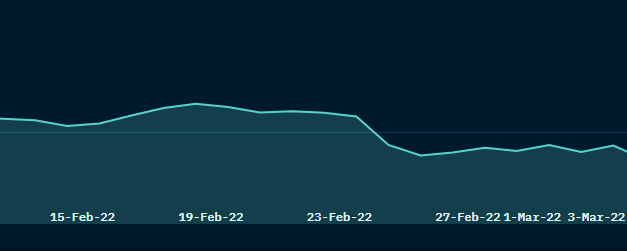
The research branch of Nansen, a popular blockchain data firm, has published a meticulous twelve-page report quantifying the performance of Ethereum-based nonfungible tokens, or NFTs, since the turn of the year, unveiling a number of compelling indications as to the economic and cultural future of the ecosystem.Citing the profound impact of traditional financial indexes such as the Dow Jones Industrial Average, S&P 500 and the Nasdaq Composite, the report contemplates the vast potential for comparable models focusing on NFT’s, arguing that both education and adoption could be significantly enhanced through their wide-scale utilization.Last month, Nansen released six NFT indexes: Nansen NFT-500, Nansen Blue Chip-10, Nansen Social-100, Nansen Gaming-50, Nansen Art-20, Nansen Metaverse-20, all which according to the accompanying blog post, were designed to “raises the bar for quality financial infrastructure that supports the growing depth of the NFT industry.”Nansen’s NFT-500 index aggregates the performance of the leading 500 NFT collections on Ethereum for both ERC-721 and ERC-1155, across ETH and USD market capitalization. These collections equate to 85.4% of the daily market volume since 1 January 2022.Assessing the performance of the NFT-500 index across the period Jan 1st to March 9th 2022, it is revealed that the price of assets increased by 68.5% when denominated in ETH, and gained 20.9% when measured in USD.In contrast, the performance of the ETH index of the last 30-days — as illustrated in the line graph below — stands in stark contrast, recording -28.8% and -38.5% in ETH and USD, respectively.Upon our request for specific clarification as to the calculation method for the numerical figure seen on the y-axis, research analyst at Nansen, Louisa Choe stated that “the index level is the value of an investment relative to its value at one fixed point in time. The index started at 1,000 on 1/1/2022.”Source: Nansen. NFT-500 Line ChartCointelegraph conversed with Choe to ascertain a deeper understanding into how Nansen anticipates the impending influx of quantitative data sources, such as NFT indexes, positively influencing the industry.Choe stated that “we believe that reliable data (both on a broad market level, like through the index, and micro level on a wallet basis) can help market participants to better navigate this space”, before sharing their intended purpose for the service.“A key motivation behind the index was to enable users to separate the hype from reality, or to enhance their due diligence process.”Related: Blockchain analytics firm Nansen secures $12M in Andreessen Horowitz-led raiseIn addition to providing NFT analytic dashboards and trend metrics for both retail and institutional investors across multiple timeframes, Nansen is also well-regarded for their decentralized finance (DeFi) services. In Nov 2021, the platform integrated data from Solana, Arbitrum, Fantom, and Avalanche, among others. In June 2021, the company raised $75 million in a Series B round led by early-growth venture capital firm Accel, alongside further participation from the likes of Andreessen Horowitz (a16z) and Tiger Global, among others, and succeeding their $12 million Series A just six months prior.

Čítaj viac

FCA issues termination order for Bitcoin ATMs

Financial Conduct Authority (FCA), United Kingdom’s central financial regulator, has issued a verdict on the presence of Bitcoin (BTC) ATMs within the island country.In what has come as a surprise to many within the industry, the U.K. authority has issued a stern “shut down or face further action“ order to operators of Bitcoin ATMs, outlining their intentions to contact these companies to affirm the notice.The watchdog cited a lack of regulatory structure, the high-risk potential of fluctuating assets and the importance of upholding the principles established within the Money Laundering Regulations (MLR) as the primary reasons for the enforcement.“We are concerned about crypto ATM machines operating in the UK and will therefore be contacting the operators instructing that the machines be shut down or face further action.”The FCA has granted registration approval to 33 crypto companies since August 2020 under the MLR framework, the most notable of which being: Gemini Europe Ltd, Kraken‘s holding company Payward Ltd, Galaxy Digital UK Limited and, more recently added to the list on Jan. 14, eToro (UK) Ltd.Additionally, the FCA has offered temporary registration status to 22 companies until March 31, 2022, at which time a decision will be determined on the validity of their application. These companies include the likes of Blockchain Access UK Limited (blockchain.com), Copper Technologies (UK) Limited, Revolut Ltd and Wirex Ltd, among others. Analytical data conducted by Coin ATM Radar indicate that there are 81 Bitcoin ATMs within the U.K., operated by eight companies. The word presented by the FCA is that none of the 33 approved companies have filed appropriate documents or attained licensing status to operate Bitcoin ATM services within the jurisdiction, and therefore all other must be deemed as illegal enterprises.Precedent for this ruling was established on Nov. 15, when Gidiplus Limited, the Bitcoin-centric crypto asset automated teller machine (CATM) service, was handed a decision notice by the FCA which refused their application as a “crypto asset exchange provider,” otherwise known as a Bitcoin ATM service.According to the official sixteen-page report, Gidiplus did not meet the “conditions for registration” under the MLR law.On Dec. 3, Gidiplus unsuccessfully appealed the decision to overturn the ruling in the Upper Tribunal chamber, with the FCA concluding their assessment with the notion that the appellants case provided a “lack of evidence as to how Gidiplus would undertake its business in a broadly compliant fashion pending determination of its appeal.”

Čítaj viac

Ethereum's 'consensus layer' contract hits 10M ETH staked

Quantitative analysis conducted on popular blockchain site Etherscan, indicates that 184,441 transactions have been responsible for 10.2 million ETH staked into the Eth2 (consensus layer) deposit contract since inception on Nov 4th last year. This figure is equivalent to over $26 billion based upon current Ethereum prices.Mathematical calculations suggest that the milestone was surpassed during block 14348729 in the evening of March 8, identified by mainstream cryptocurrency publications and community advocates in the last few hours.In late January this year, the Ethereum Foundation published an alteration to the network’s terminology, with the initial proof-of-work blockchain, or Eth1, now being referred to the execution layer, and the upcoming proof-of-stake blockchain, or Eth2, now known as the consensus layer.To participate, each user is required to deposit and stake 32ETH into the official Ethereum Launchpad to acquire validation status on the network. At the time of writing, the number stands at roughly $83,252.Evolution to the consensus layer is observed as a highly-anticipated event within numerous provinces of the crypto landscape — from decentralized finance, or DeFi, protocols and nonfungible token, or NFT, projects and marketplaces, to ETH asset holders — due to the reliance on Ethereum’s blockchain for a multitude of on-chain engagements.Related: Ethereum 2.0 approaches 6 million staked ETH milestoneEth2 staking contract just hit 10,000,000 $ETH https://t.co/0qke0XBaCB— Ryan Carson (@ryancarson) March 10, 2022In January this year, Ethereum’s hashrate metric achieved an all-time high of 1.11 PH/s, a prime indication of higher node adoption, and by factor of geography, greater decentralization of the network in the wake of the Arrow Glacier upgrade.

Čítaj viac

HBAR Foundation launches $100M climate-focused impact fund, declaring DOVU as inaugural grantee

The HBAR Foundation, a philanthropic and independent subsidiary of distributed ledger firm Hedera Hashgraph, has announced the launch of the environmentally-conscious Sustainable Impact Fund, SIF, conceived to foster the development of climate-conscious solutions within the Hedera ecosystem.The first recipient, a Welsh blockchain company called DOVU, will be granted $100 million to pursue their open-source Guardian technology to develop publicly transparent mechanisms, such as their audit trail, to verify carbon-offsetting data.A supporter of the Crypto Climate Accord, Dovu’s carbon-centric market capitalization platform aggregates an abundance of real-time quantitative data on all Ethereum-based projects, tracking and openly publishing their carbon debt based upon transaction output, and suggesting tokenomic negation measures through investment in Dovu’s native asset, DOV.Stablecoins Tether (USDT) and USD Coin (USDC) currently occupy the top two spots with a cost-to-offset valuation of $64,514,997 and $11,361,957, respectively, while Wrapped Ethereum (WETH) makes up third position with $2,722,699.Dovu works with rural agricultural communities across the world to determine and report on carbon concentration levels in the soil, cultivating a circular economic model in which farmers are incentivized to extract the element from the atmosphere and return it underground for the access of selling carbon-credits on the marketplace.The HBAR Foundation was established in mid-September last year following a successful Hedera Governing Council vote two months prior. Members of the council voted for an initial allocation of 5.35 billion HBAR into the token treasury — valued at $2.5 billion at the time, and just over $1.1 billion as of today — for investments in a disparate number of projects and developers striving to enhance the growth of the Hedera ecosystem.According to data metrics showcased on their website, the HBAR Foundation has allocated over $32.1 million in funding grants to-date across 19 projects in 4 industry sectors who are each building upon some aspect Hedera’s consensus algorithm. The sectors include Payments & Fintech, Crypto Economy, Metaverse, and the newly endowed Sustainable Impact Fund.Of the four available quadrants for funding applicants, the Crypto Economy and Metaverse funds are the most populated, housing eminent brands such as Binance US, Bittrex, Huobi Global and Moonpay, among others, while the Metaverse category comprises of eight companies including Venly, Tune.fm and Calaxy.Cointelegraph spoke to Wes Geisenberger, the Vice President of Sustainability & Environmental, Social, and Governance (ESG) at the HBAR Foundation for an insight into which of the specific 17 environmental targets within the UN Sustainable Development Goal initiative the SIF most aligns with, as well as how the foundation anticipate their partnership with DOVU positively impacting this goal.Geisenberger stated that the foundation is intent on “addressing all 17 UN SDGs where we can make a measurable impact” and noted that “DLT plays a strong role in that impact”, alongside specifying their ambitions for the year:”In 2022 we’ll be investing a significant portion of the Sustainable Impact Fund in grantees addressing major challenges in climate change (13), renewable energy (7), and sustainable consumption and production (12) as key areas of focus.”Related: Crypto’s climate impact: Are carbon offsets good enough? Welcome to the throughput performance test here at @dovuofficial, you thought yesterday was fun today is gonna be well wicked. To begin here is 1 million txns in one hour, is a sustained 277 TPS ⚡️⚡️Thank you for being awesome @dragonglassme @hedera @MrLemonBird pic.twitter.com/savY8pr0h1— Matt Smithies (,) (@flyinggazelle) March 10, 2022Carbon offsets became a prevalent topic of discussion during Glasgow’s COP26 summit late last year, with some experts from the field arguing that the measures are not-so-much preventative, but rather a method for corporations to delay or procrastinate on environmental actions.Focusing on the traceability aspect of DOVU’s technology, Dovu’s CTO Matt Smithies spoke on how the company intends to uphold accountability and transparency across the ecosystem using blockchain tokenization.Smithies stated that: “Every actor that plays a part in the audit trail will be recorded, making it possible for anyone who makes a purchase – be they an organisation or an individual – to understand its journey from origin through to retirement”, before revealing how the imbalanced demand supply ratio could impact the industry.”This is going to continue to push up the price of carbon – regardless of whether it’s a cheaper offsets or a premium, verified quality carbon credit. Therefore it will be in the interest of purchaser to reduce their carbon emissions in the first place; not doing so will become even more costly.”

Čítaj viac

Získaj BONUS 8 € v Bitcoinoch

nakup bitcoin z karty

Registrácia Binance

Burza Binance

Aktuálne kurzy