
Autor Cointelegraph By Stephen Katte

‘Stablecoins’ are an outdated term from crypto’s early years: a16z Crypto

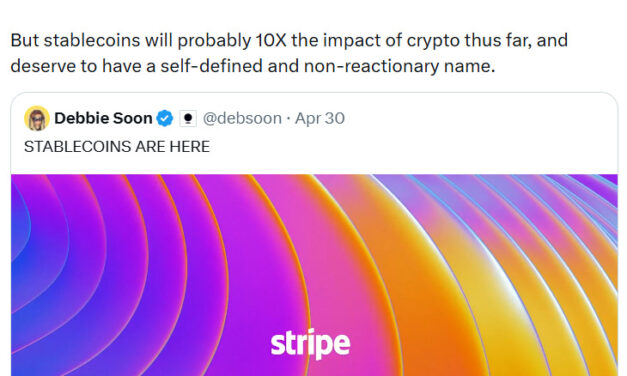
Stablecoins, the name given to cryptocurrencies pegged to the price of a stable asset such as the US dollar or gold, have outgrown their label as they become part of the global financial system, said Robert Hackett, head of special projects at a16z crypto. Hackett said in a report on Friday that the term “stablecoins” was coined in crypto’s early years, when wild volatility defined the space and the tokens were created to maintain stable value and encourage their use for everyday financial activity.“The name was straightforward, if slightly defensive: not a volatile coin, but a stable one. It described the problem it solved perfectly. But the technology has since outgrown the label,” he said.“Stability is now table stakes. It’s a prerequisite, and not the point. The question is no longer ‘will it hold its value?’ But ‘what else can we build with it?’” Hackett added. “That’s why the name stablecoin is outdated now: It still points to the original problem it was designed to solve, not the platform it has become. The term frames the category as a patch rather than a new primitive.”Stablecoins have emerged as a key use case for crypto. The global market has grown to more than $321 billion, according to DefiLlama. Adoption is also expanding across economies as banks and institutions seek to use the technology for faster payments and other benefits.John Palmer, a developer and brand adviser, made a similar argument on Thursday and said it “feels like a bug” to call them stablecoins because “stablecoins will probably 10x the impact of crypto thus far and deserve to have a self-defined and non-reactionary name.”Source: John PalmerThe stablecoin name will likely linger Hackett said a rebrand to a term that better captures the essence of the technology, such as “digital cash” or “programmable money,” is too clunky to use. Related: Stablecoins overtake Bitcoin in Latin America crypto purchases — Bitso At the same time, he argued that the first term that gains traction with a new technology often sticks, such as email, which no longer operates like traditional mail, or horsepower when describing a car’s engine power.“Stablecoins will probably follow the same quirky etymological path. The skeuomorphic name may linger long after it stops being descriptive. Or it may gradually fade as we simply speak of digital dollars, digital euros and other onchain assets,” Hackett said. “Most likely though, the technology will disappear into the background entirely and become just how money works, the same way we stopped saying electric lighting once that newfangled gadgetry became the default. Now they’re just lights.”Magazine: AI-driven hacks could kill DeFi — unless projects act now Cointelegraph is committed to independent, transparent journalism. This news article is produced in accordance with Cointelegraph’s Editorial Policy and aims to provide accurate and timely information. Readers are encouraged to verify information independently.

Čítaj viac
Bakkt completes acquisition of stablecoin payments firm Distributed Technologies Research

Digital asset company Bakkt completed its acquisition of stablecoin infrastructure firm Distributed Technologies Research (DTR) through an equity-based transaction as part of its bid to create a digital settlement layer.Bakkt CEO Akshay Naheta said on Thursday that the deal aims to combine Bakkt’s institutional infrastructure with DTR’s native artificial intelligence payments engine and stablecoin technology to create a 24/7 digital settlement layer.“The architecture of money movement rarely evolves at this level,” he said. “This transaction accelerates the re-platforming of global financial infrastructure. By fully integrating DTR’s technology, we are introducing stablecoin functionality as a critical bridge between legacy financial systems and the next generation of digital assets.”The global stablecoin market has grown to roughly $320 billion, with adoption expanding across both developed and emerging economies as banks and institutions seek to leverage the technology for faster payments and other benefits.Source: BakktAcquisition deal completed through share issuanceAs part of the deal, Bakkt issued more than 11.3 million shares to the beneficial holders of DTR, with the possibility of an additional 725,592 shares, according to the announcement.The deal was initially revealed in January and originally involved 9.3 million shares. The company also announced a corporate name change to Bakkt Inc. at the same time.Ahead of the deal’s completion, Bakkt’s share price (BKKT) fell roughly 8% to $7.86 by Wednesday’s close, but recovered to $8.62 by Thursday’s market close.Bakkt’s share price fell Wednesday but has since risen 10%. Source: Google Finance Bakkt threatened with delisting in 2024Founded in 2018, Bakkt is 55% owned by Intercontinental Exchange (ICE), which also owns the New York Stock Exchange (NYSE), and has received backing from major partners such as Starbucks and Mastercard.In March 2024, the NYSE threatened to delist Bakkt’s shares because the price had fallen below $1 and remained there for 30 days.By May the company disclosed to regulators that there was “significant uncertainty associated with our expansion to new markets and the growth of our revenue base, given the uncertain and rapidly evolving environment associated with crypto assets.”  Related: Stablecoins overtake Bitcoin in Latin America crypto purchases — BitsoMonths later, reports said President Donald Trump’s media and tech group, Trump Media, was in advanced talks to acquire the company but the deal ultimately fell through. The company has since launched multiple fundraising rounds through share sales, with the latest, in February, aiming to raise $48 million.Magazine: Forget stablecoin yield, how does the CLARITY Act treat DeFi?    Cointelegraph is committed to independent, transparent journalism. This news article is produced in accordance with Cointelegraph’s Editorial Policy and aims to provide accurate and timely information. Readers are encouraged to verify information independently.

Čítaj viac
Tokenized RWA market grows 420% since 2025 on regulatory clarity, access

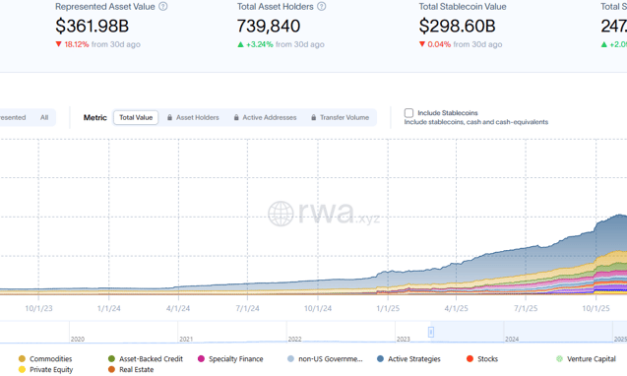
The size of the tokenized real-world asset (RWA) market has increased by more than 420% since the start of 2025, as investors were treated to easier market access and regulatory clarity, according to analysts. The RWA market cap was about $5.8 billion on Jan. 1, 2025, but has since risen to more than $30.2 billion as of Wednesday, according to analytics platform RWA.xyz. Tokenized US Treasurys experienced the largest increase, from $3.9 billion at the start of 2025 to more than $15 billion, followed by commodities.Dominick John, an analyst at Zeus Research, told Cointelegraph the surge in the RWA sector was driven by tokenized Treasurys, which offer compliant onchain access to real-world yield and effectively turn blockchain rails into a distribution layer for institutional capital.“Expansion into tokenized funds and equities has materially increased the addressable market. This points to a shift from speculative inflows toward yield-driven capital,” he said.The RWA market capitalization was around $30.2 billion as of Wednesday. Source: RWA.xyz“Tokenized commodities like gold have gained traction, particularly amid heightened volatility from ongoing geopolitical tensions, as 24/7 markets unlock continuous liquidity and global access when traditional venues are closed,” the analyst added.  Tokenization has been one of the drivers of institutional interest in blockchain and crypto over the past year. Cathie Wood’s ARK Invest predicts digital assets could grow into a $28 trillion market by 2030, with Bitcoin, decentralized finance, stablecoins and tokenized RWAs as key drivers.Regulatory clarity coaxed institutional players into the marketRegulatory clarity through legislation such as Europe’s Markets in Crypto-Assets Regulation (MiCA) has also helped attract institutional players and fresh capital to the RWA sector, according to a Thursday report from crypto data aggregator CoinGecko.Zhong Yang Chan, CoinGecko’s head of research, and research analyst Yuqian Lim said in the report that a few years ago, the RWA market rallied more on hype than substance. “However, the RWA sector has finally started to take shape from 2024 onward. Regulatory clarity has enabled major TradFi institutional players to dip their toes in. As early experiments paved the way by turning into best practices and playbooks, the pace of tokenization has noticeably accelerated,” they said.Source: CoinGeckoBlackRock’s USD Institutional Digital Liquidity Fund (BUIDL) went live in March 2024. The tokenized US Treasury fund provides onchain access to short-term US government debt. Fidelity followed suit in September 2025 with its own tokenized Fidelity Digital Interest Token (FDIT).“2025 has proven to be a watershed year for RWAs. For both crypto-native and traditional players, competition within the RWA and tokenization stack has intensified, with issuers now differentiating on regulatory standing, asset coverage and distribution reach,” Zhong and Yuqian added.Related: Flow Capital plans to tokenize $150M private credit fund via DigiFT: Report Continued growth could depend on other areas of the sector Tokenized Treasurys and commodities have experienced the largest rise in the RWA sector, but in the long term, other areas will likely need to be catalysts for continued growth, said John of Zeus Research. “Growth remains strong as tokenized Treasurys keep absorbing capital and bring more institutions on board, but the rate of expansion should moderate as the easiest flow has been allocated,” he said.“The next leg higher depends on whether tokenized equities, funds and private credit scale meaningfully.”Magazine: Singapore isn’t a ‘crypto hub’ — it’s something better: StraitsX CEO Cointelegraph is committed to independent, transparent journalism. This news article is produced in accordance with Cointelegraph’s Editorial Policy and aims to provide accurate and timely information. Readers are encouraged to verify information independently.

Čítaj viac
Meta rolls out stablecoin payouts for creators in Philippines, Colombia

US tech giant Meta has launched USDC payouts for creators on its platforms in the Philippines and Colombia, with plans to expand to additional markets. Creators who opt into the service will receive payments directly into crypto wallets on the Solana and Polygon blockchains. However, Meta does not offer a built-in conversion option, so an external exchange is required to convert USDC into fiat currency, according to the announcement on Wednesday. The service is currently available only to select creators in Colombia and the Philippines, but Polygon said Wednesday that the stablecoin rollout is expected to expand to more jurisdictions soon.“Live in Colombia and the Philippines, with 160+ markets coming, users now get faster settlement with USDC while gaining access to dollar-denominated assets,” Polygon said. “This is how creators’ lives are improved.”Source: PolygonStablecoins have emerged as a key use case for crypto. Lamine Brahimi, co-founder and managing partner at crypto custody provider Taurus, told Cointelegraph earlier this month that financial institutions across Europe are actively selecting infrastructure partners to support stablecoin adoption.Facebook creators were paid $3 billion last yearCreators who opt for Meta’s stablecoin payout can connect their third-party crypto wallet to Facebook’s payout platform. However, Meta said it “reserves the right to pay” in an alternate payment method in the “event of technical difficulties or unforeseen circumstances.”Meta creators include influencers, educators, and entertainers who earn money by posting content on the company’s platforms, such as Facebook and Instagram. Facebook paid creators nearly $3 billion in 2025, a 35% increase from the previous year, according to the company.Related: Visa adds Polygon, Base support as stablecoin settlement run rate hits $7BCircle’s USDC is currently the second-largest stablecoin by market capitalization with over $77.3 billion as of Thursday, according to decentralized finance analytics platform DefiLlama. The market leader is Tether’s USDt (USDT) with a market cap of $189.4 billion.Meta’s first stablecoin project scrapped in 2022The stablecoin creator payments come years after the company scrapped its open-source stablecoin project Diem, due to friction with regulators.The project faced opposition over privacy and antitrust concerns. Central banks and lawmakers also objected, citing concerns about financial stability, consumer protections and the lack of a clear regulatory framework for crypto at the time.In a January 2022 statement, the project said it was “clear from our dialogue with federal regulators that the project could not move ahead,” and all its assets were sold to Silvergate Capital Corporation.Magazine: Singapore isn’t a ‘crypto hub’ — it’s something better: StraitsX CEOCointelegraph is committed to independent, transparent journalism. This news article is produced in accordance with Cointelegraph’s Editorial Policy and aims to provide accurate and timely information. Readers are encouraged to verify information independently.

Čítaj viac

US, UAE and China joint effort dismantles 9 crypto scam centers

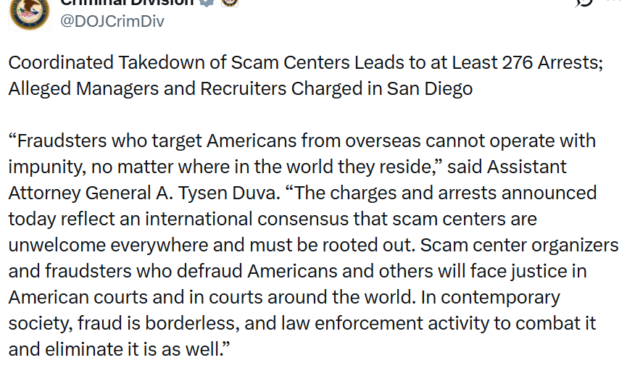
A Dubai police-led international crackdown on scam rings last week resulted in the arrest of 276 individuals and the shutdown of at least nine crypto scam centers, the US Department of Justice revealed on Wednesday. In a joint operation with the FBI and China’s Ministry of Public Security, Dubai authorities arrested 275 people, with an additional person arrested by the Royal Thai Police. Six people have been charged in connection with the scam centers. Four of the defendants and two fugitive co-conspirators were charged with federal fraud and money laundering in federal court in San Diego, according to the DOJ. If convicted, each offense carries a potential sentence of up to 20 years in prison and hefty fines.“The charges and arrests announced today reflect an international consensus that scam centers are unwelcome everywhere and must be rooted out…. In contemporary society, fraud is borderless, and law enforcement activity to combat it and eliminate it is as well,” said US Assistant Attorney General Andrew Tysen Duva. The FBI reported earlier this month that Americans’ losses from crypto and artificial intelligence-related scams in 2025 exceeded $11 billion, with investment scams flagged as the most damaging.Source: US Department of Justice Criminal Division Scammers used fake crypto investment platforms to deceive victimsAll six defendants are accused of working for three different companies operating the scam centers, promoting fake crypto investment platforms and deceiving victims into making deposits. FBI investigators have identified millions of dollars in losses caused by the criminal network.“Today’s indictment demonstrates the FBI’s determination to identify, disrupt, and dismantle these global scam centers defrauding Americans no matter where they set up shop,” said Special Agent in Charge Mark Remily of the FBI San Diego Field Office.  European police shut down scam network with 450 employeesMeanwhile, in a separate police action involving Austrian and Albanian authorities, with support from Europol and Eurojust, ten people were arrested in connection with three scam centers in Tirana and Albania, Europol said on Wednesday.Inside one of the shuttered scam centers. Source: EuropolVictims were drawn in by “seemingly legitimate online investment platforms,” advertised on social media and the promise of profitable investments, according to Europol. Once registered, they were assigned a fake broker who pressured them into making investments. Losses from the scheme are estimated at more than 50 million euros ($58 million) and affected people worldwide.Related: OFAC sanctions Cambodian politician linked to pig butchering scam centers “The scale and professionalism of the criminal network were evident in its structure, which involved up to 450 employees across various departments, including customer acquisition, handled by conversion agents, and customer service, managed by retention agents,” Europol said.“Additionally, the network had dedicated teams for management, finance, IT, human resources and various back-office activities.”Magazine: AI-driven hacks could kill DeFi — unless projects act nowCointelegraph is committed to independent, transparent journalism. This news article is produced in accordance with Cointelegraph’s Editorial Policy and aims to provide accurate and timely information. Readers are encouraged to verify information independently.

Čítaj viac

Získaj BONUS 8 € v Bitcoinoch

nakup bitcoin z karty

Registrácia Binance

Burza Binance

Aktuálne kurzy