Autor Cointelegraph By Stephen Katte

7 Democrats seen as ‘key’ to advancing CLARITY Act: Galaxy

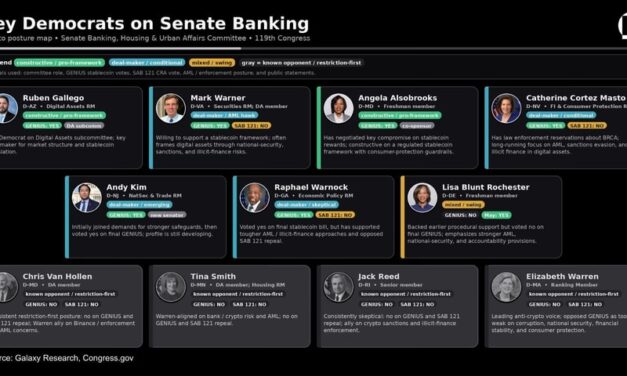
Crypto investment firm Galaxy Digital said seven Democratic lawmakers on the US Senate Banking Committee could be key to advancing the Digital Asset Market Clarity Act when it goes to markup on Thursday, sending it to the Senate for a vote.In an X post on Sunday, Galaxy Digital labeled Democratic lawmakers Ruben Gallego and Angela Alsobrooks as “constructive/pro-framework” when it comes to crypto. Four other lawmakers are seen as “deal-makers,” while one lawmaker is seen as “mixed.” “If Democrats vote for the bill in markup, likelihood of ultimate passage on the Senate floor increases significantly,” Galaxy Digital said. Passing the CLARITY Act through the Senate and into law would create clearer federal rules for the US crypto industry, potentially reducing years of regulatory uncertainty and encouraging more projects to build in the country.Galaxy Digital speculates that seven Democrats on the US Senate Banking Committee could be swayed to approve the CLARITY Act. Source: Galaxy DigitalGalaxy listed Mark Warner, Catherine Cortez Masto, Andy Kim and Raphael Warnock as “deal-maker/conditional,” saying they have shown support for a crypto framework and voted to pass the GENIUS Act.Galaxy said they also want stronger safeguards against illicit finance and money laundering risks.Lisa Blunt Rochester, who was labeled “mixed,” is considered a possible swing vote because she has backed the crypto framework but voted against the GENIUS Act.At least four are likely to vote against the billJack Reed, Elizabeth Warren, Tina Smith and Chris Van Hollen all voted against the GENIUS Act, and Galaxy predicts they will follow a similar path on the CLARITY Act based on past statements.The CLARITY Act has been scheduled for markup on Thursday. To pass through the Senate Banking Committee, at least half of the 24-member group, which is made up of 13 Republicans and 11 Democrats, will need to approve it.After passing through the committee, the bill heads to the Senate floor for scheduling, debate and possible further amendments before a vote. Kara Calvert, vice president of US policy at crypto exchange Coinbase, told attendees at the Consensus 2026 conference that the bill needs at least 60 votes to pass in the Senate and bipartisan support to become law.Stand With Crypto, a US crypto advocacy and tracking platform that scores politicians on their crypto stance based on past statements and actions, lists Warner, Cortez Masto, and Alsobrooks as strongly supportive of crypto.Related: ‘Visible flaws’ in Bitcoiners’ mid-bear market forecast: Analyst Kim is considered neutral, and Reed, Warren and Smith are all considered strongly opposed to crypto. Warnock, Blunt Rochester, Gallego, and Van Hollen are not ranked due to insufficient data, according to Stand With Crypto.The CLARITY Act, introduced in July 2025, was expected to progress but stalled in January after Coinbase withdrew its support for the legislation, citing concerns over a lack of legal protections for open-source software developers, a prohibition on stablecoin yields and decentralized finance regulations.Magazine: Guide to the top and emerging global crypto hubs — Mid-2026 

Čítaj viac

SUI spikes 50% amid staking moves, zero-fee stablecoins, privacy push

Sui network’s native token, SUI, has climbed 50% over the past seven days after a Nasdaq-listed company staked a large portion of the token’s supply and developers announced upcoming features, including zero-fee stablecoin transfers and private transactions. SUI traded around $0.94 on May 4 before climbing to $1.41 on Sunday, according to CoinGecko. Over the same timeframe, trading volume surged from more than $213 million to over $2.5 billion. Ryan McMillin, co-founder and chief investment officer of Australian crypto investment manager Merkle Tree Capital, told Cointelegraph the rally has likely been driven by multiple reinforcing catalysts.He pointed to a “meaningful supply squeeze” as the “clearest near-term trigger” after Nasdaq-listed SUI Group Holdings revealed Friday that its entire SUI treasury of more than 108 million tokens, worth over $143 million, has been staked.Sui launched its mainnet in May 2023, aiming to be scalable and process transactions fast enough for financial institutions. African payments infrastructure company Paga Group announced at Consensus 2026 in Miami on Thursday that it has partnered with Sui to develop blockchain‑powered cross‑border transfers and stablecoin products. Private fee-free stablecoin promise Adeniyi Abiodun, a co-founder of Mysten Labs, the developers behind the Sui network, also announced at Consensus 2026 that zero-fee stablecoin transfers would roll out soon and reiterated plans to add a private transaction feature.Privacy-focused cryptocurrency Zcash (ZEC) spiked by more than 70% last week as crypto traders started paying closer attention to privacy-focused projects. Privacy had been a significant investment theme for crypto in 2025, with privacy-focused tokens surging despite a broader downturn in the rest of the market.Source: Adeniyi Abiodun“This positions Sui as low-friction rails for payments and liquidity and also attractive to agentic AI payments. The Nasdaq angle is also notable: it puts SUI in the same public company treasury/equity market access group as BTC, ETH, SOL and others, signaling growing institutional comfort,” McMillin added.“Sui is shifting from promising L1 or high-beta play to actual adoption story. The combo of institutional staking, zero-fee ambition and regulated futures access is rare among alts. Watch on-chain metrics post-announcement for confirmation.”At the same time, Abiodun said Friday the Sui network’s prediction market DeepBook Predict was going live on the testnet. A March report from Bitget Wallet and Polymarket found that prediction markets are among the most active on-chain applications, with $25.7 billion in trading volume that month.Rally’s success depends on execution, rollout SUI has settled at around $1.31 as of Monday. McMillin said that in the short term, the token could extend its rally because supply shocks and product news generally sustain momentum.“We are also in an environment where we are seeing green shoots all over the crypto ecosystem and it looks more and more likely the bear market hibernation is over,” he said.“Medium-term: more uncertain but constructive. Success depends on execution, actual zero-fee rollout, Paga integration traction in Nigeria and stablecoin volume growth. Sui has real tech edges and usage momentum, but token unlocks and broader crypto cycles remain risks.”Magazine: Guide to the top and emerging global crypto hubs — Mid-2026 

Čítaj viac
Europe sees ‘hyperconcentration’ of crypto wrench attacks as losses hit $101M

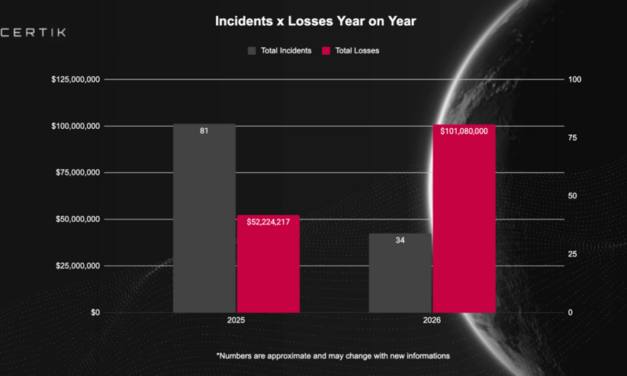
Estimated losses from global crypto wrench attacks reached $101 million in the first four months of 2026, with most attacks occurring in Europe, according to Web3 security company CertiK.With just 34 documented crypto wrench attacks, the losses have nearly doubled those of 2025, which came in at $52.2 million. Europe accounted for 82% of incidents, according to CertiK. “Our 2025 report documented a gradual tilt from Asia and North America toward Europe, and these first four months of 2026 mark a European hyper-concentration.”The frequency of wrench attacks has increased since 2025. They involve physical force to gain access to a victim’s crypto holdings and have taken the form of home invasions, kidnappings and other extortion attempts. CertiK said there have been 34 attacks since the start of the year.If the trend continues, CertiK predicts that by year-end the number of incidents could hit 130, and losses could reach “several hundred million dollars.”There have been 34 verified wrench attacks worldwide since the start of the year. Source: CertiK France is an epicenter of wrench attacksOf the attacks, 24 crypto wrench attacks occurred in France this year, said CertiK. France’s National Prosecutor’s Office for Organized Crime has reported a higher figure of 47 incidents in 2026.CertiK said France has likely emerged as a hot spot for these kinds of criminals because of the presence of crypto executives from major crypto companies such as Ledger, Paymium and Binance.Crypto holders in France are being targeted more than anywhere else in the world. Source: CertiK It also pointed to numerous data leaks, such as the January breach at crypto accounting firm Waltio and tax official Ghalia C, who is accused of selling crypto asset holder data to criminal networks, and “a culture of flexing and voluntary doxxing that remains deeply embedded in the community.”“Early 2026 marks the shift to a data-driven targeting model in which prior physical surveillance becomes unnecessary once attackers have the victim’s full name, home address, financial profile, and so on.”“The structural takeaway is clear: as the security of protocols and wallets tends to improve, the threat migrates toward the human link. As long as crypto-asset holdings remain associated with identifiable financial data, physical coercion will remain the economically most rational attack path,” CertiK added.Blockchain intelligence company TRM Labs reported in May last year that wrench attacks have been on the rise because of the perceived pseudonymity of crypto transactions, the public visibility of wealth, and the ease with which bad actors can gather personal data online.The criminal teams are often “complete amateurs”Across recorded wrench attacks, CertiK said the orchestrators are often located outside the target country. The criminal teams on the ground usually consist of three to five people, and they frequently pose as delivery drivers or police officers, or lure victims into an ambush with a ruse such as a fictitious business meeting.Related: Law enforcement freezes $41M connected to $150M crypto Ponzi collapse“Most of the time, they are recruited via messaging apps such as Telegram or Snapchat for a few thousand dollars. They don’t know each other and are complete amateurs,” CertiK added.Meanwhile, Casa chief security officer Jameson Lopp has recorded 31 crypto wrench attacks so far this year and reported in March that four cases he was tracking for his list turned out to be mistaken identity, with the thieves attacking the wrong targets. Source: Jameson LoppIn April, at least 88 people, including 10 minors, were indicted in connection with alleged wrench attacks on crypto owners in France.“The growing proportion of minors signals an increasing externalization of criminal liability toward profiles less exposed to mandatory minimum sentences,” CertiK added.Magazine: DeFi’s billion-dollar secret: The insiders responsible for hacks  Cointelegraph is committed to independent, transparent journalism. This news article is produced in accordance with Cointelegraph’s Editorial Policy and aims to provide accurate and timely information. Readers are encouraged to verify information independently.

Čítaj viac

Zcash gains 70% in a week amid growing interest in crypto privacy

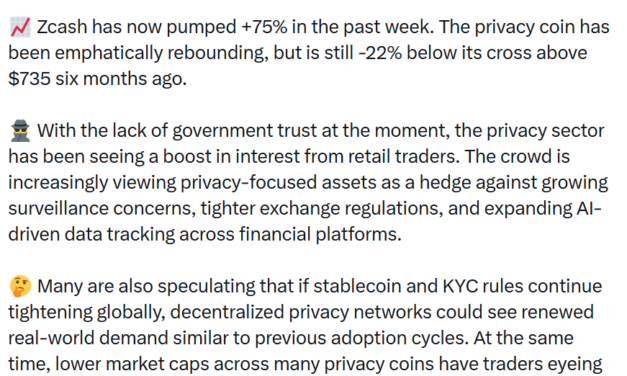
Privacy-focused cryptocurrency Zcash (ZEC) has spiked by more than 70% over the past week as crypto traders have been paying closer attention to privacy-focused projects.Zcash traded at about $346 on Friday, May 1, before hitting a seven-day peak of $593.86 on Wednesday. It has since settled at around $570 as of Friday, according to CoinGecko.Pav Hundal, lead market analyst at crypto exchange Swyftx, told Cointelegraph that traders have begun paying closer attention to privacy projects “amid broader concerns about the impact of AI, quantum computing and financial surveillance on crypto.”He added that ZEC was also boosted after Tushar Jain, the co-founder of the investment firm Multicoin Capital, said on Wednesday that it had “built a significant position” in ZEC since February.Zcash is one of the more prominent privacy-focused cryptocurrencies, trailed by its significant rival Monero (XMR), and Jain said it is an attractive investment as “institutions will increasingly seek private assets to protect themselves” from what he claimed was a “political trend to seize private wealth.”Several crypto firms have also recently released new privacy features. The Ethereum scaling solution Polygon launched private stablecoin payments on Sunday, while Aptos Labs’ privacy feature Confidential APT, which conceals token balances and transfer amounts, went live on the mainnet in April.The market intelligence platform Santiment said in an X post on Wednesday that Zcash was “emphatically rebounding,” as fear of missing out and social media mentions of Zcash spiked along with its price.Santiment pointed to a lack of government trust as a possible catalyst for the surge in interest from retail traders. Source: Santiment“The crowd is increasingly viewing privacy-focused assets as a hedge against growing surveillance concerns, tighter exchange regulations and expanding AI-driven data tracking across financial platforms,” Santiment said.Related: Dash Evolution chain integrates Zcash Orchard privacy pool“At the same time, lower market caps across many privacy coins have traders eyeing them as high-upside momentum plays during this mild altcoin rally crypto has seen so far in May,” it added.Zcash rally could be short-livedPrivacy was a significant investment theme for crypto in 2025, with privacy-focused tokens surging last year despite a broader downturn in the rest of the market.  Zcash nearly crossed $700 in November, its highest price since 2018, while fellow privacy coin Monero reached a new all-time high of $797.73 in January.However, neither held on to the gains, and Swyftx’s Hundal said that the recent rally could also be short-lived.“Zcash’s move has some hallmarks of a narrative rotation into privacy coins,” Hundal said. “I’d be careful calling it a clean fundamental repricing just yet. We need more time to see how durable investor interest is.” Magazine: Guide to the top and emerging global crypto hubs — Mid-2026 Cointelegraph is committed to independent, transparent journalism. This news article is produced in accordance with Cointelegraph’s Editorial Policy and aims to provide accurate and timely information. Readers are encouraged to verify information independently.

Čítaj viac

Chaos Labs says oracles secure after attempted ‘nation-state’ wallet attack

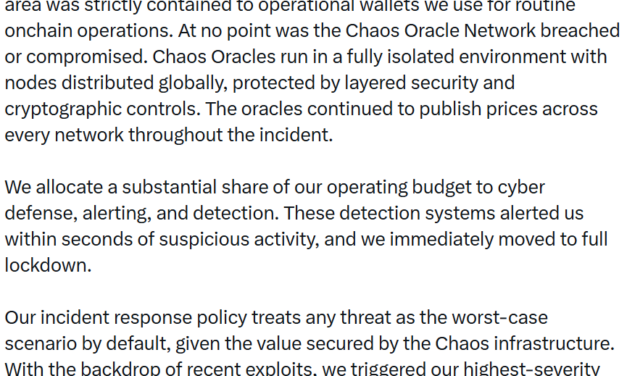
Crypto risk management and infrastructure provider Chaos Labs said its Chaos Oracle Network, which provides data feeds to blockchain applications, was not compromised after a hacking attempt over the weekend by a potential “nation-state.”Chaos Labs founder Omer Goldberg said in an X post Thursday that the company identified an attack over the weekend, possibly by a “nation state,” and immediately moved to a full lockdown. “The surface area was strictly contained to operational wallets we use for routine onchain operations. At no point was the Chaos Oracle Network breached or compromised.”“Chaos Oracles run in a fully isolated environment with nodes distributed globally, protected by layered security and cryptographic controls,” Goldberg said.“The authorities and cyber professionals working with us have characterized the activity as consistent with nation-state attacks,” he added. “The investigation continues, and we will share more as it allows.”State-backed hacker groups, particularly those from North Korea, have been seen as a persistent threat to the crypto space. North Korea-affiliated actors have been accused of stealing at least $578 million across several major incidents in April and have been linked to many of the industry’s largest hacks. North Korea recently rejected claims linking it to global cybercrime, calling the allegations unfounded.Goldberg said that Chaos Labs has rotated all keys since the attempted attack and said there hasn’t been any further suspicious activity. Source: Omer GoldbergRecent industry exploits prompted “highest severity” responseThe April Kelp DAO hack has been one of the year’s largest security incidents, causing broader ecosystem contagion and impacting the interconnected crypto lending market.Drift Protocol, a decentralized cryptocurrency exchange, and at least a dozen other crypto entities were hacked in the same month. Goldberg said against the backdrop of recent exploits, Chaos Labs triggered its “highest-severity incident response” after detecting the attempted hack.“We allocate a substantial share of our operating budget to cyber defense, alerting, and detection,” he added.Several crypto firms shift to ChainlinkBorrowing platform Tydro said it is migrating to the Chainlink oracle platform following the attack on Chaos Labs, adding to the list of crypto firms that have switched providers in recent weeks.Related: Chaos Labs taps out as Aave’s risk provider, decision ‘not made in haste’DeFi protocol Kelp DAO is migrating its restaking token rsETH to the Chainlink oracle platform following the April exploit. It continues to blame the attack on LayerZero’s cross-chain infrastructure, which LayerZero has disputed. Decentralized finance platform Solv Protocol has also flagged plans to migrate its cross-chain infrastructure from LayerZero to Chainlink in “light of recent industry events.”Magazine: Guide to the top and emerging global crypto hubs — Mid-2026 Cointelegraph is committed to independent, transparent journalism. This news article is produced in accordance with Cointelegraph’s Editorial Policy and aims to provide accurate and timely information. Readers are encouraged to verify information independently.

Čítaj viac

Získaj BONUS 8 € v Bitcoinoch

nakup bitcoin z karty

Registrácia Binance

Burza Binance

Aktuálne kurzy