
Autor Cointelegraph By Stephen Katte

US banks expect ‘slow, then fast’ shift to digitized finance: Moody's

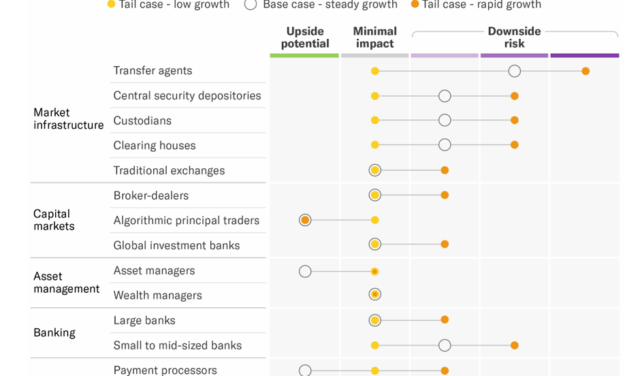
Major US banks and financial market intermediaries expect the transition to a digitized financial system to start slowly, then hit a tipping point at which it accelerates, according to credit rating agency Moody’s Ratings.In a report Tuesday, the agency said that, during conversations with US banks and other financial market intermediaries, most viewed the shift as inevitable and agreed it would start “slow, then fast,” with tokenization volume increasing and extending to more market participants, assets and use cases.“Across our conversations, industry leaders generally believed that broad asset tokenization will happen; the main uncertainties center around how quickly and in what sequence,” Moody’s said.“In the near term, progress is expected to remain gradual and focused on those simpler segments, such as funds and short-term instruments, running alongside traditional processes. But beyond that, many believe a tipping point will eventually be reached where broader adoption accelerates rapidly.”Tokenization has been one of the drivers of institutional interest in blockchain and crypto and is expected to experience massive growth over the next few years. Cathie Wood’s ARK Invest predicts digital assets could grow into a $28 trillion market by 2030, with Bitcoin, decentralized finance, stablecoins and tokenized RWAs as key drivers.TradFi is laying the groundworkCurrent tokenization activity is low, according to Moody’s, with the main uses coming through cryptocurrency trading, cross-border retail payments and some institutional use cases. But traditional financial institutions are actively preparing for a surge in adoption.The size of the tokenized real-world asset market has increased by more than 420% since the start of 2025 and is worth $31.6 billion as of Thursday, according to analytics platform RWA.xyz.“Almost all large banks and major financial market intermediaries have established dedicated digital-asset teams or innovation units and are participating in industry pilots to test new infrastructure,” Moody’s said.“These efforts are strategic: firms want to be ready to serve clients with digital asset and digital money capabilities if adoption takes off, so they are not caught flat-footed by a sudden shift in market demand.”In January, Morgan Stanley tapped veteran executive Amy Oldenburg to lead the investment bank’s new crypto unit weeks after announcing plans to launch three crypto exchange-traded funds and a crypto wallet.Related: Moody’s brings credit ratings onchain with Canton Network integrationThree possible outcomes for financial systemMoody’s said in a separate report on Monday that there are three possible outcomes for the financial system, depending on the pace of tokenization. In the “steady growth” base case, which the agency said is the most likely, the financial system will largely stay the same; tokenization would scale in select assets such as stablecoins and tokenized deposits, but incumbent asset managers, banks and infrastructure providers retain central roles.However, in a low-growth scenario, in which regulatory friction, unresolved legal questions and low demand from end users have stifled adoption, asset tokenization and digital money would stay confined to narrow use cases with modest changes to the financial system.Moody’s predicts there are three possible outcomes for the financial system depending on the pace of tokenization. Source: Moody’sThe most disruptive would be if tokenization undergoes rapid growth and assets such as stablecoins become widely embraced as an onchain settlement option.“Some incumbents would face greater pressure. For example, payment processors and parts of the legacy market plumbing, such as correspondent banks may lose revenue associated with settlement delay and siloed infrastructure, and for small to mid-sized banks, deposit balances could decline,” Moody’s said.Macro investor and former hedge fund manager Jordi Visser said on Saturday the “tokenization reality” will start this year, with tokenized assets powering agentic AI payments.Meanwhile, international financial institution, the International Monetary Fund, said in April tokenization has the potential to remove friction and boost transparency in finance but also warned it has the potential to create challenges around financial stability.Magazine: Guide to the top and emerging global crypto hubs — Mid-2026 

Čítaj viac

Upexi falls 8% after widened fiscal Q3 net loss

Shares in Solana treasury company Upexi fell 8.16% on Tuesday after reporting a widened net loss of $109 million in its fiscal third quarter, driven by a fall in the value of its crypto holdings. The company reported $92.3 million in unrealized losses on digital assets, according to a filing on Tuesday. This was despite total revenue rising 46% to $4.6 million compared with the same period last year, driven by crypto staking revenue. Upexi CEO Allan Marshall said during the earnings call that Upexi faced a challenging environment, along with the rest of the industry, but it has focused on initiatives to improve the company’s fundamentals through share buybacks and a convertible note offering to raise additional capital.“Our fiscal third quarter was characterized by a challenging environment, most notably a continued decline in both the price of Solana and industry multiples. Both had a direct impact on our stock and were the result of a general bear market in crypto,” he said.Source: Upexi“While we, like any treasury company, are heavily impacted by token prices and valuation multiples, we are not simply waiting around for the environment to improve but rather are taking a proactive approach with several efforts afoot,” Marshall added.Solana holdings increased by 9% during the quarter Upexi had 2.5 million Solana tokens, worth more than $238 million, in its holdings as of March 31, its results show, making it the second-largest corporate Solana treasury after Forward Industries, which holds more than 7 million tokens, according to CoinGecko.Related: Strategy CEO Phong Le says company will sell BTC only in specific casesPreviously, its business centered on consumer products and e-commerce before publicly announcing a pivot to becoming a Solana treasury company in late April 2025.Marshall said that, in the long term, the company expects Solana to be viewed independently of Bitcoin as investor knowledge increases and to be judged on its own underlying fundamentals.“While we believe the biggest determinant of the price of Solana will be the price of Bitcoin over the near term, we see this changing over the next few years,” he said.“This is primarily because Bitcoin and Solana are two completely different constructs, with the former a store of value or digital gold, and the latter a new type of computer, and one that is upgrading our antiquated financial infrastructure.”Forward Industries, the largest Solana treasury company, has scheduled its next earnings call for Thursday. In its previous results, released in February, its revenue increased from $4.6 million to $21.4 million. The company said the increase was largely driven by staking revenue.Magazine: Guide to the top and emerging global crypto hubs — Mid-2026 

Čítaj viac

Iran war, AI spending could push Bitcoin back to $126K this year: Hayes

The ongoing war in Iran and the race to dominate the AI sector will result in money printing that could benefit the crypto ecosystem and push Bitcoin back to its all-time high this year, according to Arthur Hayes, the chief investment officer of crypto investment fund Maelstrom.In a Substack post on Tuesday, Hayes said the competition between US and China to win the arms race has led both to pursue looser financial conditions and more fiat printing as the technology “directly relates to national security.”“The combination of the political will to win the AI race and the financial will to fund the build-out with printed money and bank loans produces the perfect environment for crypto,” he said.  Source: Arthur Hayes“There will be vastly more units of fiat tomorrow than today, and the rate of change is accelerating due to rapidly increasing yearly AI and electrification CAPEX expenditures,” Hayes added. Most of the crypto sector registered new all-time highs last year, with the market capitalization hitting $4.28 trillion in October, according to CoinMarketCap. However, the market slumped toward the end of last year, and analysts have debated when it will fully recover.Bitcoin to $126,000 is a “foregone conclusion”Hayes said war is inflationary and the Iran conflict is no different. Military spending and a shift by nations toward domestic infrastructure investment rather than US Treasurys and equities will lead to further money printing. He also predicted in March that the US Federal Reserve could ease monetary policy to help finance the country’s conflict with Iran and boost crypto.Related: Hyperliquid’s HYPE price will increase by August, predicts Arthur Hayes“The politicians support this money printing out of real and perceived necessity. That is why Bitcoin post-February 28th is outperforming the other major risky assets such as gold and US tech stocks,” Hayes added.Bitcoin has traded between $79,467 and $82,496 over the past seven days, according to CoinGecko. It was trading at about $81,000 as of Wednesday, up more than 31% from its Feb. 6 low of $62,822. Gold was trading around $4,581 at the start of February and has climbed to $4,710 in the same timeframe, for a 2% gain.Arthur Hayes said Bitcoin has been outperforming other major assets, such as gold, since February. Source: Substack “Bitcoin bottomed earlier this year at $60,000, and with a tailwind of trillions of dollars and yuan yet to be created at its back, retaking the $126,000 is a foregone conclusion,” Hayes said.“I expect the rally to intensify and the haters to cower in the corner as Bitcoin’s upward price trajectory turns explosive after punching through $90,000, where many call over-writers will rush to cover as their strike gets taken out.”Magazine: Guide to the top and emerging global crypto hubs — Mid-2026 

Čítaj viac
Three men charged in US over crypto wrench attack spree

US authorities have unsealed an indictment against three men accused of stealing at least $6.5 million in a “violent robbery spree targeting cryptocurrency owners.”The Justice Department said in a statement Monday that a federal grand jury indicted three men for allegedly planning to kidnap and rob four people around San Francisco and Los Angeles for their crypto.The trio, Elijah Armstrong, Nino Chindavanh and Jayden Rucker, are alleged to have posed as delivery drivers to force their way into residences and use threats of violence to extract crypto seed phrases.So-called wrench attacks, where crypto owners are subject to physical threats, have increased globally since 2025. French authorities charged 88 people in April with committing attacks against local crypto owners.US prosecutors claimed they identified at least four people the trio targeted from Nov. 22 until Dec. 31. One of the people was allegedly forced to transfer $6.5 million in crypto to a wallet controlled by the trio, according to an unsealed indictment filed in a San Francisco federal court.One of the victims was allegedly forced to transfer $6.5 million in crypto to the attackers. Source: PACER “These individuals, as alleged, terrorized their victims in the hopes of stealing vast sums of cryptocurrency,” Craig Missakian, the US Attorney for the Northern District of California, said in a statement Monday. “The scheme was not only sophisticated, it was brazen, violent, and dangerous.”Related: Law enforcement freezes $41M connected to $150M crypto Ponzi collapse Source: FBI San FranciscoThe three men were arrested in December last year and face charges of conspiracy to commit robbery, conspiracy to commit kidnapping, attempted robbery, and attempted kidnapping.Armstrong and Rucker are scheduled to appear in court on Tuesday. Chindavanh is scheduled to appear in court on June 26.Blockchain intelligence company TRM Labs reported in May last year that wrench attacks have been on the rise because of the ease with which bad actors can gather personal data online, the perceived pseudonymity of crypto transactions and the public visibility of wealth in the crypto sector.Magazine: Guide to the top and emerging global crypto hubs — Mid-2026 

Čítaj viac

Bitmine slows Ethereum buys, targets December to own 5% of supply

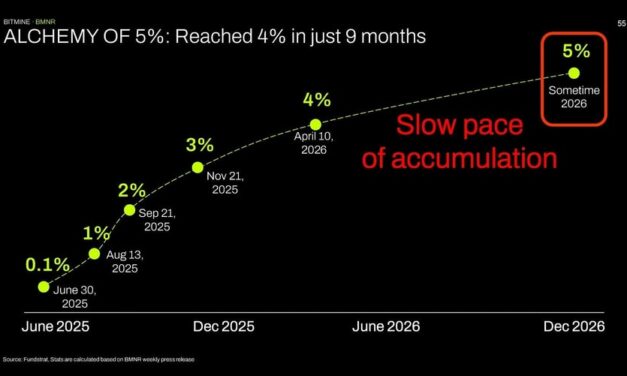
Ether treasury company Bitmine Immersion Technologies has slowed the pace of its Ether purchases after previously increasing its buying rate and acquiring more than 100,000 tokens over the last three weeks.Bitmine said on Monday that it purchased 26,659 ETH over the last week, down from the over 100,000 tokens a week it was previously maintaining, but that it was still on track for its goal to buy 5% of the token’s 120.7 million circulating supply by the end of the year. “We have decided to slow down our pace of weekly accumulation from >100,000 per week as we originally targeted reaching the ‘alchemy of 5%’ target in late 2026,” Bitmine chairman Tom Lee said. “Our previous pace of >100k weekly buys would have us reach 5% by mid-July.”Bitmine is the largest Ether treasury company and one of the most frequent buyers of the token, a business model it adopted from Michael Saylor’s Bitcoin treasury firm Strategy.Bitmine estimates it will reach its goal of holding 5% of the Ether supply by the end of 2026. Source: BitmineBitmine plans staking of entire Ether stashBitmine’s total staked Ether stands at over 4.7 million, and the company estimates its annual staking rewards will be roughly $352 million once its entire stash is staked. Blockchain explorer beaconcha.in has tracked over 38 million Ether staked as of Sunday.Lee said the goal is for Bitmine to eventually stake its entire stash.“We intend to hold and stake our ETH holdings, which means our ETH holdings are essentially reducing available supply of ETH and removed 4.3% of ETH supply since June 30th, 2025. In other words, ETH supply has been disinflationary since June 2025,” he said.Bitmine has staked over 4.7 million Ether. Source: BitmineEther hit an all-time high of $4,946 in August 2025, but it dropped in line with the rest of the crypto market toward the end of last year. It’s still down 52% from its peak and has been drifting between $2,274 and $2,411 over the last seven days, according to CoinGecko.Crypto spring in full swingLee also doubled down on his belief that a so-called “crypto spring has started and pointed to Ether’s price rising in correlation with software stocks as further evidence. “Crypto spring has commenced and we wanted to highlight the importance of owning ETH as a source of diversification, and the likely drivers of this coming ‘crypto bull’ cycle,” he added.“If ETH closes above $2,100 at the end of May 2026, this would be the third consecutive monthly gain – this has never been seen in a crypto bear market. Thus, a close above $2,100 would validate ‘crypto spring’ has arrived.”Magazine: Guide to the top and emerging global crypto hubs — Mid-2026 

Čítaj viac

Získaj BONUS 8 € v Bitcoinoch

nakup bitcoin z karty

Registrácia Binance

Burza Binance

Aktuálne kurzy