
Autor Cointelegraph By Stephen Katte

Republican lawmakers call for permanent CBDC ban as House vote approaches

A pair of Republican lawmakers is calling for a permanent ban on a US central bank digital currency (CBDC) to be enshrined in the 21st Century ROAD to Housing Act, as the measure is expected to come up for a vote in the US House this week. The bill released by the US Senate Committee on Banking, Housing and Urban Affairs in March mainly concerns revisions to federal housing programs but also includes a section banning the Federal Reserve System or any Federal Reserve bank from issuing a CBDC or similar instrument until Dec. 31, 2030.The US House has created its own amended bill, which Congressman Mike Flood said reverses the “backdoor green light for a CBDC” and aims to make the ban permanent.The amended legislation is expected to go to a vote in the House this week. If it passes, the bill will return to the Senate, where it could undergo further amendments. The legislation must pass both chambers before it can go to President Donald Trump’s desk to be signed into law.Critics of CBDCs often cite their potential for misuse. The Human Rights Foundation said the benefits of CBDCs include the potential to expand financial inclusion for populations with limited access to the financial system. Drawbacks include the currency’s potential to infringe on privacy and open new avenues for government corruption, among other concerns.Ban needs to be made permanent: Warren DavidsonUS Representative Warren Davidson, a member of the House, also supported a permanent CBDC ban as the “2030 sunset works a pre-launch development period.”“The US House of Representatives could deliver a unifying win this week with bipartisan housing affordability legislation. Instead, they currently plan to deliver a go-live date for Central Bank Digital Currency, using housing as the Trojan Horse,” he added.Source: Warren DavidsonThe American think tank The Atlantic Council’s tracker lists only three countries that have officially deployed a CBDC: Nigeria, Jamaica, and the Bahamas, while 41 others are in the pilot phase.Alternate bills to ban a CBDC on the sidelines Meanwhile, Tom Emmer, the House majority whip, one of the top Republican leadership positions in Congress, is advocating for his Anti-CBDC Surveillance State Act. The bill passed the House on July 17 but has yet to receive full Senate approval. It aims to block the Federal Reserve from creating or issuing a CBDC.Source: Tom Emmer“The Chinese Communist Party uses a central bank digital currency (CBDC) to surveil and control its people. If the US adopted its own CBDC, privacy and economic freedom as we know it would cease to exist,” he said.Related: Bank of Korea governor backs CBDCs, deposit tokens in first address“My Anti-CBDC Surveillance State Act BANS our government from ever creating this Orwellian tool. The House passed it. Now, the Senate must act.”Previously, Senator Mike Lee introduced the “No CBDC Act” as a standalone bill prohibiting the Fed or Treasury from issuing a CBDC. However, it stalled in Congress. Magazine: Bitcoin ETFs bleed $1B, Aave’s $71M ETH unfreeze bid delayed: Hodler’s Digest, May 10 – 16

Čítaj viac
Verus Ethereum bridge reportedly exploited for $11.6M in latest DeFi attack

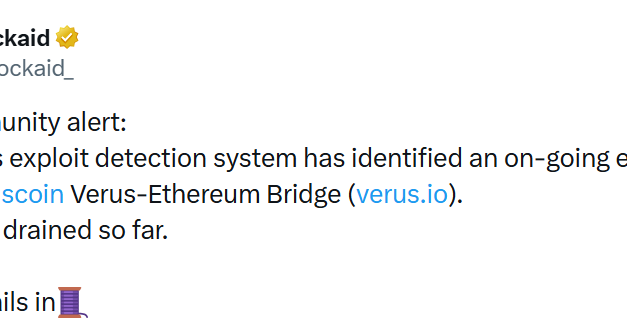
Verus Protocol’s Ethereum bridge was reportedly exploited on Monday through a fake cross-chain transfer message that allowed a hacker to fraudulently transfer out at least $11.58 million in cryptocurrency.Onchain security platform Blockaid said in an X post on Monday that its detection system identified an ongoing exploit on the Verus-Ethereum bridge and shared a transaction on Etherscan showing a transfer of 1,625 Ether (ETH), 147,659 USDC (USDC) and 103.57 tBTC v2, worth over $11.5 million.Blockchain security company PeckShield also called the transfer an exploit, with onchain data showing the funds have since been converted into Ether. The wallet shows a balance of 5,402 Ether, worth over $11.4 million, according to Etherscan.Cointelegraph reached out to Verus for comment. The protocol had not publicly confirmed the exploit at the time of publication.Source: BlockaidCrypto hackers stole more than $168.6 million in crypto from 34 decentralized finance protocols in the first quarter of 2026. April saw the two largest hacks of the year so far: the $280 million Drift Protocol exploit at the start of the month and the $292 million Kelp exploit.Fraudulent transfer instructions likely caused exploit Blockaid said the Verus Protocol incident resembles the $190 million Nomad Bridge exploit and the $325 million Wormhole exploit from 2022.The attacker exploited the Verus Ethereum bridge by deceiving the protocol into believing transfer instructions were real, causing the bridge to send funds from its reserves to the attacker’s wallet, Blockaid said.“NOT an ECDSA bypass. NOT a notary key compromise. NOT a parser/hash-binding bug. IS a missing source-amount validation in checkCCEValues – ~10 lines of Solidity to fix,” it added.Blockchain security provider ExVul reached a similar conclusion and said the attacker used a “forged cross-chain import payload” that passed the “bridge’s verification flow” and resulted in “three attacker-attached transfers to the drainer wallet.”Related: Aethir halts bridge exploit, promises compensation after $90K loss“Cross-chain import proofs must bind every downstream transfer effect to authenticated payload data before execution,” the blockchain security provider said, adding that “Bridges should add strict payload-to-execution validation, defense in depth around proof verification and pause outbound flows when anomalous imports are detected.” The incident follows THORChain confirming on Saturday that it suffered a $10 million exploit.Magazine: The legal battle over who can claim DeFi’s stolen millions

Čítaj viac

Hana Financial to acquire 6.55% stake in Upbit operator Dunamu for $668M

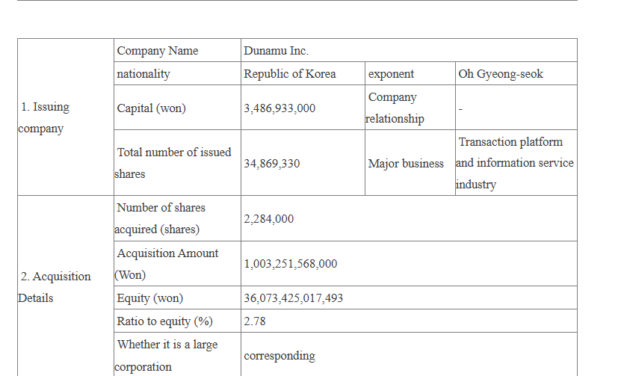
Major South Korean financial conglomerate Hana Financial is buying a stake in Dunamu, the operator of the crypto exchange Upbit, in its latest venture into the digital assets sector, amid a broader trend of traditional financial institutions wading into the digital assets market.In a regulatory filing on Friday, Hana Financial announced it is buying more than 2.2 million shares in Dunamu, or roughly 6.55% of the company, from investment firm Kakao Investment, worth over 1.003 trillion Korean won ($668 million).Hana Financial’s 6.55% stake from Kakao makes it the fourth-largest Dunamu shareholder. South Korean outlet The Chosun Daily reported last September that major shareholders of Dunamu include its chairman Song Chi-hyung with 25.5%; Vice Chairman Kim Hyoung-nyon with 13.1%; Kakao with 10.6% and Woori Technology Investment with 7.2%.Hana Financial said in the filing that the acquisition is to secure “competitiveness in new finance through strategic equity investment.” At the same time, Kakao also filed regarding the sale and said it was keeping 1.4 million shares on its books while offloading the rest to secure “funds for future investments.”Hana Financial is buying more than two million shares in Dunamu, or roughly 6.55% of the company. Source: DARTA growing number of banks and traditional financial institutions have started to dip their toes into crypto after years of skepticism. Mirae Asset Consulting, an affiliate of South Korean multinational financial services company Mirae Asset Group, acquired a controlling stake in crypto exchange Korbit in February.Earlier in the year, fellow exchange Coinone announced it was exploring the sale of shares held by its chairman, with local financial institutions and foreign exchanges rumored to be circling. South Korean tech company Naver Financial also agreed last year to acquire Dunamu through a share swap, bringing the Upbit operator under its umbrella.Hana Financial very active in crypto sector The financial conglomerate has been very active in the crypto sector. Hana Financial signed a trilateral memorandum of understanding in April to launch a blockchain-based remittance system with POSCO International and Dunamu. Related: South Korea crypto holdings halve in a year as investors turn to stock marketMeanwhile, in March, it struck a deal with the UK’s Standard Chartered Group to collaborate on global financial and digital asset markets, and also inked agreements with USDC issuer Circle and major US crypto exchange Crypto.com to promote stablecoin-based payments for foreign visitors in South Korea.Magazine: eToro founder timed Bitcoin top perfectly due to belief in 4 year cycles Cointelegraph is committed to independent, transparent journalism. This news article is produced in accordance with Cointelegraph’s Editorial Policy and aims to provide accurate and timely information. Readers are encouraged to verify information independently.

Čítaj viac

Australia’s proposed CGT changes could discourage long-term crypto holding

Australia’s proposed changes to capital gains tax could lead to smaller profits for cryptocurrency traders, especially low-income earners, and could discourage “patient investing,” according to several crypto executives. The proposed reform, announced by the ruling Labor Party on Tuesday as part of its fiscal year 2027 budget, will bring in a minimum 30% tax on capital gains and scrap the 50% capital gains tax discount on assets held for more than 12 months. Robin Singh, CEO and founder of crypto tax platform Koinly, told Cointelegraph the proposed changes are a mixed bag: The new system “theoretically” protects investors from being taxed on purely inflationary gains, but in practice, most crypto investors will pay more tax, with low-income earners hit the hardest.“A lower-income earner who would have paid around $3,800 under the old rules, 19% on a $20,000 discounted gain, will pay $10,200 under the new ones. That’s nearly triple. For students, part-time workers and anyone without significant other income, this is the biggest shift,” Singh added.Many investors, particularly Gen Z and Millennials, have seen crypto as a way to create wealth and long-term financial well-being. The new tax changes could impact that notion. A 2025 report from crypto exchange Independent Reserve found that 30% of people were investing in crypto to diversify their portfolio, while 25% were trading to get rich. “For retail and mid-sized holders, the hodl tax incentive is effectively gone. Crypto has historically grown much faster than inflation, so the inflation adjustment doesn’t come close to offsetting the loss of the 50% discount. With no tax reward for sitting on positions, expect more frequent trading and shorter holding periods.” A quarter of people are trading crypto to get rich. Source: Independent Reserve“That said, the market has always adapted. Investors will rework their strategies, advisors will rework their advice, and the dust will settle,” Singh added.Crypto trader behavior will likely shiftJonathon Miller, the Australian general manager for crypto exchange Kraken, agreed that the changes will make long-term crypto holding less attractive. Source: Crypto Tax Made Easy “The bigger risk is that reducing the benefit of long-term holding makes patient investing less attractive, particularly in a market where assets can be traded around the clock. That could push some investors toward shorter-term behavior, which is not necessarily the best strategy for long-term wealth building,” Miller said.“The sector will continue to mature, but policy settings can influence whether that maturity is built around long-term confidence or shorter-term activity.”Andrea Yuen, the co-CEO of Australian crypto trading platform Swyftx, said the tax changes could prompt crypto traders to shift to other avenues for long-term wealth creation.“The change is likely to act as a catalyst for patient capital over the next few years. We expect a significant trend toward crypto allocations within retirement portfolios and self-managed super funds. Investors are essentially being incentivized toward structured, long-term wealth creation,” Yuen added.Related: Coinbase launches crypto service for Australian retirement funds Australian crypto exchange BTC Markets reported in its Investor Study Report that SMSF registrations increased 69% year-on-year during the 2024–2025 financial year.New CGT rules need to pass through ParliamentThe Australian government has argued that the changes will curb investor appetite for property purchases because, without tax incentives, property is less attractive as an investment and that could free up supply.The new measures will apply only to gains accrued after July 1, 2027, and new homes are exempt. Critics argue that it will instead push up housing prices, stifle investment, impact business and add pressure to the new housing supply, The Australian reported on Friday. The tax reforms will still need to pass through the Australian Parliament. Angus Taylor, the leader of Australia’s other major political party, the Liberals, has reportedly vowed to oppose the measures and repeal them if they form government after the next federal election in 2028.Source: Pete Wargent The Labor Party will also need to get the tax reforms through the House of Representatives, with 76 votes required to pass, and through the Senate with 39 votes. Labor holds 94 seats in the House and 30 in the Senate.Magazine: eToro founder timed Bitcoin top perfectly due to belief in 4 year cycles

Čítaj viac

Trump’s White House weighs 250 pardons to celebrate America's 250th birthday

US President Donald Trump is reportedly considering pardoning 250 people to commemorate the country’s 250th birthday on July 4, according to The Wall Street Journal.An official announcement could come on June 14, Trump’s birthday, or during the Independence Day event on July 4, the WSJ reported Thursday, citing people familiar with the matter.However, the pardons are still in the preliminary stages and have yet to be confirmed. More than 16,000 formal requests for presidential pardons were submitted last year. On his first day back in office last year, Trump issued more than 1,500 pardons to people involved with the storming of the US Capitol in 2021. Several jailed crypto founders and their supporters have been advocating for pardons from Trump since his inauguration.Cointelegraph has contacted the White House for comment.FTX, Samourai Wallet founders want pardonsFTX founder Sam Bankman-Fried was convicted on all seven counts connected to the collapse of the cryptocurrency exchange and was sentenced to 25 years in prison in 2024. He has waged a social media campaign in the hopes of getting a pardon, but Trump reportedly ruled it out earlier this year. Keonne Rodriguez, one of the developers behind the crypto-mixing protocol Samourai Wallet, has also publicly expressed hopes for a pardon. Trump said last December he would review Rodriguez’s case and explore a pardon. There is also a petition that has attracted 16,082 signatures as of Thursday.Source: Keonne RodriguezMeanwhile, at least two petitions calling for a pardon for the Tornado Cash founders, Roman Storm and Roman Semenov, are currently live; however, they have only 22 and 9 signatures, respectively. Storm has not publicly asked for a pardon. Storm was convicted last August on charges of conspiring to operate an unlicensed money transmitting business and is still facing charges of money laundering and sanctions violation conspiracy. Semenov is considered on the run and is wanted by the FBI.The case against Rodriguez and Storm has been closely followed by crypto advocates, many of whom argue they shouldn’t be held responsible for the actions of third parties using their software. Some crypto pardons already grantedSeveral crypto founders have already received pardons during Trump’s second term as president. Last year, the White House pardoned the co-founders of crypto exchange BitMEX: Arthur Hayes, Benjamin Delo and Samuel Reed, who all pleaded guilty to failing to maintain anti-money laundering and know-your-customer programs in violation of the Bank Secrecy Act.Related: US CLARITY Act sees ‘big step forward’ as markup set for May 14 Binance founder Changpeng “CZ” Zhao was also pardoned in 2025. He already served a four-month prison sentence after pleading guilty to one count of violating the US Bank Secrecy Act for failing to maintain an effective anti-money laundering program at Binance.Silk Road founder Ross Ulbricht was one of the first to receive a pardon from Trump in January 2025 for his life sentence in connection with his operation of the dark web marketplace.Magazine: eToro founder timed Bitcoin top perfectly due to belief in 4 year cycles

Čítaj viac

Získaj BONUS 8 € v Bitcoinoch

nakup bitcoin z karty

Registrácia Binance

Burza Binance

Aktuálne kurzy