Autor Cointelegraph By Stephen Katte

‘Developed ecosystem’ based on crypto has sprung up for AI agents: Report

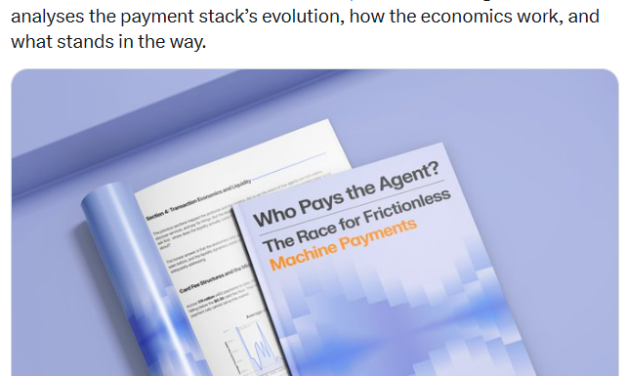
Artificial intelligence agents settling payments have gone from concept to reality in the last 12 months, with $73 million settled across 176 million transactions from May last year through April 2026, according to crypto investment firm Keyrock.In a report released Thursday, written in collaboration with crypto exchange Coinbase and the blockchain Tempo, Keyrock researcher Ben Harvey said that “in the past 12 months, machine-to-machine payments have gone from concept to a developed ecosystem.”“Agents have settled over $73 million across 176 million transactions, and incumbents have deployed more than $8 billion in acquisitions to secure their position in what is emerging as an entirely new payment stack,” Harvey added.Source: KeyrockAI agents are becoming increasingly popular among crypto users. Some crypto executives have speculated that AI agents settling transactions could drive adoption and transaction volumes, with Circle CEO Jeremy Allaire predicting in January that billions of AI agents will operate with stablecoins on users’ behalf within five years.Traditional payment rails too slow and expensiveBy the end of the first quarter this year, there were more than 104,000 agents registered across 15 or more directories and registries, according to Harvey. The average transaction size was about 31 cents.“That number tells you almost everything about why traditional payment rails can’t serve this market. A fixed processing fee of roughly 30 cents per transaction makes sub-dollar payments uneconomical. An agent paying three cents for a weather API call can’t route through Visa,” Harvey said.“Stablecoins won the settlement layer for machine commerce almost by default; they were the only instrument that could handle sub-dollar transactions without the economics collapsing.” Related: Exodus launches AI agent-focused stablecoin on Solana  AI agents are also used to build Web3 applications, launch tokens and interact with services and protocols autonomously, with some platforms exploring AI for trading. Last April, a CoinGecko survey of 2,632 crypto users found that most are comfortable with AI trading on their behalf; 87% said they would let AI agents manage at least 10% of their crypto portfolio.USDC the leading settlement optionMore than 98% of settlements by AI agents were in Circle’s USDC (USDC), according to Harvey, who said this serves as both a “validation and a vulnerability” because the entire ecosystem depends on one company, carrying significant risks.“This is a lot of dependence on a single stablecoin issuer’s reserve management, regulatory standing, and technical infrastructure. If Circle faces a regulatory challenge, a de-peg event, or even sustained downtime, the agent economy has no fallback,” he added.“This is a systemic risk that nobody in the space is publicly discussing, and one we believe warrants serious attention as volumes scale.”Magazine: Crypto scammers face death, Aussie CGT makes Asian hubs attractive 

Čítaj viac

Accused attackers of Sandbox exec’s wife tried to flee via Uber

Two of the six men accused of attempting to kidnap the wife of Sébastien Borget, the co-founder of The Sandbox, were arrested after calling an Uber to flee the scene, according to local reports. One of the attackers, disguised as a delivery driver, allegedly convinced Borget’s wife to open the gate at their home in the Île-de-France region in northern France. Then five masked accomplices rushed into the courtyard and tried to force her into a nearby car, Le Journal du Dimanche reported Thursday. Neighbors intervened, forcing the attackers to flee. Four escaped in the vehicle, while two others fled on foot and ordered an Uber, which was then intercepted by the Meaux Anti-Crime Brigade, according to Le Journal du Dimanche. The two suspects were allegedly found with a replica handgun, cable ties and balaclavas.Preliminary police investigations have linked the attack to crypto. It comes amid a rise in crypto wrench attacks since 2025, with Web3 security company CertiK flagging Europe as a hotspot in a report earlier this month, with most attacks occurring in France. CertiK added that most of these attacks are carried out by “complete amateurs” recruited through messaging apps like Telegram or Snapchat, with orchestrators located outside the country. Countries across Europe, particularly France, have recorded a large number of wrench attacks this year. Source: CertiKFour suspects still on the runBorget’s wife was reportedly uninjured, and the four other members of the group are still on the run. Blockchain intelligence company TRM Labs reported in May last year that wrench attacks have been on the rise because of the perceived pseudonymity of crypto transactions, the public visibility of wealth, and the ease with which bad actors can gather personal data online.Related: Law enforcement freezes $41M connected to $150M crypto Ponzi collapse The firm also said it is becoming common for bad actors to target family members of crypto holders. Last May, four men tried to abduct the daughter and grandchild of French exchange executive Pierre Noizat in Paris. In the same month, French police rescued the kidnapped father of a crypto entrepreneur who was being held for ransom.Casa chief security officer Jameson Lopp has recorded 38 crypto-wrench attacks so far this year, according to his list of incidents dating back to 2014.Magazine: Bitcoin ETFs bleed $1B, Aave’s $71M ETH unfreeze bid delayed: Hodler’s Digest, May 10 – 16   

Čítaj viac

Tax evaders are trying ‘novel digital assets’ to dodge authorities: Chainalysis

Tax dodgers have started turning to Bitcoin Ordinals, BRC-20 tokens and other digital methods in an attempt to hide their wealth from tax authorities, according to blockchain analytics platform Chainalysis.“Tax evasion and unreported income are age-old financial crimes, but the methods used to commit them are rapidly evolving,” Chainalysis said in a report Wednesday.“As digital assets become more mainstream, bad actors frequently attempt to exploit novel technologies — such as NFTs, decentralized finance protocols, or emerging token standards — in hopes of keeping their wealth hidden from tax authorities and law enforcement.”Tax authorities have been scrambling to catch up with technological advances and to track and apply taxes. A March study estimated that only 32% to 56% of US crypto owners report their gains. In Norway, that percentage was only 12%, according to a study from August 2024. Source: ChainalysisItalian authorities uncover $1 million tax evasion schemeChainalysis reported that Italy’s Economic and Financial Police Unit in Foggia reportedly uncovered a tax evasion scheme in which an individual allegedly used Bitcoin Ordinals and the BRC-20 token standard to hide 1 million euros ($1.1 million) in undeclared capital gains.Introduced in 2023, the Ordinals protocol assigns a serial number to a satoshi, the smallest unit of Bitcoin, and allows data, such as images or text, to be embedded in a Bitcoin transaction. The BRC-20 standard, built on top of it, allows text inscriptions to be deployed, minted into tokens and transferred on the Bitcoin blockchain.Italian authorities discovered during their investigation that the suspect was using the Ordinals protocol and the BRC-20 standard to create tokens, then sent them and listed them on marketplaces, according to Chainalysis.“The assets were sold for multiples of their original cost, and the profits were routed back to the suspect’s primary wallet in Bitcoin,” Chainalysis said. “The suspect continually reinvested these earnings into new inscriptions.”Blockchain intelligence essential infrastructureThe US Internal Revenue Service estimates that the gross tax gap, the government’s best estimate of the total tax it is legally owed but did not receive, is about $606 billion. Tax evasion tactics usually include paying in cash and underreporting income.However, Chainalysis said using crypto for tax evasion comes with a “fatal flaw” because of the “inherent transparency of the blockchain. No matter how sophisticated a scheme appears, the underlying technology leaves a permanent immutable trail.”Blockchain intelligence can reconstruct a financial network and cross-reference it with data that crypto exchanges are required to report to unmask transactions tied to suspected tax dodgers, according to Chainalysis.Related: Italy’s largest bank more than doubles crypto holdings to $235M in Q1: Report“This landmark Italian case serves as a powerful reminder for law enforcement and compliance professionals globally: the technical novelty of crypto does not equal anonymity,” it said.“As new digital asset classes continue to emerge and generate income streams, the gap between actual on-chain wealth and declared tax positions will become a primary target for global investigative attention. In today’s financial landscape, blockchain intelligence is essential infrastructure.”Magazine: Bitcoin ETFs bleed $1B, Aave’s $71M ETH unfreeze bid delayed: Hodler’s Digest, May 10 – 16  

Čítaj viac

Trump orders review of fintech firms' access to Fed payment services

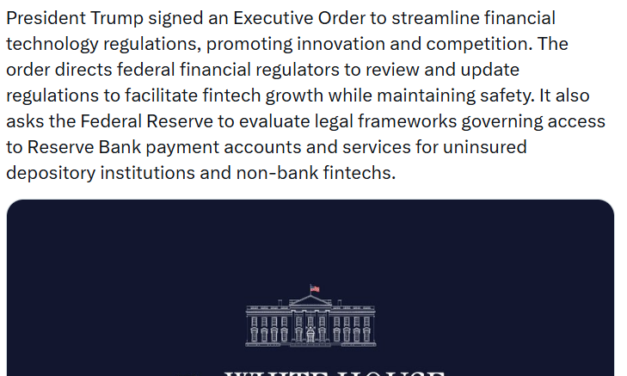
US President Donald Trump signed an executive order on Tuesday to review any barriers that might be stifling fintech innovation or preventing access to banking partnerships and payment rails.The order directs the Federal Reserve Board to evaluate the legal, regulatory and policy framework governing fintech and crypto firms’ access to Federal Reserve payment systems and submit a report to Trump within 120 days.The governors have also been asked to assess the Federal Reserve’s legal authority to grant direct access to fintech and crypto firms and to explore “options for expanding such access to the extent permitted by law, subject to appropriate risk management requirements.”Federal Reserve payment systems provide access to core banking infrastructure, making it easier to move money efficiently and reducing dependence on intermediary banks. Fintech and crypto firms have faced significant friction in accessing banking services. In one of the more extreme cases, they faced debanking, losing access to banking rails as part of what has been dubbed “Operation Chokepoint 2.0.”Source: Whitehouse.gov NewsReview into bank partnership barriers As part of the order, over the next 90 days, the heads of each US federal financial regulator are asked to review regulations, orders, and no-action letters that may be preventing fintech firms from entering into partnerships with federally regulated institutions such as credit unions, broker-dealers, and investment advisers.They are also required to review existing regulations, guidance, supervisory practices, and application processes and to flag any that could be updated “to facilitate innovation.”“The United States is a global leader in financial innovation, driven in part by the rapid growth of financial technology and fintech firms,” Trump wrote in the executive order.  “To foster this financial innovation, the federal government must update regulations to allow integration of digital assets and innovative technology into traditional financial services and payment systems.”The Trump administration has walked back many of the policies that led to crypto debanking. A US think tank, the Cato Institute, found in January that most debanking cases in the US resulted from government pressure rather than individual banks’ policies.Streamlined applications for bank, credit union chartersThe heads of the federal financial regulators are also asked to review regulations, guidance documents, orders, and no-action letters that could be amended to streamline applications for eligible fintech firms seeking bank charters, credit union charters, deposit or share insurance, and other federal licenses.Related: Crypto lobby backs formal removal of ‘reputation risk’ from bank examinationsA national bank trust charter authorizes a financial institution to engage in fiduciary activities such as trust services, custody and asset safekeeping.In December, the Office of the Comptroller of the Currency conditionally approved five applications for crypto-related national trust banks, including First National Digital Currency Bank, Ripple, BitGo, Fidelity Digital Assets and Paxos.Magazine: Bitcoin ETFs bleed $1B, Aave’s $71M ETH unfreeze bid delayed: Hodler’s Digest, May 10 – 16 

Čítaj viac

Bankr temporarily disables transactions after 14 wallets hacked

AI-powered crypto trading assistant Bankr said it disabled transactions after identifying an attacker who gained access to at least 14 wallets, with users reporting that as much as $150,000 in crypto was drained from some wallets. In an X post on Tuesday, Bankr said it was investigating reports that several wallets had been compromised and that transaction activity, including swaps, transfers and deployments, had been disabled “out of caution” while the investigation continues.“We’ve identified an attacker was able to access 14 Bankr wallets. We’ve temporarily locked things down while we work through the details. We will be reimbursing any and all lost funds. Will provide more updates as we have them,” it added.Bankr allows users to prompt AI to trade, transfer and launch tokens using plain language rather than a standard wallet interface. It also automatically creates a crypto wallet for every X handle that interacts with its bot. Earlier this year, someone reportedly exploited this feature and tricked Grok into requesting that Bankr launch a token, then drained funds from the token into a wallet they controlled.Source: BankrCrypto hackers have been active in recent months. Bad actors stole more than $168.6 million in crypto in the first quarter. April saw the two largest hacks of the year so far: the $280 million Drift Protocol exploit at the start of the month and the $292 million Kelp exploit. More recently, Verus Protocol’s Ethereum bridge was exploited Monday.Social engineering attack targeting bot could be to blameSlowMist founder Yu Xian said the exploit, from Bankrbots’ own reply, was likely a social engineering scheme targeting the AI agent. Three identified attacker addresses collectively hold $440,000 in crypto.“It was a social engineering exploit targeting the trust layer between automated agents—specifically an interaction between grok and Bankrbot that allowed unauthorized transaction signing,” Xian said.Source: Yu Xian“It seems like a combo of social engineering exploits targeting Grok + Bankrbot. Previously, the wallet-related assets allocated by Bankrbot to Grok were also stolen through a similar combo, prompt injection exploitation,” he added.Don’t sign transactions until further notice: BankrBankr has recommended that users avoid signing transactions until further notice and warned one individual that their seed phrase “is likely in the hands of an attacker.”Bankr also said anyone with a compromised wallet should stop using it, create a new wallet, generate a new seed phrase on a clean device, move any remaining tokens or nonfungible tokens to the new address and revoke approvals if remaining assets can’t be moved.Related: Aethir halts bridge exploit, promises compensation after $90K loss “Attackers often use existing approvals to drain funds. Check your devices, scan your computer and phone for malware or suspicious browser extensions. If you used a software wallet, the leak likely came from your device,” Bankr added.Losses could reportedly be up to $150,000 per walletSome X users reported that up to $150,000 in crypto had been drained from affected wallets.Tech entrepreneur Austen Allred said a Bankr wallet connected to his Kelly Claude AI assistant project was among those compromised. The hacker stole Ether (ETH), but none of the project’s memecoin stash was touched. Source: Austen Allred“There’s no evidence anyone other than myself ever logged into the Bankr account; they must have accessed the keys some other way,” Allred added.Magazine: The legal battle over who can claim DeFi’s stolen millions 

Čítaj viac

Získaj BONUS 8 € v Bitcoinoch

nakup bitcoin z karty

Registrácia Binance

Burza Binance

Aktuálne kurzy