
Autor Cointelegraph By Stephen Katte

Aurora Labs exec details 'fascinating and devious' crypto scam he almost fell for

Aurora Labs’ head of product, Matt Henderson says there is a sophisticated over-the-counter (OTC) transaction scam running about that almost duped him into losing a stash of his hard-earned cryptocurrency. Henderson detailed his personal run-in with a scam artist known as ‘Olai’ to his Twitter followers on Aug. 5. Olai’s scam essentially involves tricking a victim into believing payment had been received for an OTC crypto transaction, when in fact it wasn’t.Today I nearly got caught by a fascinating and devious crypto scam during an OTC transaction. Read on to learn what happened, so you can avoid it happening to you.— Matt Henderson (@dafacto) August 5, 2022How it workedHenderson explained the crypto scam began when Olai contacted him on the Telegram messaging app, inquiring about purchasing AURORA tokens with USC Coin (USDC). The pair agreed to conduct the transaction via escrow, a common strategy by which a trusted, neutral third party holds assets on both sides of the transaction and releases them to the counterparty when payment conditions are met. In this case, Henderson selected Aurora Labs’ head of security Frank Braun to act as the escrow agent, who he initially referred to as “Steve” in the Twitter thread. Olai suggested: 1. I send the AURORA to Steve2. Olai sends me a small USDC test transaction3. Steve send Olai an small AURORA test transaction4. Olai send me the USDC balance5. Steve then sends them the AURORA balance— Matt Henderson (@dafacto) August 5, 2022

However, Henderson caught wind of something suspicious when his escrow partner shared a screenshot of him supposedly giving the go-ahead to release the full amount of AURORA tokens to the buyer. According to Henderson, the scammers replicated his Discord profile and directed Braun to release the AURORA token balance to the scammers.  Discord’s blocking function made sure Henderson was unaware his profile had been cloned and scammers were impersonating him. Based on this, some security steps I’ll take in the future:1. All funds sent to the escrow. No exceptions.2. Inspect transactions in block explorers. Don’t accept verbal confirmations.3. Always create group chats yourself.4. Verify IDs and confirmations out of band.— Matt Henderson (@dafacto) August 6, 2022

After successfully evading the con, Henderson later unpacked the intricacies of the scheme, warning anyone trading crypto through OTC means to take extreme caution and avoid falling victim to the sophisticated scheme. Related: Solana-hacked crypto could be claimed as a tax loss: ExpertsHe also shared that the scammer named ‘Olai’ may still be active in the community, as a person using a similar name and tactic has been spotted on Telegram, according to Twitter user Scott Yeager. “How curious… I was recently approached by an Olai Olsen on Telegram attempting to initiate an OTC deal and offering USDC. Same character?” Earlier this year, the United States Federal Trade Commission found that nearly half of all crypto-related scams originated from social media platforms in 2021. In a report in June, the FTC reported that as much as $1 billion in crypto has been lost to scammers throughout the year, more than a five-fold increase from 2020. 

Čítaj viac

$2B in crypto stolen from cross-chain bridges this year: Chainalysis

Cross-chain bridge hacks have accounted for 69% of the total crypto stolen in 2022, amounting to $2 billion in losses, according to a new report. The report comes from blockchain analytics firm Chainalysis on Aug. 2, noting there have been 13 separate token bridge hacks this year — the most recent being the $190 million Nomad Bridge exploit.Q1 2022 was by far the quarter that saw the most amount of crypto stolen since 2021, due mainly to the Ronin Bridge Attack in late March, which saw $624 million in Ether (ETH) and Circle USD (USDC) stolen.Following last night’s exploit of the Nomad Bridge, an estimated $2B has been stolen from cross-chain bridges so far in 2022. Read our blog to learn what makes these protocols vulnerable and what the industry can do about it. https://t.co/WLo62H6NFe pic.twitter.com/CZRnqrPikh— Chainalysis (@chainalysis) August 2, 2022Cross-chain bridges, also known as blockchain bridges are designed to transfer cryptocurrencies from one blockchain network to another. Chainalysis explains that while bridge designs vary, users typically deposit their tokens from one chain to the bridge protocol which are then locked into a contract. The user is then issued the equivalent of a parallel token in another chain. Bridge vulnerabilitiesAccording to the Chainalysis report, bridges are often targets because they “feature a central storage point of funds that back the ‘bridged’ assets on the receiving blockchain.””Regardless of how those funds are stored – locked up in a smart contract or with a centralized custodian – that storage point becomes a target.”According to some experts, effective bridge design is still in its nascent stages of development, and some developers still have relatively little understanding of security protocols, making their protocols vulnerable to exploitation by hackers. In a July 22 clip posted on Twitter, almost two weeks before the recent attack, Nomad founder James Prestwich says it will be “at least another year or two before there is enough familiarity across chain security models to build defenses as a standard.” “In cross-chain systems, we haven’t built up that kind of expertise about attacks yet, people don’t know what the common attacks are, and so they don’t defend against them.”Centralized exchanges were once the favorite target of hackers, but advances in security protocols have seen a drop in successful cyber attacks, according to Chainalysis.The blockchain analytics firm has stressed that cryptocurrency services, including bridges, should start investing in security upgrades and training sooner rather than later. “A valuable first step towards addressing issues like this could be for extremely rigorous code audits to become the gold standard of DeFi, both for those building protocols and for the investors evaluating them. Over time, the strongest, safest smart contracts can serve as templates for developers to build from.”

Čítaj viac

BTC wholecoiners up by 40K since June crash began

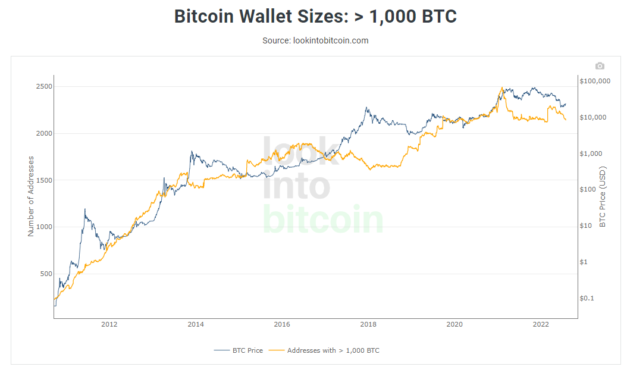
Smaller Bitcoin (BTC) investors have found a unique opportunity during the crypto slump to snap up their favorite cryptocurrency. The number of “wholecoiners” has surged by 40,000 since the June slump alone. According to LookIntoBitcoin, the number of BTC “wholecoiners” has been steadily increasing since January 31, when the BTC price was around $38,000.However, Bitcoin’s price fell around 27% in May and another 40% in June, the same month that saw 25,389 new wallets holding at least one whole Bitcoin. BTC’s price at the current time of writing is $23,035, down 64% from its ATH of $64,400 in November 2021, and the number of wholecoiners is currently at an all-time high of 891,346 as of August 1, 2022. Crypto investor Lark Davis told his Twitter followers on Monday that “a lot of people are hitting their whole coin goal!” The number of wallet addresses holding at least 1 #bitcoin has jumped by about 40,000 since the crash started! A lot of people hitting their whole coin goal! pic.twitter.com/5Lh1hRLKIh— Lark Davis (@TheCryptoLark) August 2, 2022Interestingly, the data shows the number of wallets holding more than 10 BTC, 100BTC and 1000BTC have started to taper off, or even decline during the same period. Wallet addresses with more than 10 BTC rose by only 600 since May, addresses with more than 100 BTC have declined by 125, and wallets with more than 1,000 BTC have fallen by 113. Source: LookIntoBitcoinRelated: Bitcoin traders pinpoint key levels to watch as BTC price tests key trendlinesBitcoin’s price has been trending up since mid-July, however, there are mixed opinions on whether the cryptocurrency has already met its bottom, or if further downsides are on the way.

Čítaj viac

Crypto lender Vauld granted three-month protection from creditors

Embattled crypto lending platform Vauld has been granted a short period of reprieve from creditors after being given a three-month moratorium by the Singapore High Court on Monday. Its initial request by Vauld’s parent company Defi Payment Limited for a six-month moratorium was reportedly denied by Justice Aedit Abdullah on August 1, citing concerns that a lengthier moratorium “won’t get adequate supervision and monitoring,” according to a Bloomberg report.Under the moratorium, Defi Payments would be protected from wind-up resolutions, the appointment of a receiver or manager, and any legal proceedings that could be directed toward the company, including any that could be laid out by its 147,000 creditors. Vauld claimed in its updated website FAQ on Monday that the moratorium would provide the breathing room necessary to come up with a restructuring plan for the business and provide a better outcome for its creditors. “The moratorium is an important procedure to provide the company with the breathing room necessary for it to formulate and consider its options carefully.”Vauld noted that without a moratorium, it would be “highly likely” that creditors would only receive a fraction of their account’s worth.While the new protection order expires on November 7, Judge Abdullah says he will grant an extension if Vauld is transparent about their progress in repaying creditors. The crypto platform has also been given two weeks to form a creditors committee and provide details around cash flow and valuation of assets to creditors. Exploring the possibility of minimum withdrawals for their remaining customers has also been recommended by the high court judge. Restructure plan Vauld halted customer withdrawals last month for its 800,000 customers, citing unfavorable market conditions and an unprecedented $200 million worth of withdrawals in under two weeks.Under the protection of the moratorium, Vauld hopes to formulate a restructuring proposal and explore options to revive the business. The company plans to present creditors with a restructuring proposal in the form of a detailed Explanatory Statement outlining an estimate of recoveries and repayment plans that will be made available to creditors.Eventually, Defi Payments plans to convene a creditors’ meeting and hold a vote on whether to approve any possible restructuring; however, there is no set date yet.Nexo’s offer to buyOn July 5, Vauld Co-founder Darshan Bathija announced on Twitter that crypto lender Nexo had signed an indicative term sheet, with the intention of possibly acquiring Vauld and its assets. “The completion of this transaction is pending due diligence — which both teams are working on as we speak. Vauld has strived to deliver long-term value to all customers, and we believe coming under the Nexo umbrella will significantly help achieve this.”The term sheet grants Nexo a 60-day exclusive exploratory period to conduct due diligence on Vauld operations before committing to a purchase. If the order of protection expires before the end of the exploratory period, Vauld claims in their website FAQ it could possibly disrupt the deal. After the end of the 60-day period, Vauld will be free to conduct negotiations with other possible investors.

Čítaj viac

Israel puts the brakes on cash to spur digital payments

Authorities in Israel on Monday has in put in place further restrictions on cash payments as a means to combat illegal activity and spur digital payments in the country. Since January 2019, Israeli businesses and consumers have been subject to limits on cash payments under the Law for the Reduction in the Use of Cash. It’s aimed at shifting the country’s citizens and businesses toward digital payments, allowing authorities to more easily track tax evasion, black market activity, and money laundering.From August 1, the limits on cash payments have been tightened to 6,000 Israeli Shekel (NIS), equivalent to $1,760 United States dollars (USD) for business transactions and NIS 15,000 ($4,400 USD) in personal transactions. Further restrictions are expected to follow in the future, prohibiting the stockpiling of more than NIS 200,000 shekels ($58,660 USD) in cash at private residences.Tamar Bracha, who is reportedly in charge of executing the law on behalf of the Israel Tax Authority (ITA), recently told Media Line that limiting the use of cash will make increase the difficulty of criminal activity, stating: “The goal is to reduce cash fluidity in the market, mainly because crime organizations tend to rely on cash.”Meanwhile, the new limits placed on hard-cash transactions have been seen by some as a good sign for future crypto adoption in the country. On July 30, Crypto influencer Lark Davis told his 1 million followers on Twitter that Israel is neither the first nor last country to introduce such restrictions, and took the opportunity to reference Bitcoin in his post. From Monday Israel will ban cash payments over $4,400! That means you cannot pay cash for a used car, designer bag, or any other higher ticket item. Not the first or last country to introduce such restrictions. Got #bitcoin?— Lark Davis (@TheCryptoLark) July 30, 2022Meanwhile, strategic investor Lyn Alden, founder of Lyn Alden Investment Strategy said that the trend “will probably continue to other countries over time.” CBDCs & crypto regulationThe country is also one of several nations in the region exploring central bank digital currencies (CDBCs), having first considered a CBDC at the end of 2017. In May, the Bank of Israel revealed the responses to a public consultation around its plans for a “digital shekel,” indicating that there was strong support for continued research on CBDCs and how it would impact the payments market, financial and monetary stability, and legal and technological issues.In June, the Bank of Israel revealed it had conducted a lab experiment examining user privacy and smart contracts’ use in payments, marking its first technological experiment with a CBDC.The country is also in the process of creating a regulatory framework around digital assets. During this year’s annual Israel Crypto Conference in May, Jonathan Shek of Oz Finance revealed that Israel’s financial authorities had been preparing a comprehensive and holistic regulatory framework for digital assets.While he didn’t give an exact date, Shek teased it would come in the near future because the Israeli government was keen to foster the growth of the crypto industry in their state if done in a responsible manner.

Čítaj viac

Získaj BONUS 8 € v Bitcoinoch

nakup bitcoin z karty

Registrácia Binance

Burza Binance

Aktuálne kurzy