Autor Cointelegraph By Stephen Katte

Countries ignoring crypto AML rules risk placement on FATF's 'grey list' — Report

Countries failing to adhere to anti-money laundering (AML) guidelines for cryptocurrencies could find themselves added to the Financial Action Task Force’s (FATF’s) “grey list.”According to a Nov. 7 report from Al Jazeera, sources say the global financial watchdog is planning to conduct annual checks to ensure countries are enforcing AML and counter-terrorist financing (CTF) rules on crypto providers. The grey list refers to the list of countries the FATF deems as “Jurisdictions under Increased Monitoring.”The FATF says countries on this list have committed to resolving “strategic deficiencies” within agreed timeframes and are thus subject to increased monitoring. It differs from the FATF “blacklist,” which refers to countries with “significant strategic deficiencies in relation to money laundering”, a list which includes Iran and the Democratic People’s Republic of Korea. At the moment, there are 23 countries on the grey list, including Syria, South Sudan, Haiti and Uganda.Crypto hotspots like the United Arab Emirates (UAE) and the Philippines are on the grey list as well, but according to FATF, both countries have made a “high-level political commitment” to work with the global financial watchdog to strengthen their AML and CFT regime. Pakistan was previously also on the list, but after taking 34 actions to solve FATF’s concerns, they are no longer subject to increased monitoring. One of the anonymous sources cited by Al Jazeera noted that while failure to comply with crypto AML guidelines won’t automatically put a country on the FATF’s grey list, it could affect its overall rating, tipping some to fall into increased monitoring. Cointelegraph has reached out to the Financial Action Task Force for comment but has not received a response at the time of publication. In April 2022, the AML watchdog reported that many countries, including those with virtual asset service providers (VASPs), are not in compliance with its standards on Combating the Financing of Terrorism (CFT) and Anti-Money Laundering (AML).Under FATF guidelines, VASPs operating within certain jurisdictions need to be licensed or registered.In March, it found that several countries had “strategic deficiencies” in regard to AML and CTF, including the United Arab Emirates, Malta, the Cayman Islands and the Philippines. Related: Crypto regulation is 1 of 8 planned priorities under India’s G20 presidency — Finance MinisterIn October, Svetlana Martynova, the Countering Financing of Terrorism Coordinator at the United Nations (UN) noted that cash and hawala have been the “predominant methods” of terror financing.However, Martynova also highlighted that technologies such as cryptocurrencies have been used to “create opportunites for abuse.” “If they’re excluded from the formal financial system and they want to purchase or invest in something with anonymity, and they’re advanced for that, they’re likely to abuse cryptocurrencies,” she said during a “Special Meeting” of the UN on Oct. 28.

Čítaj viac


OpenSea launches on-chain tool to enforce NFT royalties

Nonfungible (NFT) marketplace OpenSea appears to have taken a position in the NFT royalties debate — launching a new “on-chain” tool helping creators enforce royalties. The NFT marketplace, which according to CoinGecko commands 66% of the market share in NFT marketplaces, has been relatively silent on the issue of royalties and enforcement while others in the space have been implementing their own strategies over the last few months. In a Nov. 6 blog post, OpenSea CEO Devin Finzer noted that in marketplaces where fees are optional, they’ve “watched the voluntary creator fee payment rate dwindle to less than 20%”, while in other marketplaces creator fees are “simply not paid at all.”The OpenSea CEO announced the marketplace has launched a new tool that will allow creators to deliver “on-chain enforcement” of their royalties. There’s been a lot of discussion over the past few months about business models for NFT creators & whether creator fees (“royalties”) are viable. Given our role in the ecosystem, we want to take a thoughtful, principled approach to this topic & to lead w/ solutions. — OpenSea (@opensea) November 6, 2022Finzer described the tool as a “simple code snippet,” which allows creators to enforce royalties on new and future NFT collection smart contracts, and existing upgradeable smart contracts. The code will also restrict NFT sales to only marketplaces that enforce creator fees.”It’s clear that many creators want the ability to enforce fees on-chain; and fundamentally, we believe that the choice should be theirs to make — it shouldn’t be a decision made for them by marketplaces,” Finzer said. Finzer also said OpenSea will enforce royalties for new collections using an on-chain enforcement tool, but won’t do so for new collections that don’t opt-in. Finzer explained in an accompanying Twitter Spaces that OpenSea is “not requiring folks to use our specific solution,” creators can use “whatever solution you want and implement it anyway.” “We provide a template GitHub repo that helps you use a solution that basically blocks lists marketplace that doesn’t support creator fees, you don’t have to use that solution; the requirement is that if you want creator fees, you have to enforce them on chain.” The tool also won’t be rolled out for existing NFT collections for the moment due to implementation challenges. “To the best of our knowledge, the only way to achieve on-chain creator fee enforcement for existing collections with non-upgradeable smart contracts is to take drastic measures with their communities, like shifting the canonical collection to a new smart contract,” Finzer said.”In our opinion, by far the better option is for existing creators to explore new forms of monetization and alternative ways of incentivizing buyers and sellers to pay creator fees, and to ensure that future collections enforce creator fees on-chain,” he added. According to Finzer, this could include options such as continuing to enforce off-chain fees for some subsets of collections, allowing optional creator fees and collaborating on other on-chain enforcement options for creators. Related: OpenSea revises NFT rarity ranking protocol after community feedbackReaction among the NFT creator and Twitter community has been mixed. Wab.eth, founder of the Sappy Seals NFT collection and co-founder of The Pixlverse and Pixl Labs told their nearly 60,000 followers that while “I don’t fundamentally agree with the removal of royalties, I do appreciate this execution.” I don’t fundamentally agree with the removal of royalties though but I do appreciate this execution. There has to be give and take with these things.Recognizing you are making a (unavoidable) change that harms your audience but also simultaneously presenting a solution.— wab.eth ❁ (@wabdoteth) November 6, 2022

Others users had questions they felt were not answered. Betty, the pseudonym for one of the creators of the Deadfellaz NFT collection, told their 89,000 followers, “it feels like there is no plan and no clear answers were given in regards to existing collections & artist’s royalties.” Although later noted, “I look forward to reading more concrete communication from them soon in regards to proposed strategies.” After speaking with @opensea it feels like there is no plan and no clear answers were given in regards to existing collections & artist’s royalties. Communication has been misleading and facts are not there. Speak up if you feel a certain way about this because it has impact.— BETTY (@betty_nft) November 6, 2022

Čítaj viac

Programmer spends 69 nights in 'Bitcoin Cash City' using only BCH: Here's how it went

When programmer Jonathan Silverblood flew to Townsville, Australia from his Finland home for a two-and-a-half-month holiday in August, he had one main task — pay for everything he could using Bitcoin Cash (BCH).The coastal city of Townsville is known as the “Bitcoin Cash City,” a name derived from a conference of the same name that first launched in 2019. It is understood to have a strong number of merchants that accept the Bitcoin-forked token.Silverblood said while attending the conference in 2019, he was intrigued by the number of merchants and vendors offering BCH as a payment option in Townsville and had planned a return to the city once COVID-19 restrictions were lifted. I have now been in #Townsville, the #BitcoinCashCity for for 59 days and I have made 97 bitcoin cash transactions to pay for living. That does not include the transactions that the rest of my family have done, and the transactions when I’ve been a guest and someone else paid…— Jonathan Silverblood (@monsterbitar) October 8, 2022″Going to this destination was entirely about using BCH and was also kind of an excuse to spend more than I usually do, while simultaneously getting more work done by letting family and kids have a vacation with their grandma,” he told Cointelegraph after he returned home from the trip. “Using it to pay for things while I was there just made sense, partially because I already have my income paid in BCH, and partially because it’s just so much less effort than some of the other forms of payment I use.” Silverblood is a Bitcoin Cash enthusiast and programmer. He has been working at General Protocols for the last three years where his salary is paid in BCH. He noted that in the 69 nights he spent in the city, he was ultimately able to conduct 130 transactions using Bitcoin Cash. These included goods and services at cafes, restaurants, and hotels, getting a tooth pulled at a dentist, a haircut, and getting a Steam Deck gaming console repaired. “Some days were pretty busy; we would buy breakfast, lunch, ice cream, bread and dinner, but sometimes my family wanted to go elsewhere rather than eat at the specific BCH accepting merchants.” Silverblood also made several payments using BCH that weren’t with businesses in Townsville, including Steam and Netflix gift cards, “plus a few bills back home.”However, his Bitcoin Cash-funded holiday was not without its hiccups. Silverblood says his experience using BCH as a payment method was successful but not “wildly successful” because of issues with payment terminals running out of power, WiFi access and some merchants being unable to offer crypto as an option at the time of payment. “When I got to the airport in Townsville I also wanted to pay for a cab ride to the hotel, but a competing cab company bought up the cab company that took BCH, so that was no longer an option.” He also found that not all merchants were open to the idea of using BCH because they did not want to “complicate bookkeeping” and “couldn’t stomach the volatility.””For most merchants I spoke with during my trip, it seems to just be that the number of customers paying with crypto is just too small to motivate additional staff education costs, additional hardware like WiFi and payment terminals,” Silverblood said. “Cryptocurrencies are here, and they work, but merchant adoption is slow and spread out, which makes it hard to live entirely off,” he added. Silverblood said he also didn’t end up buying his plane tickets with BCH, as his family wanted to fly Qatar Airways specifically, which doesn’t currently accept crypto as a payment method. This is despite the airline launching their own Metaverse in July.Related: 21-year-old got ‘thought-provoking’ questions after teaching crypto to old folksSilverblood and his family have since returned home to Finland, but the programmer is confident this won’t be the last time he will use crypto to pay for goods and services. “Can’t bitcoin the dentist, can’t bitcoin my breakfast, can’t even use bitcoin at bitcoin conventions”… I have now done all of those in the #BitcoinCashCity #Townsville. I am so going to miss this place when I fly home tomorrow.https://t.co/dj2l8TopEp— Jonathan Silverblood (@monsterbitar) October 18, 2022

“I will absolutely try and do something like this again, in just a few weeks, I’m flying over to another Bitcoin Cash hotspot, St Kitts, for the BCH 2022 conference,” he said. “I don’t know what to expect there though, I’ve heard everything from 100% all merchants accept it, only half do, and merchants will accept it, but you need a special wallet.”

Čítaj viac

I'm the captain now: Musk chops Twitter board, becomes sole director

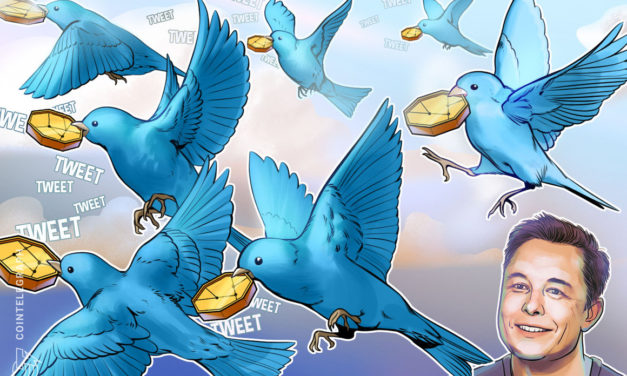
Crypto-friendly billionaire Elon Musk has become the sole director of Twitter, following the dissolution of nine former board members, according to newly filed documents. In an SEC filing dated Oct. 27, the “consummation” of Musk’s takeover of Twitter came with the dissolution of Twitter’s board members, including Bret Taylor, Parag Agrawal, Omid Kordestani, David Rosenblatt, Martha Lane Fox, Patrick Pichette, Egon Durban, Fei-Fei Li and Mimi Alemayehou.“On October 27, 2022, and as a result of the consummation of the Merger, Mr. Musk became the sole director of Twitter,” the filing reads. The Tesla CEO later tweeted in a response to a Twitter user that the arrangement was “just temporary.” Previously, Musk has said the platform under his ownership will focus on free speech, eliminating spam bots and fake accounts, an edit function, and possibly even crypto payments. In the days since the Tesla CEO assumed ownership of Twitter, Musk has been busy providing updates on what his new platform could bring to the table. He has already floated the idea of a monthly $19.99 payment to get the blue tick verification and bringing back Twitter’s defunct short-form video service Vines, which saw 69% of five million voters in favor of its comeback in an online poll. The whole verification process is being revamped right now— Elon Musk (@elonmusk) October 30, 2022Meanwhile, Musk has also declared the formation of a “content moderation council” aimed at ensuring free speech on the platform and to consider reversing bans of certain Twitter accounts, such as that of former U.S president Donald Trump. A crypto wallet is rumored to be in development as well, but Musk has not made any comments about whether this is true. Of course, the takeover has also seen CEO Parag Agrawal, chief financial officer (CFO) Ned Segal and head of legal and policy Vijaya Gadde all ousted from their executive roles for allegedly misleading Musk about the number of spam and fake accounts on the platform. Related: Binance wired $500M to back Musk’s Twitter takeover — CZMeanwhile, Twitter co-founder Jack Dorsey who left Twitter’s board in May, and supported Musk’s purchase, appears to have doubled down on his stance by rolling over his stake of  over 18 million shares, worth around $975 million at the buyout price of $54.20, into the new private company, according to a filing with the SEC dated Oct. 27. The platform is a popular communication tool for crypto enthusiasts with roughly 120,000 tweets per day about #Bitcoin alone, according to BitInfoCharts.Musk changed his Twitter bio to “Chief of Twit,” the same day he visited Twitter’s San Francisco-based office carrying a sink. On Oct. 31, he changed his bio again to “Twitter Complaint Hotline Operator” and, at one user’s suggestion, made his profile picture what appears to be him answering the phone as a child.

Čítaj viac

Huobi Global denies ‘large-scale layoffs’ and key exec resignations

Huobi Global says it has no plans to conduct “large-scale layoffs” and has refuted reports that two of its top executives have resigned amid a takeover of the Seychelles-based crypto exchange.Reports that the company’s chief executive officer (CEO) Leon Li and chief financial officer (CFO) Chris Lee have resigned appeared to have originated from an Oct. 29 Twitter post from Chinese crypto blogger Colin Wu, citing “people familiar” with Huobi. The Twitter post also suggested there could be mass layoffs planned for its 1,600 employees due to “too many people” working at the company.However, a spokesperson from Huobi Global told Cointelegraph that rumors there could be mass layoffs are “untrue” and that its senior management continues to perform their duties “as per normal,” stating:“Huobi Global’s senior management team is performing their duties as per normal, and rumors of large-scale layoffs are untrue. At present, Huobi Global enjoys a healthy cash flow, and the new shareholders have completed the capital injection.””Huobi has demonstrated positive development potential in key regional markets, and will continue to invest in business innovation, exploring international markets and recruiting local employees,” they added.However, the spokesperson admitted that due to the crypto market downturn, some cost-cutting could still be on the cards though it didn’t clarify what this could entail, stating: “Huobi Global is in a sound financial position at present, but due to the current market downturn, Huobi will also make adjustments to reduce costs and increase efficiency.”Related: Why is the price of Huobi Token up 12% today as rest of the market slumps?Huobi is a Chinese cryptocurrency exchange founded by Leon Li in 2013 and currently has operations in more than 30 countries around the world and a presence in over 100 countries.In August the crypto exchange got the green light to offer fiat cryptocurrency trading services in Australia, after registering as a digital currency exchange provider with the Australian Transaction Reports and Analysis Centre (AUSTRAC). September saw Huobi establish a partnership with South Korea’s “blockchain” city of Busan to provide research and development, technology and financial support for the Busan Digital Currency Exchange. Huobi is also set to assist in identifying and hiring blockchain talent for Busan’s local exchange.While the biggest news came in October when About Capital Management (HK) Co. Ltd, a Hong Kong based-asset management firm, became the exchange’s controlling shareholder following a successful buyout deal for an undisclosed amount.

Čítaj viac

Získaj BONUS 8 € v Bitcoinoch

nakup bitcoin z karty

Registrácia Binance

Burza Binance

Aktuálne kurzy