
Autor Cointelegraph By Stephen Katte

Blockchain Capital is raising $700M for 2 new funds: Report

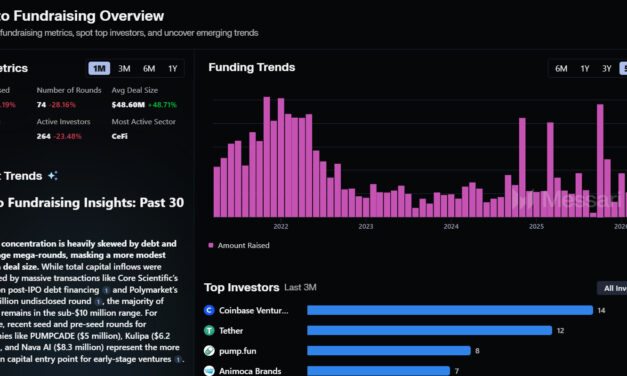
Crypto-focused venture capital firm Blockchain Capital is in the process of raising another $700 million for two new funds, according to Bloomberg, citing a person familiar with the matter.The firm is raising capital for its seventh early-stage fund aimed at experimental or early-stage projects as well as a second growth fund, which covers more mature companies that already have some traction, Bloomberg reported on Tuesday.Blockchain Capital previously raised a total of $1 billion for crypto investments, the source said. The new funding rounds are expected to be completed in the next six months, but the firm has already begun deploying some of the new capital.Venture capital funds are responsible for investing in crypto startups. Blockchain Capital has more than $2 billion in assets under management and has invested in crypto exchanges Kraken and Coinbase, and stablecoin issuers Circle and Tether. Cointelegraph has contacted Blockchain Capital for comment. Average fundraising deal size up 50% in the past 30 daysDespite a crypto market slump, the average crypto funding deal size is up nearly 50% over the last 30 days, according to market intelligence platform Messari.The average crypto funding deal size is up nearly 50% over the past 30 days. Source: MessariHowever, crypto projects have raised only $466 million so far in April, down from $3 billion in March, with Bitcoin miner and artificial intelligence infrastructure company Core Scientific’s $1 billion debt financing through investment bank Morgan Stanley the largest deal of the month.“Capital concentration is heavily skewed by debt and late-stage mega-rounds, masking a more modest median deal size,” Messari analysts said.“While total capital inflows were bolstered by massive transactions like Core Scientific’s $1 billion post-IPO debt financing and Polymarket’s $600 million undisclosed round, the majority of activity remains in the sub-$10 million range,” they added.Related: Switzerland’s Crypto Valley funding rose 37% in 2025 as TON led dealsMonthly crypto fundraising has also cooled significantly since its peaks in November 2021 and May 2022, when funding consistently exceeded $4 billion per month.However, according to Messari, institutional infrastructure and fintech-adjacent crypto services such as financial platform Slash and cross-border payment company OpenFx are still attracting high-value raises, with capital flowing toward platforms that bridge traditional finance and digital assets.Magazine: How to fix suspected insider trading on Polymarket and KalshiCointelegraph is committed to independent, transparent journalism. This news article is produced in accordance with Cointelegraph’s Editorial Policy and aims to provide accurate and timely information. Readers are encouraged to verify information independently. Read our Editorial Policy https://cointelegraph.com/editorial-policy

Čítaj viac
Kalshi bans 3 US politicians for betting on their own election races

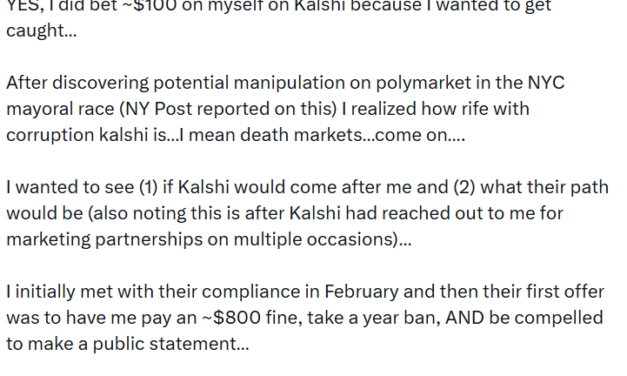
Two US congressional candidates and one sitting lawmaker have received fines and bans from Kalshi after they were found betting on the outcomes of their election races, as prediction market platforms crack down on insider trading.Matt Klein, a sitting member of the Minnesota State Senate, was fined $539 for betting on his primary race in his bid for the US House of Representatives, which is set to take place in August. Ezekiel Enriquez, who ran for a US House seat in March, received a $784 penalty, according to Kalshi’s notice of settlement.Another case involved Mark Moran, a candidate in Virginia’s US Senate race, who received a $6,229 penalty and was ordered to return any profits from his trades after allegedly refusing to cooperate with Kalshi to resolve the issue. All three were banned from the platform for five years.Prediction markets, which let users trade contracts on the outcomes of future events, have faced growing scrutiny over insider trading and possible violations of gambling laws. Kalshi and Polymarket, the two largest platforms, have pledged to introduce stricter controls and crack down on unlawful activity.Lawmakers offer reasons for insider tradesMoran said in a statement on X that he placed his wager to test Kalshi’s procedures and see how the platform would respond to insider trading.“YES, I did bet ~$100 on myself on Kalshi because I wanted to get caught,” he said, adding that he “wanted to see (1) if Kalshi would come after me and (2) what their path would be.”Source: Mark MoranKlein said in a statement that he placed the wager out of curiosity about how prediction markets worked, but later learned it violated platform rules.“In compliance with their request, I paid a penalty and agreed to be suspended from the platform. That was the only wager I have ever made on a predictions market,” he added.Klein is a co-sponsor of a bill in the Minnesota Legislature that aims to ban wagers on the outcomes of real-world events such as elections or policy decisions.Cointelegraph was unable to reach Ezekiel Enriquez for comment.Kalshi’s ongoing insider trading crack downBobby DeNault, Kalshi’s head of enforcement, said Tuesday these cases violated Kalshi’s exchange rules but didn’t warrant referral to the US Commodity Futures Trading Commission or the Department of Justice for further investigation and prosecution.Related: Charles Schwab, Citadel Securities are eying prediction markets“Regardless of the size of a trade, political candidates who can influence a market based on whether they stay in or out of a race violate our rules. No matter how small the size of the trade, any trade that is found to have violated our exchange rules will be punished,” he added.The platform issued a $2,000 fine and a five-year ban in February to a former California gubernatorial contender for betting on his own candidacy last year.Magazine: How to fix suspected insider trading on Polymarket and KalshiCointelegraph is committed to independent, transparent journalism. This news article is produced in accordance with Cointelegraph’s Editorial Policy and aims to provide accurate and timely information. Readers are encouraged to verify information independently. Read our Editorial Policy https://cointelegraph.com/editorial-policy

Čítaj viac
AI drives surge in ‘bug bounty’ reports, but the ‘slop’ is rising too

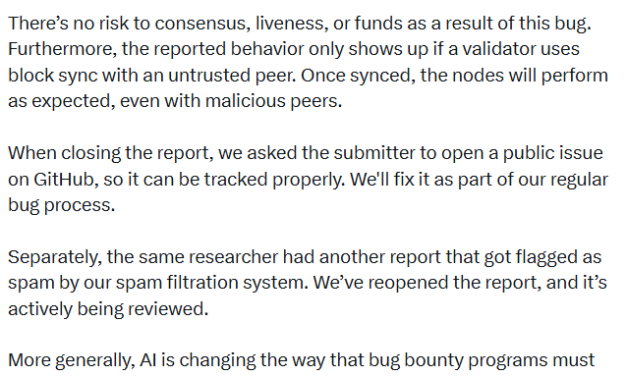
Crypto protocols have warned that an increase in AI use has led to a flood of bogus bug bounty submissions, putting a strain on teams trying to identify real threats to their protocols. Bug bounties are a system to reward “good” hackers for submitting reports about potential vulnerabilities and are popular in the crypto industry. AI has now made it easier to sift through large amounts of code to find possible bugs, though AI is also known to hallucinate. “AI is changing the way that bug bounty programs must operate,” said Barry Plunkett, co-CEO of Cosmos Labs, on Tuesday, responding to a bug bounty hunter who accused the protocol of ignoring their vulnerability report. Source: Barry Plunkett“Our program has seen a 900% increase in submission volume from last year, on the order of 20-50 per day,” he said, adding that it’s led to a huge increase in both valid and invalid reports. Kadan Stadelmann, a blockchain developer and chief technology officer at Komodo Platform, told Cointelegraph he has also seen a notable increase in bug bounty submissions and payouts across organizations. “There has definitely been an increase in low-quality bug bounty submissions, some of which have been false positives, potentially suggesting AI sourcing. One potential explanation is that AI has caused a decrease in the cost to produce a report, resulting in an influx of submissions.” In January, Daniel Stenberg, the creator of the open-source data transfer tool curl, which is used in many apps, including blockchain infrastructure, announced he was ending his bug bounty program because of an influx of “AI slop in vulnerability reports,” and he was exhausted from sifting through them.The creator of the open-source data transfer tool curl said he has received an influx of bug bounty submissions. Source: Daniel StenbergHackerOne, one of the largest bug bounty platforms in the world, reported in January that there were 85,000 valid bounty submissions in 2025, up 7% from the previous year.AI could be both the cause and the solutionPlunkett said Cosmos Labs has already started to adapt its approach as a result of the uptick in bug bounty submissions by tightening how it scores submissions, prioritizing trusted researchers with a proven track record and working with other bug bounty providers that offer more advanced triage.Meanwhile, Stadelmann said bug bounty programs have proven integral to defending decentralized systems, and adopting AI to assist in sifting through the noise could be a solution.“Blockchain teams will have to create AI deterrents to sift through incoming bug bounties. The smaller the team, the bigger the problem of increased bug bounties will become. Software engineers won’t have the capacity to examine everything,” he said.“This is where defensive AI systems to automatically sift through incoming bug bounties will be crucial. Teams dependent on bug bounties will need to develop stricter standards on their bug bounty programs as a means of lowering the number of incoming reports.”Related: Crypto hackers stole $17B over past 10 years: DefiLlamaCointelegraph is committed to independent, transparent journalism. This news article is produced in accordance with Cointelegraph’s Editorial Policy and aims to provide accurate and timely information. Readers are encouraged to verify information independently. Read our Editorial Policy https://cointelegraph.com/editorial-policy

Čítaj viac
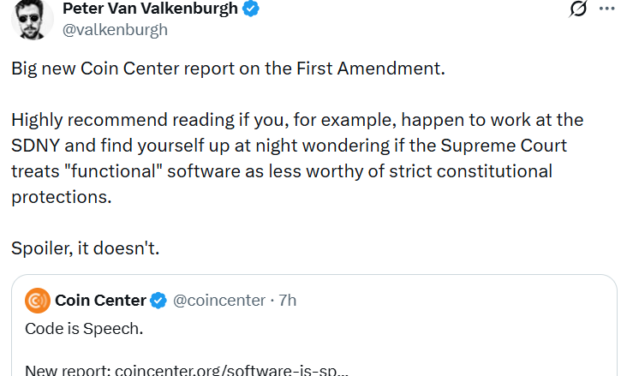
Code is ‘functional’ free speech under the First Amendment: Coin Center

Crypto lobby Coin Center expanded its argument that software code is free speech and should be protected under the First Amendment of the US Constitution, amid continued uncertainty over whether crypto developers are liable for how their inventions are used.In a report published Monday, Coin Center executive director Peter Van Valkenburgh and director of research Lizandro Pieper said writing and publishing crypto software code is the same as writing a book or publishing a recipe.The pair argued that the First Amendment, which protects individuals’ freedom of speech and expression, offers strict constitutional protection for developers who only publish and maintain software. “They are speakers and inventors, not agents, custodians, or fiduciaries. Extending pre-registration or licensing requirements to this speech activity drops the historical logic of financial oversight and imposes a classic prior restraint on activities that are primarily speech and expression—which is almost always unconstitutional,” they added.Source: Peter Van ValkenburghCrypto software developers have been seeking legal protections to shield themselves from criminal liability over the software they create. Last year also saw several high-profile convictions of crypto developers based on how their software was used, including the trial of Tornado Cash developer Roman Storm.Regulation applies when devs interact directly with usersVan Valkenburgh and Pieper said the paper is aimed at providing a framework for courts and regulators to distinguish between protected software publication and a developer’s professional conduct. They argued that a developer crosses into regulatable conduct when controlling user assets, executing transactions for users or making decisions on users’ behalf.“Lower court confusion over the distinction between conduct and speech naturally found in software publishing has fueled the development of what might be called a functional code theory of diminished First Amendment protection,” they said.Source: Neeraj Agrawal “Some courts have suggested that because software can be executed to produce real-world effects, it resembles conduct rather than speech,” Van Valkenburgh and Pieper added.“We argue that such activities are pure speech and that the Supreme Court’s existing jurisprudence insists on this interpretation even if some lower courts have gone astray.”The pair cited the 1985 case of Lowe v. SEC, in which the Supreme Court found that a publisher that does not hold assets on behalf of a client or take action on the client’s behalf is protected by free speech and does not count as practicing a regulated profession. Crypto developers can’t be used as scapegoatsIn some cases, crypto software has eliminated certain traditional middlemen, with self-custody and peer-to-peer transactions removing the need for a central authority to send funds or hold them. Traditionally, financial institutions acting on a user’s behalf as intermediaries are regulated by governments and required to hold licenses.Related: Coin Center urges Senate not to axe crypto developer protection billVan Valkenburgh and Pieper said that while it is challenging to build regulatory frameworks around new technology, declaring software developers to be middlemen for “administrative convenience” is not the answer either. “Crypto software does not necessitate the invention of new legal doctrines or novel carveouts. It requires the faithful application of settled First Amendment principles to a new technological context,” they added.“In the age of computers, where software is the primary means for expressing ideas and organizing economic life, those principles matter more, not less. Writing and publishing code is speech. And in a free society, speech cannot be licensed into silence.”Storm was convicted last year on charges of conspiracy to operate an unlicensed money-transmitting business, but his lawyers have been working on a motion to dismiss using the Supreme Court case, Cox Communications Inc. v. Sony Music Entertainment, to argue he had no intent to participate in the crimes of which he is accused The co-founders of privacy-focused Bitcoin wallet Samourai Wallet were also found guilty on the same charge and were sentenced to between four and five years in prison.Magazine: Will the CLARITY Act be good — or bad — for DeFi?Cointelegraph is committed to independent, transparent journalism. This news article is produced in accordance with Cointelegraph’s Editorial Policy and aims to provide accurate and timely information. Readers are encouraged to verify information independently. Read our Editorial Policy https://cointelegraph.com/editorial-policy

Čítaj viac

Získaj BONUS 8 € v Bitcoinoch

nakup bitcoin z karty

Registrácia Binance

Burza Binance

Aktuálne kurzy
