Autor Cointelegraph By Staff Writer

Argentines turn to Bitcoin amid inflation worries: Report

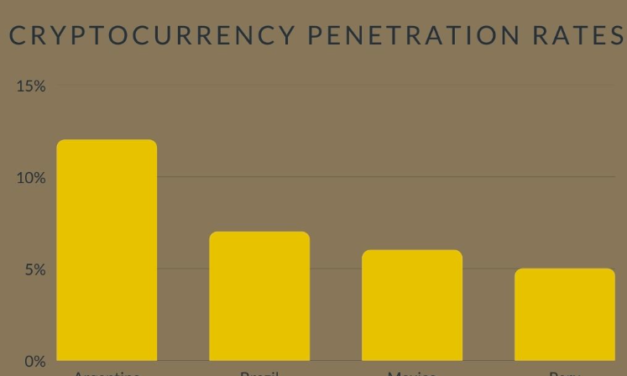
Since 2016, Argentina has been engaged in a war against inflation. Caused by multiple factors, like a lack of trust in the central bank or government overspending, the depreciation of the Argentinean peso has negatively impacted citizens’ purchasing power.This has brought 37.3% of the population under the poverty line, and many others have had their savings vanish into thin air. Against this backdrop, many Argentines have turned to Bitcoin (BTC) and crypto as a way to hedge against 60% inflation, despite the market being in the red for several months and the central bank forbidding financial institutions from operating with digital assets.Related: Argentina’s central bank steps in to block new crypto offerings from banksIn an Americas Market Intelligence report cited by Reuters, it was found that “crypto penetration” in Argentina had reached 12%, double that of Peru, Mexico and other countries in the region.Argentines appear to be adopting crypto at a faster pace due to inflation. Chart created via Canva.In addition to Bitcoin, Argentines have been turning to stablecoins increasingly as a means of storing value in the United States dollar, especially as their country imposes strict capital controls on foreign exchange services.When the creator of Ethereum, Vitalik Buterin, visited Argentina in December, he stated that cryptocurrency adoption in the country was on the rise and that stablecoin adoption was also growing significantly. He cautioned that this could change if the U.S. dollar began exhibiting serious problems. On a broader scale, Argentina appears to be taking a cautious approach to digital asset regulation. In a 2021 Youtube interview, Argentine President Alberto Fernandez said, “There’s a huge discussion about cryptocurrencies, it’s a global debate and I must confess it’s a matter of caution.” On a brighter note, he also stated that “crypto has an advantage” because “it helps contain inflation” and that, “in a sense, it’s a steady asset.”

Čítaj viac


Paraguay paves the way for crypto regulation despite internal opposition

Paraguay is viewed by many as a potential hot spot for cryptocurrency adoption due to low electricity costs and relatively soft taxation. The government has recognized this opportunity by pushing forward new legislation around digital assets. On May 25, a bill that regulates cryptocurrency trading, mining and custody was approved by the Paraguayan Congress in a vote of 40 to 12. The bill must now be ratified by the Senate to finally reach President Mario Abdo Benítez.Aprueban con modificaciones proyecto que regula la industria y comercialización de criptoactivoshttps://t.co/Z8kVoqVWWz@sebagar8 @DipNacBuzarquis @CelsoKennedy @tadeorojasm @bachinunez_nuez @luchozacariasAP @carlitosrejala pic.twitter.com/AlQ0Dh914S— Cámara de Diputados (@DiputadosPy) May 25, 2022If ratified, the bill would apply to any individual or organization in Paraguay involved in the mining, commercialization, trading, transfer, production, custody or administration of cryptocurrencies and related functions. The legislation proposes financial and legal guarantees to businesses and individuals, while also imposing restrictions on the matters of electricity spending and taxation. For example, a translation of article 11 of the bill states: “Crypto mining is recognized as an industrial and innovative activity. This activity will be a beneficiary of all mechanisms and incentives foreseen in the national legislation ”Regulations didn’t come without resistance, though; both the Paraguayan Central Bank and budget commission have expressed their disapproval of digital currencies, calling the movement a “high-risk project with no benefit for the state.” This statement was also accompanied by the usual suspicion that cryptocurrencies aid criminal enterprise and substantially increase electricity costs.Related: Latin America’s largest digital bank will allocate 1% to BTC, offer crypto investment servicesParaguay is one of several Latin American countries actively exploring the regulation of digital assets. El Salvador began the trend of legalization in June 2021 by recognizing Bitcoin (BTC) as legal tender. Other countries with ongoing crypto regulation discussions include Brazil, Argentina, Uruguay, and Panama.

Čítaj viac

Indie Russian news firm raises $250K in crypto after sanctions cripple finances

A Russian independent news company has raised more than US$250,000 in cryptocurrency donations from supporters in order to continue reporting independent news under a barrage of Russian government propaganda and censorship. Meduza, a Latvian-based Russian-language news site that claims to report on “the real Russia, today” has been asking for donations since March in the form of USD, euros and cryptocurrency, including Bitcoin (BTC), Ethereum (ETH), Binance (BNB), Tether (USDT), Monero (XMR) and zcash (ZEC).Since publishing their donations plea, the news company has received around US$250,000 in crypto donations through 146,000 individual transactions. Around 93% of the total donation amount came in the form of 3.75 BTC ($116,954) and 49.9 ETH ($117,767). Folks, Meduza has redesigned its crowdfunding after being disconnected from our supporters in Russia. We now turn to you—our global audience—to replace those 30k donators. Help us keep Russians & the world informed about the monstrous war against Ukraine. https://t.co/y83ieV9LuT— Meduza in English (@meduza_en) March 14, 2022Meduza’s money troubles actually began in April 2021, after it and several other independent media outlets got labelled by Russia’s Justice Ministry as “foreign agents,” requiring the company to place a large font warning in each of its Russian-language articles informing readers of its “foreign agent” status. The same warning also has to appear in all advertisements, leading to a loss of nearly all its advertisers. It wrote on its donations FAQ: “As you can imagine, few companies will pay to promote their products below a warning that the content was “created by foreign agents.”Being labelled as a foreign agent did not prevent readers in Russia from donating to the organization however, as the company promptly set up an avenue for contributors to provide regulator donations through their banks using payment processor Stripe. But in March, Meduza found itself pincered by both Russian government censorship and the impact of Western sanctions. Its website was blocked by Russian authorities for “disseminating information in violation of the law,” and its only avenue of receiving donations from Russian supporters blocked by a ban on the SWIFT network for Russian banks on February 26. SWIFT is a global financial messaging network used by financial institutions to execute international money transfers. Meduza wrote on its donation website that the financial restrictions had made it impossible for them to field donations from their supporters in Russia. Since February 25, the news organization and its journalists have been publishing daily updates on Russia’s war against Ukraine, sharing images and stories about Ukrainian civilians impacted by the war and other major events not reported by local Russian media. “Millions of people in Russia now rely on our reporting,” wrote Meduza, noting its journalists were forced to leave the country. “Since the outbreak of this war, transferring money from Russia to Europe has been impossible. We lost 30,000 donators. At the moment, we get no money from Russia at all.”Ivan Kolpakov, editor-in-chief of Meduza told Bloomberg the donations will help their 25 journalists, who have since fled the country to resettle in Riga, Latvia, where the company’s headquarters is located. Related: The Ukraine invasion shows why we need crypto regulationMeduza and its journalists are not the only unintentional victims of the Russian sanctions. Media reports over the months have pointed to everyday Russians, students studying abroad, international students in Russia, and even entire nations’ civilian populations as having been severely impacted by Russian-facing sanctions.

Čítaj viac

Nifty News: Solana NFT Okay Bears tops charts, South African wine NFTs rake it in and more

Okay Bears, a Solana-powered NFT, managed to top OpenSea’s 24-hour sales tracker for the first time earlier today, beating out all other Ethereum (ETH) projects on offer. It’s the first time a Solana (SOL) NFT project has reached the top spot in popular NFT marketplace OpenSea’s 24-hour sales tracker. .@okaybears No.1 on the OpenSea 24h rankingsA @solana project has topped OpenSea’s market-wide 24h sales tracker for the first time!Check out the latest featured Solana collections on our dedicated SOL page: https://t.co/gteXeNRocn pic.twitter.com/1duEDQyxyn— OpenSea (@opensea) April 27, 2022The Solana-based NFT, which features a collection of 10,000 diverse images of bears, told its Twitter followers it had sold out its collection only a day after its launch, bringing in 231,000 SOL, equivalent to $23.1 million in total sales to date at the time of writing, according to NFT tracker Cryptoslam. Sold out. We ARE Okay pic.twitter.com/QxuLpeY1Jt— Okay Bears (@okaybears) April 26, 2022

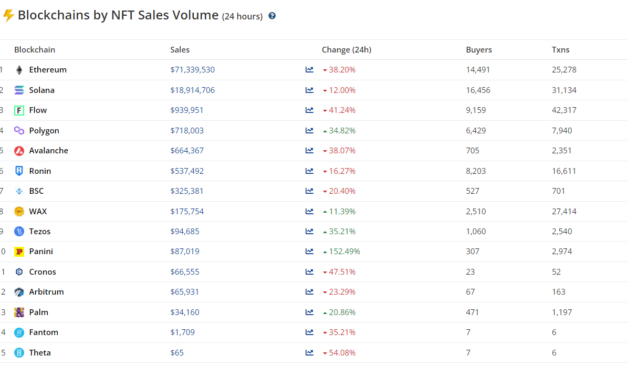
The Solana network has been gaining traction as a contender in the Ethereum-dominated NFT market. Today, it is the second most active blockchain by NFT sales volume over the last 24 hours.Source: CryptoslamFine wine NFTs auctioned in South African wine industry firstIn a first for South Africa’s fine wine industry, five of the country’s finest and historic wine collections have been auctioned off as NFTs, raising nearly 3 million RAND (US$186,800). The auction was undertaken through Strauss & Co, a fine art auctioneer and consultant, with several wine estates including Klein Constantia, Meerlust, Mullineux, Kanonkop and Vilafonté putting their collections under the gavel. Two of the lots were paid with Bitcoin (BTC) immediately after the sale. [embedded content]“It shows that collectors value the ability to own and trade fine wines through these new ownership certificates,” said Web3 company Fanfire’s CEO Gert-Jan Van Rooyen, the tech partner behind the auction. “We envision a future where collectors can hold an entire portfolio of wines from across the world in their crypto wallets.”Almost R2.4m already bid on Africa’s 1st 5 wine NFTs! So excited about this project. @FanfireWeb3 created a new type of “vault” NFT to hold individual bottles. One vault holds 288 bottles that can be traded as collection, or redeemed & traded individuallyhttps://t.co/FJcN37jpvp— G-J van Rooyen (@gvrooyen) April 25, 2022

Five NFT collections are outpacing the rest Bored Ape Yacht Club, Azuki, Clone X, Doodles and Moonbirds NFTs continue to hover as the top performers in terms of gains in the market, according to Twitter user NFTstatistics.eth, who operates under the Twitter handle @punk9059. This trend continues: BAYC, Azuki, CloneX, Doodles & now Moonbirds separating themselves from everyone else. I’ve talked about large-caps outperforming, but it’s really the top-5 projects driving all the gains. pic.twitter.com/UsUlwHMJ9M— NFTstatistics.eth (@punk9059) April 26, 2022

The Twitter user describes themselves as a keeper of NFT data, charts and thoughts, with 17,000 followers.The five NFTs are currently ranked within the top 12 NFT collections ranked in terms of sales, according to CryptoSlam. Other Nifty NewsApeCoin (APE) underwent a modest selloff earlier this week after it was reported Bored Ape Yacht Club (BAYC), a popular nonfungible token (NFT) brand, reported losing $2.4 million worth of digital collectibles in a robbery.A Chinese court has issued a one-of-a-kind judgment against an NFT marketplace for allowing a user to mint NFTs of stolen artwork. A user of NFTCN allegedly stole the copyrighted artwork of Ma Qianli, a Chinese painter and artist.

Čítaj viac

Hong Kong watchdog warns stablecoins could undermine HKD in CBDC paper

The Hong Kong Monetary Authority (HKMA) has warned that stablecoins could undermine the Hong Kong dollar in a just released discussion paper about its retail central bank digital currency, e-HKD. The HKMA today issued a discussion paper, outlining the policy and design issues involved in the introduction of e-HKD, and encourages the public and industry to participate in the consultation and share their views. Find out more: https://t.co/GndjuZ2Pay pic.twitter.com/hRz2noD0Ps— HKMA 香港金融管理局 (@hkmagovhk) April 27, 2022Many in the crypto industry believe that interest in developing central bank-issued digital currencies has been in response to the rise of private-sector stablecoins. This discussion paper appears to confirm that view.“With continued developments in stablecoins, it cannot be ruled out that a popular stablecoin may eventually emerge,” wrote the HKMA as part of the “e-HKD: A Policy and Design Perspective” discussion paper released on Wednesday.“In a scenario where the use of these stablecoins becomes widespread… the role of the domestic currency as the single unit of account could be undermined.”The authority also highlighted risks that such stablecoins could undermine payment integrity due to operational or financial failures, or allow for greater ease of capital flight during a financial crisis period, which would undermine the control of central banks over the local economy. The HKMA first announced its plans to study a retail-focused central bank issued digital currency in June 2021 as part of its “Fintec 2025” strategy, however, the authority has also been studying to merits of issuing a wholesale CBDC since 2017.Retail CBDCs are targeted toward the general public and used for everyday transactions. Wholesale CBDCs are issued only to financial institutions and are aimed at making their transactions faster, less expensive, and more secure. The monetary authority has made no commitment to introducing a digital currency, with the most recent discussion paper merely inviting industry leaders and consumers to provide additional feedback on potential challenges and benefits of the proposed rCBDC.It also asks for feedback on certain design considerations such as an appropriate rCBDC issuance mechanism, interoperability across large-value and retail payment systems, privacy and data protection, legal considerations, private sector participation, and potential use cases. Across the border in mainland China, the central bank-issued digital currency continues to pick up steam. Earlier this month, the People’s Bank of China (PBOC) said it will be expanding its digital yuan trial to six more cities, adding to the existing 10 major pilot cities already undergoing trials. Related: Fitting the bill: US Congress eyes e-cash as an alternative to CBDCMeanwhile, the Philippines government on Wednesday announced it will be pursuing its own pilot project for a wholesale central bank digital currency, called Project CBDCPh, which it envisions will be used for cross-border payments, equity securities payments, and intraday liquidity facilities (ILF).

Čítaj viac
  • 1
  • 2

Získaj BONUS 8 € v Bitcoinoch

nakup bitcoin z karty

Registrácia Binance

Burza Binance

Aktuálne kurzy