Autor Cointelegraph By Shiraz Jagati

Crypto volatility may soon recede despite high correlation with TradFi

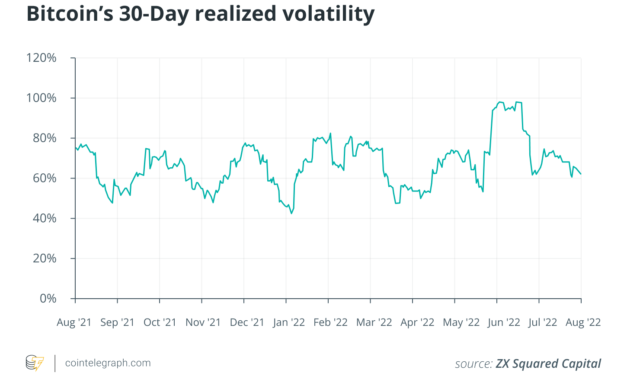
After forging a minor recovery of sorts earlier this month, the crypto market has returned to exhibiting high levels of volatility over the past two weeks. This trend has pervaded the market since late last year, with the total market capitalization of the digital asset industry having dipped from an all-time high of $3 trillion back in November 2021 to its current levels of $1.08 trillion, representing a drop of over 65%.This then begs the question: How long is this volatility going to last? Especially since the macroeconomic conditions surrounding the global finance sector have continued to deteriorate steadily since 2020 — i.e., following the start of the COVID-19 pandemic.In this regard, Abdul Gadit, chief financial officer of automated digital asset trading platform Zignaly, told Cointelegraph that whether one likes it or not, the crypto market is now deeply connected with the traditional finance (TradFi) economy, with the two now beginning to follow a similar trajectory. In his view, the reason for the ongoing choppy price action and lack of liquidity is extreme retail and institutional caution emanating from rising inflation and recessionary pressure. He went on to add that whenever things start to go south with the economy, investments — especially within the realm of crypto finance — tend to start slowing down. Gadit added:“Right now, global markets are in the middle of this bearish cycle with the crypto industry getting tighter in terms of its trading ranges. This price action can continue for weeks, if not months unless there is a macro environmental change. Chances of that are fairly low.”What lies ahead for the crypto market?Andrew Weiner, vice president of VIP services for cryptocurrency exchange MEXC Global, told Cointelegraph that even though the cryptocurrency market is closely correlated with United States equities, an industry that has remained quite stable over the last few months, there is still a lot of volatility due to growing action within the crypto derivatives segment. However, he said that the crucial narrative dictating the price action of the digital asset sector — at least for now — is the Ethereum 2.0 Merge, adding:“After the recent discussions surrounding the Merge, the market seems to have totally priced in its effects. If we look at things from a fundamental analysis view, the market has stopped bleeding and is getting ready to start recovering.”To support this claim, Weiner alluded to his company’s research data, which suggests that from Aug. 8 to 14 alone, a total of 19 projects within the Web3 space raised a total of $501.3 million.He pointed out that of this figure, the Metaverse, nonfungible tokens (NFTs) and GameFi projects raised $82, while decentralized finance (DeFi), Web3 and infrastructure projects raised a combined $379.3 million. Lastly, various blockchain firms were able to accrue approximately $40 million from various venture capital firms. “Fundraising events are actively going on, which is a good sign of the market,” he added.Recent: What the Taliban crackdown means for crypto’s future in AfghanistanCharmyn Ho, head of crypto insights for digital asset trading platform Bybit, explained to Cointelegraph that global markets are experiencing volatility, as investors seem to be on the fence following the Fed’s Jackson Hole speech. She noted that with equities riding many highs and lows over the past two weeks, the global economy’s near-term outlook remains quite obscure, especially as consumers, investors and policymakers can’t seem to agree on whether the U.S. is in a recession or if the Fed has inflation under control. Talking about the crypto market, in particular, she added:“The main event riding price action is Ethereum’s Merge. Some actors, mostly miners who won’t be able to continue their operations on the post-Merge chain, are planning to keep the proof-of-work Ethereum blockchain going through the hard fork. All this has the ability to impact short-term prices. With Ether being the second largest cryptocurrency in the space, its price movements certainly possess the capacity to move the crypto market.”Is the ongoing volatility going to subside anytime soon?Himran Zerhouni, head of business development for decentralized creator-oriented Web3 platform Favor Labs, told Cointelegraph that the ongoing turbulence is largely driven by macroeconomic factors, primarily high inflation in the U.S. and Europe and the risk of a looming global recession. Additionally, he believes that the digital asset market is also gripped by certain fears that have been provoked by the tightening of crypto regulation and the clear desire of world regulators to fully control the cash flows in cryptocurrencies. However, Zehrouni sees this trend potentially changing in the near-to-mid near term, adding:“Over the coming year or so, the regulatory turbulence around stablecoins will subside. I suppose clear legislation for stablecoin issuers in the United States will emerge. The growing interest of users in the advantages of web3 and decentralization will push entire industries to adopt digital assets. Lastly, the Bitcoin halving in 2024 will inevitably lead to a new bull cycle in the crypto market. I believe it will start somewhere in the second half of 2023.”Andrei Grachev, managing partner at DWF Labs — an early-stage blockchain investment firm — highlighted to Cointelegraph that crypto volatility has continued to subside, albeit slowly, in recent weeks, claiming that we are already at the downside of the current bear market cycle. That said, in his view, Bitcoin (BTC) could still go lower than its current levels, but its near-to-mid-term upside opportunity continues to remain extremely high. As per DWF Lab’s in-house research data, after hitting an all-time high of near $70,000 last November, BTC can potentially scale up to around the $80,000–$90,000 mark when the next bull cycle commences. However, he did concede that since crypto, by its very nature, is volatile, there is little to suggest that volatility levels will decrease in the immediate future. “This is mostly due to the size of the market, which is relatively small compared to other traditional industries,” he said.Technical data is giving mixed signals about Bitcoin’s futureAccording to CK Zheng, partner and chief investment officer for crypto hedge fund ZX Squared Capital, when examining Bitcoin’s 30-day realized volatility over the last twelve months, one can see that it has continued to range between 40% to 100%, staying at an average of around 70%. Realized volatility refers to the variation in returns associated, calculated by analyzing its historical returns within a defined time period.As seen from the chart below, volatility spiked right after Singapore-based crypto hedge fund Three Arrows Capital — which had about $10 billion in assets under management — filed for bankruptcy in late July. Zheng to Cointelegraph:“The current volatility is about 10% below the average. However, we believe the volatility will increase during the Sept-Oct time period to be above the average. This is mainly due to the market’s reaction to the Fed and a potential re-test of the June low.”Similarly, Weiner believes that with BTC having dropped below the $22,000 level but continuing to find strong support in that range, he sees the flagship crypto — as well as the market at large — forging a trend reversal and scaling up to around $25,000 to $26,000 by mid-September. Recent: Crypto market turmoil highlights risks of leverage in tradingLastly, Ho believes that the stabilization of digital asset prices in the near term is not immune to macro market uncertainty, but what is apparent is that, as the crypto market matures, investors and market makers can count on deeper liquidity, better trading and security infrastructure across the board and more stable crypto space. She stated that much of the turbulence experienced by the crypto market is due to the small market capitalization of the asset class, stating:“Bitcoin is the largest crypto asset and has a market cap of over $400 billion. This is very small compared to most mature markets. Take gold, for example, which has a market cap of $11.6 trillion. When the crypto market grows to that level, perhaps volatility will reduce drastically. For now, it is important to note that just like other markets, there will always be an array of factors that can contribute to market volatility.”Therefore, as we head into a future plagued by a growing amount of financial uncertainty, it will be interesting to see how the digital asset industry continues to react to the prevailing pressure and whether or not it can forge an uptrend anytime soon.

Čítaj viac


Blockchain audits: The steps to ensure a network is secure

The last few years have seen blockchain platforms becoming the centerpiece of many tech conversations across the globe. This is because the technology not only lies at the heart of almost all cryptocurrencies in existence today but also supports a range of independent applications. In this regard, it should be noted that the use of blockchain has permeated into a host of novel sectors, including banking, finance, supply chain management, healthcare and gaming, among many others. As a result of this growing popularity, discussions pertaining to blockchain audits have increased considerably, and rightly so. While blockchains allow for decentralized peer-to-peer transactions between individuals and companies, they are not immune to issues of hacking and third-party infiltration.Just a few months ago, miscreants were able to breach gaming-focused blockchain platform the Ronin Network, eventually making their way with over $600 million. Similarly, late last year, blockchain-based platform Poly Network fell victim to a hacking ploy that resulted in the ecosystem losing over $600 million worth of user assets.There are several common security issues associated with current blockchain networks.Blockchain’s existing security conundrumEven though blockchain tech is known for its high level of security and privacy, there have been quite a few cases where networks have contained loopholes and vulnerabilities related to insecure integrations and interactions with third-party applications and servers. Similarly, certain blockchains have also been found to suffer from functional issues, including vulnerabilities in their native smart contracts. To this point, sometimes smart contracts — pieces of self-executing code that run automatically when certain predefined conditions are satisfied — feature certain mistakes that make the platform vulnerable to hackers.Recent: Bitcoin and the banking system: Slammed doors and legacy flawsLastly, some platforms have applications running on them that haven’t undergone the necessary security assessments, making them potential points of failure that can compromise the security of the entire network at a later stage. Despite these glaring issues, many blockchain systems have yet to undergo a major security check or independent security audit. How are blockchain security audits conducted?Even though several automated audit protocols have emerged in the market in recent years, they are nowhere as efficient as security experts manually using the tools at their disposal in order to conduct a detailed audit of a blockchain network. Blockchain code audits run in a highly systematic fashion, such that each and every line of code contained in the system’s smart contracts can be duly verified and tested using a static code analysis program. Listed below are the key steps associated with the blockchain audit process.Establish the goal of the auditThere’s nothing worse than an ill-advised blockchain security audit since it can not only lead to a lot of confusion regarding the project’s inner workings but also be time and resource exhaustive. Therefore, to avoid being stuck with a lack of clear direction, it is best if companies clearly outline what they may be looking to achieve through their audit.As the name quite clearly implies, a security audit is meant to identify the key risks potentially affecting a system, network or tech stack. During this step of the process, developers usually narrow down their goals as to specificy which area of their platform they would like to assess with the most amount of stringency. Not only that, it is best for the auditor as well as the company in question to outline a clear plan of action that needs to be followed during the entirety of the operation. This can help prevent the security assessment from going astray and the best possible outcome emerging from the process.Identify the key components of the blockchain ecosystemOnce the core objectives of the audit have been set in stone, the next step is usually to identify the key components of the blockchain as well as its various data flow channels. During this phase, audit teams thoroughly analyze the platform’s native tech architecture and its associated use cases. When partaking in any smart contract analysis, auditors first analyze the system’s current source code version so as to ensure a high degree of transparency during the latter stages of the audit trail. This step also allows analysts to distinguish between the different versions of code that have already been audited as compared to any new changes that may have been made to it since the commencement of the process. Isolate key issuesIt is no secret that blockchain networks consist of nodes and application programming interfaces (APIs) connected to one another using private and public networks. Since these entities are responsible for carrying out data relays and other core transactions within the network, auditors tend to study them in great detail, carrying out a variety of tests to ensure that there are no digital leaks present anywhere in their respective frameworks. Threat modelingOne of the most important aspects of a thorough blockchain security assessment is threat modeling. In its most basic sense, threat modeling allows for potential problems — such as data spoofing and data tampering — to be unearthed more easily and precisely. It can also help in the isolation of any potential denial-of-service attacks while also exposing any chances of data manipulation that may exist.Resolve of the issues in questionOnce a thorough breakdown of all the potential threats related to a particular blockchain network has been completed, the auditors usually employ certain white hat (a la ethical) hacking techniques to exploit the exposed vulnerabilities. This is done in order to assess their severity and potential long-term impacts on the system. Lastly, the auditors suggest remediation measures that can be employed by developers to better secure their systems from any potential threats.Blockchain audits are a must in today’s economic climateAs mentioned previously, most blockchain audits start by analyzing the platform’s basic architecture so as to identify and eliminate probable security breaches from the initial design itself. Following this, a review of the technology in play and its governance framework is carried out. Lastly, the auditors seek to identify issues related to smart contacts and apps and study the blockchain’s associated APIs and SDKs. Once all of these steps are concluded, a security rating is handed out to the company, signaling its market readiness.Recent: How blockchain technology is changing the way people investBlockchain security audits are of great importance to any project since it helps identify and weed out any security loopholes and unpatched vulnerabilities that may come to haunt the project at a later stage in its lifecycle.

Čítaj viac

Tornado Cash saga highlights legal issues affecting the crypto market

Things have not been looking too good for the crypto market in recent months, with the market seemingly being gripped by one piece of bad news after another. To this point, on Aug. 8, the United States Department of the Treasury’s Office of Foreign Assets Control (OFAC) issued legal sanctions against digital currency mixer Tornado Cash.As per the regulatory body, since the platform’s inception in 2019, it has been used for a host of illicit money laundering activities estimated to be worth $7 billion. Of this sum, it is estimated that $455 million was controlled by the notorious Lazarus Group, a North Korean state-sponsored hacking group. Additionally, Tornado Cash was also used to launder over $96 million of ill-gotten funds derived from June’s Harmony Bridge hack and $7.8 million from this month’s Nomad heist.Before proceeding any further, however, it would be best to understand what exactly a cryptocurrency mixer is. Simply put, it is an offering that helps obfuscate potentially identifiable or tainted cryptocurrency funds with others to erase any trails linked with the assets, thus making it impossible for anyone to trace the tokens back to their original source.Creator arrest leads to public outcryOn Aug. 12, Alexey Pertsev, the creator of Tornado Cash, was arrested by Dutch authorities. According to a press release issued by the financial crime authority of the Netherlands — the Fiscal Information and Investigation Service — the arrest was made based on Pertsev being involved in the “concealment of criminal financial flows and facilitating money laundering.”While Tornado Cash can potentially be used by bad actors to hide criminal proceeds, it can and is also be used to facilitate a wide array of legitimate activities. The Dutch police have yet to make it clear as to which exact rules Pertsev broke, even though different media outlets have speculated and offered varying explanations as to why he was arrested. The Tornado creator has yet to be charged with any wrongdoing.Following Pertsev’s detainment, a mass of protesters gathered in Amsterdam’s Dam Square on August 20 to voice their displeasure with the handling of the matter. And, while the demonstrators did not directly comment on the legal issues surrounding the arrest, they did claim that Pertsev’s arrest signaled a dark future for the fast-growing Web3 ecosystem. Not only that, but they also believe that it could have a chilling effect on the Netherlands’ existing blockchain ecosystem.Mark Smargon, CEO of decentralized payment network Fuse, told Cointelegraph that while he is very disappointed to see a developer being arrested for simply having written a piece of code, to avoid such scenarios in the future, crypto finance entities — especially those who see mainstream adoption on the horizon — should be willing to meet regulators halfway to mitigate existing security issues while ensuring people’s rights to individual privacy.However, Abraham Piha, CEO and co-founder of Web3-focused firm Tomi, told Cointelegraph that government sanctions like these are scary if one starts looking at them objectively:“Tornado existed only because most blockchains were not private enough. If successive updates of Ethereum or Bitcoin include protocol integrations like Mimblewimble, will the next step be to block them as well? This act is yet another reason to push for Web3, a free web, controlled by users and not by some big brother governments.”A spokesperson for crypto policy think tank Coin Centre noted that the nonprofit is considering taking the matter to court since it believes that the core argument prohibiting the platform from operating is unjustified. Not only that, but the independent body also believes that the Treasury’s actions may have exceeded its statutory authority.Was Tornado’s forced shutdown unconstitutional?In a recent interview with Bloomberg, Jesse Powell, CEO of digital-asset exchange Kraken, argued that the Treasury Department’s actions to shut the Tornado Cash could be “unconstitutional,” stating that people have a right to privacy and thus, it will be interesting to see if the regulatory body’s assertions can hold any sort of ground in a court of law. He further stated that the subsequent removal of Tornado’s native code repositories was a “totally unnecessary step.” Recent: Ethereum Merge prompts miners and mining pools to make a choiceFollowing the sanctions, USD Coin (USDC) stablecoin issuer Circle decided to block all Tornado Cash addresses, to which Powell reacted: “Having a digital currency that’s so controlled and able to be controlled by maybe unconstitutional government action is a little bit scary.”Kenny Li, co-founder and core developer for Manta Network — a privacy-preservation protocol — told Cointelegraph that the Treasury’s decision to sanction Tornado Cash is far-fetched and extreme even though in the past, certain individual crypto wallet addresses have been subject to the same treatment. But, in most cases, he said, there was a clear case of fraud, hacks or a Ponzi scheme:“In this case, smart contract addresses are being blacklisted. Smart contracts aren’t people. Not only that, but people forget that Tornado Cash is a protocol, not a person or an entity, which means it will continue to run regardless of the sanctions. It is time that we realize privacy and anonymity aren’t the same, and Web3 is all about privacy.”On the subject of people moving their USDC to other stablecoins following Circle’s decision to block Tornado Cash wallet addresses, Li noted that, unfortunately, there has been an increase in the number of platforms blacklisting wallet addresses maintained via Tornado Cash. He pointed out that the move was due to Circle’s status as a regulated platform, thus obliging it to comply with any sanctions issued by a government body whose jurisdiction it operates under. Lastly, he believes that Circle’s actions of blocking the movement of millions of dollars worth of USDC can potentially inhibit innovation within this space. Li concluded:“No one wants their funds to be blocked, especially for activities they aren’t involved in. That said, there’s no certainty that tomorrow Tether won’t block addresses that have touched Tornado Cash. Ultimately, this action from the Treasury will likely instigate a domino effect, most of which is yet to be felt.”Human rights violations brewing?One aspect of Pertsev’s detention that has drawn public attention is that since his arrest, he has reportedly been denied visits of any sort, including those from his wife, Ksenia Malik. In recent correspondence with Cointelegraph, Malik said, “He’s kept in prison as if he were a dangerous criminal,” despite simply “writing open source code.”With Dutch authorities continuing to bar any contact with the outside — not even “one short call” — several rallies are being organized to support him. Decentralized finance aggregator 1inch tweeted that the arrest stands to establish a dangerous precedent, one that could potentially “kill the entire open-source software segment” if developers are continued to be held accountable for any misuse that emanates as a result of the software they create.Decentralized finance aggregator 1inch tweeted that the arrest stands to establish a dangerous precedent, one that could potentially “kill the entire open-source software segment” if developers are continued to be held accountable for any misuse that emanates as a result of the software they create.1/ Is it really a crime to be an open-source #blockchain developer nowadays ⁉️Stand up for the right to build open-source software!Help Alex Pertsev get out of jail!Sign the petition: https://t.co/r5sdHaYKCN#FreeAlex #OpenSourceNotACrime #DeFiWhy is it important⤵️ pic.twitter.com/CqqD4Ds8AQ— 1inch Network (@1inch) August 18, 2022Despite the heartfelt sentiments of the open-source development community, it is pertinent to highlight a recent report from blockchain security platform SlowMist, which found that approximately 74% of all funds stolen from the Ethereum network over Q1 and Q2 of this year made their way to Tornado Cash, with researchers noting:“The platform accounts for most of the initial funding for these security incidents. There have also been reports of withdrawals from exchanges, trading platforms, and personal wallets to fund these security incidents.”Lastly, it should be noted that despite the outpouring of public support for Pertsev, his arrest hasn’t been entirely disapproved of by members of the global finance arena. For example, in a recent interview, venture capitalist Kevin O’Leary stated that platforms like Tornado Cash — which are advertised as “privacy tools” — have created a culture where it is fine to tinker around with federal regulations. Recent: Ethereum advances with standards for smart contract security auditsIn his view, Pertsev’s arrest was necessary and that it’s fine to have “sacrificed him” because it will, in his view, help introduce a high degree of stability within the market in the long run. Therefore, moving forward, it will be interesting to see how legal issues such as these continue to be dealt with by regulatory agencies across the globe.

Čítaj viac

Metaverse still not ready for virtual weddings and legal proceedings

As the global Web3 ecosystem continued to evolve at a staggering pace, so have the various use cases associated with this niche. In a striking new development, a high-ranking Singaporean government minister recently noted that legal marriage proceedings, court case disputes, and government services could one day be conducted using Metaverse platforms.While delivering a keynote address at Singapore’s TechLaw Fest 2022 late last month, the country’s second minister for law, Edwin Tong, was quoted as saying that he would not be surprised if, in the future, intimate events such as the solemnization of marriages as well as legal disputes “could take place within the Metaverse,” adding:“It would not be unthinkable that, besides registration of marriages, other government services can soon be accessed online via the Metaverse. There’s no reason why the same cannot be done for legal services. The pandemic has already shown us that even dispute resolution — once seen to be a physical, high-touch process […] can be held online.”Expounding on his stance, Tong used a hypothetical example of a dispute involving an accident on a construction site, which he believes could be viewed in a 3D environment using augmented reality technology, thus allowing for a better reimagining of the accident. “You can put yourself into the actual tunnel or the oil containment facility to look at the dispute,” he added.A hybrid outlook such as this, Tong believes, could make the dispute resolution process extremely convenient and efficient for governments across the planet. Could digital legal proceedings become the norm?According to Joseph Collement, general counsel for cryptocurrency exchange and wallet developer Bitcoin.com, dematerializing government services that require in-person attendance is the next, most coherent step for nations across the globe, especially as the world shifts from an analogous age to a digital one in this post-covid era. He added:“Nowadays, approximately one-third of legal agreements worldwide are signed electronically. Therefore, it comes as no surprise to see modern nations such as Singapore adopt all-inclusive technologies like the Metaverse for government services. The same thinking should apply to certain civil court cases, which are still subject to extreme delays due to backlogs. While justice is delayed, the involved parties often have to suffer.”A similar view is shared by Alexander Firsov, chief Web3.0 officer for Sensorium — an A.I.-driven Metaverse platform. He told Cointelegraph that as a space dedicated to bridging the gap between the real world and digital experiences, it’s only logical that the Metaverse will one day transform into a medium where legal proceedings can take place. In his view, by adopting immersive technologies, virtual legal proceedings won’t feel much different from real-life events. In fact, he believes the use of photorealistic avatars can bring a degree of humanization and presence that online meetings fail to meet. Lastly, Firsov noted that justice systems all over the world are notoriously slow, costly and the Metaverse can help address these inefficiencies, adding:“The Metaverse can have a positive impact when it comes to the work of law enforcement agencies and other legal entities on issues such as cooperation, record keeping, and data transmission, as it holds the ability to improve important processes through the use of emerging technologies such as blockchain.”Not everyone is sold on the ideaDimitry Mihaylov, A.I. scientist, UN expert contractor and associate professor at the National University of Singapore, told Cointelegraph that the first problem when talking about digitally facilitated legal proceedings is that of intellectual property (IP) based legislation — since geographical borders do not factor into proceedings taking place in the Metaverse, least as of yet. He explained:“When you get a patent, it’s valid only within a particular territory. Yet, with the Metaverse, it will be used by people worldwide. People can accidentally violate laws by using a patent in the Metaverse that is outside its area of legalization. Here’s where relevant authorities need to determine who owns the IP and under which court’s jurisdiction it falls.”The second issue, in his opinion, pertains to data collection and ownership. This is because mainstream tech conglomerates have for the longest time been abusing the data of their clients and, therefore, it will be important that regulations pertaining to the storing and use of legal data on the Metaverse are developed before any court proceedings can take place on it.Collement believes a physical courtroom presents features that cannot be replicated in the Metaverse. For example, the cross-examination of a witness in front of a jury to attack his credibility is an important strategy in certain cases. Even with advanced video-conferencing, some important cues and details from a witness examination can be missed by the jury. He added:“It is unclear to me that the Metaverse is ready to host trials. Uncertainty remains as to the enforceability of Metaverse-held judgments in countries that are a member of the Hague Convention but who have not yet issued any guidance or laws in regard to these virtual proceedings.”Furthermore, Mihaylov noted that the question of copyright is quite pertinent in this regard since it protects digital works across many countries. He explained that nowadays, companies like Google are extremely swift with their copyright actions and block any sites that infringe on their rights. “Copyright covers more than 100 countries, and it’s very close to the model that the Metaverse should use. But it has no applications yet, and no such precedents have arisen so far,” he added.Are the masses willing to accept court proceedings on the Metaverse?Mattan Erder, associate general counsel for public blockchain infrastructure provider Orbs, told Cointelegraph that as things stand, it is actually a question of whether people are truly willing to believe the outcome of what occurs on the Metaverse as being real, especially from a legal perspective. In his view, most individuals are quite detached from a reality where they can ever see trials deciding the future of an individual, adding:“I think we have some time before these things become real. However, the more people live their lives in the Metaverse, the closer we will get to a mental shift. There are a variety of elements that need more development before it will be really possible to have these types of core social institutions exist there.”In Erder’s opinion, the situation being discussed here is one that is usually dealt with by governments almost exclusively. Therefore, it makes sense for the masses not to get ahead of themselves in thinking that any of these changes are going to come in the near term. He believes that legal systems have a clear preference when it comes to wanting the physical presence of all those involved in a trial, adding:“Most people have the belief that being in the same room with someone, such as a witness, and looking them in the eyes, seeing their mannerisms, etc., is important in evaluating their credibility. Democracies grant defendants the right to directly confront the witnesses and the evidence against them, and litigants have the right to confront each other and the judge/jury.”Lastly, a key driver when it comes to people and governments getting onboard with Metaverse-based legal proceedings and marriages is their definition of reality. To this point, Erder thinks that as the Metaverse becomes an integral part of people’s lives, the things that happen there will start to matter to people. “The Metaverse will become a microcosm of human society where there will be a natural need for things like dispute resolution,” he concluded.The future looks “Metaverse ready”Similarly, quite recently, the South Korean government announced that it had been actively taking steps to bolster its Metaverse ambitions by setting aside $177 million from its coffers. The country is looking to devise a platform for its citizens that grants access to a wide array of government services in a completely digital fashion.Back in July, Metaverse infrastructure company Condense closed a seed funding round to continue the development of a 3D live streaming technology. The technology underlying the firm’s digital offering utilizes “cutting-edge computer vision, machine learning and proprietary streaming infrastructure to capture and embed a live 3D video (Video 3.0).” In the near term, the firm hopes to stream this unique live video experience into various Metaverse games and mobile applications, as well as other platforms that have been created using Unity or the Unreal Engine.Earlier this year, Metaverse platform Decentraland laid claim to the distinguished honor of hosting the world’s first wedding on the Metaverse, with the event being attended by a total of over 2,000 guests. The proceedings were administered and solemnized by the law firm Rose Law Group.

Čítaj viac

Crypto contagion deters investors in near term, but fundamentals stay strong

The past six-odd months have been nothing short of a financial soap opera for the cryptocurrency market, with more drama seemingly unfolding every other day. To this point, since the start of May, a growing number of major crypto entities have been tumbling like dominoes, with the trend likely to continue in the near term.The contagion, for the lack of a better word, was sparked by the collapse of the Terra ecosystem back in May, wherein the project’s associated digital currencies became worthless almost overnight. Following the event, crypto lending platform Celsius was faced with bankruptcy. Then Zipmex, a Singapore-based cryptocurrency exchange, froze all customer withdrawals, a move that was mirrored by crypto financial service provider Babel Finance late last month.It is worth noting that since December 2021, nearly $2 trillion have been wiped out from the digital asset industry. And, while markets across the board — including equities and commodities — have been severely affected by the prevailing macro-economic climate, the above-stated slew of collapses have definitely had a role to play in the ongoing crypto drain. To this point, Ben Caselin, head of research and strategy for crypto exchange AAX, told Cointelegraph:“The contagion has played a big part in the recent downturn, but we cannot ignore the wider market conditions and the change in fiscal policy as important factors playing into price. The situation concerning Celcius, Three Arrows Capital but also Terra is expressive of an over-leveraged system unable to withstand severe market stress. This should in the least serve as a wake up call for the industry.”He went on to add that increasing mass adoption of digital currencies in the future should be done by expanding the scope of crypto beyond its prevailing “sound money narrative.” Caselin highlighted that the market as a whole now needs to take into account and implement financial practices that are sound and sustainable in the long run.What do the recent insolvencies mean for the industry?Felix Xu, CEO of decentralized finance (DeFi) project Bella Protocol and co-founder of ZX Squared Capital, told Cointelegraph that the past month has been a “Lehman moment” of sorts for the crypto market. For the first time in history, this industry has witnessed the insolvency of major asset managers such as Celsius, Voyager and Babel Finance within a matter of months. According to his personal research data, while ailing projects like Voyager and Genesis collapsed due to the fact that they had the most exposure to Three Arrows Capital (3AC), the collapse of 3AC, Celsius and Babel Finance emanated due to rogue management practices associated with the assets of their users. Xu added:“I believe the first wave of forced liquidation and panic selling is now over. As asset managers and funds file for bankruptcies, their crypto collaterals will take a long time to be liquidated. On the other hand, DeFi lending platforms such as MakerDAO, Aave and Compound Finance performed well during this downturn, as they are over-collateralized with strict liquidation rules written into their smart contracts.”Going forward, he believes that the crypto market is likely to move in correlation with other asset classes including equities, with the industry potentially taking some time to rebuild its lost investor confidence. That said, in Xu’s opinion, what happened last month with the crypto market is nothing new when it comes to the traditional finance space. “We’ve seen it in the 2008 financial crisis and the 1997 Asian financial crisis,” he pointed out.Recent: Metaverse visionary Neal Stephenson is building a blockchain to uplift creatorsHatu Sheikh, co-founder of DAO Maker — a growth technologies provider for nascent and growing crypto startups — told Cointelegraph that the aftermath of this contagion has been strongly negative but not for the reason many people would imagine:“A key loss here is that many of the cenrtalized finance platforms that went bankrupt due to the contagion were active onramps to the industry. Their unsustainable and often deceptive means of attracting new industry participants brought millions of people to trickle deep into nonfungible tokens and DeFi.”In Sheikh’s view, while DeFi onboarding may come to a halt or at least slow down in the near term, many venture capital firms operating within his space have already raised billions and are thus capable of continuing to inject funds into many upcoming startups. “We’ll have a new roster of companies that’ll replace the lost ones’ role of being an onramp to the industry,” he said.Undisputed damaged to the market’s reputation Misha Lederman, director of communications for decentralized peer-to-peer and self-custody crypto wallet Klever, told Cointelegraph that the recent crash has definitely damaged the reputation of the industry but believes that the aforementioned insolvencies have helped cleanse the industry of bad players, adding:“This presents a huge opportunity for blockchain platforms and crypto communities with a responsibility-driven approach to innovation, in which user funds are protected at all costs. As an industry, we have to be better than the fiat debt system we aim to replace.”A similar opinion is shared by Shyla Bashyr, public relations and communications lead for UpLift DAO — a permissionless and decentralized platform for token sales and swaps — who told Cointelegraph that the industry has been hit hard and is currently shrouded with more negativity than ever before. However, she believes such scenarios are sometimes needed since they present new opportunities to build transparent products that provide additional insurance, hedging and security for peoples’ investments. Sheikh pointed out that while there’s rampant criticism that DeFi apps have lost billions, it is worth noting that the losses accumulated by CeFi lenders are notably higher:“The fact remains that the notable blue chips of DeFi have remained mostly unscathed, yet the losses in CeFi are from industry leaders. However, as crypto CeFi is a stepping stone in people’s journey to DeFi, the industry’s adoption will be steeply hurt in the short term.”He concluded that the “CeFi contagion” could eventually prove to be a powerful catalyst for the growth of its decentralized counterpart as well as a validation of crypto’s core use case, such as being self-sovereign wealth. The future may not be all badWhen asked about what lies ahead for the crypto market, Narek Gevorgyan, CEO at CoinStats, told Cointelegraph that despite the prevailing conditions, the market has already started showing promising signs of recovery, stating that institutional investors are back on the playing field and exchange inflows are on the rise. In this regard, banking titan Citigroup recently released a report stating that the market slide is now in recession, with researchers noting that the “acute deleveraging phase” that was recently in play has ended, especially given that a vast majority of large brokers and market makers in within the industry have come forth and disclosed their exposures. Not only that, the study also shows that stablecoin outflows have been stemmed while outflows from crypto exchange-traded funds (ETF) have also stabilized.Gevorgyan believes that the trust investors had built up over the last couple of years has been somewhat dissolved due to recent events. Nevertheless, the blockchain community is still better funded than at any point in its short history, with development most likely to continue. He then went on to add:“The Terra implosion triggered a meltdown that brought several CeDeFi platforms down with it. The community has become more aware of the shortcomings of the CeDeFi model. Overall, the string of insolvencies has provided the crypto market with a chance to start afresh, as DeFi2 and Web3 are continuing to become more significant. Maybe the Metaverse will take center stage in this new configuration.”CeFi vs DeFiSheikh believes that the best of CeFi has lost more than the worst of DeFi, highlighting that Bitcoin (BTC) has continued to remain one of the most liquid assets in the world. In his view, the next wave of retail adopters will have glaring references to the problem of skipping self-custody, thus paving the path for greater focus on decentralized apps, especially as the market continues to mature.On the other hand, Bashyr sees a lot of protected projects such as insurance protocols and hedged products flourishing from here on out. In her opinion, decentralized autonomous organizations (DAOs) will become more prominent and functional, providing real governance and allowing users to participate in instrumental decisions by voting on proposals that make a difference. Recent: Decentralized storage providers power the Web3 economy, but adoption still underwayLastly, in Xu’s opinion, the insolvencies have resulted in millions of users calling for regulations like those governing traditional finance within the global crypto economy so as to increase transparency on investment of user assets. Xu added that since DeFi benefits from no single point of control while offering full transparency and autonomous rules, it will eventually take over the crypto asset management business.Therefore, as we head into a future plagued by economic uncertainty, it will be interesting to see how the future of the crypto market plays out. This is because more and more people are continuing to look for ways to preserve their wealth — thanks, in large part, to the recession fears that are looming large on the horizon — and therefore consider crypto to be their way out of the madness.

Čítaj viac

Získaj BONUS 8 € v Bitcoinoch

nakup bitcoin z karty

Registrácia Binance

Burza Binance

Aktuálne kurzy