Autor Cointelegraph By Savannah Fortis

Three-quarters of institutions to use crypto in the three years: Ripple

A whopping 76% of surveyed financial institutions plan on using crypto within the next three years, according to the report. Ripple’s new report highlights trends in the adoption and utilization of emerging technologies like crypto and blockchain in enterprise and financial institutions. Both financial institutions and enterprises are understanding the benefits of internal crypto usage. The most common reason is that crypto gives more people access to more financial services, says 42% of financial institutions and 41% of enterprises.According to the survey, portfolio management and payments come forward as the most valuable additions to the enterprise world. Portfolio management is detailed as hedging against inflation, hedging against other asset types and asset appreciation. Participants said data security and quality are two major benefits of blockchain and crypto usage for payments.Related: A mandate for blockchain businesses is to rebuild global trustNonetheless, as this is an emerging technology, adoption is still an uphill battle for large institutions. According to the report, enterprises and financial institutions both find that a general lack of understanding is one of the biggest challenges. However, the report also stressed that the slow-moving process of regulations surrounding the industry stirs up hesitation from potential users. Regulations from countries across the globe have been in constant flux as officials rush to keep up with the fast-paced crypto scene.Recently, regulators in the United States came under scrutiny from the U.S. Congress for their “non-judicial actions” against crypto companies. The Securities and Exchange Commission (SEC) of the U.S. is in the throes of implementing effective crypto regulations for one of the industry’s most active regions.Related: Tech trade group calls for regulatory clarity, claiming crypto job losses threaten US interestsDespite setbacks in crypto-ed and murky regulations, the report still reveals the active interest of global institutions and central bank digital currencies (CBDCs). 34% of surveyed institutions say CBDCs will help with the “acceleration of digitization of finance” and give “greater access to credit for consumers and businesses.”From a global perspective the report analyzed regional nonfungible token (NFT) interest based on emotional vs functional benefits. Respondents in the Asia-Pacific region were three times more likely to purchase an NFT for sentimental or emotional reasons compared to other reasons. Of the eight NFT genres listed 55% said music-related NFT are of the most interest. Sustainability was also assessed, as it remains a hot topic both in and outside of the industry. According to Ripple’s data, over 75% of surveyed consumers prefer to buy sustainable cryptocurrencies. More than 20% claim they would only purchase “sustainable” crypto. 

Čítaj viac
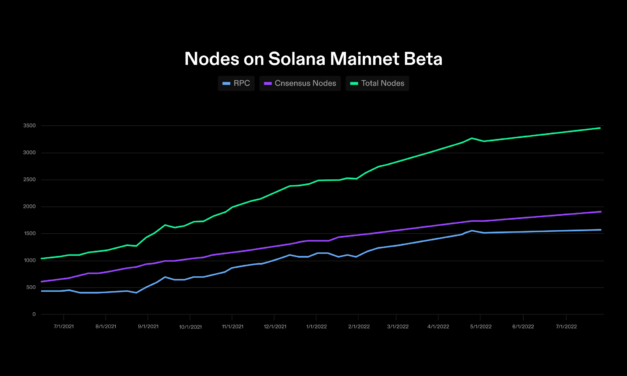

Over 1,900 block-producing nodes in the Solana ecosystem, new report reveals

Solana released its first-ever, “Validator Health Report” which revealed information on its network operators. According to the report the network has over 1,900 block-producing nodes with nearly 1,688 (88.14%) of those run by independent entities. Solana says the health and strength of its validators is critical to the long-term health of the ecosystem. Previously, the network has faced backlash for both a lack of decentralization and expensive validator hardware. Though this new report highlights the 3,400 validators across six different continents. 9/ Distribution across geographies is important. Resilient blockchains continue operating through all types of global events. Here’s how stake is distributed across the @Solana network, with a snapshot of Ethereum miner distribution for benchmarking. https://t.co/1jsylk9J3J pic.twitter.com/faepZ4RvYm— Solana Foundation (@SolanaFndn) August 10, 2022Moreover, the report shows how activity on the network has risen in the last year. On average the network has seen 95 new consensus nodes and 99 RPC nodes join every month since June of last year. Source: SolanaIt also stressed that the Nakamoto Coefficient on Solana, aka the amount of validator collusion needed to censor the network, is 31 — and growing. A chart published in the report showed Solana with the highest Nakmoto Coefficient compared to other networks such as Avalanche, Binance and Polygon. Nonetheless, this report comes in the aftermath of last week’s hack. Around $5.2 million in Solana (SOL) was hacked from 8,000 wallets including Phantom, Slope and Trust. The news shook the industry and users were urged to abandon their hot wallets for cold storage wallets for extra security, while being vigilant against scams. Related: Is your SOL safe? What we know about the Solana hack | The Market ReportInvestigations into the hack are currently ongoing. Some experts point to the Slope wallet as responsible for the compromise. Slope is a Web3 provider of a hot wallet for the Solana layer-1 (L1) blockchain. Reports say the compromised wallets were at one point, “​​created, imported or used” in the mobile application for Slope. Prior to the wallet hack, experts speculated a 40% price hike in SOL despite the bear market conditions. Shortly after the news broke of the hack the cryptocurrency had a price drop of nearly 8%, followed by a rebound of $40 per coin. At the time of writing, SOL hovers around $44 USD per coin.

Čítaj viac

Carbon credit NFTs are only effective if burned, experts say

Using nonfungible tokens (NFTs) as carbon credits, or carbon offsets, reveals an outlet for Web3 technology to foster a more environmentally friendly future.NFTs as carbon credits are a slow-rolling trend in the refinance market and decentralized finance (DeFi). Most of this activity currently takes place on the Polygon (MATIC) blockchain, as it has already offset its entire carbon footprint. However, the way these digital assets work with carbon credits differs from other ventures in the space. Rather than a store of wealth or a piece of unique digital art, carbon credit NFTs serve as a repository of information related to a specific batch of carbon offsets. This information could include, but is not limited to, the total number of offsets (i.e., how many metric tonnes), the vintage year of the removal, the project name, geographical location or the certification program utilized. Such NFTs are then fractionalized into Ethereum-based ERC-20 tokens, fungible with each other. However, unlike the majority of NFTs available to consumers, a properly functioning carbon credit NFT comes with a catch. In order for it to serve its true purpose, verifying and standing in for carbon emission offsets, it must be burned. In off-chain settings in the carbon market, this is called “retirement.”A core member of KlimaDAO, a decentralized organization, using DeFi to fight climate change, explained to Cointelegraph how this works both on- and off-chain. “Retirement means that someone is essentially taking that carbon offset, claiming it for its environmental benefit, meaning that they’re basically offsetting their emissions. Then that carbon offset is permanently taken out of circulation and can no longer be traded or sold to anyone else.” However, when it comes to retiring these carbon offsets in an on-chain setting, one must burn the token once the retirement certificate is obtained. In other words, it must be removed from the database and no longer available for trades. It’s very important that if there is any type of environmental claim being made regarding the offset being embedded in an NFT, that NFT is actually burned in some respect, and a specific entity or individual is named to claim that environmental incident.There are a large number of projects popping up in the space that claim to implement NFT technology for carbon offsets, including carbonABLE and MintCarbon. However, with a market value of over $850 billion, the carbon credit industry is not a small one. Like other profitable markets, it is susceptible to scams. As NFTs continue to rise in popularity, NFT scams become more prevalent. Related: Scams in GameFi: How to identify toxic NFT gaming projectsKlimaDAO stressed that projects that claim NFTs as carbon credits should also carry accreditation from internationally recognized standards. Principally, an endorsement from ICROA, or the International Carbon Reduction and Offset Alliance. If not, projects with this claim should be looked at carefully before investing under that pretext. Although the carbon credit market is valuable, the way it operates is still vunknown to the masses. “The thing is, you’re combining Web3 with a market that isn’t very well known. So, unfortunately, you do have various actors that are taking advantage of people.”Nonetheless, these carbon offset NFTs could be really useful if fully disclosed because they would be doing what they promise. These offsets provide an injection of capital from some other source to maintain and develop a project. This could range from renewable energy generation to forest protection or reforestation.

Čítaj viac

Web3 helps Taiwan secure information against cyberattacks

The Taiwanese Ministry of Digital Affairs (MODA) plans to implement decentralized technology into its web portal in an effort against cyberattacks. InterPlanetary File System (IPFS) is a Web3 technology that government officials will employ for decentralized file sharing. IPFS identifies content through file hashes, which allows files stored by multiple parties to be found anywhere and can be accessed by simple HTTP. This development comes after the controversial visit of United States House Speaker Nancy Pelosi to Taiwan, despite warnings from mainland China. Since the visit, government websites have faced multiple attacks sourced from the mainland. This includes a distributed denial-of-service (DDoS) attack rendering the sites inaccessible. Pelosi’s visit to Taiwan not only rocked the boat geopolitically speaking but also made waves in the crypto market. Bitcoin rose to its daily resistance of $23,500 on Aug. 3, the following day. Related: ‘Nobody is holding them back’ — North Korean cyber-attack threat risesHowever, the new MODA site is getting a makeover through the implementation of Web3 technology and currently has files and the original site index available on IPFS. Taiwan’s Digital Minister Audrey Tang told official state media that until now, the MODA site has not been attacked since it debuted on the same day the Chinese military began its drills. Tang said the site uses a combination of Web3 and Web2 tools. “It uses a Web3 structure, which is tied to the global blockchain community and the global Web2 backbone network. So if it can be taken down, everything from Ethereum to NFTs will be taken down, which is unlikely.”According to officials in Taipei, Taiwan saw nearly 5 million daily cyberattacks or at least scans for system vulnerabilities last year.The implementation of Web3 technology is a positive step toward emerging technology implementation. Though Tang did highlight the risks of other Web3 assets like crypto in activities such as money laundering. Related: Decentralized finance faces multiple barriers to mainstream adoptionTaiwan’s relationship with crypto ebbs and flows. Recently, the country indirectly banned buying cryptocurrencies with credit cards after the chief financial regulator compared cryptocurrencies to online gambling. Nonetheless, the country, like many others around the world, is piloting its own central bank digital currency (CBDC). Currently, it’s distributing its digital currency to five Taiwanese banks for distribution.

Čítaj viac

Nvidia ups its metaverse bet with new developer tools

Hardware maker Nvidia is ramping up its efforts to make a stand in the Metaverse. On Tuesday, the company revealed a new set of developer tools focused on metaverse environments, including new AI capabilities, simulations, and other creative assets. Creators utilizing the Omniverse Kit, along with apps such as Nucleus, Audio2Face and Machinima, will be able to access the new upgrades. Nvidia says one primary function of the tools will be to help enhance building “accurate digital twins and realistic avatars.”Quality of metaverse interaction is a hot topic in the industry, as developers and users ponder the quality of experiences over the quantity. One example of this could be seen during the first-ever metaverse fashion week, which happened in spring. Overwhelmingly stated in the feedback of the event was the lack of quality in the digital environments, garments, and particularly the avatars with which people interacted. The new Nvidia toolkit includes the Omniverse Avatar Cloud Engine (ACE). The developers claim  that ACE will improve building conditions of “virtual assistants and digital humans.”“With Omniverse ACE, developers can build, configure and deploy their avatar applications across nearly any engine, in any public or private cloud.”Digital identity is a key focus of the update in the Audio2Face application. The official statement from Nvidia says users can now direct the emotion of digital avatars over time, including full-face animation.[embedded content]It’s clear that engagement in the metaverse will continue to develop. In fact, the metaverse market share should surpass $50 billion in the next four years, signaling an increase in participation. Moreover, new events, workplaces, and even university classes are popping up in digital reality. Therefore, more users will seek to create digital versions of themselves. The development of technology to support mass metaverse adoption is crucial.Related: Digital identity in the Metaverse will be represented by avatars with utilityAnother addition to the Nvidia update includes Nvidia PhysX, which is an “advanced real-time engine for simulating realistic physics.” This means developers can include realistic reactions to metaverse interactions that obey the laws of physics. NVIDIA’s AI technology has been an important element in creating spaces for social interaction in the digital universe thus far. Even more so now, as it rolls out new applications for developers to enhance the metaverse.

Čítaj viac

Získaj BONUS 8 € v Bitcoinoch

nakup bitcoin z karty

Registrácia Binance

Burza Binance

Aktuálne kurzy