Autor Cointelegraph By Savannah Fortis

Binance assures users after 3rd-party glitch briefly halted withdrawals

Cryptocurrency exchange Binance announced a temporary freeze on withdrawals on Wednesday morning. The suspension took place across multiple networks as a result of a technical issue by a third-party provider, according to Binance. In a tweet, the exchange said the incident took place around 7:00 am UTC and was resolved by the team within an hour. Earlier today, around 07:00am UTC, #Binance temporarily closed withdrawals for multiple networks due to an issue with a third-party technical provider. Our team responded quickly, resolving the issue within 1-hour.Funds are SAFU. Thank you for your patience and understanding.— Binance (@binance) August 17, 2022Binance also assured users that despite the freeze, funds are “SAFU.” This acronym stands for the exchange’s monetary fund, Secure Asset Fund for Users (SAFU). The fund was created in 2018 by Binance to compensate customers in light of a hack on the exchange. It holds 10% of all trading fees. After questions about the fund from Twitter users, the exchange promptly clarified the purpose and its $1 billion value. Here’s everything you need to know about SAFU. https://t.co/umGZ0xv1rl pic.twitter.com/cq3TCPVBfm— Binance (@binance) August 17, 2022

This comes only days after Binance recovered and froze nearly $450,000 worth of the stolen assets from the Curve Finance hack. In June, Binance also halted Bitcoin (BTC) withdrawals due to major network congestion. Binance is the world’s largest crypto exchange and deals with nearly 3.224 million transactions per day. Volatile market conditions have caused major turbulence for crypto companies. The crypto exchange Celsius also halted withdrawals in June, though it cited market instability. Shortly after it declared bankruptcy. As a forewarning, Coinbase announced it will halt deposits and withdrawals of Ethereum (ETH) and ERC-20 tokens during the upcoming Ethereum Merge, scheduled to take place this September. Related: The worst places to keep your crypto wallet seed phraseMarket volatility has caused some hodlers to reexamine where they store their digital goods. Many are turning to hardware wallets as the answer. One Twitter user responded to Wednesda’s Binance freeze with:ANOTHER NEAR MISS…”Funds are SAFU” …. Until they are not …… how many warnings do people need?…NOT YOUR KEYS NOT YOUR COINS— HEX Ⓜ️achine Not in it for the tech. soz (@HexMachineV2b) August 17, 2022

According to a July report, the global hardware wallet market should outpace the global exchange market. It has an anticipated value of $1.1 billion by the year 2027, whereas the exchange market should reach a value of $675 million by 2028.

Čítaj viac


Troubled miner returns 26,000 rigs to eliminate debt

The United States-based Bitcoin mining company, Stronghold Digital Mining (SDIG), announced on Tuesday new moves to elevate outstanding debt and restructure its financial operations.In an agreement with lender New York Digital Investment Group (NYDIG), the company plans to release 26,000 of its mining rigs, 18,700 of which are currently running. The sell-off will create more liquidity and clear $67.4 million in debt held by Stronghold. Before the agreement, the company had $47 million in liquidity as of Aug. 12. After Stronghold returns 26,000 rigs, with a total hash rate of 2.5 EH/s, their operational fleet will be approximately 16,000 miners. Overall the hash rate capacity will be over 1.4 EH/s and a total power draw of 50-55 megawatts. The crypto market crash has played a significant role in the current difficulties for miners. In July, Bitcoin (BTC) mining revenue dropped to a one-year low at nearly $15 million. It was around this time other mining operations, such as Compass Mining, were also forced to sell rigs while facing bankruptcy. For the past three months, Bitcoin miners hodl-ed 27% less due to the need for major sell offs.Industry insiders refer to the bear market as a moment in crypto that will weed out operations that lack long-term sustainability while allowing others to restructure. Related: The best bear market plan? ‘Relentless optimism for the future,’ says fintech CEOStronghold’s restructuring and expansion also come with an agreement with WhiteHawk, which adds an additional $20 million available for borrowing. According to the official statement, the company will “ opportunistically” deploy the capital to purchase new miners.Greg Beard, co-chairman and chief executive officer of Stronghold, said the restructuring will provide, “significantly improved liquidity and flexibility to deploy capital opportunistically in a way that creates equity value through cycles in the Bitcoin and power market.” Despite the sell-offs, restructuring could be a move in the right direction as experts say there is still long-term profitability in crypto mining. After reaching its low in July, mining revenue reversed its trajectory with a 68.6% increase in August. Recently, a New York judge approved a request from the Celsius Network to include BTC mining in its refinancing efforts post-bankruptcy.

Čítaj viac

BNB Chain aims to raise 30K new Web3 developers across Latin America in 2022

BNB Chain, a blockchain network created by crypto exchange Binance, and Latin America-focused education platform Platzi announced that they will be launching a Web3 development course for the region.By the end of the year, the course aims to be accessible to 30,000 students. Gwendolyn Regina, investment director at BNB Chain, told Cointelegraph that this course focuses on growing the skills of developers.“This is going to be the major educational resource available in Spanish for Web2 developers to build on Web3 with BNB Chain.”This development is an effort to push wider adoption of blockchain technology and Web3 education in the region. Generally, the greatest barriers of entrance into the industry are accessibility and education, along with unclear regulations from local governments. Even among those who have already purchased crypto, the understanding of how the technology works is often misunderstood. According to a survey from the Motley Fool, nearly 10% of respondents who own crypto said they don’t understand how it actually works.Therefore, education is key. It’s even more important in regions like Latin America, where crypto has the potential to empower the local population outside of traditional, messy financial institutions. Regina told Cointelegraph: “If we increase the accessibility to resources to build Web3 tools on BNB Chain, we can significantly support the development of the region.”In El Salvador, the first country to make Bitcoin legal tender, efforts to educate the general public on crypto are underway. The country introduced a grassroots diploma program called Mi Primer Bitcoin, or “My First Bitcoin,” which aims to increase crypto literacy among young people.To encourage participation in the new BNB Chain course, those attending the BNB Chain Developer Camp this September in Bogota, Colombia, will have a chance at a limited number of scholarships for the new online course. Related: Decentralized finance may be the future, but education is still lackingLatin America is a growing hub for innovation and adoption of crypto and Web3 developments. Earlier this month, Binance and Mastercard released prepaid crypto cards in Argentina. “Latin America needs to balance the retail experience with the building potential. There’s a big community that knows about crypto and its utility by daily experience,” says Regina.

Čítaj viac

Huobi Global suspends derivative trading in New Zealand

Crypto exchange Huobi Global announced the suspension of derivatives trading in New Zealand. The statement from Huobi said the new restrictions against derivative offers are in light of compliance with local regulations. Users in New Zealand will no longer have access to derivative trading services, which include coin-margined futures and swaps, USDT-margined contracts, options and exchange-traded products (ETPs).The new restrictions will take effect on Aug. 23, 2022. On the same day, Huobi Global will no longer accept users with New Zealand Know Your Customer (KYC), along with IP addresses from the area. Users wishing to close out active positions can do so only on and after the effective date of the restrictions.Cointelegraph reached out to Huobi Global for a comment on the development.Huobi has a growing list of restricted countries, including 11 jurisdictions unable to access any of its services. Locations such as the United States, Canada and Japan fall into this category. At the same time, places like mainland China, Taiwan and the United Kingdom are unable to access derivative trading. Related: Uzbekistan blocks access to foreign crypto exchanges over unregistered tradingThis comes shortly after reports of Huobi co-founder Leon Li wanting to sell a majority stake in the company. The stake has a value of over $1 billion. Founded in 2013, Huobi Global handles more than $1 billion in volume of daily trades. Despite this development in New Zealand, the company has recently made moves toward expanding its offerings in other regions. In early August, Huobi received the green light from Australian regulators, a neighboring country of New Zealand, to be an exchange provider in the country.In the United States, Huobi secured its FinCEN license this past July. A subsidiary of the company called HBIT received its Money Services Business (MSB) license from the United States Financial Crimes Enforcement Network (FinCEN).All these developments come as Huobi launched a $1 billion investment initiative with a focus on decentralized finance (DeFi) and Web3 expansion.

Čítaj viac

Mailchimp bans crypto content creators without prior notice

The email marketing platform Mailchimp appears to have suspended its services to crypto content creators. Platforms associated with crypto news, content or related services started to have issues logging into accounts, followed by notices of service interruptions that began surfacing this week. Crypto-associated accounts such as the Edge wallet, a provider of self-custody crypto holding services, and Messari, a crypto research company, were among some of the affected. Early this morning, Sam Richards, at the Ethereum Foundation Tweeted that the Ethereum Foundation Ecosystem Support Program is likewise facing suspension. Add @Ethereum Foundation’s @EF_ESP to the list of customers @Mailchimp has rugged.Anyone have good recommendations for email subscription services with solid API integrations? Or any that don’t pull the plug on paying customers without any notification or justification? https://t.co/Cjg2kkqwoT— samrichards.eth (@samonchain) August 12, 2022Cory Klippsten of Swan Private, a Bitcoin investment advisory firm for corporations and high net worth individuals, also Tweeted about the incident. Klippensten called to other marketing agencies in the industry to “step up” in light of this incident and others. After Hubspot, Klaviyo, Twilio, and Mailchimp all getting taken bc of their crypto clients, it’s time for the entire marketing communications / CRM software industry to step up their security BIG time.And yes, we’ve been taking additional measures. See @skwp thread above.— Cory Klippsten (@coryklippsten) August 12, 2022

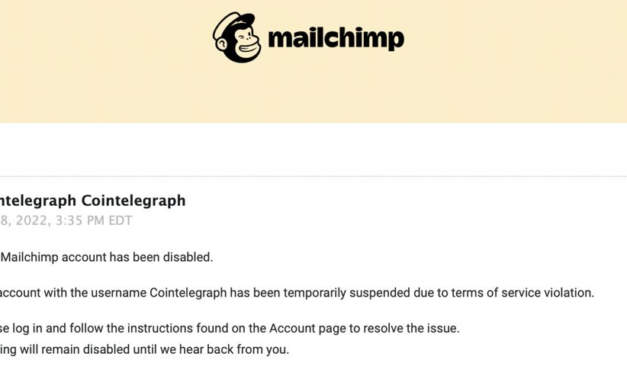
Indeed Mailchimp, the service previously used for the Cointelegraph newsletter, sent Cointelegraph a notice of service interruption this past Monday as well.Source: CointelegraphThough Mailchimp has responded in the time since Cointelegraph’s inquiry, no direct answer to our questions was provided. It later became clear that accounts were being disabled or “temporarily suspended” due to service violations. According to the Mailchimp website, the clause falls under the “Acceptable Use” policy where it outlines prohibited content. In this section, it states, “cryptocurrencies, virtual currencies, and any digital assets related to an Initial Coin Offering” are prohibited due to “higher-than-average abuse complaints.” The site policy claims to have been updated in May of last year.Last year the emailing marketing service provider was acquired by financial services giant Intuit. Instances of service disruptions or suspensions are surfacing again this week, though this is not the first time Mailchimp went after crypto-releated content. This type of behavior can be traced back to 2018. It was in 2018 when Facebook also banned any cryptocurrency-related advertisement on its site due to breeches in the regulatory guidelines.Related: Haters to unite at the first conference for crypto skepticsHowever, at that time the company made a public announcement that “cryptocurrency-related information isn’t necessarily prohibited” and can be distributed so long as the sender isn’t involved in, “the production, sale, exchange, storage, or marketing of cryptocurrencies.” There has yet to be an official statement from Mailchimp regarding the recent developments.  What was released on Wednesday, however, was a message from former CEO and co-founder of Mailchimp, Ben Chestnut. He announced that he is formally stepping down from the role after 21 years. In his place Mailchimp will be led by Rania Succar, formerly in charge of the QuickBooks Money team, also a part of Intuit. 

Čítaj viac

Získaj BONUS 8 € v Bitcoinoch

nakup bitcoin z karty

Registrácia Binance

Burza Binance

Aktuálne kurzy