Autor Cointelegraph By Savannah Fortis

MiCA coming in hot in October, NFTs not in focus: EU regulators

Members of the Germany-based Bundesblock, otherwise known as the German Blockchain Association, updated the community on the upcoming Markets in Crypto-Assets (MiCA) regulations in a virtual panel held on Thursday, Sep. 1.According to the panel, the final legal text for the long-awaited regulations is set to be released in the upcoming 4-6 weeks. However, nonfungible tokens (NFTs) and stablecoins are still not covered, while crypto asset service providers (CASPs) are discussed in scope.@bundesblock panel discussion of #MiCAR with @DrStefanBerger, @SchildtMoritz, @paddi_hansen, moderated by Alireza Siadat. Key take aways: final text of MiCAR available in 4-6 weeks, MiCAR fully applicable as of 2024, #NFTs & existing stable coins not covered but #CASP in scope. pic.twitter.com/18wQDn2n5o— Nina Siedler (@ninsie3) September 1, 2022Lawmakers in the European Union (EU) initially agreed on the MiCA terms, boasting of Europe being the first continent with decided crypto-asset regulations. The purpose of the law is to set specific guidelines for all EU member states on crypto regulation, as well as the licensing and operations of crypto companies. On June 30, lawmakers released the initial agreement which was quickly deemed by crypto-Twitter as “unworkable.”It included provisions such as established intervention powers of the European Securities and Market Authority (ESMA) and the European Bank Authority (EBA) over CASPs. This entails prohibiting or restricting any activity deemed a threat to investors, market integrity or financial stability.Stablecoins were of particular interest with a of 200 million euros in transactions per day and the need to have full backing reserves, among other things. Related: Talking with Eva Kaili, VP of the European Parliament, on MiCA regulationUntil now the final legal text has yet to be released, therefore the fine details of the MiCA are still on the table. Nonetheless the legislation known thus far has served as an example to lawmakers across the globe.The Bank of Korea said that MiCA provisions effectively protected EU users without too many limitations, which could hinder innovation.As the continent awaits the final verdict from regulators, additional crypto crackdowns are in sight. The European Securities and Markets Authority (ESMA) recently issued a statement that they are looking to collect more crypto data. Local authorities want “crypto off-chain data” or data involving crypto-related transactions outside of the blockchain.

Čítaj viac

DeFi can take a hint from traditional finance to lower risks, says ex-Morgan Stanley exec

The decentralized finance (DeFi) ecosystem scored another win against traditional finance, often called TradFi, with a former Morgan Stanley executive launching a DeFi protocol.Kevin Lepsoe, the former head of structuring for Morgan Stanley, aims to deliver an institutional fixed income scheme that offers fixed and floating rates with his new project named Infinity Exchange.According to Lepsoe, his new project will allow DeFi traders to “implement arbitrage, pull liquidity from other protocols and hedge their futures rates basis risk positions.” The DeFi market is known for its volatility and, therefore, risk in digital asset trades. Trading with more options enables one to hedge risk and speculate along the entire span of a maturity curve. With more investable asset options available to trade along the said curve, users can move from risky and riskless assets more easily. Lepsoe told Cointelegraph that introducing a crypto yield curve is important to the growth of DeFi trading because it lowers volatility. “If there was a crypto yield curve, a more robust suite of products around stablecoins and a way to unify both TradFi and DeFi rates, crypto volatility would be markedly lower.”This development sets the stage for institutional traders and investors to continue pouring into the space. According to a recent survey from Bitstamp, institutional interest is still high. 80% of polled institutional investors believe that crypto will overtake traditional investment forms in the next decade. Related: Where today’s DEXs are falling short, explainedLepsoe reiterated if the space wants more institutional investors to feel safer in the market, applying mechanics that already work within known markets is a place to start. “In TradFi, institutional investors are more active in the fixed income markets than they are in the equity markets,” Lepsoe said.The CEO highlighted that institutional adoption will follow if fixed income markets are a thing of the future for DeFi.

Čítaj viac

California State Assembly passes bill for licensing and regulating crypto firms

Lawmakers in California State Assembly 71-0 passed the Digital Financial Assets Law, also known as AB 2269, on Tuesday, Aug. 30. The bill is now in the hands of the state’s governor Gavin Newsom, who will either set it into motion or veto it completely. This bill requires digital asset exchanges and crypto companies to have an operating license given by the state of California’s Department of Financial Protection and Innovation. Any operations outside of said license will be prohibited. It would come into effect on and after Jan. 1, 2025.If not followed, perpetrators could receive a civil penalty up to $100,000 for each day of violation.Assemblyman Timothy Grayson (D-Concord), who sponsored the bill, previously stated he understands the excitement around cryptocurrencies and digital assets.“I’m impressed by the market’s ability to help consumers feel empowered to make financial investments and participate in a system that has, in many cases, felt closed off to them.”However Grayson also said the newness brings on risks due to inadequate regulation.“This bill will provide consumers basic but necessary protections and will promote a healthy cryptocurrency market by making it safer for everyone.”Currently, the law in place in the state of California is the Money Transmission Act. This act prohibits the business of money transmission without a valid license from the Commissioner of Financial Protection and Innovation.If introduced, the new bill would also authorize the department to conduct probes of a licensee, among other things.Related: California again allows crypto contributions to state, local political campaignsRegulators in California have been actively keeping tabs on the crypto space. In May, Newsom signed an executive order to align the federal and state regulatory framework for blockchain.Lawmakers in the state also told consumers to take “extreme caution” when dealing with interest-bearing crypto-asset accounts.This comes as a new CoinGecko survey reveals California to be the state most interested in Bitcoin (BTC) and Ether (ETH) based on internet search data.

Čítaj viac

NFT micro-philanthropy gives a new voice to the opera

The music industry has been a major adopter of Web3 integration, with use cases ranging from song rights, blockchain-based streaming and new forms of digital releases. Genres like pop, EDM and hip hop have represented nonfungible tokens (NFTs) in the music industry so far. However, classical music, and specifically opera, just found its entrance. Living Opera, a Web3 community that combines classical music with blockchain innovation, is turning to the emerging technology to give a new voice to the prestigious art and the artists who perform it. Soula Parassidis, CEO of Living Opera, told Cointelegraph in an interview that the premiere Magic Mozart NFT collection is a way of introducing the innovative world of fintech to the traditional one of classical music and vice versa. “We wanted it to be easy to understand, low risk, and a way for people to feel comfortable.”Parassidis explains that these NFTs pay tribute to the concept of the “musikalisches würfelspiele,” a dice game to randomly generate music from precomposed options. This is one of the earliest examples of generative art and is allegedly attributed to Mozart. Musicians have used NFTs for extra revenues and fan incentives, like Grimes’ $5.8 million digital asset project. For classical music, this could mean a completely new life and a step into relevancy for the next generation. A survey from the National Endowment for the Arts found that the percentage of adults in the United States who attend at least one opera a year dropped from an already low 3.2% in 2002 to 2.2% in 2017. The pandemic escalated this by shuttering classical venues and opera houses all over the world. One of the world’s premiere opera houses, the Metropolitan Opera, reported that in July 2021 it was down $25 million in revenue from the previous year. Related: Experts explain how music NFTs will enhance the connection between creators and fansChristos Makridis, COO of Living Opera, told Cointelegraph that NFTs open a new way for classical artists and opera singers to bypass the traditional proposal process for grants and endowments. “Blockchain-based digital assets remove traditional barriers, the proposals, artist grants, etc. so that artists can connect directly with philanthropists and remove a lot of that administrative expenses.”Makridis says that NFTs give artists in this genre access to “short-term liquidity” that never existed before.Some classical artists have dabbled in personal NFTs, such as New Zealand composer Matthew Thomas Soong or American composer poser Cristina Spinei.In 2021 the Dallas Symphony Orchestra was one of the earliest pioneers of classical music NFTs. The orchestra released an NFT as a fundraiser for musicians affected by the Met Opera’s pandemic-related paycheck suspension. The DAO-like structure of Living Opera opens up micro-philanthropy for artists involved and their projects. Parassidis highlighted the rarity of such innovation in a very traditional industry and called NFTs a catalyst for socio-cultural change. “They can be used as a mechanism to draw attention to voices, art forms, causes that really need more visibility.”Both Parassidis and Makridis say this technology can help excite young people to engage with the art form and allow long-term fans new engagement possibilities.

Čítaj viac

Eurozone hits record inflation of 9.1% amid gas and energy crisis

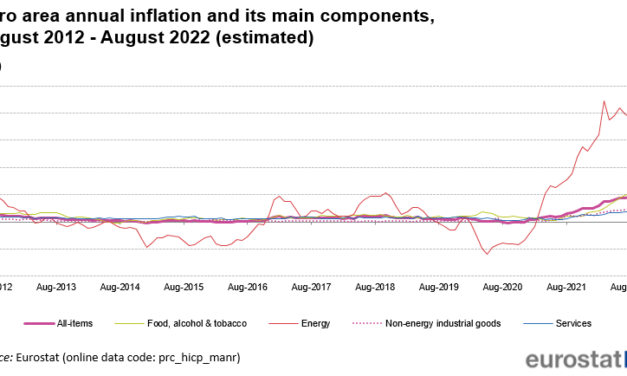
August marks the ninth consecutive month of rising inflation for the Eurozone at 9.1%. In July, the official inflation numbers landed at 8.9%. The Eurozone consists of 19 countries, including Germany, France and Belgium. This comes as the European Union (EU) faces a massive energy and gas crisis, largely as a result of the ongoing conflict in Ukraine. Current prices for daily necessities such as food, gas and electricity have soared across the continent. Over the last month, energy prices made up the largest price push, up by an annual rate of 38.3%, While food, alcohol and tobacco all rose by an annual rate of over 10%.Former EU member the United Kingdom also hit a 40-year-high inflation rate of 10.1% in July, as reported by the Organization of National Statistics (ONS).Eurozone countries Estonia and the Netherlands both experienced noticeable inflation spikes of 2% up from July. Related: How to preserve capital during inflation using cryptocurrencies?Florian Glatz, an EU-based lawyer specializing in blockchain technology, co-founder of the German Blockchain Association and member of the EU Crypto Initative, told Cointelegraph:“Europe is facing historic challenges, with inflation eroding away the economic security of middle and lower income households.”Moreover, Glatz believes the crypto industry has been warning global governments that current monetary and economic systems “don‘t hold up to the challenges” at hand. Among those who have already adopted crypto, it’s often seen as a hedge against inflation. Though, for this to work, the crypto community must continue to push for mass adoption and proper implementation. Glatz says the EU needs to become relevant in the digital economy to present a better value proposition for the financial future of its people. “We need a new deal for EU citizens that is powered by financial inclusion, opportunities in new digital markets and the desire to make Web3 the long-awaited Digital Revolution made in Europe.”This comes as the European Central Bank released its guidelines on licensing digital assets, such as cryptocurrencies, on Aug. 17. 

Čítaj viac

Získaj BONUS 8 € v Bitcoinoch

nakup bitcoin z karty

Registrácia Binance

Burza Binance

Aktuálne kurzy