Autor Cointelegraph By Savannah Fortis

Ecosystem is bullish on the Metaverse, no matter what the numbers imply

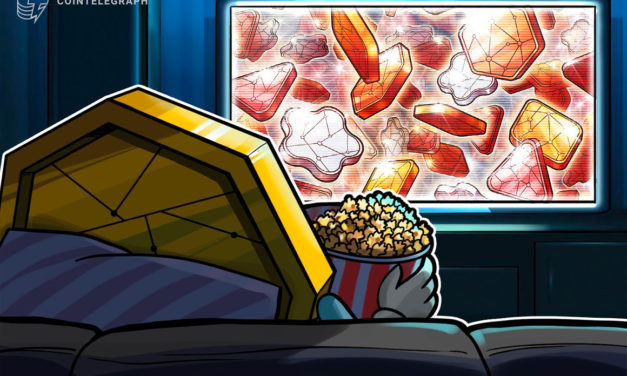
An initial interpretation of DappRadar numbers on Oct. 11 reported extremely low engagement numbers for Decentraland, one of Web3’s most-hyped metaverses. The numbers shocked the community, as the platform has a current market evaluation of $1.2 billion.Shortly after the initial report broke, both DappRadar and Decentraland verified that the published number of less than 40 unique active wallets (UAW) was not an accurate representation of activity on the network. According to DappRadar’s tracker at the time of writing, UAW is just over 600.A DappRadar report following the incident revealed that blockchain games and metaverse projects raised a cumulative $1.3 billion in the third fiscal quarter. However if user engagement is low, what keeps investors coming back for more metaverse? Cointelegraph spoke with Decentraland, DappRadar and prominent metaverse investor Animoca Brands, to better understand what it is about the metaverse that keeps investors coming back. Robert Hoogendoorn, the head of content at DappRadar, highlighted that despite the plummet in both crypto token prices and trading volume in U.S. dollars (USD) for metaverse land, the actual number of trades only dropped by 11%. “This shows there’s still strong demand,” he says. Hoogendoorn also reiterated that participation in the metaverse goes far beyond just logging in. It is also decentralized autonomous organizations (DAO) activity and development teams leveraging each other’s open source software. “It’s not a one-way stream from business to consumer, but a web of entangled stakeholders, builders, creators, users, investors, organizers and so on.”Sam Hamilton, the creative director of the Decentraland Foundation, said it is obvious that the space is still young. He continued to say that it “might be shocking” but numbers aren’t stopping anyone from joining in this creative climate. Hamilton understands that many dismiss the metaverse as nothing more than “pointless entertainment,” but in reality developers are creating something much larger. “When you spend your days building something as massive and impactful as the metaverse, it becomes very hard to be short-sighted and merely care about numbers.”Yat Siu, co-founder and executive chairman of Animoca Brands, said negative responses to important technological shifts are nothing new but expects to see them shift as the technology itself ripens. Related: Food companies secure trademarks to enter metaverseSiu stressed that from an operational perspective, the decentralized metaverse is a better business model which is easier to both obtain capital and offer cool opportunities to consumers. However, from a user perspective he said it is even more important because products and services offer empowerment as never before. Non-fungible ownership presents new benefits from digital goods and data to “give users a stake and a voice in the products and services that they use.”“Blockchain is not simply a technological change but also one that enables socio-political change.”Siu is previously quoted saying that he believes GameFi will be the onboarding point for users into the metaverse. While some on crypto Twitter questioned the value of the metaverse, developers and investors have shown no hesitation in building out a digital universe. New tools and events are constantly being deployed to make the metaverse a more tangible experience.

Čítaj viac
Women remain bullish on crypto investment despite market lull: Survey

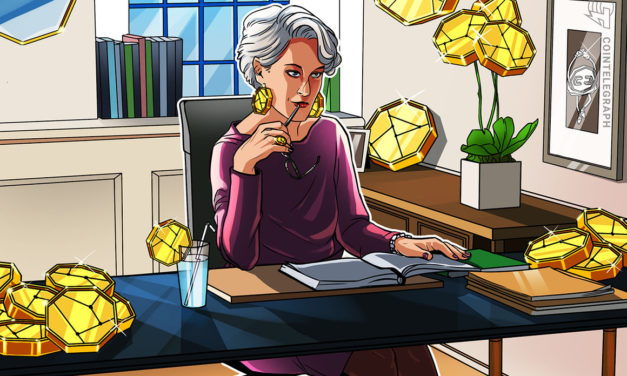
The crypto market downturn is proving a difficult storm to weather for both investors and businesses alike in the industry. However, according to new data, this hasn’t stopped women from being bullish on crypto.A new survey conducted by BlockFi, a crypto trading and investment platform, asked women across the United States about their views of and participation in the crypto industry between Sept. 2021 and Mar. 2022.According to the findings one in ten women chose crypto as their first investment, with 17% of that being Millennial women investors and 11% Gen Z. Findings even revealed that of the women surveyed 7% of Gen X, which includes individuals born between 1965-1980, reported crypto as their first investment.However, as past data has revealed, more education and clarity surrounding the space is needed to make investors feel secure and confident in their investment.The survey highlighted that while an overwhelming majority of surveyed women (81%) have heard of crypto, 77% still view it as a risky investment.Flori Marquez, the founder and chief operating officer of BlockFi, echoed the sentiment that education is key to bringing more women into the space:“Knowledge drives empowerment and confidence. “Despite the barriers, both market and education-wise, many women still see a place for themselves in the industry. Over one in five (22%) said they have the intention to buy crypto in the next year. 20% of Gen Z women called Bitcoin the “best long term investment” among others in a lineup of investment choices.Related: US lawmakers say crypto industry has a ‘tech bro’ problem hurting innovationData from the BlockFi survey showed that women are indeed here to hodl with 69% of female crypto owners saying they hold crypto and remain hold-only. Marquez says the current downturn of the crypto market is the perfect time to build on these communities of female hodlers. “The best building happens during bear markets. It’s imperative that we utilize this time to build products and communities that are inclusive to all investors.” Back in May of this year, billionaire Tim Draper insisted that the next bull market will be driven by adoption from women investors.

Čítaj viac

Rarible NFT marketplace adds Web3 aggregation with new version

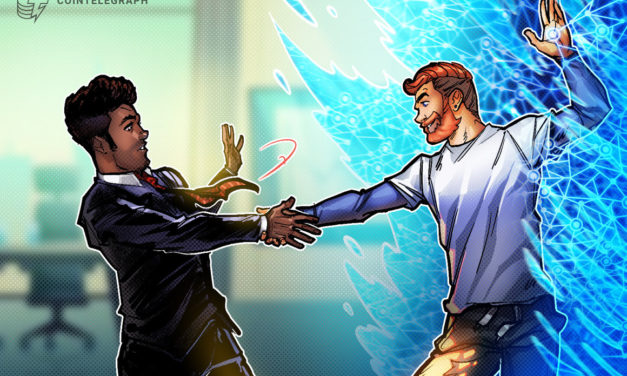
Rarible, the Ethereum-based nonfungible token (NFT) marketplace, announced its platform upgrade to Rarible 2 on Oct. 20.The NFT marketplace says it is introducing new aggregation tools to showcase NFTs from across the Web3 space. This means users can browse and purchase Ethereum-based digital assets from Rarible, OpenSea, LooksRare, X2Y2 and Sudoswap.Alex Salnikov, the chief strategy officer and co-founder of Rarible, told Cointelegraph that the NFT platforms we have now are “siloed,” and aggregation is the way to change that.“It creates an open environment where users can access the best prices for NFTs all through one interface.”This development from Rarible comes after a report from DappRadar, which hinted at impending NFT “marketplace wars.” DappRadar’s report highlighted other major platforms in the Web3 space such as Uniswap and OpenSea, both of which acquired NFT aggregator platforms this past year.While OpenSea and Uniswap acquired outside aggregators, Rarible simply transformed its services to an aggregation-based model. The report says that such acquisitions could stir up direct competition between platforms.Related: OpenSea to allow users to submit bulk NFT listings and purchasesRarible also introduced a mechanism in which users can lock up their $RARI, the native token of the marketplace, to earn rewards and incentives for ecosystem participation. Salnikov says this is a step towards further decentralization of the platform. “Users get to make decisions on where the ecosystem goes next. They have a say in Rarible’s future and that’s something you can’t get with just funds or an NFT.”Decentralization of NFT marketplaces is a relevant discussion within the Web3 community. Many on Twitter have been calling out market dominators like OpenSea for being too centralized.Opensea is way too CENTRALIZED https://t.co/HdAFlQ4EeW— Bruce (@Brucuuuueeeee) October 18, 2022While another user tweeted that centralized marketplaces like MagicEden and OpenSea have got to go:We allowed NFTs to become centralized, and ran into the same problems Bitcoin was created to solveNot your fault @MagicEden or @opensea but you’ve got to go. We appreciate your service. ERC721 is moving to Defi.— mylost.sol 《TYR》| tD | MonkeDAO Alpha Minter (@ChemixRx) October 18, 2022

Earlier this year the Rarible marketplace was saved by researchers from a potential major security breach.A vulnerability in the marketplace was identified by researchers at cyber security software company Check Point, which could’ve cost nearly two million active monthly users their NFTs in a single transaction.

Čítaj viac

Can NFTs democratize scheduled programming of TV in the Web3 era

Nonfungible tokens (NFTs) leave almost no part of the physical world untouched. From museums and major fashion brands like Gucci adopting the technology to digital items to musicians breaking archaic song rights distribution methods.Now even television, or in a streaming era — scheduled programming, is taking on NFTs as a means of crowdfunding programs. NFTV is streaming crypto-themed content but using NFTs as the backbone to crowdfund shows while providing viewers with some say in what’s on deck.Each program has a set of related NFTs, which give creators the reins of their projects, rather than giant media houses, while holders have the chance to contribute content.Greg Cipes, co-creator of NFTV, spoke with Cointelegraph to discuss the fine line between content democratization and an artist’s vision manifesting true to itself.Big names in the entertainment industry have joined the NFT craze, like Kim Kardashian, Snoop Dogg, Eminem and Matt Damon. When it comes to creative output, many artists have a specific vision for their content, especially industry veterans with a specific style or band.When NFTs come into the picture and give the community a say, Cipes said this can “absolutely” take away from creators, and a fine line must be walked.Related: The creator economy: How we arrived there, and why we need its Web3 upgradeHe related upcoming NFT-based streaming networks to operating like a pirate ship with the captain having the final say and all other decisions are democratic, such as featured characters.“Everyone has a role, responsibility and accountability to own. [And must] lead their respective team with creative freedom.”Cipes continued to highlight the added utility of NFTs in a television network setting as keys to extra network perks, like a subscription membership but with tangible abilities and ownership aspects.“Content is a great way to connect the concept of NFTs with a utility like entertainment.”NFTV will have content related to popular themes in the crypto community such as the Bored Ape Yacht Club and an NFT-world cartoon among others.One barrier is an accurate understanding of how NFT democratization works, even from those within the crypto space. Cipes says with this project and others, hands-on involvement helps increase overall understanding of technology.“People get projects more when they’re involved in media they enjoy consuming.”The crypto community itself also continues to push entertainment and mainstream projects, as they tend to be catalysts for both adoption and education on real-world utility.On Oct. 18, blockchain solution provider Ripple announced the second wave of $250 million in funding for its creator program to bring in entertainment and media-focused Web3.

Čítaj viac

Will museums of the future just be giant NFT galleries?

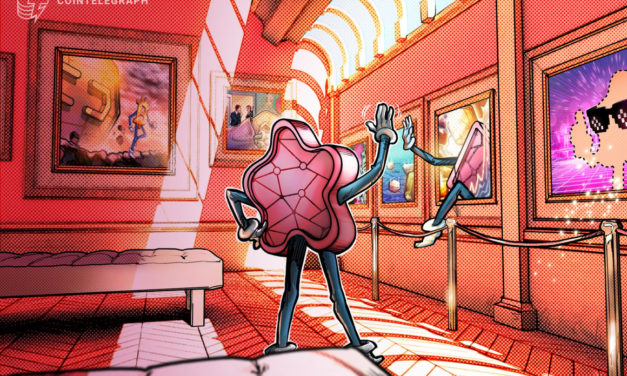
Museums, individuals and metaverse initiatives have used nonfungible tokens (NFTs) as a new means for reinventing themselves before their fans. The family of Frida Kahlo unveiled never-before-seen art and personal artifacts of the artist at an exclusive event in Decentraland for its art week in August.In Belgium, the Royal Museum of Fine Arts Antwerp became the first European museum to tokenize a classic art masterpiece worth millions of euros. The Kharkiv Art Museum in Ukraine launched a new NFT collection with Binance to preserve their cultural heritage and raise funds amid the ongoing regional conflict.However, as everything becomes tokenized, questions arise. Will museums in the future just be giant NFT galleries with every piece of art having a digital counterpart? How does ownership really work in such a scenario?Cointelegraph spoke with Hussein Hallak, founder and CEO of Momentable a company servicing museums to help with NFT integration, to understand what an NFT-ized future looks like for the art world.Related: NFT pics are the funhouse mirror high-end art deservesWhile digital art that is native to the Web3 space finds its place in virtual museums, traditional art and museums are taking on a layer of Web3. Thus, Hallak believes it’s “inevitable” for museums to eventually transform into a giant NFT gallery. “We believe everything will be an NFT, just like a serial number, for every product there will be an NFT.”According to Hallak, it’s just a matter of technology becoming easier to use in order to become ubiquitous. For now he predicts the most common use of NFTs by museums should be for proof and maintenance of items in their collections, second would be digital editions accessible to the public. “NFTs are an integral tech innovation museums can’t afford to ignore if they want to step into the future,” Hallak says. “But they needs to be part of a larger strategic modernization roadmap.”When asked if fractional ownership diminishes the value of physical precious heirlooms held by museums Hallak says it’s a fair question but the answer is no. Art just becomes more accessible. He relates it to the value increase of a private company going public:“Making art more accessible through fractionalized ownership or limited digital editions, will most likely drive interest, raise the appreciation of the art and artist and eventually increase its value.”Ownership that comes with fracationalization is key to Web3. It is one of the defining characteristics, which differentiates it from the internet known before. In the case of museums and the art up for NFT auction, is it really ownership if the art is still under some type of custodianship or is it perceived ownership? Hallak perceives NFTs as a tool for supporting public art rather than a transfer of custodianship. “A more likely [NFT] model is funding a public display of artworks and artifacts by creating several digital versions.”Over time NFTs will increasingly become an opportunity for museums to capitalize on their collections and curatorial prowess in a digitalize future, as seen with the aforementioned museum in Belgium. A recent report valued the NFT market to be worth nearly $231 billion by 2030.

Čítaj viac

Získaj BONUS 8 € v Bitcoinoch

nakup bitcoin z karty

Registrácia Binance

Burza Binance

Aktuálne kurzy