
Autor Cointelegraph By Sasha Shilina

How to convert your digital art into NFTs and sell it

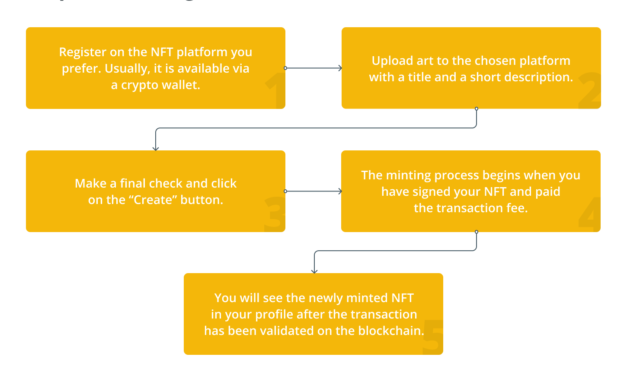
What is an NFT?NFTs are nonfungible tokens. The adjective “nonfungible” is often used in economics to represent features such as uniqueness and non-interchangeability. In the crypto space, nonfungibility simply indicates that one item cannot be exchanged for another. A “token” as a unit of account is basically a certificate of validity stored on the decentralized blockchain, making digital assets traceable and accessible to everyone. As a result, NFTs are a one-of-a-kind virtual currency that can fall into pretty much any category and usually take the shape of paintings, videos, music, collectible items in video games or any other type of creative digital production.Since NFTs boomed in early 2021, everyone is now buying and selling these tokens throughout the world. But, how can someone convert real art into NFTs and how can they sell them? Is it hard? Is coding necessary to make an NFT? In a nutshell, the steps are quite simple. To understand the main procedure and its specifics, read this quick guide below.What is crypto art?Art is the most common use case for NFTs, and it is no wonder that crypto art in NFT form has recently exploded in popularity. The fact that the novel blockchain technology creates conditions that now allow artists to earn tens of millions of dollars from their digital paintings attracted many creative people who could only dream about such a level of ease and accessibility before. Sensational high-profile auctions of NFTs linked to digital art have received considerable public attention. The most expensive sales hit the headlines as they fetched millions. In 2022, the most expensive NFT with a price of $91.8 million was “Merge” by pseudonymous digital artist Pak. In 2021, Everydays: the First 5000 Days NFT collection by artist Mike Winkelmann, known as Beeple, was another very expensive auction and was sold for $69.3 million.Crypto art is associated with unique art pieces created by well-known artists and sold on auctions on marketplaces that include not only popular NFT platforms but also traditional auction houses like Sotheby’s and Christie’s. Still, the majority of art in the crypto space is being created by unknown talented beginners.However, some NFT collections including the pioneer one named CryptoPunks or the most hyped recently named Bored Ape Yacht Club are examples of generative art. This type of art is usually created with the help of various autonomous systems. The images in these popular collections are created by assembling a selection of simple picture components in different combinations.Related: How to assess the value of an NFT?How to turn your art into an NFT?If you already wonder if you should convert your art into an NFT, the answer is obviously, “yes, why not try.” The process of creating an NFT is neither complex, costly nor technical. All it requires is a set of creative skills and a personal computer. Again, it is worth noting that NFTs can potentially convert not only images but songs, videos, GIFs and other digital items. So, first, you need to choose a proper art field which suits you best. Depending on this, you will understand what set of skills you will need to become a real NFT creator.For example, as a graphic artist, you will be required to use such graphic editing tools as Adobe Illustrator, Adobe Photoshop, MS Paint, CorelDraw and the like. You can also try alternative ways such as three-dimensional (3D) modeling which is known to be more difficult for beginners. If you choose 3D animation, you will be expected to use 3D modeling tools such as Blender or Cinema 4D to design animated graphics and characters that will then be converted into NFTs.After that, you will need to come up with a unique idea for your single artwork or maybe a full collection and think about the content into which it will eventually turn. Is coding necessary for NFTs?It is quite easy to create an NFT from digital art without coding. The process of creating them is called minting. It is basically the act of publishing a unique instance of the token on the blockchain. NFTs are minted once they are created, similar to how metal coins are created and added into circulation. After this procedure, the particular piece of digital art becomes secure and tamper-proof, as well as hard to manipulate. Since this digital item became an NFT, it can now be bought, sold and digitally tracked when it is resold or recollected. For artists, minting NFTs into digital art is the novel way to monetize their work fairly. On most NFT marketplaces, artists can program a royalty clause upon minting so that secondary sales of their works will generate passive income for them. If the demand for the artwork increases and becomes famous and raises in value, the artists can benefit from it.Minting is an automated process provided on most NFT marketplaces. To start it, you will need to take a few simple steps mentioned below: Still, you can try to code an NFT yourself if you are already experienced in this sphere and want to become an NFT developer. To dive deeply into NFT programming, you need to take in mind that the Ethereum network still has a monopoly on the development of NFTs. The usual coding language used for NFT development is Solidity, which has been designed for developing smart contracts that run on the Ethereum blockchain. Others are Javascript and HTML/CSS. Additionally, the InterPlanetary File System is usually used to store artists’ NFTs.Choosing the NFT marketplace to make and sell your NFTsAn essential part of the process of minting NFTs is choosing a proper NFT platform. The right choice depends on various factors like supported file format, crypto wallet matching, accessibility to the platform for users and a price to mint an NFT, or a transaction fee, which is a payment made to compensate for the computing energy required to process and validate transactions.There are a bunch of various online NFT marketplaces in the crypto space and each of them operates slightly differently. The crucial thing for artists is knowing whether the platform is curated or if it is self-service based and choosing the one which is the most suitable, visited and user-friendly for them.Self-service-based or non-curated NFT platforms provide free access to all artists. In order to upload NFTs onto them, you only need to register via crypto wallet and pay the transaction fee to mint an NFT. The most popular are such mass self-service NFT marketplaces as OpenSea and Rarible.Curated NFT platforms are more selective about artists. To register and start minting your art on these platforms, you will need to submit an application with all the details about the NFT collection and your previous artistic experience. Another visible disadvantage of curated NFT marketplaces is the long waiting period for the experts’ decision. Due to this stringent selection criteria, however, mostly top digital artworks are exhibited on such platforms so that buyers have more confidence in artists who collaborate with these platforms. Well-known curated platforms are SuperRare and Nifty Gateway, to name a few.Related: The NFT Marketplace: How to buy and sell nonfungible tokensSetting up a cryptocurrency walletA cryptocurrency wallet is a tool that you will need to access NFT platforms, sign transactions and manage your balances. Before setting it up, the most important thing is to make sure that the wallet matches the cryptocurrency used on the NFT platform you intend to use. Since most NFT marketplaces are Ethereum-based, they accept Ethereum’s native cryptocurrency Ether (ETH) as a payment. Therefore, it is necessary to have a crypto wallet with some ETH handy.There are plenty of crypto wallets with already millions of users. Many of them have diverse functionality and some of them have their own mobile applications and browser extensions for easy access to blockchain-based platforms.The choice of a suitable cryptocurrency wallet depends on what kind of safety you are willing to have. The main types of them include custodial, noncustodial and hardware wallets. A custodial wallet is also known as a hosted wallet since users’ funds are automatically stored in it by a third party, similar to how banks keep the money in checking and savings accounts. It is considered to be the most user-friendly and easy to set up. A noncustodial wallet gives users complete control of the security of their crypto and does not rely on a third party to keep funds safe. A hardware wallet, also known as a cold wallet, is a physical device that can keep users’ crypto offline and secure it even in the worst-case scenario when someone’s computer is hacked. How to sell digital art as NFTsNFT sale is likely to be the endpoint of your NFT minting. Most of the NFT platforms have a feature to choose a selling method or an option to set a price for your NFT while minting it. Fixed price sale and auction are currently the main two ways for selling NFTs. A fixed-price sale is considered to be the easiest way as well as pretty transparent and direct. To sell your freshly minted NFT this way, you will only need to specify the price at which you want to sell it. Some platforms also ask to set a royalty percentage, the amount you will receive in case of future sales of your art, so pay attention to that, too.Another way to sell your NFT is through an auction so that buyers can browse and bid on your digital art. Some auctions may be online-only, while others may end in a full-fledged live auction. There are usually two types of them. The first type is an English auction, an increasing price auction where the highest bid wins in the end. A timed auction is a specific form of English auction when an NFT can be bid over a defined period of time and at the end, the collector who has submitted the highest bid has won. The second type is a Dutch auction, a decreasing-price auction in which the price drops until someone buys your NFT. It is up to you which way of selling NFT to choose. Each way has their pros and cons, whether it is a possible lack of understanding the real value of your artwork when setting up a fixed price or dependence on time during sales through auctions.

Čítaj viac
What is Solana, and how does it work?

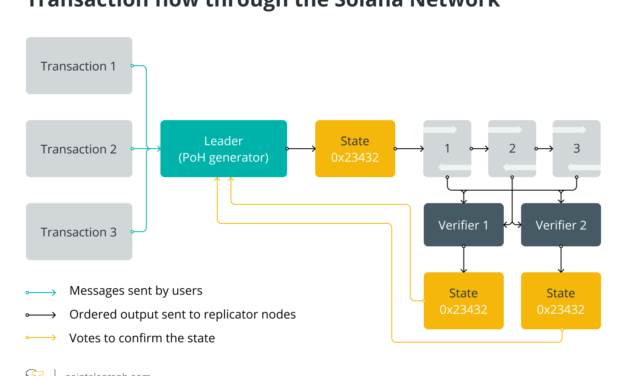
What is Solana?Solana is a highly functional open source project that implements a new, permissionless and high-speed layer-1 blockchain. Created in 2017 by Anatoly Yakovenko, a former executive at Qualcomm, Solana aims to scale throughput beyond what is typically achieved by popular blockchains while keeping costs low. Solana implements an innovative hybrid consensus model that combines a unique proof-of-history (PoH) algorithm with the lightning-fast synchronization engine, which is a version of proof-of-stake (PoS). Because of this, the Solana network can theoretically process over 710,000 transactions per second (TPS) without any scaling solutions needed. Solana’s third-generation blockchain architecture is designed to facilitate smart contracts and decentralized application (DApp) creation. The project supports an array of decentralized finance (DeFi) platforms as well as nonfungible token (NFT) marketplaces.Solana blockchain was rolled out during the 2017 initial coin offering (ICO) boom. The project’s internal testnet was released in 2018, followed by multiple testnet phases leading to the eventual official launch of the main network in 2020.What makes Solana unique?Solana’s ambitious design aims to solve the blockchain trilemma, a concept proposed by Ethereum creator Vitalik Buterin, in its unique way. This trilemma describes a set of three major challenges that developers face when building blockchains: decentralization, security and scalability. It is widely believed that blockchains are built in such a way that forces developers to sacrifice one of the aspects in favor of the other two, as they can only provide two of the three benefits at any given time.The Solana blockchain platform has proposed a hybrid consensus mechanism that compromises on decentralization to maximize speed. The innovative combination of PoS and PoH makes Solana a unique project in the blockchain industry.Generally, blockchains have greater scalability, depending on the number of transactions per second they can support, the more and better they scale. In decentralized blockchains, however, time discrepancies and higher throughput slow them down, meaning that more nodes verifying transactions and timestamps take more time.In a nutshell, Solana’s design solves this problem by having one leader node chosen based on the PoS mechanism that sequences messages between nodes. Thus, the Solana network benefits, reducing workload that results in increased throughput even without a centralized and exact time source. Also, Solana creates a chain of transactions by hashing the output of one transaction and using it as the input of the next transaction. This history of transactions gives a name to Solana’s main consensus mechanism: PoH, a concept that allows for greater scalability of the protocol which, in turn, boosts usability.How does Solana work?The core component of the Solana protocol is proof-of-history, a sequence of computations that provides a digital record that confirms that an event has occurred on the network at any point in time. It can be presented as a cryptographic clock that gives a timestamp to every transaction on the network, along with a data structure that can be a simple addition of it.PoH relies on PoS using the Tower Byzantine fault tolerance (BFT) algorithm, an optimized version of the practical Byzantine fault tolerance (pBFT) protocol. Solana uses it to reach a consensus. The Tower BFT keeps the network secure and running and acts as an additional tool to validate transactions. Moreover, PoH can be considered as a high-frequency Verifiable Delay Function (VDF), a triple function (setup, evaluation, verification) to produce unique and reliable output. VDF maintains order in the network by proving that block producers have waited enough time for the network to move forward. Solana uses a 256-bit secure hash algorithm (SHA-256), a set of proprietary cryptographic functions that output a 256-bit value. The network periodically samples the number and SHA-256 hashes, providing real-time data according to the set of hashes included on central processing units.Solana validators can use this sequence of hashes to record a specific piece of data that was created prior to the generation of a specific hash index. The timestamp for transactions is created after this particular piece of data is inserted. To achieve claimed huge numbers of TPS and block creation time, all nodes on the network must have cryptographic clocks to keep track of events rather than waiting for other validators to verify transactions.The Solana (SOL) tokenSolana’s cryptocurrency is SOL. It is Solana’s native and utility token that provides a means of transferring value as well as blockchain security through staking. SOL was launched in March 2020 and has strived to become one of the top 10 cryptocurrencies entering the space by means of total market capitalization.SOL token operation scheme is similar to that used in the Ethereum blockchain. Even though they function similarly, Solana token holders stake the token in order to validate transactions through the PoS consensus mechanism. Furthermore, the Solana token is used to receive rewards and pay transaction fees while also SOL enabling users to participate in governance.Related: Proof-of-stake vs. proof-of-work: Differences explainedAnswering the question of how many Solana coins are there, there will be more than 500 million tokens released in circulation with the current total supply of Solana exceeding 511 million tokens — Solana’s circulating supply is just over half that. Around 60% of SOL tokens are controlled by Solana’s founders and the Solana Foundation, with only 38% reserved for the community.If you would like to know where to buy Solana, SOL tokens can be purchased on most exchanges. The top cryptocurrency exchanges for trading in Solana are Binance, Coinbase, KuCoin, Huobi, FTX and others. Solana vs. EthereumSolana has received a lot of accolades for its speed and performance and has even been cited as a legitimate competitor of crypto industry leaders such as Ethereum.So, how is Solana different from Ethereum and can it be considered as a potential Ethereum killer? In terms of processing speed, Solana is able to challenge the dominant smart contract platform, as it is supposedly capable of reaching a speed of over 50,000 TPS. Solana uses different consensus algorithms to avoid slow transaction confirmation. This feature makes Solana one of the fastest blockchains in the industry to compete with other industries outside of the crypto space. Compared to this enormous number, the current low scalable Ethereum proof-of-work model can only handle 15 TPS. Thus, Solana is thousands of times faster than Ethereum. Another Solana advantage is the network’s extreme cost-effectiveness, as the project implements new tokenomics for lower fees.Related: What is Web 3.0: A beginner’s guide to the decentralized internet of the futureAlso, it is worth noting that Solana’s blockchain, while implementing one of the variations of PoS, is more eco-friendly and sustainable. This is in contrast with Ethereum, whose current PoW model requires the use of tremendous computational power. However, everyone in the crypto community is looking forward to the Ethereum upgrade to PoS. A new kind of Ethereum, which is being diligently developed, will consist of an execution layer (previously known as Ethereum 1.0) and a consensus layer (previously Ethereum 2.0). It could greatly increase throughput, improve scalability, lower transaction fees and stop unsustainable power consumption.The downsides of SolanaIf you’re still wondering if Solana is a good investment and whether you should buy it, the answer is still up to you. Despite the visible advantages, Solana has its demerits like any existing crypto project. First and foremost, although the Solana blockchain can compete with high-end blockchain projects, it is still vulnerable to centralization, as there are not many blockchain validators. Anyone on the network can become a Solana validator but doing so is still difficult because it requires a lot of computing resources.Along with this, the protocol still labels itself as a beta version of the mainnet, which does not negate the possible presence of bugs and errors.Despite these issues, Solana is still one of the biggest ecosystems in the crypto industry and seems to be on the right growth path.

Čítaj viac

Custodial vs non-custodial NFTs: Key differences

Nonfungible tokens can be minted, sold or bought on NFT trading platforms that are either custodial or non-custodial Today, the crypto space is filled with NFT platforms of all kinds such as mass and niche ones, self-service or invite-only platforms, gaming NFT platforms, sports or music NFT marketplaces and many others. All of them operate slightly differently, provide distinct functionality and offer various types of NFTs. The majority of NFT marketplaces are based on the Ethereum blockchain while others belong to blockchains like Binance Smart Chain (BSC), Polkadot, Solana and Cosmos, to name a few. Some marketplaces are custodial and some are non-custodial. It is worth noting that some types of NFTs may not get accepted on certain platforms, mostly custodial ones as they get to choose what comes in and what doesn’t. These platforms are curated and NFT content may be censored. At the same time, non-custodial marketplaces are more open to a variety of NFT types from art NFTs and virtual collectibles to music and fashion NFTs — it all boils down to the capabilities of the uses’ imagination. Custodial marketplaces act as a third party, as well as an escrow, for a sale by acting as a professional fiduciary for users’ conditional financial operations. By utilizing these marketplaces, users deposit their funds in the custody of the platform before digital assets are exchanged. This is the case for Binance NFT marketplace and Nifty Gateway platforms. On these platforms, interaction with other users is mediated by the marketplace that acts as an intermediary. Non-custodial marketplaces create a private connection directly between users, creators or sellers, and uphold autonomy and the anonymity of users, as there is no need for KYC checks. Platforms like OpenSea and SuperRare allow users to have access to others, all connected in a decentralized network to exchange NFTs without an intermediary.  Other differences between NFT marketplaces are based on various factors like if they support a definite file format whether it is a Joint Photographic Experts Group, a Graphics Interchange Format, a certain audio or video format. Other factors include the accessibility of the platform (self-service or invite-only) and the price to mint an NFT, as to mint an NFT, users usually have to pay for creating a smart contract through gas fees. Knowing the main variabilities between custodial and non-custodial NFTs is intended to help users to choose how they want to secure and manage their NFT portfolios.

Čítaj viac

Získaj BONUS 8 € v Bitcoinoch

nakup bitcoin z karty

Registrácia Binance

Burza Binance

Aktuálne kurzy

