Autor Cointelegraph By Sasha Shilina

What are dynamic NFTs?: Use cases and examples

There are lots of dynamic NFT examples in the cryptocurrency space, including gaming items that evolve as players progress and digital artworks that are transformed by the actions of collectors, time or even the surrounding environment. One of the first examples of dynamic NFTs was the unique work titled “Crossroad” by Mike Winkelman, also known as Beeple. The NFT was created before the 2020 United States presidential election and was supposed to change its appearance depending on the result. After Joe Biden became president, the image changed to depict former President Donald Trump lying in a heap.  In 2022, the most expensive experimental NFT art project titled Merge by the pseudonymous digital artist Pak sold nearly $92 million worth of “mass” tokens on the Nifty Gateway marketplace. The tokens are combined to form dynamic NFT collectibles that vary in part based on how many tokens were merged. The artwork is generated on-chain using a custom script, similar to the popular “Art Blocks” NFTs.  Art Blocks is a platform for creating and selling generative art pieces that are represented by dynamic nonfungible tokens. The art pieces are algorithmically generated and can be customized by the owner, creating a one-of-a-kind piece of art. Async Art is another platform for creating and collecting programmable art pieces that can change and evolve over time based on different external inputs or conditions. The art pieces are represented by dynamic NFTs, making them unique and valuable to collectors. Permissionless NFT marketplace Rarible also allows for the creation and sale of dynamic NFTs. One example of a dynamic NFT on Rarible is the “Crypto Warrior” series, which allows collectors to upgrade their nonfungible tokens with additional features and abilities over time. “Organic Growth Crystal Reef” are dynamic NFTs that evolved over time. Within a developer-set period of three months, the crystals grow in traits and transform their appearance based on transactions and time. Moreover, these crystals can be utilized in augmented reality (AR) and will soon have physical replicas showcased in art museums.  One more notable example of dynamic NFTs is LaMelo Ball’s dynamic NFT collectibles that are maintaining records of the professional basketball player’s game stats and change according to the updates in his points scored, rebounds and assists.  These are just a few examples of how dynamic NFTs that are being created in the cryptocurrency space are being implemented. As the phenomenon continues to evolve, we can expect to see even more innovative and creative use of them.

Čítaj viac
What is Humanode human-powered blockchain?

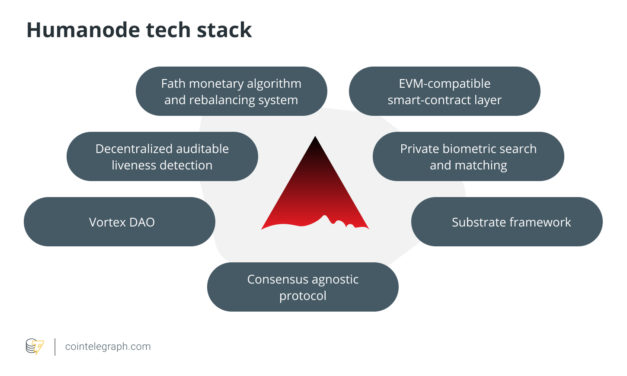
Humanode is a project that gracefully combines different technological stacks including blockchain and biometrics.  Humanode tech encompasses a bunch of layers such as a blockchain layer represented by a Substrate module: a biometric authorization module based on cryptographically secure neural networks for the private classification of three-dimensional (3D) templates of users’ faces, a private liveness detection mechanism for identifying real human beings, a Vortex decentralized autonomous organization (DAO) and a monetary algorithm named Fath, where monetary supply reacts to real value growth and emission is proportional. Let’s look at them in more detail. Substrate framework Humanode is a layer-1 blockchain whose architecture lies on the Substrate open-source framework that allows the quick development of highly customized blockchains. Substrate, the brainchild of the Parity team, provides interoperability within the Polkadot and Kusama ecosystems as well as an environment for the creation and deployment of general-purpose or specialized blockchain networks with remarkably varied parameters and sound capabilities. Being a Substrate-based chain, Humanode benefits from it and from the high throughput and scalability inherent to the Polkadot ecosystem.  Consensus agnostic protocol  One of the interesting features of Humanode is consensus agnosticism, which is the ability to change the network’s consensus mechanism if the Humanode DAO approves it. It derives from the necessity for constant research on the most suitable consensus for a leaderless system with equal validation power of nodes. Different consensus mechanisms have numerous pros and cons which constantly change. A swappable consensus mechanism allows the system to evolve and not be limited by a single unchangeable framework.  EVM-compatible smart-contract layer On top of that, Humanode is Ethereum-compatible. Due to an Ethereum Virtual Machine (EVM) pallet, Humanode can use existing Ethereum development tools and take advantage of smart contracts development, supported by several popular languages including Solidity and WebAssembly. On the other hand, Humanode can provide private biometric processing and Sybil-resistance to numerous Ethereum-based decentralized applications (DApps) including decentralized finance (DeFi) and play-to-earn (GameFi) projects, NFT solutions, DAOs, metaverses and others. Private biometric search and matching  As for Humanode’s biometrics stack, it seems like the privacy and security of biometric data have been among the most critical aspects of the project.  Due to the private classification of images of users’ faces, the system guarantees the images’ privacy, performing all operations without the users’ biometrics data having to leave the device. The only device needed to pass biometric authentication is a smartphone with a camera. Once users scan their faces, they become human nodes. The whole process is private and secure. All the Humanode system cares about is if the user is a unique human being, if they are registered and if they are alive.  Decentralized liveness detection A technique that ensures that the biometric sample is submitted from a real live person, a substantial security feature that mitigates the vulnerability of biometric systems to spoofing attacks, is called liveness detection. Biometric liveness refers to the use of computer vision technology to detect the actual presence of a living user rather than a representation such as a photograph or a mask, video or screen, a fake silicon fingerprint or other spoof artifacts.  Biometrics accuracy grew tremendously in the last decade. Currently, the possibility of a match between two different people is 1 to 125,000,000, and the possibility of spoofing an identity without a real human in front of the camera is 1 to 80,000. And, these numbers are constantly improving. For its first version of the crypto-biometric identification solution, which utilizes secure enclaves for some portions of the process, Humanode integrates FaceTec’s face biometrics and liveness detection. Humanode’s first testnet was launched in January 2021 and the official testnet 1 with liveness detection and the updated technical stack was launched in September 2021. Since then, there have been additional testnets deployed with more than 10,000 people becoming human nodes. Vortex DAO Currently, there are three types of nodes in the Humanode ecosystem. First, human nodes who have passed biometric authentication and received a fraction of the network transaction fees. Then, there are delegators: nodes that opt to delegate their voting power to so-called governors. Governors are nodes that participate in Humanode’s governance and must meet certain governing requirements.  Each of these node types forms an important part of Humanode’s governance DAO named Vortex. Unlike other projects, which allow nodes to accumulate voting power based on how much capital they have or delegate, the Humanode platform ensures that all nodes are equal in terms of validation and voting power, bringing true equality between peers in a decentralized environment. Fath monetary algorithm and rebalancing system Humanode implements the Fath hypothesis as the basis for the circulation of HMND Humanode token (HMND). Fath is a monetary algorithm with a proportional distribution of issued tokens. It is an alternative to modern fiat credit-cycle financial networks and capital-based public blockchains.

Čítaj viac

What is decentralized identity in blockchain?

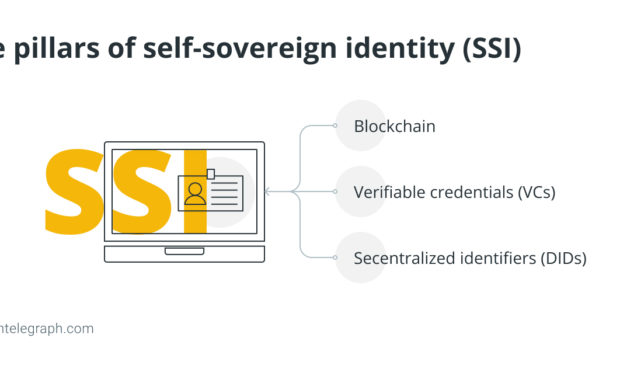
Self-sovereign identity is a concept that refers to the use of distributed databases to manage PII. The notion of self-sovereign identity (SSI) is core to the idea of decentralized identity. Instead of having a set of identities across multiple platforms or a single identity managed by a third party, SII users have digital wallets in which various credentials are stored and accessible through reliable applications. Experts distinguish three main components known as the three pillars of SSI: blockchain, verifiable credentials (VCs) and decentralized identifiers (DIDs). Blockchain is a decentralized digital database, a ledger of transactions duplicated and distributed among network computers that record information in a way that makes it difficult or impossible to change, hack or cheat. Second, there are VCs referred to as tamper-proof cryptographically-secured and verified credentials that implement SSI and protect users’ data. They can represent information found in paper credentials, such as a passport or license and digital credentials with no physical equivalent, such as, for instance, ownership of a bank account. And last but not least, SSI includes DIDs, a new type of identifier that enables users to have a cryptographically verifiable, decentralized digital identity. A DID refers to any subject like a person, organization, data model, abstract entity, et cetera, as determined by the controller of the DID. They are created by the user, owned by the user and independent of any organization. Designed to be decoupled from centralized registries, identity providers and certificate authorities, DIDs enable users to prove control over their digital identity without requiring permission from any third party. Alongside SII, which is rooted in blockchain, DIDs and VCs, decentralized identity architecture also embraces four more elements. They are a holder who creates a DID and receives the verifiable credential, an issuer that signs a verifiable credential with their private key and issues it to the holder, and a verifier that checks the credentials and can read the issuer’s public DID on the blockchain. Moreover, a decentralized identity architecture encompasses special decentralized identity wallets that fuel the whole system. How decentralized identity works The basis for decentralized identity management is the use of decentralized encrypted blockchain-based wallets. In a decentralized identity framework, users utilize decentralized identity wallets — special apps that allow them to create their decentralized identifiers, store their PII and manage their VCs —instead of keeping identity information on numerous websites controlled by intermediaries. Besides distributed architecture, these decentralized identity wallets are encrypted. Passwords to access them are replaced by non-phishable cryptographic keys that do not represent a single weakness in the case of a breach. A decentralized wallet generates a pair of cryptographic keys: public and private. The public key distinguishes a concrete wallet, while the private one, which is stored in the wallet, is needed during the authentication process. While decentralized identity wallets transparently authenticate users, they also protect users’ communications and data. Decentralized apps (DApps) store PII, verified identity details and the information needed to establish trust, prove eligibility or just complete a transaction. These wallets help users give and revoke access to identity information from a single source, making it faster and easier. On top of that, this information in the wallet is signed by multiple trusted parties to prove its accuracy. For example, digital identities can get approval from issuers such as universities, employers, or government structures. Using a decentralized identity wallet, users can present proof of their identity to any third party.

Čítaj viac

What is Bloktopia (BLOK) and how does it work?

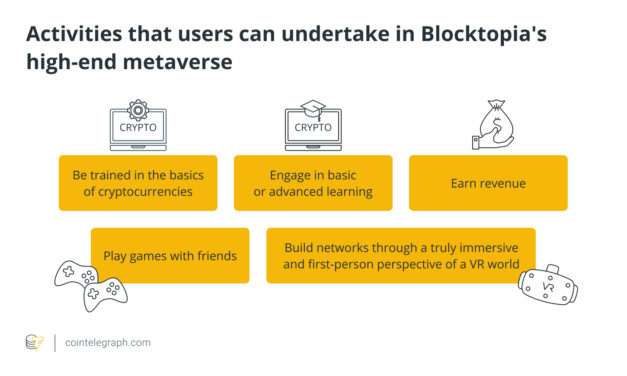
The Metaverse is a major buzzword in the worlds of crypto and technology, as well as in the art and gaming spaces. The term was coined in the early 1990s by American science fiction writer Neal Stephenson in his work Snow Crash. In this novel, he describes a virtual world in the imagined future where virtual reality (VR) goggle-wearing users inhabit three-dimensional (3D) avatars and buy and sell virtual real estate on a planet-encircling market.In a nutshell, the Metaverse concept refers to a persistent simulated online digital universe that combines multiple elements of technology, such as VR, augmented reality (AR), mixed reality (MR) and blockchain, along with social media concepts. Related: Augmented reality vs. virtual reality: Key differencesBasically, the decentralized Metaverse is a future iteration of the internet that creates environments that enrich users’ interaction by mimicking the real world. In metaverses, users can do work or shopping, play games, meet and socialize together and perform online most of the activities that they do in everyday life. Additionally, video games provide the closest metaverse experience to offer usually by creating virtual economies and hosting in-game events. What is Bloktopia?Bloktopia is a metaverse project that aims to be an educational and entertainment hub for all levels of crypto experience with information and immersive experience in one place. Built on top of the Polygon network and powered by the cross-platform game engine Unity, Bloktopia leverages the technology to create stunning visualizations and user experiences.The Bloktopia metaverse platform is designed as a decentralized VR skyscraper made of 21 floors. The number 21 was chosen not by chance but in honor of Bitcoin’s total supply of 21 million, programmed by its inventor Satoshi Nakamoto. Related: Can Bitcoin’s hard cap of 21 million be changed?The high-tech Bloktopia tower’s VR and AR technologies, alongside blockchain and crypto, all merge to create a decentralized environment for future entrepreneurs, investors, players and developers. Bloktopia metaverse’s economy is based on a dedicated nonfungible token (NFT) mechanism that allows its users, Bloktopians, to own and develop land as virtual real estate, with advertisements and events that create earning opportunities for visitors.The Bloktopia metaverse is like a giant shopping mall, where stores exist alongside other types of activities where blockchain and NFTs projects, exchanges, influencers and brands showcase their product. To sum up, Bloktopia is used for education, income, gaming, creativity and VR social experience.If you wonder who is behind Bloktopia, the answer is simple: experienced blockchain veterans who have been active in the tech, crypto and film spaces for decades. They are co-founder and CEO Ross Tavakoli, co-founder and chief marketing officer Paddy Carrol and chief technology officer Simon Benson.How does Bloktopia (BLOK) work?By providing a VR experience for the community of Bloktopians, Bloktopia users can engage in an immersive environment according to the project’s four core pillars: learn, earn, play and create. Generally, Bloktopia’s high-end metaverse allows visitors to: First of all, to engage with Bloktopia, users need to create avatars that spawn outside the Bloktopia 21-story skyscraper. Then, once users create their avatars, they enter the first level which is a first-class commercial space. There they can get information about cryptocurrency prices, contact support, use the navigation area and help desk, and see the agenda of the events and the summary of all events. Level one users are also able to participate in the events through registration.Basically, level one presents an overview of what’s going on in the Metaverse and is the area for crypto influencers for advertising. Bloktopia offers advertising boards named totems: 21 large and 84 small ones that are located on this floor and are considered to be excellent advertising opportunities.On floor six, users can find the Auditorium. This place hosts immersive and interactive video presentations from crypto influencers and constitutes part of the key events in the Bloktopia metaverse. Some crypto talks and presentations are promoted within this metaverse and users receive rewards for attending them.Another space is a penthouse and gaming section. This floor is created to refresh the mood of Bloktopians. In it, Bloktopians can play poker or some multiplayer games of chance. In addition to having fun, one of the benefits of playing them is the opportunity to win Bloktopia metaverse’s native tokens.Furthermore, besides prominent Bloktopia use cases such as access to educational and learning tools about crypto, virtual events and gatherings, Bloktopia users can unlock multiple streams of passive and active income, as well as staking. One of the monetization opportunities is an option to purchase real estate blocks in the form of NFTs, which can later be leased to advertising parties or used to host Bloktopian events. Tokens inside BloktopiaBloktopia’s native token is named BLOK. It is a utility token with which users can access exclusive events and buy things within the Bloktopia metaverse. In particular, BLOCK is required to purchase customized avatars or lease all virtual real estate within Bloktopia, making BLOK tokens valuable and necessary for the ecosystem to operate. For instance, it is used for upgrading real estate space or purchasing items from within the Bloktopia marketplace. BLOCK is an ERC-20 token that works on the Polygon network, a layer-2 scaling solution of Ethereum. It was launched in October 2021 and has a total emission of 200 billion BLOKs. All BLOK tokens from initial real estate purchases are publicity burned, decreasing the overall supply of the token. Bloktopians are able to buy and sell BLOK via decentralized exchanges (DEXs). BLOK is available to buy and sell on OKEx, KuCoin, Gate.io and QuickSwap, to name a few.BLOCK crypto tokens can be exchanged for other Bloktopia tokens: REBLOK tokens to buy or rent virtual real estate, ADBLOK tokens to buy or rent advertising space in the metaverse and BLOKG governance tokens that will become essential power of Bloktopia’s decentralized autonomous organization (DAO). Simply put, BLOCK tokens allow its holders to purchase NFTs, which represent ownership for REBLOK and ADBLOK and vote with BLOKG. What is the future of Bloktopia?Bloktopia metaverse is a nascent project that has already grabbed the attention of the crypto community due to its potential to become a disruptive informative hub of immersive entertainment and education. Bloktopia is a good crypto project that aims to be a formidable competitor in the global VR and AR and gaming markets, which are gradually moving to the next generation of gaming technologies. Examples of prominent metaverse projects such as Decentraland and The Sandbox already showed the community what they can bring. So, why invest in Bloktopia? The original idea and the scope of new technologies applied by Bloktopia are no doubt impressive. However, always consider the risks along with the benefits while investing in any project.

Čítaj viac

What is Vulcan Forged (PYR) and how to make money playing it?

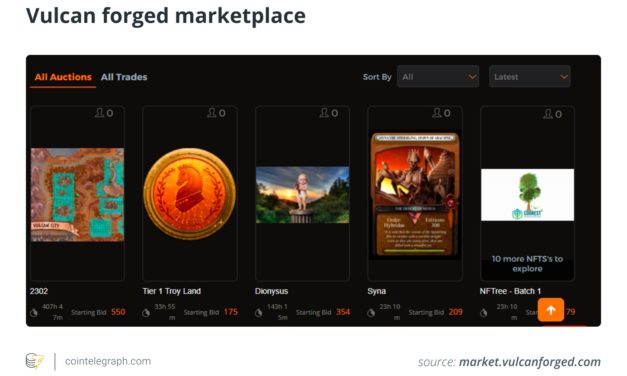
What is a play-to-earn crypto game?Distributed technologies including blockchain and nonfungible tokens (NFTs) enable game developers and gamers a more interactive, immersive and incentivized experience than ever before through the new game model advertised by tech enthusiasts and named the play-to-earn (P2E) crypto games model. P2E games, also known as blockchain-based or cryptocurrency games, gain significant attention from the gaming community and developers as they provide an opportunity to own data for in-game assets, fuel in-game economic systems and provide many other perks to facilitate the metaverse ecosystems. Related: My Neighbor Alice: A beginner’s guide to the play-to-earn crypto gameWith P2E games, players can own and trade various in-game inventory and objects such as characters, skins, weapons, virtual land and other digital accessories to achieve higher performance in the game as well as to receive financial rewards. Due to the P2E model, gamers are compensated for their skills, and developers and gaming projects have the potential to attract more players. P2E crypto games are a win-win phenomenon for emerging recently as a successful trend.What is Vulcan Forged?Designed as an easy-to-build and P2E ecosystem, Vulcan Forged incorporates a game studio dedicated to NFT games built on Ethereum, Polygon, and BNB Chain, as well as an NFT marketplace, launchpad, a decentralized exchange (DEX) called the VulcanDex, and a decentralized application (dApp) incubator that restlessly supports third-party game creators and procures NFT trading for its native Vulcan Forged ecosystem.Related: Polygon blockchain explained: A beginner’s guide to MATICSo far, the Vulcan Forged studio has created about a dozen video games, with each one allowing players to win, sell and upgrade their in-game items and NFTs to earn crypto. Among the series of games in the Vulcan Forged ecosystem, VulcanVerse is one of the most popular games.VulcanVerseVulcanVerse is the Vulcan Forged studio’s flagship product. It is a metaverse and a fantasy massively-multiplayer online role-playing game (MMORPG) backed by fighting-fantasy authors Jamie Thomson and Dave Morris, where users can explore, build, quest and earn crypto.The game is based on Greek and Roman mythology. Land, Gods, Items and Vulcanites are the main assets to own in the VulcanVerse. Gods endow players with passive abilities that improve stats such as speed and attack. Other in-game items add utility as well, providing players with spells that temporarily activate different special powers.Pet collectibles named Vulcanites also play a considerable role in VulcanVerse’s gameplay. They are companions that follow the player throughout the map and assist them in defense, battles, foraging and espionage. On top of that, players can use their Vulcanites in other games within the Vulcan Forged ecosystem. Vulcanites vary by stats, lore, and level and can be upgraded. Moreover, VulcanVerse is a place where the Vulcan Forged community can purchase, exchange and construct land parcels as portions of the map in the form of NFTs. These land plots, each sized 20×20, can be bought on the game-native marketplace and start at Level 1. Players are able to move up the seven levels to reach a higher rank, unlock new features, gain better tools, obtain pet Vulcanites or even stake assets to earn passive income.VulcanVerse gameplay is interesting even for an avid gamer, as it is entertaining and easy to play. Just follow the instructions.What is the PYR token?PYR is the native utility token of the Vulcan Forged community-based blockchain gaming ecosystem. It is a cross-chain ERC-20 token that powers the whole scope of dApps, which players can use across all studio’s games. PYR can be used in the Vulcan Forged for various purposes including fees for marketplace settlement, upgrading and sustaining game asset levels, buying and selling NFTs on the Vulcan Forged marketplace, earning P2E benefits, launchpads for decentralized finance (DeFi) games and gaming pools. Also, users can stake Vulcan Forged (PYR) and other assets. Moreover, PYR provides access to Vulcan Forged game developers and the dApp incubation program.PYR is available on both the Ethereum and Polygon mainnet. Although Vulcan Forged initially launched on Ethereum, most of the features offered by the project utilize the Polygon version. For instance, the NFT marketplace executes transactions denominated in PYR/Polygon (MATIC) exclusively. By porting PYR over to the Polygon network, which is a layer-2 scaling solution, the team has significantly reduced transaction fees. As a result, Vulcan Forged seamlessly executes high-speed transactions at a low cost.As for Vulcan Forged tokenomics, 50 million PYR have been created. 20 million of them are in max circulation, and another 10 million will be used for play-to-earn pools, staking and more. For now, PYR is available at Uniswap, Quickswap and other platforms. Users can trade PYR on Kucoin, Gate.io, Binance and Bittrex exchanges.The secondary token of the Vulcan Forged ecosystem is named LAVA. Players can earn it by staking PYR and playing Vulcan Forged games. LAVA can also be used as an in-game currency for land building and NFT upgrades.How to earn money in Vulcan Forged?Vulcan Forged is designed to reward users with tokens at every stage of the gameplay, significantly increasing their involvement in the game. Rewards can be received through a fight with another player or by befriending a user, through guest completion and map navigation, hunting for things and even by taking screenshots of one’s area.Basically, Vulcan Forged P2E reward system revolves around staking and improving the land by spending PYR and LAVA. Staking Vulcan Forged tokens on various in-game assets is considered to be the most profitable P2E option. This method programmatically locks crypto to improve gameplay functionality and special rights. To unlock staking functionality, players need to “SOW” their land, which comes down to paying a one-time fee that allows upgrading a piece of land to the next level. Once gamers upgrade their land to the second level, they can start staking their tokens. They can level up a plot of land only seven times, with each level corresponding to the amount of staking rewards that can be earned.By upgrading a land to the seventh level, players maximize their PYR rewards. Users’ PYR tokens can be unstaked at any moment and restored to the land owner. Still, the seeding investment will be lost, and LAVA will be burned. In addition, the LAVA Appreciation Program allows Vulcan Forged players to earn LAVA tokens by holding PYR. The program is divided into eight stages, each of which is awarded by LAVA based on the number of PYR tokens held. The only ones eligible for this program are users who have PYR in their Vulcan Forged marketplace wallets. Other ways to staking PYR tokens include collecting seeds in exchange for special items from Vulcan’s Vault, offering liquidity using PYR staking programs and staking a pool.What is the future of play-to-earn crypto games?Highly popular among metaverse enthusiasts and gamers, Vulcan Forged is one of the major gaming ecosystems alongside video games and virtual worlds that gamers play for crypto token rewards such as Axie Infinity, Sandbox, Sorare, Illuvium and others that are notably contributing to the new digital economy. The numbers speak for themselves, as the P2E gaming market is growing at a fast pace, generating billions in revenue.Furthermore, the renaming of Facebook to Meta, the acquisition of Activision Blizzard by Microsoft, the Ubisoft launch of the Quartz platform for playable and energy-efficient NFTs and other recent massive events in the industry indicate that the traditional IT and gaming industries are serious about the implementation of blockchain innovations into mainstream gaming. Even if P2E does not completely overtake the traditional gaming industry, all these developments and the support from the community strongly suggest that the P2E crypto games are one of the major directions in the future of gaming.

Čítaj viac
  • 1
  • 2

Získaj BONUS 8 € v Bitcoinoch

nakup bitcoin z karty

Registrácia Binance

Burza Binance

Aktuálne kurzy