Autor Cointelegraph By Sam Bourgi

NFT-focused holding company raises $50 Series A

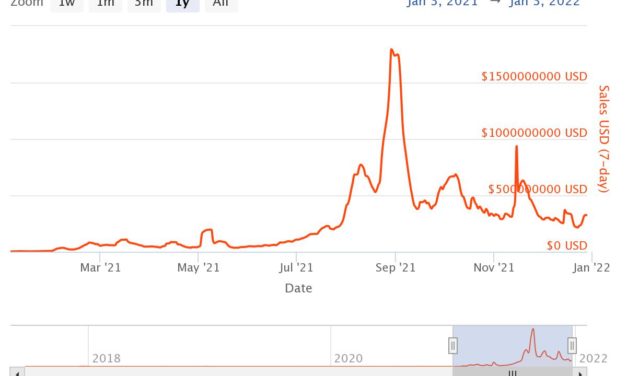
Digital asset curator Metaversal announced Tuesday that it has completed a $50 million funding round to further expand its investment capabilities in the nonfungible token (NFT) and metaverse sectors. The Series A funding round was co-led by investment firms CoinFund and Foxhaven, with additional participation from Collab+Currency, Dapper Labs, Digital Currency Group, Franklin Templeton, Rarible, Theta Blockchain Ventures, Galaxy Vision Hill and others. Metaversal said it will use the funding to expand its NFT-focused business, including acquiring high-profile digital collectibles and supporting projects that are being bootstrapped by its venture studio. The funding also enabled Metaversal to secure partnerships with NFT platform Rarible and Dapper Labs’ Flow blockchain. Flow, which provides the infrastructure for NBA Top Shot and CryptoKitties, is also being supported by Google and Filecoin, among other notable partners. Related: Square Enix CEO reveals plans for blockchain, metaverse, NFTsNFTs were a major factor behind crypto and blockchain’s mainstream success in 2021. The sector generated over $14 billion in sales during the year, with digital art collections and digital collectibles accounting for 91% of transactions, according to industry data. While digital art has largely dominated the NFT market to date, that could soon change with the arrival of music NFTs and fashion-focused collectibles. NFT sales peaked in late August and early September. Source: NonFungibleVenture funds have also identified NFTs as a major growth vector and have funded projects in this space to the tune of $2.1 billion as of Q3 2021. Silicon Valley venture firm Andreessen Horowitz was responsible for nearly 40% of NFT-focused deal activities, according to PitchBook. As Cointelegraph reported, venture funds invested over $17 billion into crypto- and blockchain-focused startups in the first 10 months of 2021, which was more than three times the amount in all of 2020. 

Čítaj viac

Bitcoin price reverses gains on New Year’s Eve; hodlers continue stacking sats

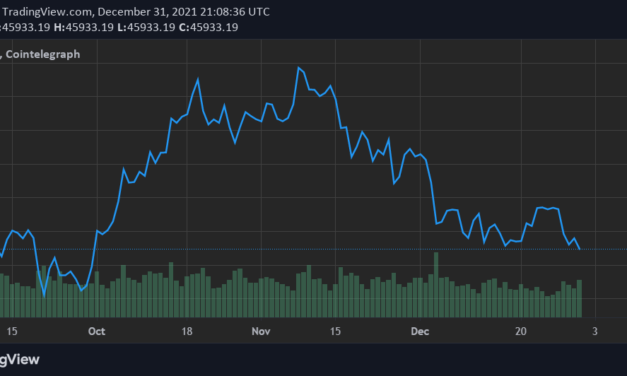
Bitcoin (BTC) and the broader cryptocurrency market turned lower later in the day on Dec. 31, erasing intraday gains to cap off a highly successful year on a weaker note. Market UpdateBTC price fell below $46,000 on Dec. 31 and was last seen hovering below that level, according to data from Cointelegraph Markets Pro and TradingView. The flagship cryptocurrency is down over 5% from its intraday peak and 2.9% on the day to trade at $45,933. Bitcoin’s price is back on the defensive as the year draws to a close. Source: Cointelegraph Markets ProAltcoins faced a similar downward trajectory as Bitcoin, with the likes of Ether (ETH), Binance Coin (BNB) and Solana’s SOL each falling more than 2%. Cardano’s ADA declined over 4% on the day. The combined market capitalization of all cryptocurrencies shed over $100 billion from its intraday peak, falling from a high of $2.4 trillion to $2.27 trillion, according to CoinGecko.The crypto market cap was down more than $100 billion from its intraday peak. Source: CoinGeckoThe sudden reversal followed a modest relief rally for BTC and other cryptocurrencies that took place early on Dec. 31. As Cointelegraph reported, Bitcoin’s price appreciated by more than $1,500 in less than an hour — a rally that may have been aided by a December options expiry event worth roughly $6 billion. Related: Price analysis 12/31: BTC, ETH, BNB, SOL, ADA, XRP, LUNA, AVAX, DOT, DOGECrypto OGs keep on accumulating Bitcoin is bracing for a year-to-date return of less than 60%, which is well below what many, if not most, prognosticators were calling for at the start of 2021. Although BTC never came close to achieving lofty six-figure valuations, the leading cryptocurrency continues to attract investors with a low time preference. (Investors with a low time preference place more emphasis on their financial well-being in the far future as opposed to the present.)BTC’s recent price correction has been largely driven by so-called crypto tourists who entered the market in the summer. As Cointelegraph recently reported, veteran holders are still selling record-low amounts of BTC as of late December. Meanwhile, buying activity on Coinbase appears to have picked up substantially toward the end of the year. Earlier this week, UTXO Management analyst Dylan LeClair said “The true OGs are holding tight,” in reference to Bitcoin’s long-term holders having a much lower on-chain cost basis than those who are currently selling. The average on-chain cost basis for long-term BTC holders is $17,825 compared with $33,890 for those currently spending their coins. #Bitcoin long-term holders have an average on-chain cost basis of $17,825, but the ones currently moving spending their coins have a cost basis of $33,890.The true OGs are holding tight. pic.twitter.com/VtxuAcZzUw— Dylan LeClair (@DylanLeClair_) December 30, 2021Related: Top 5 bullish Bitcoin stories of 2021In addition to the retail-oriented class of long-term hodlers, the crypto market saw an influx of sophisticated institutional investors in 2021. Net proceeds into crypto funds exceeded $9.3 billion in 2021, with Bitcoin accounting for over two-thirds of that total, according to CoinShares data. These funds registered 16 consecutive weeks of inflows through Dec. 13.

Čítaj viac

Crypto Biz: The blockchain revolution will cast aside the skeptics, Dec. 23-30

From a price perspective, the cryptocurrency market is ending 2021 with a whimper as Bitcoin (BTC), Ether (ETH) and other digital assets continue to trade well below their prior peaks. But the business of blockchain and crypto is heating up, as evidenced by the arrival of institutional capital and the flood of venture funding into the space. According to Nischal Shetty, CEO of India’s WazirX crypto exchange, the digital asset revolution is already underway and will continue with or without your participation. Below is the concise version of the latest “Crypto Biz” newsletter, which is delivered to your inbox every Thursday. Register for the full newsletter below to receive comprehensive insights every week.Crypto won’t wait for nations to come on board: WazirX CEOWith crypto being thrust into mainstream consciousness in 2021, lawmakers around the world are scrambling to regulate the digital asset class. WazirX’s Nischal Shetty believes nation-states will soon be in an arms race to develop and launch local versions of central bank digital currencies, or CBDCs. “We’re optimistic that we’ll get regulatory clarity and see institutional participation fuel retail adoption,” he said. “There is a $2.5-trillion market out there, and it is not going to wait for any nation to come on board.” FTX wants to intice banks to start accepting stablecoinsCryptocurrency derivatives exchange FTX is prepared to offer banks $1 million in prize money to begin accepting stablecoins. The offer, which was floated in a Tuesday Twitter post, is intended to strengthen FTX’s ties with traditional finance to help its customers better facilitate “near-instant and near-free deposits and withdrawals through stablecoins.” Although the offer is no doubt intriguing, banks are unlikely to commit to supporting stablecoins until federal regulators chime in on the matter. How much would it cost to convince a bank to accept stablecoins? If we offered a $1m prize for the first bank in each region that does it is that enough?Do you work for a bank and want to discuss this?— FTX – Built By Traders, For Traders (@FTX_Official) December 28, 2021DeBank valued at $200M following private equity roundThis week’s biggest funding news came courtesy of DeBank, a cryptocurrency wallet focused on decentralized finance solutions. On Tuesday, the firm announced it had completed a $25 million private equity round that was led by Sequoia China with additional participation from Dragonfly, Hash Global and Youbi, among several others. DeBank is now valued at $200 million, highlighting once again that DeFi-focused startups were attracting significant interest from venture capitalists. Related: Kevin O’Leary says his crypto holdings could reach 20% of portfolioBinance pursues regulatory approvals in Bahrain and CanadaBinance is wrapping up a highly tumultuous year on a positive note after the cryptocurrency exchange announced it had received a pair of licensing approvals from Bahrain and Canada. The green light from Bahrain gives the exchange license to operate as a crypto service provider in the tiny Gulf state. In Canada, however, the picture is a bit murkier. While Binance claims that it is licensed to operate in the country after incorporating a subsidiary called Binance Canada Capital Market, Ontario’s securities regulator issued a statement Thursday that the exchange is “not registered under securities law” in the province. (It should be noted that Binance’s subsidiary registered as a federal corporation whereas the Ontario Securities Commission has jurisdiction over the province of Ontario.) As Cointelegraph reported, Binance was effectively kicked out of Ontario, Canada’s most populous province, in June after local regulators began clamping down on unregistered trading platforms. 

Čítaj viac

Crypto Biz: What's up with Jack? Dec. 16-23

When you’re no longer at the helm of a publicly-traded company, you have more leeway to express controversial views. Former Twitter CEO Jack Dorsey took to social media this week to express his discontent over venture capital’s role in Web 3.0. Some of his Twitter followers agreed with his views, others disagreed and some even blocked him entirely. Below is the concise version of the latest “Crypto Biz” newsletter, which is sent to your inbox every Thursday. For a comprehensive breakdown of business developments over the last week, register for the full newsletter below. “You don’t own Web 3.0,” says DorseyDorsey’s gripe with Web 3.0 — a broad term that refers to a more decentralized and interconnected version of the internet — stems from those who control a commanding stake in these emerging protocols. By owning a large stake in Web 3.0 startups, venture capital funds and limited partners can pressure the founders to comply with centralized regulations that go against the ethos of decentralization. Tesla CEO Elon Musk joined Dorsey on Twitter in mocking Web 3.0 projects.Has anyone seen web3? I can’t find it.— Elon Musk (@elonmusk) December 21, 2021Seven Seven Six and Polygon launch $200M fundReddit co-founder Alexis Ohanian has deployed vast sums of capital via his Seven Seven Six venture firm to back new Web 3.0 and social projects building on Polygon. The fund, which is valued at a whopping $200 million, will focus specifically on gaming applications and social media platforms. The news came more than a month after Ohanian’s VC teamed up with Solana Ventures on a $100 million Web 3.0 growth fund. In other words, 2022 could be the year where “crypto social” takes off. SBI Group launches crypto-asset fund in JapanOne of Tokyo’s biggest financial services companies is making it easier for Japanese investors to access large-cap cryptocurrencies. Earlier this week, SBI Group unveiled its SBI Alternative Fund, which provides exposure to seven digital assets: Bitcoin (BTC), Ethereum (ETH), Litecoin (LTC), Ripple (XRP), Bitcoin Cash (BCH), Chainlink (LINK) and Polkadot (DOT). Crypto-curious investors will have until the end of January to file their applications to invest in the fund.Binance Labs leads $60M funding round for MultichainBinance’s venture capital arm, Binance Labs, was one of several big-name investors to back cross-chain protocol Multichain in a $60 million private seed round. Multichain claims that its protocol connects “more public blockchains and crypto assets than anyone else,” which likely explains Binance Labs’ strong interest in the project. Investors can expect to hear more about interoperability in 2022 as the crypto economy continues to mature. 

Čítaj viac

Top 5 bullish Bitcoin stories of 2021

In terms of price action, cryptocurrencies like Bitcoin (BTC) and Ether (ETH) are ending 2021 with a whimper, confounding expectations for an end-of-year blow-off top scenario. A six-figure Bitcoin by December became a consensus trade among many analysts, investors and market observers who were expecting the flagship cryptocurrency to replicate its previous four-year cycle. Although Bitcoin is still a long way off from that coveted milestone, exponential markets require a longer-term view. When we zoom out, we see that Bitcoin continues to print higher highs and higher lows on the yearly chart. We also see significant uptake from both retail and institutional investors who now consider crypto to be a legitimate asset class. Bitcoin yearly lows:2012: $42013: $65 2014: $2002015: $185 2016: $3652017: $7802018: $3,2002019: $3,3502020: $3,8002021: $27,734Bitcoin HODLers are the floor. They are the revolutionaries that have preserved and grown Bitcoin.Do you still want to bet against them?— Dan Held (@danheld) March 15, 2021Despite the recent downward price action, 2021 was crypto’s big year. Amid all the positive developments we observed over the past 12 months, five stories, in particular, caught our eye as being the most bullish from a business and adoption perspective. Tesla adds Bitcoin to its balance sheetElon Musk’s Tesla Motors sent shockwaves across the crypto community in February when it revealed that it had allocated a sizable portion of its balance sheet to Bitcoin. The company’s final Form 10-K filing for its 2020 fiscal year showed a $1.5 billion allocation to BTC, which represented roughly 7.7% of its gross cash position at the time. In addition to buying Bitcoin, the company said it was accepting BTC payments for its vehicles, a move that gave crypto whales more reason to splurge on Tesla products. Tesla’s decision not only sent the Bitcoin price soaring but also signaled to other corporations that crypto is a strategic reserve asset. After winning the hearts of crypto loyalists, Musk would later reveal that his company was halting BTC payments over concerns about the cryptocurrency’s energy usage. He also said Tesla sold roughly 10% of its BTC holdings, but only to demonstrate the coin’s liquidity. Although these could be taken as negative developments — the crypto community sure thought so at the time — the billionaire also hinted that his company was closer to accepting Bitcoin payments again. Oh, and he says he never offloaded any of his personal BTC bags.No, you do not. I have not sold any of my Bitcoin. Tesla sold 10% of its holdings essentially to prove liquidity of Bitcoin as an alternative to holding cash on balance sheet.— Elon Musk (@elonmusk) April 26, 2021

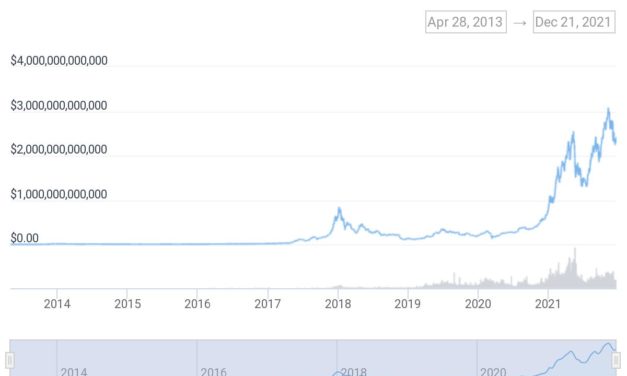
El Salvador declares Bitcoin legal tenderThe tiny Central American nation of El Salvador made crypto history in June when it became the first country to declare Bitcoin legal tender. Despite fierce opposition from the likes of the World Bank and International Monetary Fund, El Salvador believes its Bitcoin gambit could help transform its economy by streamlining remittances, promoting financial digitization, and providing consumers with a new vehicle for transactions and savings. El Salvador has issued its own state-backed Bitcoin wallet, dubbed Chivo, and installed hundreds of crypto ATMs across the country to make it easier for locals to begin transacting with BTC. [embedded content]Since implementing the Bitcoin Law, El Salvador has been keenly buying the dips on all BTC major price corrections. After its most recent purchase, on Dec. 21, the country now holds 1,220 BTC on its books worth roughly $60 million at today’s prices.El Salvador’s decision to adopt Bitcoin could have significant ramifications on a region that’s struggling with hyperinflation, fiscal pressures, and economic uncertainty. Although several other Latin American countries are reportedly considering adopting Bitcoin, no other government has followed in El Salvador’s lead yet. Related: Bank of America outlines 4 potential benefits of El Salvador’s Bitcoin strategyCrypto becomes a multi-trillion-dollar asset classWhile cryptocurrencies are known for their volatility, a longer term view shows a steadily increasing market valuation. In 2021, the cryptocurrency market capitalization set multiple milestones, including crossing the $1 trillion value mark for the first time in early January. It took the crypto market roughly four months to double to $2 trillion before briefly surpassing $3 trillion in early November, according to Coingecko data. It took the crypto market roughly four months to double to $2 trillion before briefly surpassing $3 trillion in early November, according to Coingecko data. In 2021, crypto emerged as a multi-trillion-dollar asset class that’s too big to ignore. Source: CoinGeckoCrypto’s emergence as a multi-trillion-dollar asset class means more institutional investors are planning their entry into the market. Existing crypto-focused investment managers have also seen demand for their products surge, with net asset flows into digital asset products exceeding $9.3 billion for 2021, according to CoinShares data. Financial institutions and other corporations are also transacting in crypto at a higher rate, with Europe emerging as the largest crypto economy and Asia also witnessing significant growth, according to blockchain analytics firm Chainalysis.Related: Are institutional investors the key silent partners of crypto?Bitcoin ETFs approvedThe 2017 bull market culminated with the launch of Bitcoin futures contracts by CBOE and CME, which gave institutional investors new ways to gain exposure to the digital asset. Four years later, investors are now able to buy and hold Bitcoin through various exchange-traded funds, or ETFs.In the first quarter, Canada saw the debut of two funds — the Purpose Bitcoin ETF and the Evolve Bitcoin ETF — that provide direct physical exposure to the digital asset. The debuts were a resounding success, with the Purpose Bitcoin fund accumulating over $1.3 billion in assets in less than two months. Fast forward to the end of the year, Fidelity Canada launched a spot Bitcoin ETF that’s expected to bring more investors to the digital asset market. SEMI-SHOCK: Fidelity launching a spot bitcoin ETF in Canada this week. Didn’t know about this. Will easily be the biggest asset manager to date with a bitcoin ETF. pic.twitter.com/H2XJRBY3O6— Eric Balchunas (@EricBalchunas) November 30, 2021

Regulators in the United States have been much less progressive in their approach to digital assets. While the Securities and Exchange Commission refused to greenlight a spot Bitcoin ETF in 2021, regulators did approve two futures-linked Bitcoin products that many in the industry took as an important milestone. The ProShares Bitcoin Strategy ETF became the first U.S.-approved BTC fund in October. Shortly thereafter, the Valkyrie Bitcoin Strategy ETF hit the market. Then, in November, VanEck launched its own Bitcoin Strategy ETF in the United States.[embedded content]Related: Why now? SEC took eight years to authorize a Bitcoin ETF in the USVenture capital arrivesPerhaps the most bullish indicator of all for crypto in 2021 was the tidal wave of venture capital flooding the market. Dozens of crypto unicorns were crowned this year as startup valuations soared above $1 billion.Amber Group, Bitso, Blockchain.com Blockstream, BlockFi, CoinList, CoinSwitch Kuber, ConsenSys, Figure Technologies, Fireblocks, OpenSea, 2TM, and others all joined this exclusive list thanks to highly successful private funding rounds. In the first ten months of 2021, venture capital had funded crypto- and blockchain-focused startups to the tune of $17 billion, more than three times the 2020 amount, according to data from PitchDeck.Related: Unicorns in crypto: A growing herd of billion-dollar crypto companiesThe arrival of venture capital means smart money has identified crypto and blockchain as major growth themes. Of course, if you’re Jack Dorsey, that’s not necessarily a good thing: https://t.co/YaEO5tLlWl— jack⚡️ (@jack) December 21, 2021

Nevertheless, VCs splurging on blockchain startups, regardless of where we are in the market cycle, is a sign that the industry is maturing. It’s also a gentle reminder to all those who survived ICO mania that their initial hunch to invest in crypto was probably correct. After all, you beat Silicon Valley to the punch.

Čítaj viac

Získaj BONUS 8 € v Bitcoinoch

nakup bitcoin z karty

Registrácia Binance

Burza Binance

Aktuálne kurzy