Autor Cointelegraph By Sam Bourgi

Hong Kong-based Chiron Partners launches $50M Terra fund

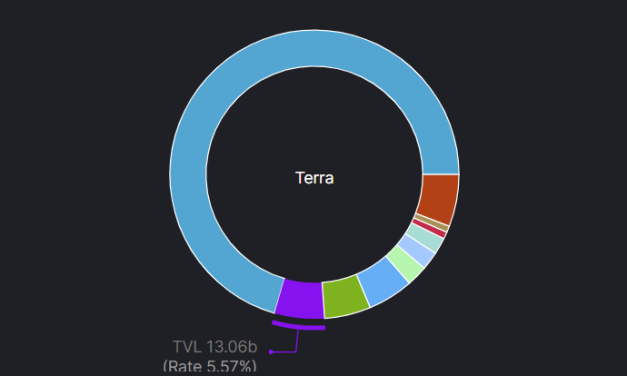
Hong Kong venture capital firm Chiron Partners has launched a new ecosystem fund dedicated to Terra (LUNA), opening the door to new innovations for the layer-one decentralized finance, or DeFi, protocol.The Chiron Terra Fund I, also referred to as CTI, will deploy $50 million in capital to support innovative projects building on top of the Terra ecosystem. Projects at the intersection of decentralized finance and “metaverse-linked” nonfungible token platforms are eligible for support, the company announced Wednesday. Built using Cosmos SDK and Tendermint, Terra is a DeFi protocol that uses fiat-pegged stablecoins to power global payment systems. The native LUNA token has been designed to absorb the short-term volatility of Terra-based stablecoins. Following its Columbus-5 upgrade in October, Terra is reportedly set to house over 160 new projects by early 2022. Terraform Labs, the South Korean development company behind the Terra blockchain, successfully raised $150 million in funding earlier this year. Major crypto venture funds including Pantera Capital, Galaxy Digital and BlockTower Capital contributed to the raise. Related: The stablecoin scourge: Regulatory hesitancy may hinder adoptionTerra has emerged as one of the largest DeFi-oriented blockchains on the market, with total value locked surpassing $13 billion, according to industry data. Only Ethereum has a higher TVL. In terms of TVL, Terra is second only to Ethereum and ahead of Solana, Avalanche, Tron and Polychain. Source: DeFi LlamaIn terms of price performance, LUNA has skyrocketed over 9,000% this year. Last month, the cryptocurrency peaked above $77.00. The cryptocurrency has a total market capitalization of $24.2 billion, placing it in the tenth spot among active projects.

Čítaj viac


SiennaSwap adds Bitcoin, Monero trading pairs in push for privacy-focused DeFi

Cross-chain DeFi protocol Sienna Network has enabled Bitcoin (BTC) and Monero (XMR) trading pairs on its decentralized exchange, giving users the ability to transact privately in two of the world’s most recognizable cryptocurrencies. Effective immediately, users of the privacy-focused SiennaSwap DEX will have the ability to trade BTC and XMR against the protocol’s native Sienna token, chief evangelist Monty Munford confirmed with Cointelegraph. The decision to incorporate Bitcoin and Monero transactions follows a “huge amount of requests for additional yield options” from both communities, he said. Sienna’s infrastructure is built on the Secret Network, a custom blockchain that supports private transactions but, perhaps just as critically, doesn’t endorse trading techniques based on anonymity. Regulators have cast a dark shadow over cryptocurrencies that provide enhanced anonymity, with several exchanges moving to delist privacy-centric cryptocurrencies XMR, Zcash and Dash earlier this year.As part of its mandate, Sienna Network is attempting to provide an environment where crypto transactions are kept private without the added stigma and regulatory implications of anonymity. [embedded content]Since launching on Oct. 7, SiennaSwap has generated over $254 million in cumulative trade volumes, further highlighting the growing popularity of decentralized exchanges. Cryptocurrency entrepreneur and Bitcoin Cash (BCH) proponent Roger Ver has come out in favor of SiennaSwap’s recent additions. “Maintaining privacy while enabling DeFi for Monero and Bitcoin is crucial and Sienna Network seems to be doing exactly that,” he said. Ver has long been an advocate for crypto-oriented privacy tools and their role in promoting freedom.People who are serious about protecting their privacy use long keys, and people who are serious about violating privacy try to pass laws restricting the length of those keys. pic.twitter.com/OKPcQ9YlnZ— Roger Ver (@rogerkver) August 23, 2018Related: DeFi privacy project Panther raises $22M in 1.5-hour public saleThe crypto industry as a whole has been criticized for not making privacy a tier-one priority. Although the media’s role in conflating privacy and anonymity (and thus nefarious behavior) is partly to blame, builders of the new economy have also favored other priorities, such as security, decentralization and scalability. Whereas privacy-focused projects had a strong presence during the 2017-18 crypto bull market, the 2021 market melt-up has been driven largely by DeFi, nonfungible tokens and, more recently, GameFi and Metaverse concepts. Sienna Network reiterated that privacy of financial transactions is not only a personal right but also a legal obligation in Europe and the United States.

Čítaj viac

Vitalik Buterin outlines ‘endgame’ roadmap for ETH 2.0

Ethereum co-founder Vitalik Buterin has outlined his vision for a “plausible roadmap” for Eth2, presenting a future where the largest smart-contract platform can increase its scalability while meeting high standards for trustlessness and censorship resistance. In a Monday post titled “Endgame,” Buterin presented a thought experiment for how the average big blockchain — defined by very high block frequency, high block size and thousands of transactions per second — can still be considered sufficiently trustless and censorship-resistant. The obvious trade-off for this level of scalability is the centralization of block production. Buterin’s solutions, as presented in the blog post, do not address the centralization issue, but still provide a roadmap for implementation. [embedded content]With respect to the solutions, Buterin suggested “a second tier of staking, with low resource requirements,” to carry out distributed block validation; “introduce either fraud proof or ZK-SNARKS to let users directly (and cheaply) check block validity” directly; “introduce data availability sampling to let users check block availability [and] add secondary transaction channels to prevent censorship.”With these updates, “We get a chain where block production is still centralized, but block validation is trustless and highly decentralized, and specialized anti-censorship magic prevents the block producers from censoring,” Buterin explained. Related: Vitalik Buterin proposes calldata limit per block to lower ETH gas costsButerin said block production would remain centralized even with the implementation of so-called “rollups,” which are layer-two solutions that execute transactions outside of the main Ethereum chain. (Interestingly, Buterin presented a rollup-centric roadmap for Ethereum in October 2020). “No single rollup succeeds at holding anywhere close to the majority of Ethereum activity. Instead, they all top out at a few hundred transactions per second,” he said. While it may appear that rollups could contribute to distributed block production, decentralization may not last because of the possibility of cross-domain maximal extractable revenue, or MEV. As the name implies MEV refers to the maximum amount of value that can be earned from block production in excess of standard block rewards and gas fees. The Ethereum co-founder concluded that there’s a high probability that block production will ned up centralized regardless of the path to scalability that the network takes. The benefit of Ethereum’s rollup-centric roadmap is that it’s open to all futures, he said. Eth2 isn’t going to solve all of society’s challenges, but its design is well suited to empower people to solve them together, argues @ViktorBunin https://t.co/JhBvyVjr49— Cointelegraph (@Cointelegraph) April 24, 2021Excitement surrounding ethereum has been building since November 2020 when the protocol first embarked on its long transition to proof-of-stake. The highly anticipated London hard fork, which puts ETH on track to become a deflationary asset, was implemented in August of this year. The hard fork introduced EIP-1559, which aims to reform the network’s fee market. As Cointelegraph reported, over 1 million ETH has already been burned since the EIP-1559 came into effect.

Čítaj viac

Crypto Biz: Wall Street veteran launches $1.5B crypto fund, MELD ISPO shines spotlight on Cardano, Dec. 2

Crypto converted another Wall Street veteran this week after former Citi executive Matt Zhang launched a $1.5 billion digital asset fund. A new funding mechanism allowing users to access early-stage crypto startups shined the spotlight on Cardano’s massive community. One of Latin America’s biggest crypto exchanges raised $50 million in private funding to expand its operations. 1inch Network raised another $175 million from leading crypto venture capitalists to expand DeFi liquidity. These were just some of the week’s biggest business headlines from the world of crypto. Every Thursday, Cointelegraph’s Crypto Biz newsletter gives readers a pulse of the business behind blockchain and cryptocurrency, delivered directly to their inbox. Below is a concise version of the Thursday edition of our newsletter. Former Citi banker launches $1.5B crypto fundMatt Zhang left a 14-year career at Citigroup to launch Hivemind Capital Partners, a $1.5 billion multi-strategy crypto and blockchain fund. The fund is designed to invest in emerging blockchain projects, support institutional access to crypto and actively trade digital assets.MELD’s $1B ISPO shines the spotlight on CardanoIn October, DeFi banking protocol MELD concluded a $1-billion initial stake pool offering (ISPO), giving Cardano (ADA) holders the ability to stake their ADA in exchange for MELD tokens. The ISPO was a resounding success as more than 40,000 participants staked 620 million ADA. MELD CEO Ken Olling provided Cointelegraph with exclusive commentary. 2TM raises $50M, further cementing unicorn statusCrypto unicorn 2TM, which operates Mercado Bitcoin, one of Latin America’s largest digital asset exchanges, has concluded a $50.3 million private investment round. 2TM is planning to expand its services in the region as crypto adoption continues to grow in places like Brazil, Mexico and Argentina. Amber Group leads 1inch Network’s $175M Series BEarlier this week, decentralized exchange aggregator 1inch Network closed a $175-million private financing round, with contributions from some of crypto’s biggest venture investors, including Amber Group, VanEck, Jane Street, Fenbushi Capital, Alameda Research, Celsius and Nexo. The Series B was more than double the $70 million target 1inch had initially planned and further demonstrated the enormous appetite for DeFi solutions.

Čítaj viac

Získaj BONUS 8 € v Bitcoinoch

nakup bitcoin z karty

Registrácia Binance

Burza Binance

Aktuálne kurzy