Autor Cointelegraph By Sam Bourgi

Amid sanctions, Russia weighs crypto for international payments: Report

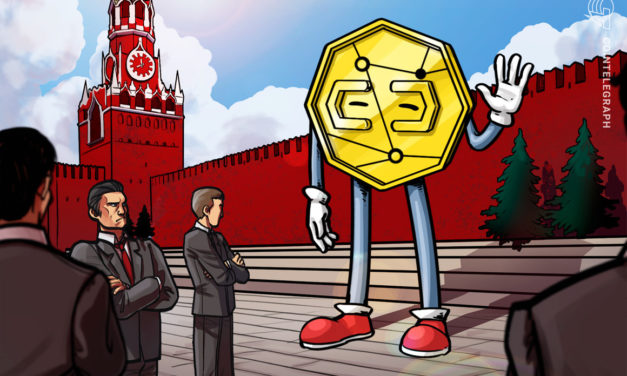
The Russian Federation is reportedly considering accepting cryptocurrencies for international payments in response to Western sanctions against the country that were prompted by its full-scale invasion of Ukraine earlier this year. The Moscow-based Interfax news agency and Reuters reported Friday that Ivan Chebeskov, who heads the Financial Policy Division within Russia’s Finance Ministry, is actively considering the possibility of incorporating crypto payments. “The idea of using digital currencies in transactions for international settlements is being actively discussed,” he said. According to local newspaper Vedomosti, the Finance Ministry is considering adding the proposal on international payments to an updated version of a crypto law that’s still under construction. Support for cryptocurrency legalization appears to be coming from all segments of the Russian government. According to trade minister Denis Manturov, Moscow plans to legalize crypto payments “sooner rather than later.” In April, the country’s Finance Ministry supported legalization in a bill titled “On Digital Currency.” Related: Russia’s updated crypto mining bill cuts tax amnesty for Bitcoin minersThe same month, the governor of the Bank of Russia admitted that the central bank was reconsidering its hostile stance toward digital assets. Central bank governor Elvira Nabiullina said that crypto is being considered among several measures to mitigate the impact of Western sanctions against the Russian economy. 1/ Russia can’t & won’t use crypto to evade sanctions.Concerns about crypto’s use for sanctions evasion are totally unfounded. They fundamentally misunderstand:- how sanctions work- how crypto markets work- how Putin is actually trying to mitigate sanctionsI’ll explain — Jake Chervinsky (@jchervinsky) March 1, 2022It’s not entirely clear how Russia would be able to use digital assets to bypass Western sanctions given that the crypto market is not large enough or liquid enough to support a sovereign nation’s transaction needs. For starters, the United States Office of Foreign Assets Control has barred any U.S. person from doing business with individuals or entities on its Specially Designated Nationals and Blocked Persons (SDN) List. The ban on doing business with Russian SDNs exists regardless of the payment systems in place. Jake Chervinsky, head of policy for the U.S.-based Blockchain Association, explained: “There’s zero reason to think crypto’s existence will convince any of them to willfully violate sanctions laws, risking fines & jail time.

Čítaj viac


Partying in Davos with Cointelegraph: Crypto card payments accepted

With the World Economic Forum (WEF) Annual Meeting drawing to a close, attendees had the opportunity to join Cointelegraph for a farewell party at Ex Bar in Davos — where they could actually pay for food and drinks using cryptocurrency. The annual meeting of the World Economic Forum is scheduled to take place between May 22–26, with a slew of world leaders expected to attend. What role will blockchain have at the event? https://t.co/wEtEvuVK5I— Cointelegraph (@Cointelegraph) May 20, 2022Early partygoers had the opportunity to win one of 20 cards loaded with up to 100 Davos Coins, which are pegged one-for-one with the Swiss franc. The winners enjoyed a seamless checkout experience using a new hardware wallet with the look and feel of a regular credit card. Powered by German crypto custodian Trustody and Ammer Card, a self-hosted wallet created by Ammer Technologies AG, cardholders could simply tap and pay at Trustody terminals. The card’s underlying technology, which is approved by Visa and Mastercard, retains private and public cryptographic keys. The copy of the keys is held by Trustody’s secure storage, which ensures that the card can be restored in case of theft or replacement. Polygon co-founder Mihailo Bjelic told Cointelegraph that Davos Coins and the associated payment systems were spun up by Ammer Technologies in just two weeks using Polygon technology. Bjelic described Davos Coins as a “pilot project,” demonstrating how quickly crypto payments can be integrated. He said the pilot will likely be shelved after the event. The topic of crypto payments was front and center on several panels at the WEF’s four-day summit, which concluded on Thursday. An executive at PayPal told Cointelegraph that the global payment giant is looking to expand its crypto service offerings in the near future. The use of digital assets for global remittances was also featured prominently in a panel discussion that included Circle CEO Jeremy Allaire and Brad Garlinghouse of Ripple. Related: WEF 2022: Bankers at WEF see the need for caution and speed on central bank digital currenciesMeanwhile, Mastercard CEO Michael Miebach made a bold prediction that SWIFT, the global cross-border settlement platform, probably won’t exist in five years due to rapid innovation in blockchain technology and central bank digital currencies.Joseph Hall contributed to this story. 

Čítaj viac

‘Other flavors of Tether’ will bridge users to USDT: Paolo Ardoino

Tether’s decision to launch a new digital asset pegged to the Mexican peso will be a boon to crypto adoption in the Central American country by providing more onramps to the USDT stablecoin, according to Paolo Ardoino. In an exclusive interview with Cointelegraph on the sidelines of the World Economic Forum summit, the Tether and Bitfinex chief technology officer said the reason he came to Davos was to showcase the utility of cryptocurrencies. “I didn’t participate in Davos to meet CEOs of big banks,” he said. “We are here to send our message [that] there is a big world out there that needs crypto in a safe way.”Tether CTO Paolo Ardoino said that the increase in crypto demand in the Latin America region pushed their decision to expand. https://t.co/Ig7Y524VT2— Cointelegraph (@Cointelegraph) May 26, 2022Tether has identified a growing demand for crypto and stablecoin products in Mexico, especially among businesses. To meet that demand, the company announced Thursday that it will launch a new peso-backed stablecoin on the Ethereum (ETH), Tron (TRX) and Polygon (MATIC) networks. Ardoino confirmed to Cointelegraph that “MXNT” pairs will begin trading on Bitfinex next week. Describing USDT as a bridge to Bitcoin (BTC), Ardoino said he believes the dollar-pegged stablecoin will be successful in onboarding the next 2 billion crypto users. However, to bridge more people to USDT, his company must work with local banks by offering “other flavors of Tether.” Related: WEF 2022: SWIFT probably won’t exist in 5 years, says Mastercard CEOWhen asked about the prospect of Mexico adopting Bitcoin as legal tender, which became a distinct possibility after a Mexican senator advanced the idea of creating crypto regulations based on El Salvador’s BTC Law, Ardoino said he’s “bullish on the case that many countries will need, sooner rather than later, [to accept] Bitcoin.”A Mexican senator renews efforts to make #Bitcoin legal tender in Mexico, arguing that Bitcoin adoption can drive global financial inclusion. https://t.co/4Yzs3zUUNU— Cointelegraph (@Cointelegraph) February 23, 2022

However, the path to Bitcoin becoming legal tender in Mexico will be more complicated than in El Salvador because the former already has an official currency. So, while Bitcoin may not achieve the status of legal tender in the near term, it could become a “de facto legal tender” that is used alongside the peso, he said.

Čítaj viac

Binance signs MOU with Kazakhstan to further crypto adoption and regulation

Cryptocurrency exchange Binance has signed a memorandum of understanding, or MOU, with the government of Kazakhstan to bolster “virtual asset market development” in the central Asian country. The signing of the MOU, which is between Binance and Kazakhstan’s Ministry of Digital Development, Innovations and Aerospace Industry, took place on Wednesday during Changpang Zhao’s official visit to the country. The Binance CEO met with Kazakh President Kassym-Jomart Tokayev, First Deputy Chief of Staff Timur Suleimenov and Bagdat Musin, the minister overseeing the country’s digital innovation strategy. Under the framework, Binance will assist Kazakhstan in developing legislative guidelines and regulatory policies for crypto assets. The Ministry of Digital Development, Innovations and Aerospace Industry will also “seek opportunities to integrate banking infrastructure within the cryptocurrency market” and facilitate the development of blockchain technology, according to the official statement. President of the Republic of Kazakhstan Kassym-Jomart Tokayev meets CEO of Binance Changpeng Zhaohttps://t.co/K4MsXM646M— CZ Binance (@cz_binance) May 25, 2022Kazakhstan has emerged as a pivotal player in the Bitcoin (BTC) economy since absorbing Chinese mining capacity following Beijing’s wholesale crackdown on the industry. Chinese Bitcoin mining companies Canaan and BTC.com have moved their operations to the country to capitalize on cheap, abundant fuel, as well as favorable regulatory conditions. Related: China returns as 2nd top Bitcoin mining hub despite the crypto banHowever, Kazakhstan’s Bitcoin mining surge appears to have been unsustainable, as the influx of miners strained the country’s energy supply and prompted the government to reduce their access to power. Earlier this month, the government announced that all Bitcoin miners would be required to submit comprehensive reports on their power consumption.

Čítaj viac

Singapore venture firm launches $100M Web3 and metaverse fund

Crypto-focused venture firm NGC Ventures has launched a new ecosystem fund dedicated to Web3 projects, underscoring heightened investor demand for startups that are contributing to the development of a decentralized internet. NGC Metaverse Ventures, the company’s third blockchain fund, raised $100 million from investors that included Babel Finance, Huobi Ventures, Nexo Ventures, Altonomy and GBIC. The fund will allocate capital towards “high-potential projects” in the Web3 economy, according to Roger Lim, NGC Ventures’ general partner. The Web3 fund has already invested in three startups, NGC disclosed on Wednesday. Based in Singapore, NGC Ventures was founded in 2017 as a blockchain and fintech-focused venture firm. It was an early investor in Solana (SOL), Algorand (ALGO) and Oasis (ROSE), among others. Web3 and metaverse projects have attracted significant interest from the VC community. Since mid-April, venture firms have pledged nearly $3 billion to invest in such projects. Most notably, Silicon Valley VC Andreessen Horowitz launched a $600 million fund dedicated to gaming startups within the Web3 economy. Related: VC Roundup: Gaming, crypto fintech and blockchain infrastructure dominate venture capital roundsGoogle is looking for Web3 talent.The Google Cloud division is looking for a ‘Head of Product Marketing’ who will be responsible for raising awareness about Google Cloud’s Web3 initiatives in addition to eventually building customer demand. https://t.co/fdKd31Asue— Cointelegraph (@Cointelegraph) May 25, 2022The Web3 economy has been a key talking point at the World Economic Forum’s Annual Meeting, which is underway in Davos, Switzerland this week. In an exclusive interview with Cointelegraph, Polkadot (DOT) founder Gavin Wood said the growth of Web3 has been “encouraging because it means that people are seeing this underlying technology feed into different applications” that go beyond just crypto. 2022 is shaping up to be another record-breaking year for crypto VC. In the first quarter alone, venture firms allocated $14.6 billion, or 48% of all the capital invested in 2021, toward crypto and blockchain startups, according to Cointelegraph Research. 

Čítaj viac

Získaj BONUS 8 € v Bitcoinoch

nakup bitcoin z karty

Registrácia Binance

Burza Binance

Aktuálne kurzy