Autor Cointelegraph By Sam Bourgi

Global crypto adoption slumps amid macro pressures, Turkey defies downtrend

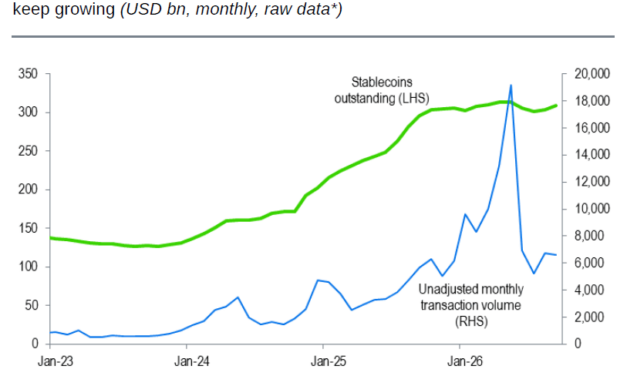
Global crypto adoption declined in the first quarter as retail activity weakened under mounting macroeconomic and geopolitical pressures, underscoring the sector’s continued sensitivity to broader market conditions.TRM Labs’ Q1 Global Crypto Adoption Index showed an 11% year-over-year drop in retail crypto volumes, to $979 billion. The decline marked a second consecutive quarterly contraction and the sharpest pullback since the 2022 bear market.The downturn was largely driven by a stronger US dollar, higher interest rates and a broader risk-off environment, all of which weighed on retail participation, TRM said. The softer demand coincided with a 22% drop in the price of Bitcoin (BTC) during the quarter.Bitcoin’s correction followed a late-2025 peak above $126,000, with prices trending lower through the first quarter alongside a broader decline in digital asset markets.Bitcoin’s quarterly returns between Q4 2022 and Q1 2026. Source: TRM LabsRelated: Crypto Biz: Will Bitcoin secure safe passage through the Hormuz Strait?Emerging markets diverge from advanced economiesThe report highlighted a growing regional divide in crypto adoption, with advanced economies such as the United States, South Korea, the United Kingdom and Germany posting the steepest declines in trading volume. In these markets, where crypto is largely used as a speculative asset, higher opportunity costs and weaker risk appetite pushed investors elsewhere. Part of that shift was tied to the outbreak of the Iran war in late February, which disrupted energy flows and heightened sensitivity to geopolitical developments across global markets.By contrast, markets where crypto serves a more functional role, including payments and savings, showed greater resilience. Turkey stood out, with volumes rising 7% year over year, while activity across Latin America and South Asia remained broadly stable.The study also flagged Venezuela as a major growth market for crypto adoption amid ongoing sanctions. Source: TRM Labs“This divergence reflects a fundamental difference in demand: where domestic monetary policy is constrained or capital controls limit alternatives, crypto functions as a store of value and shadow dollar system,” TRM said.Related: Stablecoin supply reaches $315B in Q1 as USDC rises, USDT declinesCointelegraph is committed to independent, transparent journalism. This news article is produced in accordance with Cointelegraph’s Editorial Policy and aims to provide accurate and timely information. Readers are encouraged to verify information independently.

Čítaj viac

Pyth Network to determine outcomes in Kalshi’s commodities expansion

Oracle network Pyth Network has been selected as the resolution data source for Kalshi’s expansion into commodities markets, underscoring the growing focus on reliable pricing infrastructure in event-based trading.Kalshi said on Wednesday that Pyth will supply real-time pricing data for its newly launched commodities hub, which debuted in April. The data will be used to determine how event contracts tied to commodity prices are settled.The move reflects a broader push among prediction market platforms to strengthen backend infrastructure as they expand into more complex asset classes. Accurate, tamper-resistant data feeds are critical for ensuring fair and transparent contract resolution, particularly in markets tied to real-world financial benchmarks.Kalshi’s commodities hub allows users to trade event contracts linked to physical assets, including gold, silver, oil, copper and key agricultural products. Pyth’s price feeds will serve as the source of truth for determining contract outcomes.Source: Pyth NetworkPyth has also been selected by rival prediction market Polymarket to provide price feeds for equities and commodities.Pyth Network is a decentralized oracle that delivers real-time market data to blockchain applications. As Cointelegraph recently reported, Pyth has also recently deployed infrastructure that enables institutions to publish and monetize proprietary data across multiple networks.Related: Kalshi mulls crypto expansion with perpetual futures launch: ReportKalshi’s federal status faces state pushbackKalshi is rolling out these changes as it seeks to bring more structure to the fast-growing prediction market sector. The company is regulated by the US Commodity Futures Trading Commission as a designated contract market, meaning it is approved to offer trading in derivatives contracts under federal oversight, similar to a traditional exchange.State regulators have pushed back on Kalshi and other prediction platforms, arguing that some contracts resemble unlicensed gambling or fall outside existing derivatives rules. Edit the caption here or remove the textHowever, the US Department of Justice and the CFTC recently asked a federal court to block Arizona from enforcing state gambling laws against Kalshi’s contracts, signaling support for federal jurisdiction in this area.The dispute comes as prediction market activity has grown sharply over the past two years, drawing in new entrants from both traditional finance and the crypto sector.Related: After Kalshi appeal, prediction markets fight could head to US Supreme CourtCointelegraph is committed to independent, transparent journalism. This news article is produced in accordance with Cointelegraph’s Editorial Policy and aims to provide accurate and timely information. Readers are encouraged to verify information independently. Read our Editorial Policy https://cointelegraph.com/editorial-policy

Čítaj viac

Kalshi mulls crypto expansion with perpetual futures launch: Report

Prediction market exchange Kalshi is reportedly preparing to expand into cryptocurrency trading by introducing perpetual futures contracts, marking a major shift beyond its core event-based derivatives business.In a Tuesday report, The Information cited people familiar with the matter as saying Kalshi plans to offer perpetual futures — commonly known as “perps” — on cryptocurrencies such as Bitcoin (BTC).Source: Walter BloombergPerpetual futures are a type of derivative contract that allows traders to speculate on price movements without an expiration date. Unlike traditional futures, which must be rolled over periodically, perps enable continuous exposure and are typically paired with leverage. The structure was popularized in crypto markets by BitMEX, helping fuel the rapid growth of derivatives trading.Kalshi’s planned launch would signal a move away from binary event contracts toward continuous financial markets, potentially broadening its appeal to both retail and institutional traders.Kalshi is regulated in the United States by the Commodity Futures Trading Commission (CFTC), a distinction that could position it as a compliant alternative to offshore crypto derivatives platforms.CFTC Chair Michael Selig has indicated that these products could become available in the United States in the near future, as regulators seek to bring more trading volume onshore.Related: Onchain real-world perps surge, while altcoin rout drags on: ReportCompetition for perps is gaining tractionThe reported move comes amid intensifying competition across both prediction markets and the fast-growing perpetual futures segment, with US platforms increasingly seeking to offer this trading to non-US residents. Crypto exchanges have been drawn in this direction, with Coinbase recently launching round-the-clock perpetual-style futures tied to equities for non-US traders, expanding beyond its traditional crypto derivatives offering.Although daily perpetual futures volumes are roughly half their peak levels, they still reached nearly $20 billion on Tuesday. Source: DeFiLlamaKraken has also rolled out tokenized stock perpetual futures for users outside the United States, targeting exposure to US stock indexes, precious metals and individual stocks.Related: S&P Dow Jones licenses S&P 500 perpetual futures for HyperliquidCointelegraph is committed to independent, transparent journalism. This news article is produced in accordance with Cointelegraph’s Editorial Policy and aims to provide accurate and timely information. Readers are encouraged to verify information independently. Read our Editorial Policy https://cointelegraph.com/editorial-policy

Čítaj viac

New York targets Coinbase, Gemini in fresh crackdown on prediction markets

New York’s attorney general has filed lawsuits against crypto exchange operators Coinbase Financial Markets and Gemini Titan for allegedly violating state gambling laws, according to court records cited by Reuters.Copies of the complaints show the state alleges both exchanges failed to obtain licenses from the New York State Gaming Commission to operate their markets, Reuters reported. “Gambling by another name is still gambling, ​and it ​is not ⁠exempt from regulation under our state laws and Constitution,” Attorney General Letitia James said in a statement.James said the lawsuit seeks to recover alleged illegal profits from operating prediction markets in the state, as well as restitution, and would bar Coinbase and Gemini from offering such products to individuals under 21 years of age.Source: Office of New York State Attorney GeneralRelated: Polymarket in talks to raise $400M at a $15B valuation: ReportState regulators crack down on prediction marketsThe move fits into a broader push by state regulators, including New York, to assert control over prediction markets, which occupy a fast-growing corner of crypto commerce that allows users to bet on real-world events.Much of the recent scrutiny has centered on platforms like Polymarket and Kalshi, which have drawn questions over whether their products fall under financial regulation or gambling laws.The tension has also reached the federal level. The Commodity Futures Trading Commission (CFTC) has taken legal action against several states attempting to regulate prediction markets, arguing it has sole authority over the sector.New York’s lawsuit underscores a key risk for crypto companies. Even as the federal stance has softened, state-level enforcement remains active. By targeting prediction-style markets, regulators may be opening a new front — one that could force platforms to rethink how these products are offered in major jurisdictions.Nevertheless, not every company is taking it lightly. As Cointelegraph reported, Polymarket has filed a lawsuit against Massachusetts, arguing the state lacks authority to regulate prediction markets approved by the CFTC.Source: Neal Kumar, chief legal office, PolymarketRelated: NYSE parent ICE completes new $600M investment in PolymarketCointelegraph is committed to independent, transparent journalism. This news article is produced in accordance with Cointelegraph’s Editorial Policy and aims to provide accurate and timely information. Readers are encouraged to verify information independently. Read our Editorial Policy https://cointelegraph.com/editorial-policy

Čítaj viac

Core Scientific plans $3.3B debt raise to fund AI data center push

Core Scientific is seeking to raise $3.3 billion in debt to support its expanding data center operations across the United States, as crypto miners increasingly pivot toward high-performance computing and artificial intelligence workloads amid tighter conditions in the mining sector.The financing will come through senior secured notes due in 2031, the company disclosed Tuesday. The notes will be backed by Core Scientific’s assets, giving investors priority claims in the event of default. Unlike an equity raise, the offering allows the company to access capital without diluting existing shareholders.Proceeds from the offering are expected to fund ongoing data center development and refinance existing short-term debt. In particular, Core Scientific plans to repay borrowings under its 364-day credit facility, effectively extending its debt maturities as it scales infrastructure. The company has identified expansion projects in Georgia, Texas, North Carolina and Oklahoma.The proposed raise follows a separate $1 billion credit agreement with Morgan Stanley announced in March, underscoring Core Scientific’s push to secure long-term financing for its data center buildout.Core Scientific (CORZ) shares were little changed in early Tuesday trading, extending a year-to-date rally of more than 37%. Source: Yahoo FinanceCore Scientific is among several crypto miners that have turned to leverage to expand beyond traditional bitcoin mining, particularly into high-performance computing and AI-focused data center services. Peers, including MARA Holdings, Riot Platforms and Hut 8 have pursued similar strategies, investing in infrastructure and partnerships to diversify revenue streams.Meanwhile, IREN has pursued one of the most aggressive expansion strategies in the sector, spending roughly $800 million on data centers and related infrastructure in its most recent quarter.Related: CoreWeave shows how crypto-era infrastructure quietly became AI’s backboneMining industry turns to partnershipsThe crypto mining industry is increasingly turning to partnerships to finance and expand its footprint in AI and data center workloads. On Tuesday, Soluna Holdings, a publicly traded developer of renewable-powered data centers, announced an expanded partnership with Bitcoin mining infrastructure provider Blockware. The deal is expected to add 3.3 megawatts of capacity at Soluna’s West Texas colocation facility, which primarily hosts third-party mining operations.The agreement marks Blockware’s fourth expansion with Soluna.As Cointelegraph recently reported, Soluna is also expanding into AI workloads, including a $53 million investment in a wind farm to support those operations as mining revenues come under pressure.[embedded content]Related: Aluminum giant Alcoa to sell dormant smelter to Bitcoin miner NYDIG: ReportCointelegraph is committed to independent, transparent journalism. This news article is produced in accordance with Cointelegraph’s Editorial Policy and aims to provide accurate and timely information. Readers are encouraged to verify information independently. Read our Editorial Policy https://cointelegraph.com/editorial-policy

Čítaj viac

Získaj BONUS 8 € v Bitcoinoch

nakup bitcoin z karty

Registrácia Binance

Burza Binance

Aktuálne kurzy