Kevin O’Leary doesn’t rule out criminal charges for Binance
In an interview with Cointelegraph, Kevin O’Leary said he wouldn’t rule out the possibility of more serious charges against Binance and its CEO, Changpeng Zhao.
Čítaj viac
In an interview with Cointelegraph, Kevin O’Leary said he wouldn’t rule out the possibility of more serious charges against Binance and its CEO, Changpeng Zhao.
Čítaj viac
Thiago Cesar is the 34-year-old co-founder of Transfero, a company helping to make crypto more accessible for Brazilians with BRZ, the first stablecoin pegged to the Brazilian real.
Cesar grew up in southern Brazil’s Pindamonhangaba municipality before making the 90-mile trek to Sao Paulo for college. He graduated from Fundação Armando Alvares Penteado, and it wasn’t long, Cesar says, before he became infatuated with Bitcoin as a graduate student at the University of London.
“By 2014, I’d been convinced that Bitcoin and cryptocurrencies, in general, were going to be a big thing,” Cesar says, leading him to author his graduate thesis on the “competitive and comparative advantages that Bitcoin could bring to a business.”
In 2015, Transfero was born.
Crypto became a hit in subsequent years: A 2022 Chainalysis report gave Brazil the top rank of any country in South America on its annual crypto index — and No. 7 globally. Crypto’s surging popularity is one reason why Rio de Janeiro announced in October it would begin accepting crypto for tax payments, with Transfero facilitating settlements.
What inspired you to start Transfero?
Transfero was a joint dream between me and my four Brazilian co-founders. We met in Rio de Janeiro just after I returned from the University of London in 2015, where coincidentally, I wrote my master’s thesis about Bitcoin.
Cointelegraph’s Rudy Takala, Transfero’s Thiago Cesar and Tezos co-founder Kathleen Breitman. (Thiago Cesar)
One of my co-founders Marlyson Silva had previous experience in the payments industry and developed a payment gateway that could also process Bitcoin transactions. The system immediately converted Bitcoin into reais, so merchants didn’t have to worry about price fluctuations.
Being a crypto-native group, our idea was to leverage everything that a borderless and permissionless asset class could provide. Brazil and other neighboring countries were always financially limited in some way: be it due to inflation-inducing economic policy like in Argentina or a rigid FX market with some degree of capital controls like in Brazil.Crypto can fill multiple gaps for citizens coming from emerging markets. Asset protection, international remittance rails, portfolio diversification and so on. Transfero builds on top of legacy financial technologies in LATAM — such as PIX in Brazil — and combines the abovementioned crypto elements to deliver products and services that solve real-world pains that are common in emerging markets.
Čítaj viac
Will former FTX CEO Sam Bankman-Fried be held accountable for his mismanagement of investor funds?After most of the entities tied to his cryptocurrency exchange became insolvent last week, blockchain analysts concluded the insolvencies came as a partial result of the exchange’s trading house, Alameda Research, burning through nearly $10 billion in cash that technically belonged to FTX customers. To date, the company has declined to elaborate on the contractual details that made the arrangement possible — or legal.In the aftermath of FTX’s collapse, skeptics have questioned whether the elite — in Washington or elsewhere — will be motivated to investigate the situation with any rigor. Tesla, SpaceX and Twitter CEO Elon Musk suggested in a Nov. 13 tweet that he was among those critics, sharing an image that ties Bankman-Fried — also known as “SBF” — to Securities and Exchange Commission Chair Gary Gensler. Bankman-Fried is a graduate of the Massachusetts Institute of Technology, the image notes, where Gensler served as a professor. And he’s been romantically linked to Alameda Research CEO Caroline Ellison, a Stanford graduate whose father, Glenn Ellison, also teaches at MIT. pic.twitter.com/XpH56PxLgm— Elon Musk (@elonmusk) November 13, 2022There are also more serious reasons to wonder who might be interested in holding SBF accountable — like a glowing Nov. 14 interview with SBF published by New York Times writer David Yaffe-Bellany. Noting that SBF had been “compared to titans of finance like John Pierpont Morgan and Warren Buffett,” Yaffe-Bellany says that SBF “did, however, agree with critics in the crypto community who said he had expanded his business interests too quickly across a wide swath of the industry.”OK, but what about the allegation that Alameda used more than half of FTX’s $16 billion in customer deposits to make failed trades? “He said the size of the position was in the billions of dollars but declined to provide further details,” the Times noted before moving on.Related: The market isn’t surging anytime soon — So get used to dark timesWhat about new blockchain evidence that indicates Alameda used advanced knowledge of which assets FTX would list in order to inform its purchases? Such “front-running” is a form of insider trading — one that an attorney might argue is illegal. The Times failed to even broach the issue.Disgraceful reporting by the @nytimes on FTX. It portrays SBF as a charitable entrepreneur who went under and does not mention the words fraud, criminal, substance abuse, friends & family Bahamas KYC racket, hack, stolen funds or wiped servers anywhere.https://t.co/rBJ7O0L4sV— Alex Krüger (@krugermacro) November 14, 2022
Media infatuation isn’t the only advantage SBF enjoys. As some observers — not the New York Times, but others — have noted, he also holds a degree of political influence accrued from hours spent consorting on Capitol Hill, in addition to the tens of millions he has spent on contributions. His $5.2 million donation to President Joe Biden’s 2020 presidential campaign made him its second-largest CEO donor. He gave another $39.8 million to political action committees and candidates primarily affiliated with Democrats in 2022.Related: Let’s move on from FTX’s collapse and get back to the basicsOf that figure, $27 million went to a group called Protect our Future. The group reported spending around $24 million directly on candidates’ races — including $250,000 in support of New Jersey’s newly elected Representative Robert Menendez Jr., whose father sits on the Senate Banking Committee and Senate Finance Committee. (As some may recall, a federal jury dropped corruption charges against Menendez Sr. in 2017 after failing to reach a verdict. A Menendez spokesperson said in October that he was facing a new federal probe over similar allegations.)Perhaps it’s understandable that some observers are wondering whether SBF has faced the appropriate level of regulatory scrutiny — or whether he will in the future. “I want to know how many whistleblower complaints were filed with the SEC tipping them off to FTX’s fraud,” the Blockchain Association’s policy chief, Jake Chervinsky, wrote in a Nov. 15 tweet, before referencing a March 23 meeting between Gensler and SBF. “I want to know how many were filed before FTX met with Chair Gensler’s office to talk about a sweetheart deal. I want to know why our ‘cop on the beat’ was blind to this.”I want to know how many whistleblower complaints were filed with the SEC tipping them off to FTX’s fraud.I want to know how many were filed before FTX met with Chair Gensler’s office to talk about a sweetheart deal.I want to know why our “cop on the beat” was blind to this.— Jake Chervinsky (@jchervinsky) November 15, 2022
Helius Labs co-founder Mert Mumtaz made a similar comment in a tweet a day earlier. For context, it came in response to an exchange between Democratic Representative Alexandria Ocasio-Cortez and Barron reporter Tae Kim, who alluded to SBF’s rank in a game called League of Legends. “Apparently, SBF is worse at playing videogames than @AOC,” Kim tweeted, to which Ocasio-Cortez replied, “VCs [venture capital firms] were impressed by Bronze III??”)Mumtaz opined with a reference to Alexey Pertsev, the developer jailed this year for writing the code that enabled the crypto-anonymizing service Tornado Cash. “US politicians when someone writes open-source crypto protocol: straight to jail,” Mumtaz wrote. “US politicians when someone literally defrauds people out of billions while running a drugged out polycule: ‘haha he is bad at league.’”US politicians when someone writes open-source crypto protocol: straight to jailUS politicians when someone literally defrauds people out of billions while running a drugged out polycule: “haha he is bad at league” pic.twitter.com/h0PX0JLbSj— mert | Helius (, ⚡) (@0xMert_) November 15, 2022
Of course, there are things that regulators and elected officials could do to prove the skeptics wrong. For example, legislators to whom SBF has a connection — such as the Menendez clan — could recuse themselves from participating in the inevitable congressional hearings related to FTX’s crash.Secondly, Gensler and other regulators could aggressively —and publicly — investigate the ties between FTX US and FTX’s international operations. They could refrain from disingenuously seizing the moment to target completely unrelated projects in decentralized finance (DeFi) — which are merely bits of code created and sometimes maintained by developers, such as Tornado Cash. The dishonesty inherent to using platforms that fail as an excuse to target their competitors has already led to claims that SBF was a “fed” who intentionally tarnished cryptocurrency. While those claims have mostly been light-hearted to date, it seems nearly certain that they will snowball into real conspiracy theories.At this point SBF is either pretending to be delusional or he’s on something… Washtraded high FDV low float shitcoins you created are not assets you fed-planted sociopathic clown. You will be remembered as the biggest fraud in financial history for generations. https://t.co/swFUUjXSVl— Will Clemente (@WClementeIII) November 15, 2022
i am not conspiratorially minded, but the fact that SBF is still on the loose and shit posting on twitter,after committing massive financial crime,and we see softball media coverage of the event, and Kevin O’Leary saying he might work with him againWTF IS HAPPENING???— DCinvestor.eth ⌐◨-◨ (@iamDCinvestor) November 15, 2022
Finally, lawmakers who do take aim at matters related to cryptocurrency and finance could focus on coming up with rules that prevent industry kingpins from using and abusing their customers. That would represent a welcome pivot from the approach taken by congressional Democrats, who have been much more focused on coming up with rules that target the most broke Americans. Take, for example, the Biden administration’s failed proposal to force banks to report data on bank accounts with more than $600 in annual transactions.We’ll find out soon whether America’s ruling class decides to embrace any of these measures by ejecting SBF from the industry and cracking down on any copycats. But if past is prologue, don’t get your hopes up.Rudy Takala is the opinion editor at Cointelegraph. He formerly worked as an editor or reporter in newsrooms that include Fox News, The Hill and the Washington Examiner. He holds a master’s degree in political communication from American University in Washington, DC.The opinions expressed are the author’s alone and do not necessarily reflect the views of Cointelegraph. This article is for general information purposes and is not intended to be and should not be taken as legal or investment advice.
Čítaj viac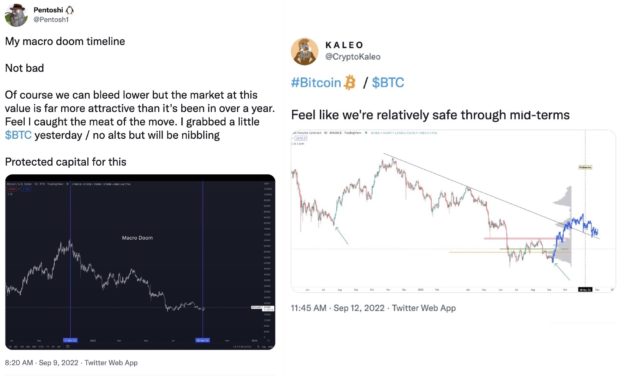
Global markets are going through a tough period — including the cryptocurrency market. But judging by talk from the peanut gallery, it seems like some observers haven’t received the memo.“Feel like we’re relatively safe through mid-terms,” Twitter’s “CryptoKaleo” — also known simply as “Kaleo” — wrote in a Sept. 12 tweet to his 535,000 followers, referring to the United State’s November mid-term elections. The prediction was accompanied by a chart indicating his belief that Bitcoin’s (BTC) price would surge to $34,000 — a 50% gain from its roughly $20,000 level as of last week — before the end of the year.“Of course we can bleed lower,” fellow pseudonymous Twitter mega-influencer Pentoshi wrote in a Sept. 9 missive to his 611,000 followers. “But the market at this value is far more attractive than it’s been in over a year. […] I grabbed a little $BTC yesterday / no alts but will be nibbling.”Those assessments come from the “respectable” observers — those who have periodically been correct in the past. One gentleman in my inbox today — a Charlie Shrem looking to sell his “investing calendar” — assured readers that a “major crypto ‘run-up’ could begin tomorrow.” Look further and it isn’t hard to find even more bullish prognostications, like the prediction that Bitcoin is on the cusp of a 400% surge that will bring it to an all-time high price of $80,000 and market capitalization of $1.5 trillion — $500 billion more than the value of all the silver on Earth.It’s good to see the optimism running rampant, even if it is mostly among influencers looking for engagement and paying customers. Unfortunately, macroeconomic headwinds indicate the reality is a little darker — perhaps a lot darker. FedEx last week underscored the possibility that economic conditions might worsen with its announcement that it had fallen $500 million short of its first-quarter revenue target. “These numbers — they don’t portend very well,” CEO Raj Subramaniam wryly noted in an interview with CNBC. His comments, which included a prediction that the numbers represented the beginning of a global recession, prompted a 21% end-of-week crash in his company’s stock price that took the wider market along for the ride.Related: What will drive crypto’s likely 2024 bull run?In response to the economic doldrums, FedEx said it was planning to take measures including the closure of 90 locations by the end of the year. The good news: Americans are so saddled with debt that it’s unlikely they were planning to visit any of those locations anyway. Consumer debt hit $16.15 trillion during the second quarter of 2022 — a new record — the Federal Reserve Bank of New York noted in an August report. The number amounts to a little more than $48,000 for every man, woman and child in the United States — 330 million in all.Total consumer debt held by Americans. Source: FRBNY Consumer Credit Panel/EquifaxWith a national median income of $31,000, that equates to an average debt-to-income ratio of 154%. If you want to factor in a little more than $30 trillion in debt held by the federal government, you can add another $93,000 per person — for a total of $141,000 and a debt-to-income ratio of 454%. (The numbers obviously become worse if you account for the fact that just 133 million Americans enjoyed full-time employment as of August.)While policymakers might be lackadaisical about government debt, they are more concerned about consumer debt. “I’m telling the American people that we’re going to get control of inflation,” President Joe Biden said in a CBS interview on Sunday, prompting observers to wonder whether he was attempting to preempt this week’s Federal Reserve announcement of a potentially enormous, 100 basis point rate hike in the federal interest rate. Such a move would likely send markets into a tailspin from which they would not recover for some time.Ironically, even that move might not be enough to tame inflation in the near term. Considering the rapid rise in debt, perhaps it’s no surprise that inflation — up a little more than 8% in August year-over-year — has shown few signs of abating. Americans may not have much money left, but — by and large — that reality hasn’t tamped down demand. If the New York Fed’s report was any indicator, the cash backing that demand is coming from credit. The bank noted that credit card debt in the second quarter experienced the largest year-over-year percentage increase in more than 20 years.Related: What will cryptocurrency market look like in 2027? Here are 5 predictionsTherein lies the rub. No matter how quickly the feds move to disincentivize debt, it isn’t clear when asset prices will rise. High debt levels — which already exist — mean less money for buying things. Increasing the cost of debt service, as the Federal Reserve is attempting to do, means less money for buying things. Forcing Americans into a state of economic ruination in order to bring costs down means less money for buying things. Failing to control inflation and allowing the cost of basic goods and services to continue rising — exacerbated, of course, by an energy crisis in Europe over which financial managers have little control — means less money for buying anything else.Maybe this outlook is the same as the one Elon Musk arrived at when he said in June that he had a “super bad feeling” about the economy. Other observers have issued even darker takes, including the famously debt-averse Rich Dad, Poor Dad author Robert Kiyosaki. “Biggest Bubble Bust coming,” Kiyosaki wrote on Twitter in April. “Baby Boomer’s retirements to be stolen. $10 trillion in fake money spending ending. Government, Wall Street & Fed are thieves. Hyper-inflation Depression here. Buy gold, silver, Bitcoin before the coyote wakes up.”Admittedly, Kiyosaki’s assessment is partially at odds with the outcomes that pessimists might expect. Economic calamity should result in declining asset prices across the board — including prices for gold, silver and Bitcoin. A more optimistic forecaster might hope that Americans will learn from their mistakes, take the next year to pay their debts, and resume spending big in 2024 — while avoiding a hyper-inflationary depression.In either scenario, one thing seems relatively certain: Neither crypto nor any other asset class is on the brink of a record-breaking surge. If you want to prosper through investing in the year ahead, you’d better start learning how to buy short options from less market-savvy optimists.Rudy Takala is the opinion editor at Cointelegraph. He formerly worked as an editor or reporter in newsrooms that include Fox News, The Hill and the Washington Examiner. He holds a master’s degree in political communication from American University in Washington, DC.This article is for general information purposes and is not intended to be and should not be taken as legal or investment advice. The views, thoughts, and opinions expressed here are the author’s alone and do not necessarily reflect or represent the views and opinions of Cointelegraph.
Čítaj viac
Are cryptocurrency games innocent fun? Or are they Ponzi schemes facing an imminent crackdown by regulators in the United States?Tokens related to cryptocurrency games — known colloquially as “GameFi” — were worth a cumulative total of nearly $10 billion as of mid-August, give or take a few billion. (The number may vary depending on whether you want to include partially finished projects, how you count the number of tokens that projects technically have in circulation, and so on.) In that sense, whether the games are legal is a $10 billion question that few investors have considered. And that’s an oversight they may soon regret.That’s because a bipartisan consensus appears to be forming among legislators in the U.S. that the industry needs to be shut down. They haven’t addressed the issue specifically — good luck finding a member of Congress who has uttered the word “GameFi” — but there are at least two bipartisan proposals circulating among senators that would effectively eject these gaming projects from American soil.The Responsible Financial Innovation Act, offered in June by Senators Cynthia Lummis (Republican from Wyoming) and Kirsten Gillibrand (Democrat from New York), would, in Lummis’ words, classify a “majority” of cryptocurrencies as securities subject to regulation by the Securities and Exchange Commission (SEC). And this month, Senators John Boozman (Republican from Arkansas) and Debbie Stabenow (Democrat from Michigan) offered a second proposal — the Digital Commodities Consumer Protection Act. The effect would be similar, but with a stronger emphasis on classifying Ethereum as a commodity — putting it under the purview of the less heavy-handed Commodities Futures Trading Commission (CFTC).Securities classification for Axie Infinity, DeFi Kingdoms and other gamesAccording to the SEC definition that Congress is looking to affirm, any token in which users invest with “an expectation of profit” is likely to be a security. Let’s talk a bit about what that may mean for your favorite tokens.For one, this definition is likely to include projects that incentivize liquidity pools. Examples of projects this would affect are Axie Infinity — which incentivizes liquidity pools with interest payouts provided through its native token, AXS — and DeFi Kingdoms (DFK), which incentivizes liquidity pools using its native tokens, JEWEL and CRYSTAL.Related: 34% of gamers want to use crypto in the Metaverse, despite the backlashWhy do liquidity pools matter? Because users are “treating it as an investment,” blockchain expert and Rutgers Business School fintech professor Merav Ozair noted in an interview last month. “If it’s a token used to buy artifacts for the game, that’s not a security. But if you can take the token and use it for investments in securities, then that token has a different use case,” she said.The Tavern in DeFi KingdomsThe definition is also likely to result in a problem for projects that have profited from initial coin offerings (ICOs), private token sales, or selling nonfungible tokens (NFTs). That includes Axie — which sold 15% of the total AXS supply in pre-game or private token sales — as well as DFK, which sold more than 2,000 “Generation 0” characters to kickstart its game last year.“Once they’re using [something] to generate capital, they fall under the definition of a security,” Ozair said.Beyond the obvious, precedent indicates that SEC prosecutors are likely to find a host of additional reasons to classify gaming tokens as securities. In a case filed last month, the agency argued that a number of tokens listed on Coinbase constituted securities for reasons that ranged from developers referring to investors as “shareholders” to one project’s decision to feature a photo of its CEO pointing at an advertisement that ridiculed Goldman Sachs.Consequences: Fines, Registration & DisclosuresConsequences: Fines, Registration & DisclosuresPenalties that game developers could face may vary depending on how lenient SEC officials feel. At the very minimum, developers will be required to follow the same disclosure laws by which public companies in the U.S. abide. That means disclosing public officers, principal stockholders — or those who hold more than 10% of token supply — and an annual report that includes an audited balance sheet and cash flows.Disclosure requirements alone could come as a rude awakening for many developers, who have become accustomed to running projects worth millions — and occasionally billions — without disclosing their names. But, more importantly, a securities classification would likely mean big fines for offending projects.Related: Crypto Unicorns founder says P2E gaming is in a long ‘maturation phase’In one case that could serve as an indicator of how regulators might approach the issue, the SEC settled this month with a project that engaged in an ICO while failing to register its offering as a security. In that case, developers agreed to file with the SEC — and compensate investors for their alleged losses — or face a penalty of up to $30.9 million.“Intent matters,” Christos Makridis, a tokenomics expert and adjunct associate research scholar at Columbia Business School, noted in an interview with Cointelegraph. “Some NFT and GameFi projects are so convoluted that there’s a clear evasion of the rules.”At the same time, he said, “If you think about the role tokens can play in gamifying education, an overly rigid and narrow definition is going to exclude a lot of value-creating projects and deter many inventors from building in the U.S.”Alabama, Hawaii, Utah, and 47 other states may want to have a wordRegulation out of Washington, D.C. is just one challenge coming down the pike for embattled crypto gaming enthusiasts. A less foreseeable issue stems from what the late U.S. Defense Secretary Donald Rumsfeld termed “unknown unknowns.”In this case, an example comes from an unlikely triad of U.S. states — Alabama, Hawaii and Utah. (If anyone is counting, Canada is also on this list.) Each jurisdiction (mostly) prohibits gambling, including raffles — which have become exceedingly popular in the world of crypto gaming.Axie, for instance, held a month-long raffle between January and February of this year promising users the chance to win a variety of NFTs if they “released” — meaning burned or deleted — their characters. DFK quickly followed suit, asking users to gamble on potentially losing their characters in March in exchange for an opportunity to receive better (more expensive) “Generation 0” characters. Smaller raffles have become ubiquitous in DFK in more recent months, with options to participate in both daily and weekly contests, among others.Experts say the raffles pose a problem for U.S. authorities even outside of the three states where they’re outright illegal.“What they need to do to be legal is set it up as a sweepstakes, which means there is an alternative free means of entry that has an equal opportunity to win as those that pay to play,” David Klein, the managing partner at New York-based law firm Klein Moynihan Turco LLP, said in an interview with Cointelegraph.“If you have to put a $200 item on the line — meaning you ruin it — to enter, then that is consideration,” Klein added. “Unless there is an alternative, 100% free method of entering, like mailing in a postcard, or calling a 1-800 number, or going to a website and filling out information.”The list of problems didn’t end there. Disgruntled players have long criticized aspects of DFK’s raffle system — including a promise to award 800 “amulets” (an NFT representing a piece of equipment) randomly to players who held between approximately $1,000 and $50,000 in JEWEL tokens from Dec. 15 to Jan. 15. As of mid-August — seven months after the raffle’s end — the amulets had yet to be awarded, with developers promising that the equipment is still in the works.“There are a lot of problems there,” Klein said. “When you have these contests, it’s important to communicate. The start date [of the raffle] has to be announced in advance of the contest starting. The contest rules have to be drafted, and they cannot be meaningfully changed. You have to do what you say you’re going to do by way of awarding prizes and when. You have to report to specific state jurisdictions who won and supply them with a list of winners within X amount of days. And if you don’t do so, you violate those state statutes.”Related: Coinbase hit with 2 fresh lawsuits amid SEC probeThat’s in addition to any other regulatory or legal hazards that developers may have instigated by taking their projects global before assembling legal teams to examine potential hazards.Declining players, expanding token supplies, dropping pricesBeyond unforeseen legal ramifications, developers face a more apparent problem: a rapidly diminishing user base. The number of users interacting with Axie Infinity fell from a peak of 744,190 on Nov. 26, according to blockchain data aggregated by DappRadar, to 35,420 on Aug. 20 — a decline of 95%. DFK players, meanwhile, declined by 85%, from a peak of 36,670 in December to 5,290 as of Aug. 19.The decline comes amid a rapid expansion in circulating token supply, with DFK’s JEWEL supply expanding from roughly 60 million to more than 100 million over the same period. The supply stands to increase by 500% — to 500 million — by mid-2024, not including a new token — CRYSTAL — the game launched on the Avalanche (AVAX) chain.When asked how many years of hard prison time developers could be facing for improperly conducted raffles, Klein — who handles compliance for a slate of confidential, big-name NFT projects — demurred. “I want to help the industry do it right,” he said. But, regarding projects that haven’t complied, he said, “You could be accused of violating state gambling laws by a regulator, which is criminal. You could be sued by a private litigant who is upset. Or a combination of the foregoing.”Axie Infinity appears to have 80 million tokens in circulation, with another 190 million scheduled for release over the next three-and-a-half years. It merits noting that developers appear to be tinkering with official circulation figures, which may become another cause for scrutiny among securities regulators in the future.Rapidly expanding token supplies — combined with a diminishing number of buyers — means unrelenting downward price pressure, an issue that could drain developers of legal funding when it’s most needed.Can devs do something?Lummis, Gillibrand and other lawmakers have indicated that Congress will likely pass legislation clarifying securities law related to crypto by mid-2023. The impending sea change begs a question: Where are the developers behind these projects? Nary a peep has been heard from the $10 billion industry. (By the way, keep in mind that figure only counts the value of tokens related to gaming projects and not their characters, land, or other NFTs.)Related: GameFi industry to see $2.8 billion valuation in six yearsDevelopers behind the top 16 play-to-earn projects — according to CoinGecko’s list — have made their identities known. That obviously includes those associated with Axie Infinity developer Sky Mavis. But the majority, like those behind DFK, have opted to remain anonymous, disclosing little about even the countries in which they reside. (In fairness, DFK did incorporate a legal entity — Kingdom Studios — in Delaware this year. That entity did not respond to a request for comment.)Realistically, developers have fewer than 365 days to begin lobbying legislators if they would like to see congressional proposals amended. So far, they’ve been radio silent. With each day that quietly passes, it seems increasingly likely that silence is going to result in GameFi investors getting wrecked.Rudy Takala is the opinion editor at Cointelegraph. He worked formerly as an editor or reporter in newsrooms that include Fox News, The Hill, and the Washington Examiner. He holds a master’s degree in political communication from American University in Washington, D.C.The opinions expressed are the author’s alone and do not necessarily reflect the views of Cointelegraph. This article is for general information purposes and is not intended to be and should not be taken as legal or investment advice.
Čítaj viac
