Autor Cointelegraph by Robert Lakin

Saylor signals Strategy is ‘Back’ to Bitcoin buying

Strategy’s Michael Saylor said “We’re Back” in his latest signal on X (formerly Twitter) of the company’s likely return to Bitcoin buying.For market watchers, the post could be a strong psychological signal as Saylor has a track record of dropping cryptic weekend teasers that precede official Monday morning treasury purchase announcements. Should that record, and community interpretation, hold true, his post points to the resumption of corporate Bitcoin accumulation following a notable summer hiatus.To put the message in context, over the past two months, Strategy paused its regular weekly Bitcoin buying spree. Instead of expanding its crypto holdings, management pivoted toward bolstering its balance sheet. The firm focused on stabilizing its preferred stock offerings, building a $5.1 billion US dollar reserve, and introducing a dedicated $1.59 billion cash pool generated through massive common stock offerings.Related: Strategy’s $66B Bitcoin machine hinges on capital markets, not BTC price: ReportThis strategic breather coincided with a challenging market stretch that left Strategy’s industry-biggest BTC treasury sitting deep in the red on paper. However, recent macro momentum has propelled Bitcoin past the $80,000 threshold.Because Strategy holds more than 840,447 Bitcoin at an average cost basis hovering around $75,385, the recent price recovery has pushed the firm’s overall position back into positive territory for the first time in months.Saylor’s “We’re Back” declaration functions on multiple levels. Operationally, it likely signals that the company is ready to deploy its considerable dry powder back into the asset class it champions. Psychologically, it marks a triumphant return to profitability and a renewed offensive for the world’s largest corporate Bitcoin treasury.Magazine: 200,000 fake AI ‘victims’ deployed to scam bait online fraudstersCointelegraph is committed to independent, transparent journalism. This news article is produced in accordance with Cointelegraph’s Editorial Policy and aims to provide accurate and timely information. Readers are encouraged to verify information independently.

Čítaj viac

Fed study finds crypto investors driven by beliefs, easily swayed by returns

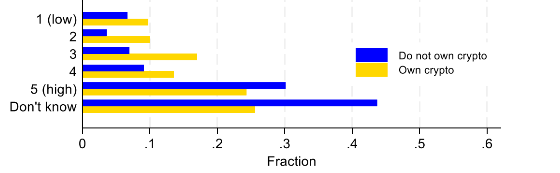
A new Federal Reserve Bank of Cleveland working paper offers a provocative explanation for why cryptocurrency behaves so differently from traditional financial assets: Americans who buy crypto don’t simply have different demographics or risk appetites, they have radically different beliefs about digital assets’ future returns.The finding could help explain both crypto’s persistent volatility and the way rallies can attract new buyers, potentially creating a feedback loop in which rising prices reinforce bullish expectations and pull more investors into the market.Using repeated surveys of as many as 25,000 US households per wave, researchers Michael Weber, Bernardo Candia, Olivier Coibion and Yuriy Gorodnichenko found that expectations about crypto returns explain more of the variation in who owns cryptocurrency than a broad range of demographic characteristics. The paper, titled “Do You Even Crypto, Bro? Cryptocurrencies in Household Finance,” also uses a randomized information experiment to show that simply giving people information about Bitcoin’s (BTC) recent performance can increase both their desired crypto allocation and their subsequent purchases. Perceived risk of crypto by ownership. Source: Federal Reserve Bank of ClevelandThe researchers say the results point to a potential mechanism behind speculative bubbles: past gains can attract new investors, whose purchases push prices higher and potentially attract still more buyers. “Positive returns attract new participants, which raises the price further,” the authors writeThat dynamic is particularly striking because cryptocurrency remains poorly understood by a large share of the population. In the researchers’ 2021 survey, 87% of people who did not own crypto said they didn’t know what return to expect from it over the following year. Among crypto owners, the figure was still 54%. Related: Canadian crypto ownership increases to 25%: Ontario surveyOwnership linked to double-digit returns expectationsFor those willing to make a forecast, however, the gap was enormous. Crypto owners expected an average 22% return over the following year, compared with just 7% among non-owners. Owners also tended to view crypto as less risky than non-owners did. The researchers found that expected returns were unusually powerful in determining ownership. A one-percentage-point increase in an individual’s expected crypto return was associated with a 0.8-percentage-point increase in the probability of owning cryptocurrency. Expectations about returns and risk together explained considerably more variation in crypto ownership than observable characteristics such as age, income and gender. That makes crypto an outlier compared with stocks, bonds and gold. For traditional assets, demographic and financial characteristics generally have much more explanatory power than differences in expected returns. Crypto reverses that relationship. Source: Federal Reserve Bank of ClevelandThe demographic profile of crypto investors nevertheless remains distinctive. People under 40 were 13 percentage points more likely to own cryptocurrency than those over 60, even after controlling for other characteristics. Men were about 4 percentage points more likely than women to own crypto, while higher-income and wealthier households were also more likely to participate. The experiment provides perhaps the paper’s most consequential finding for crypto markets.In 2025, researchers randomly assigned households to receive information about BTC, stocks, GameStop or inflation. Participants who were shown Bitcoin’s previous 12-month return increased their desired crypto portfolio allocation by roughly 2 percentage points, or about a 47% increase relative to the 4.3% desired allocation among the control group. Actual subsequent crypto purchases also rose by about 2.5 percentage points. The authors describe the result as “providing information about recent Bitcoin returns induces some households to start buying cryptocurrency.” The effect was concentrated among people who said they didn’t own crypto because they lacked sufficient information. Those who already believed crypto was a bad investment generally did not respond to the information treatment. The paper also finds that crypto wealth can spill into household consumption. A doubling in BTC’s price made a household whose entire financial portfolio was in crypto 1.4 percentage points more likely to buy a durable good, equivalent to roughly a 7% increase relative to the unconditional probability of such a purchase. But the effect did not persist into ordinary spending. That led the researchers to a stark comparison: crypto gains appear to be treated more like “gambling income” or lottery winnings than a permanent increase in wealth.The broader implication is that crypto’s volatility may be rooted partly in disagreement and learning rather than simply market fundamentals. The authors conclude that cryptocurrency stands out because it is poorly understood, investors form sharply different views about its prospects, and new information about past returns can change both expectations and behavior.“The absence of common information and beliefs about crypto across investors,” they write, “suggests that price volatility will continue to be one of the most defining characteristics of this new asset for the foreseeable future.” For crypto markets, that suggests a potentially uncomfortable conclusion: the next wave of retail demand may depend not only on Bitcoin’s price, but on what investors are told about the price that came before it.Magazine: The 100x obsession: Fundamentals grow in importance as crypto matures

Čítaj viac

Texas electric grid moratorium won’t have big impact on BTC miners: Bernstein

Bitcoin miners with operations in Texas are not expected to be impacted by a moratorium on approval of data center projects connected to the state’s grid operator ordered by Governor Greg Abbott, Bernstein analysts said Tuesday.Abbott on Monday directed the Public Utility Commission of Texas and the Electric Reliability Council of Texas (ERCOT) to audit all data centers seeking to connect to the state’s power grid. The duration of the audit was not specified and comes amid increasing public backlash to the pace of data center build-out across the state, The Texas Tribune reported.Bernstein analysts told clients on Tuesday that as most of the Bitcoin (BTC) miners operating in Texas are under contract for approved electric capacity, those operations are unlikely to be impacted by the moratorium.“However, we believe, this audit throttles speculative data center pipeline and makes genuine sites with development history more valuable,” the research team led by Gautam Chhugani said in its note. “Bitcoin mining sites are favorably placed with the longest gestation, self-funding infra and local community management,” they said.They said that the local operations of Cipher Digital (CIFR), Core Scientific (CORZ) and CleanSpark (CLSK) could be the miners most exposed to future public opposition to data center expansion, particularly during ERCOT’s approval process to convert their pipeline assets into grid-connected power capacity.“We believe with increasing political opposition to new data center projects and fresh capacity being throttled by moratoriums/state directives, the approved MWs become more valuable,” they said, highlighting the Texas mining operations of IREN (IREN), which is fully ERCOT grid approved, as are the operations of Riot Platforms (RIOT).CIFR shares were down more than 7% in Tuesday’s premarket trading, according to Yahoo Finance data. The miner reported second-quarter results earlier Tuesday, posting a loss of $0.65 per diluted share, widening from last year’s loss of $0.12 per diluted share. Related: Bitcoin may find bear market bottom in August: 10x ResearchCointelegraph is committed to independent, transparent journalism. This news article is produced in accordance with Cointelegraph’s Editorial Policy and aims to provide accurate and timely information. Readers are encouraged to verify information independently.

Čítaj viac

Hashdex to shut smallest Bitcoin ETF after more than two years

Hashdex said it will liquidate its eponymous spot-price Bitcoin exchange-traded fund this month, distributing the cash to all remaining shareholders and selling the fund’s roughly 225 BTC holdings.In a filing on Monday, the fund issuer said the decision was made after evaluating factors including trading liquidity, operating costs and investor interest. The 200,000 shares, which have traded on NYSE ARCA under the DEFI ticker since March 2024, have net assets of $14.25 million, according to the fund’s website.Late to the game, which saw the first of 10 other competing BTC ETFs debut months ahead of it, analysts saw opportunity at a time when BTC was trading for the then-all-time high of more than $73,000.“The getting is so good right now I could see this one getting some bites (if the fee is competitive) despite being so late,” said Bloomberg Senior ETF analyst Eric Balchunas in a March 27, 2024 post.Originally launched in 2022 as a Bitcoin futures ETF, Hashdex Bitcoin Futures ETF, its highest asset level was $17.54 million, reached on May 9, 2025, according to data tracker SoSoValue. The next largest ETF among the US-traded BTC issues is WisdomTree Bitcoin Trust (BTCW), with $140.37 million in net assets as of Friday’s market close.Related: Bitcoin may find bear market bottom in August: 10x ResearchCointelegraph is committed to independent, transparent journalism. This news article is produced in accordance with Cointelegraph’s Editorial Policy and aims to provide accurate and timely information. Readers are encouraged to verify information independently.

Čítaj viac

Strategy leaves preferred STRC dividend at 12% as price still below par

While Strategy’s preferred STRC shares ended July well below their $100 par value, investors were told that their August dividend will not increase, holding at 12%.Executive chairman Michael Saylor delivered the news in a tweet on Saturday, continuing to pitch STRC as a way to “stretch your income.” August will be the second month that the dividend will be paid semi-monthly after shareholders approved that change in June.STRC shares closed at $89.46 on Friday, clocking a 5.42% price increase for the month which began with a dividend hike — 50 basis points to 12% — after a poor stock performance in June. The volume on the Nasdaq-traded shares on Friday were about two-thirds of their daily average. STRC shares continued to trade significantly below their $100 par value in July.Source: TradingViewOn Friday, Strategy CEO Phong Le reiterated that management’s “corporate objective is for STRC to trade at $99-$100 over time,” without elaborating when investors might expect that to transpire. Related: Bitcoin ETFs end July in the green despite late-month sellingBuilding cash reserve to make preferred payoutsSaylor, however, did take to social media on Sunday to dangle the possibility that the company will be making an announcement of a change in its Bitcoin treasury holdings. “Bitcoin Drive engaged,” read his X post, following a familiar pattern of posting a chart of Strategy’s BTC buys from Saylortracker.com to start off the week. Last week, Strategy reported an $8.22 billion second-quarter net loss, driven primarily by an $8.32 billion unrealized loss on its Bitcoin (BTC) holdings as the cryptocurrency’s price declined during the quarter.The Bitcoin treasury company said it has built a $3.75 billion cash reserve to support preferred stock payouts following the launch of its BTC monetization program.Strategy also said it has built a $3.75 billion U.S. dollar reserve, enough to cover more than two years of preferred dividend payments and interest obligations. The company recently repurchased $25 million of its STRC preferred shares at a discount to par and said it intends to continue buying the securities while they trade below $100.Magazine: Here’s why the CLARITY Act’s ethics deal may be so hard to reachCointelegraph is committed to independent, transparent journalism. This news article is produced in accordance with Cointelegraph’s Editorial Policy and aims to provide accurate and timely information. Readers are encouraged to verify information independently.

Čítaj viac

Získaj BONUS 8 € v Bitcoinoch

nakup bitcoin z karty

Registrácia Binance

Burza Binance

Aktuálne kurzy