Autor Cointelegraph By Ray Salmond

Will the Bitcoin mining industry collapse? Analysts explain why crisis is really opportunity

Bitcoin mining involves a delicate balance between multiple moving parts. Miners already have to face capital and operational costs, unexpected repairs, product shipping delays and unexpected regulation that can vary from country to country — and in the case of the United States, from state to state. On top of that, they also had to contend with Bitcoin’s precipitous drop from $69,000 to $17,600. Despite BTC price being 65% down from its all-time high, the general consensus among miners is to keep calm and carry on by just stacking sats, but that doesn’t mean the market has reached a bottom just yet. In an exclusive Bitcoin miners panel hosted by Cointelegraph, Luxor CEO Nick Hansen said, “There’s going to definitely be a capital crunch in publicly listed companies or at least not even just publicly listed companies. There’s probably close to $4 billion worth of new ASICs that need to be paid for as they come out, and that capital is no longer available.”Hansen elaborated with: “Hedge funds blow up very quickly. I think miners are going to take 3 to 6 months to blow up. So we’ll see who’s got good operations and who’s able to survive this low margin environment.” When asked about future challenges and expectations for the Bitcoin mining industry, PRTI Inc. advisor Magdalena Gronowska said, “One of the biggest challenges that we’ve had in this transition to a low-carbon economy and reducing GHG emissions has been an underinvestment in technology and infrastructure by the public and private sectors. What I think is really amazing about Bitcoin mining is that it’s really presenting a completely novel way to fund or subsidize that development of energy or waste management infrastructure. And that’s a way that’s beyond those traditional taxpayer or electricity ratepayer pathways because this way is based on a purely elegant system of economic incentives.”Will Bitcoin destroy the environment?As the panel discussion shifted to the environmental impact of BTC mining and the widely held assumption that Bitcoin’s energy consumption is a threat to the planet, Blockware Solutions analyst Joe Burnett said: “I think Bitcoin mining is just not bad for the environment, period, I think if anything, it incentivizes more energy production, it improves grid reliability, and resilience and I think it will likely lower retail electricity rates in the long term.” According to Burnett, “Bitcoin mining is a bounty to produce cheap energy, and this is good for all of humanity.” Related: Texas a Bitcoin ‘hot spot’ even as heat waves affect crypto minersWill industrial Bitcoin mining catalyze the long-awaited “mass adoption” of crypto? Regarding Bitcoin mining dominance, the future of the industry and whether or not the growth of industrial mining could eventually lead to crypto mass adoption, Hashworks CEO Todd Esse said, “I believe that most of the mining down the road will be held in the Middle East and North America, and to some extent Asia. Depending upon how much they are eventually able to cut off. And that really speaks to the availability of natural resources and the cost of power.”While it is easy to assume that growing synergy between big energy companies and Bitcoin mining would add validity to BTC as an investment asset and possibly facilitate its mass adoption, Hansen disagreed. Hansen said: “No, certainly not, but it is going to be the thing that transforms everyone’s life whether they know it or not. By being that buyer of last resort and buyer of first resort for energy. It’s going to transform energy, energy markets and the way it is produced and consumed here in the US. And overall, it should significantly improve the human condition over time. Don’t miss the full interview on our YouTube channel and don’t forget to subscribe!Disclaimer. Cointelegraph does not endorse any content of product on this page. While we aim at providing you all important information that we could obtain, readers should do their own research before taking any actions related to the company and carry full responsibility for their decisions, nor this article can be considered as an investment advice.

Čítaj viac

Bitcoin price falls under $21K, bringing more capitulation or just consolidation?

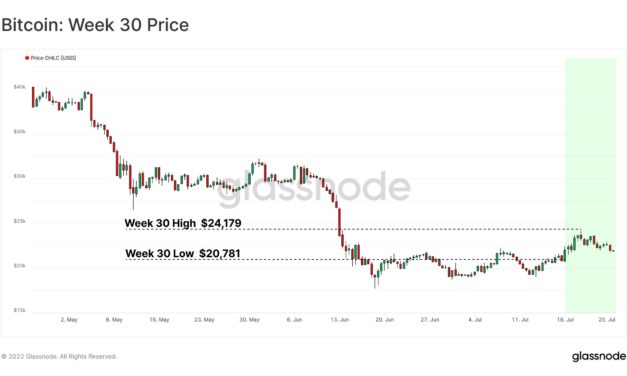
On July 26, Bitcoin (BTC) price dropped below $21,000, giving back the majority of the gains accrued in the previous week and returning to the $23,300 to $18,500 range that Glassnode analysts describe as “the Week 30 high and Week 30 low.” A handful of analysts and traders attribute the July 26 to July 27 Federal Open Market Committee (FOMC) meeting and the expected Federal Reserve rate hike as the primary reasons for the current sell-off. Barring the announcement that the United States economy has entered a recession, a few traders believe that the expected 75 to 100 basis point (BPS) hike will be followed by a relief rally that could see BTC, Ether and other large-cap altcoins snack back to the top of their current range. Of course, this sentiment reflects more speculation than sound analysis, so take it with a grain of salt. Bitcoin week 30 price range. Source: GlassnodeGiven that BTC price is simply continuing to trade in the same range that it has been in for the past 42 days, the real question is whether the market will bring more consolidation or another round of capitulation. In its July 26 on-chain newsletter, Glassnode analysts posit that investors can find their “conviction through confluence” of multiple technical and on-chain metrics which suggest the peak of capitulation has long past. According to the analysts, rapid deleveraging threw many metrics into “extreme statistical deviations” and with the worst of the selling possibly behind us, Bitcoin price returning to the high $20,000 zone was expected. Glassnode notes that the: “The June leg down in price action has produced the lowest 4-yr rolling Z-Score value on record.” And the analysts explained that the 4-year rolling MVRV Z-score “signaled undervaluation for all bear cycle bottoms, including 2015, 2018, and the March 2020 flash crash.” Bitcoin MVRV Z-Score 4 year Rolling chart. Source: GlassnodeWhen compared against various cohorts of long and short-term sellers, and metrics like Realised Price, Mayer Multiple and longer-term daily and weekly moving averages, Glassnode suggests that confluence in the indicators and historical data point to growing bullish momentum. On-chain data spots a bottom, but what does technical analysis say? From the perspective of technical analysis, Bitcoin’s move to $24,200 presented a brief breakout from the current range, but the inability to sustain momentum at this level presented the necessary alternative of a lower support retest at the range midline near the 20-day moving average ($21,500). According to independent market analyst Michaël van de Poppe, $21,600 was the area for BTC to hold and below this the asset’s price action is dependent upon commentary from this week’s FOMC comments. The markets are correcting and preferred was $21.6K to hold for #Bitcoin.That’s a crucial breaker now too if it breaks to the upside – > new highs.Looking at a $20.5K-20.7K area to hold for #Bitcoin going into FOMC tomorrow.If upwards after. pic.twitter.com/tueXPNprza— Michaël van de Poppe (@CryptoMichNL) July 26, 2022CryptoISO expressed a similar sentiment regarding the correlation of equities to Bitcoin and the importance of the $21,500 zone for BTC price.Part of longing the 21.5k zone on BTC was confluence w support on NQ.That is gone.Retesting a breakout now but all this looks like crap to be honest.Selling before tomorrow is interesting though.If you are bullish you want to see that but earnings is driving it so far. pic.twitter.com/rh5d3wKgjG— CryptoISO (@crypto_iso) July 26, 2022

Fractal lovers will note that the price action within the current range is eerily similar to the May 8 through July 12 range-bound trading and following breakdown that took place on July 12, but analysts would quickly point out that back-to-back calamities like Voyager, Celsius and 3AC blowing up played a significant role in that sell-off, whereas now there appears to be no discernible black swan events on the horizon. BTC/USDT daily chart. Source: TradingviewRegardless, both reflect periods of 34 to 42 days of sideways trading and on many occasions, veteran trader Peter Brandt has identified the current market structure as a “bearish rectangle” technical analysis pattern. Bearish rectangle breakdown. Source: MoneyControl.comIn the event that the pattern breaks to the downside from the current range, this would place the price in the $14,500 to $13,000 zone some traders have been lusting for.BTC/USDT daily chart. Source: TradingviewUltimately, last week’s range breakout to $24,200 (July 20) pierced the upper band of the Bollinger Bands momentum indicator and now that price is below the midline, there is an increased chance that BTC could trade down to the lower band which conveniently resides at the bottom of the current range ($24,200 to $18,600). Trading within range is not much to worry about until a breakout or breakdown catalyst emerges. Perhaps tomorrow’s (July 27) earnings from big tech companies, the state of the market at the opening bell and comments from the FOMC will determine the direction Bitcoin decides to take. The views and opinions expressed here are solely those of the author and do not necessarily reflect the views of Cointelegraph.com. Every investment and trading move involves risk, you should conduct your own research when making a decision.

Čítaj viac

Bitcoin miners sell their hodlings, and ASIC prices keep dropping — What’s next for the industry?

Crypto companies are going belly up left and right, and Bitcoin mining companies also appear to be taking on water faster than they can bail. In mid-June, Compass Mining CEO Whit Gibbs and chief financial officer Jodie Fisher abruptly resigned after allegations that the Bitcoin mining hardware and hosting company had failed to pay hundreds of thousands of dollars in overdue electricity bills to Dynamics Mining, a facility provider for Compass.Bloomberg recently reported that many industrial-size Bitcoin miners took on a significant amount of debt by leveraging their equipment and BTC as collateral for loans to either acquire additional gear or expand their operations. According to the report, and data from Arcane Research, miners owe some $4 billion in loans and now that Bitcoin price trades near its 2017 all-time high, the trend of miners liquidating their BTC holdings at swing lows to cover capital costs and operational costs is expected to pick up speed. In the last month Marathon Digital, Riot Blockchain, Core Scientific, Bitfarms and Argo Blockchain PLC have each sold between 1,000 to 3,000 BTC to cover debts, operational (OPEX) and capital expenses (CAPEX). The troubles faced by miners are also having a knock-on-effect on ASICs and their pricing at major mining hardware merchants like Big Sky ASICs, ASIC Marketplace, Bitmain and Kaboomracks shows popular top and mid-tier ASIC miners selling up to 70% down from their all-time highs in the $10,000 to $18,000 range. With data from Arcane Research showing publicly traded industrial miners now selling more Bitcoin than they mined in May, it’s possible that some will either reduce their footprint and scale back, or go out of business if they are unable to cover OPEX and CAPEX debt. According to Jaran Mellerud, a Bitcoin mining analyst at Arcane Research: “If they are forced to liquidate a considerable share of these holdings, it could contribute to pushing Bitcoin price further down.” Of course, news headlines and tweet threads only ever tell a small part of the story, so Cointelegraph reached out to Luxor Technologies head of research Colin Harper to gain clarity on how industrial miners view the current situation. Cointelegraph: Bitcoin is trading below the realized price and at times, it’s dipped below miners’ cost of production. So far, the price has struggled to hold above the 2017 all-time high and the hash rate is dropping. Typically, on-chain analysts pinpoint these metrics hitting extreme lows as a generational purchasing opportunity. What are your thoughts? Colin Harper: I don’t really like telling folks when and when not to buy. That said, I never thought we’d see $17,000 BTC again. Anything around or under $20,000 seems like a good deal to me, but I’m also preparing for lower prices should that happen.CT: What is the state of the BTC mining industry right now? There are miners liquidating their stack, leveraged miners might go bust, sub-optimal miners are turning off their rigs and ASICs are currency on a firesale. Listed miners’ stock price and cash flow is looking pretty bad right now. What’s happening behind the scenes and how do you see this impacting the industry of the next six months to a year? CH: The short, straight, and skinny: Profitability is in the toilet, so miners with too much debt, high operational costs, or both are being shaken out. Hash rate will grow much more slowly this year than anticipated as a result of the profitability crunch, ASIC prices will continue to fall, and a lot of new miners who hopped on the hash train last year will be thrown off. Miners with all-in costs at or below $0.05/kWh are still mining with fat profit margins.The long, lumpy, and fat:In 2021, Bitcoin mining profitability hit multi-year highs. At the same time, interest rates were still low and miners took on debt to finance hash rate expansions during this profitability boom. Now, things have changed: Profitability is slipping toward all-time lows, interest rates are rising, energy prices are skyrocketing, and all indicators point towards a global recession. Plenty of miners signed hosting contracts, power purchasing agreements, and other operational agreements using 2021 profitability models, not factoring in the current conditions. Now that bull market conditions have flipped and the bear market is here, miners with higher costs and untenable debt are starting to liquidate their operations.Still, we haven’t heard of any miners having equipment seized and forced liquidation. There’s plenty of self-imposed selling from miners who got ahead of themselves last year, but plenty of public miners are still mining at healthy margins. As for the next six months, some miners, both public and private, will become insolvent, so we expect bankruptcies and plenty of mergers and acquisitions in the year to come. With energy prices high and rising, miners will have to get smart to lower costs and find cheaper sources of power. Off-grid miners will thrive in the years to come.To illustrate this with data:In 2021, the hash price average was ~$0.30/TH/day (so, on average, a 100 TH machine like an S19j Pro would net you $30 in revenue per day). Right now, hash price is ~$0.088/TH/day, so that same machine is making $8.80 a day. If your power cost is $0.06/TH/day, then this rig is netting you $4.40 in profit (versus $25.60 on average last year). The hash price is a metric from Luxor’s Hashrate Index, which is used to calculate the expected revenue of a unit of hash rate when a miner is using a Full-Pay-Per-Share (FPPS) pool like Luxor. The hash price is denominated as $ per terahash per day, whereas terahash refers to the speed at which a Bitcoin mining machine produces computations. At $0.09/TH/day, a 100 TH machine would earn $9 per day when using Luxor or a similar FPPS pool.CT: Exactly why is now a good or bad time to start mining? Are there particular on-chain metrics or profitability metrics that you’re looking at or is it just your gut feeling? CH: Given that hashprice is nearing all-time lows, it’s a rough time to start mining, but the bear market will give shrewd investors the opportunity to lay the groundwork to flourish in the next bull market. Machine prices are falling drastically, so it’s becoming much more affordable to purchase a new generation machine (Luxor’s ASIC Trading Desk has folks selling Whatsminer M30 and Antminer S19 series rigs for $30–50/TH). Of course, there’s a reason that the rigs are getting cheaper, and that’s because they’re making 1/3rd of what they made last year (and they will likely make even less than that when this bear market is said and done). I expect machine prices to come down lower still.Now all of that said, if you can find favorable power rates and/or a good hosting agreement, the next few months will likely provide favorable ASIC prices for those looking to bootstrap a mining operation. The bear market will be a great time to position yourself for the next bull run. Related: Bitcoin’s bottom might not be in, but miners say it ‘has always made gains over any 4-year period’ CT: Let’s say I have $1 million cash, is it a good time to set up an operation and start mining? What about $300,000 to $100,000? In the $40,000 to $10,000 range, why might it not be a good time to set up at home or use a hosted mining service?CH: Definitely not a good time to try to set up a home mining operation. As for deploying capital on an industrial scale, it really depends on the site and the expertise of the folks running it.CT: Would you say that right now is a good time for home-based miners to get in the game? Say a regular joe looking to run two Antminer s19j Pros with an immersion set up? CH: Unequivocally no. If it were me, I would wait until ASIC prices drop further. Even then, I would want to make sure that I could do something to optimize ASIC efficiency to improve ROI (for example, if you can recycle heat to heat your home, and thus not pay for heating in the winter or something, then you are actually accelerating ROI because you are earning BTC and covering heating costs that you would have to pay for anyway).CT: How could the upcoming Bitcoin halving alter the landscape of industrialized mining and the amount of equipment required to solve an algorithm that becomes more difficult to crack with each halving? CH: Bitcoin miners will try to increase their hash rate as much as possible before the halving. Rising energy prices and low profitability will hamper this (some), but miners with cheap costs and conviction will grow their fleets accordingly. In terms of industrialization, it certainly seems like mining is heading that way, though I think the equation changes once energy producers (oil companies, renewables farms, power authorities, etc) start mining bitcoin at scale–power costs and recessionary pressures could limit the scope and scale industrial mining that we see with the Riot Blockchain and Core Scientific-size miners in the industry.Disclaimer. Cointelegraph does not endorse any content of product on this page. While we aim at providing you all important information that we could obtain, readers should do their own research before taking any actions related to the company and carry full responsibility for their decisions, nor this article can be considered as an investment advice.

Čítaj viac

Bitcoin’s bottom might not be in, but miners say it ‘has always made gains over any 4-year period’

Your favorite trader is saying Bitcoin (BTC) bottomed. At the same time, the top on-chain indicators and analysts are citing the current price range as a “generational buy” opportunity. Meanwhile, various crypto and finance media recently reported that Bitcoin miners sending a mass of coins to exchanges are a sign that $17,600 was the capitulation move that pins the market bottom. There’s so much assurity from various anon and doxed analysts on Crypto Twitter, yet Bitcoin price is still in a clear downtrend, and the metrics don’t fully reflect that traders are buying every dip. A critical component of BTC price that many investors often overlook is the condition and sentiment of Bitcoin miners, which is exactly why Cointelegraph had a chat with Rich Ferolo of Blockware Solutions and Will Szamosszegi of Sazmining Inc. to gain clarity on what’s happening in the mining industry and how this might impact market sentiment going forward. Cointelegraph: Is the bottom in for Bitcoin? The price touched $17,600 nearly two weeks ago and it’s starting to feel like the fund-driven capitulation armageddon might be over. Thoughts? Will Szamosszegi: It’s impossible to say whether or not Bitcoin has hit a bottom. In general, I recommend a dollar-cost-averaging strategy to people: Just buy however much Bitcoin you feel comfortable with on a consistent schedule. We’ve seen drawdowns even bigger than this before — such as 93.7% in its early days and 83.4% in 2018. Bitcoin has always made gains over any four-year period in its history.CT: Currently, Bitcoin is trading below the realized price and below miners’ cost of production. The price also dipped below the previous all-time high and the hash rate is dropping. Typically on-chain analysts pinpoint these metrics hitting extreme lows as a generational purchasing opportunity, but is it? Rich Ferolo: Blockware has done a lot of research on this and we’ve calculated the breakeven price from machines as far back as the s9 from 2016, at $.07 per kilowatt, the breakeven is $38,000 for a s9. You’re going to see older machines coming off the network eventually. For the s17s, at $.07 cents per kilowatt, BTC needs to be at around $18,000. Newish machines are more efficient and while difficulty and the hash rate adjustment are trending down for current generation machines, anything above 90 terahashes (TH/s) can make it. Anything below 34 watts per Terahash is inefficient. One factor to consider is that the value of machines is going down. Even if BTC price starts to go up and there’s a symbiotic relationship between price and the macro factors impacting Bitcoin price and prices throughout the wider-crypto market.Machines are hard assets and the big aspect of mining is the machine. Bitmain and MicroBT adjust prices as BTC price goes up. This is a hard asset that, in a way, earns yield on a daily basis, the same way that BTC does. If you’re in the long game, you don’t care about the current price of BTC. Just because the BTC price goes down doesn’t mean all the miners will go down also. It’s more about survival of the fittest. You need to be aware of the macros, but it’s not as bad as one might think. There are different perspectives and situations depending on what size outfit you’re running. Big public companies have a lot of operational factors to consider, but their operational costs (OPEX) inflate their overall cost even if they get $.05 per kilowatt. Their model is different from the analytics of the average miner outside of the public user. CT: What is the state of the BTC mining industry right now? There are rumors that leveraged miners could go under, inefficient miners are turning off and equipment is being sold 50% to 65% lower than 2020 to 2021 prices. What’s happening behind the scenes and how do you see this impacting the industry for the next six months to a year? RF: I agree with all of your observations. We’re at a price consolidation point currently and the market is cleaning up the amount of mining debt that exists. If you can hang on and keep mining, it might keep the hash rate and difficulty at bay. Blockworks believes that there is a severe lack of infrastructure in the space. To have infrastructure, you have to have an incredible amount of CAPEX to get going. There’s been and still is a lack of infrastructure. Regardless of the machines that are there, there’s not a lot of space for hosting. From the broader standpoint, you’re going to see a lot of capitulation, insolvency and excess machines. I know a lot of the big players are putting a pause on funding for miners. That’s a plus for people wanting to get in the space, but we predicted a 60% hash rate increase in 2022 when things were booming. And, as the s19XPs come into light, the hashrate will go up. WS: Many veterans in this space have grown accustomed to these cycles in the Bitcoin ecosystem. Historically, you see the hashrate decline following the price doing the same. In drawdowns like this one, newer miners typically wash out, while the network fortifies. Over the next six months, mining will become more competitive, as bigger players may consolidate and buy miners at a discount.CT: Exactly why is now a good or bad time to start mining? Are there particular on-chain metrics or profitability metrics that miners are looking at or is it just a no-brainer that Bitcoin’s current pricing makes mining attractive? Let’s say I have $1 million cash, is it a good time to set up an operation and start mining? What about $300,000 to $100,000? At the $40,000 to $10,000 range, why might it not be a good time to set up at home or use a hosted mining service? RF: Regardless of the size of the investment, I don’t think any of those values frankly would warrant you wanting to set up infrastructure at scale. A million bucks worth of machines at $5,000 per machine will get you 200 machines, almost a 0.6 megawatts worth. 1 megawatt of power is equal to 300 machines. Housing 200 machines is way different than housing 2 to 10 machines. To diversify $1 million to $300,000, or 60 machines, that’s where you want to start looking at hosting, assuming you’re all in on mining. I treat mining as a hedge, so I’d take 60% of the capital and buy machines and 40% buy spot BTC, or 60% CAPEX for machines, 20% for OPEX and 20% for spot BTC. This is a broader place to think about hosting. $100,000 gets you 20 machines, so you could apply the same strategy. Most residential homes can’t handle that much power demand. There’s a threshold of at-home mining power capacity so you’d have to consider how much power you can get to your house without shutting down the neighborhood. The $10,000 to $40,000 range is more amenable to at-home mining. If your power rate is fixed at $.10 or below you could pull it, depending on where the price is. $40,000 will get you about eight machines. That’s more doable, to be honest. It’s about 24.4 kilowatts per hour for eight machines if you start from four to five machines and test the waters. It’s almost like dollar-cost-averaging into machines and buying them if prices continue to drop.Related: Buy Bitcoin or start mining? HashWorks CEO points to ‘attractive investment yield’ in BTC miningCT: Does BTC price dropping below its all-time high for the first time ever have any significant future ramifications on the fundamentals of the asset and industry? WS: The fundamentals of BTC are unchanged, which is why I still expect BTC to evolve into a global reserve asset. The industry, on the other hand, will learn from this crash: Do not be overleveraged and do not offer yields that leave you vulnerable.RF: Great question, I think from where we’re at now, it was expected based on where people (retail) had bought in the previous cycle. Smart money expected a long bear market to happen, but what has shocked everyone is when and how fast it happened. The mysterious long-awaited blow-off top never happened. Crypto has a lot more exposure and a lot more bad press due to recent implosions and we’ll see more because the news loves bad press and it’s easier to generate. For those who believe in BTC, they’ll ignore it and it’s the opportune time to buy and invest in the space, especially once all the bad energy is cleared out. Lots of people have probably sold the bottom and won’t be back, but this is just the basic market dynamics.CT: The network’s next reward halving is approaching in 676 days. In your view, how will this alter the landscape of industrialized mining and the amount of equipment required to solve an algorithm which becomes more difficult to compute with each halving? RF: Halving events tend to induce miner capitulation. I’m surprised that the current hash rate hasn’t fallen further. We’re not seeing the sharp decrease that was expected before like 20% to 25%. This happens because older-generation machines have to unplug and the rewards don’t match the cost but the expected hash rate increase that comes with each halving means older-gen machines benefit in the short term. Miners unplug when OPEX is unfavorable and then plug back in when the time is right. WS: Miners will want to reduce their costs, as half the reward in Bitcoin may render many mining operations unprofitable (assuming a constant Bitcoin price in United States dollars). Mining equipment will continue to improve in efficiency and miners will continue to seek out the most cost-effective energy sources. Halving is one of the many genius features of the Bitcoin network because it washes out inefficiencies.Disclaimer. Cointelegraph does not endorse any content of product on this page. While we aim at providing you all important information that we could obtain, readers should do their own research before taking any actions related to the company and carry full responsibility for their decisions, nor this article can be considered as an investment advice.

Čítaj viac

Buy Bitcoin or start mining? HashWorks CEO points to ‘attractive investment yield’ in BTC mining

Recently, bad news has abounded, and the resulting fear is real. DeFi is looking dead, altcoins completed their lifecycle by returning back to $0 (I guess that’s a joke), and Bitcoin’s (BTC) price fell lower than even the smartest brains in the room expected. A unifying theme of the most recent bull market appears to have been greed. Everyone got too confident and too greedy, and it shows by the amount of debt and leverage that is being unwound as 3AC, Celsius, BlockFi and Voyager contend with the real threat of going belly up. It seems Bitcoin miners and BTC mining companies also were not immune to the sentiment of over-exuberance and the belief that “up only” was a fact until Bitcoin’s price hit the long-awaited $100,000 target most analysts stuck to.Historically, Bitcoin miners are an elusive species that are quiet and unwilling to spill the sauce to the public, but Cointelegraph had some success in securing a moment with HashWorks CEO and founder Todd Esse to discuss the current state of the mining industry and his predictions on where the market might head over the next year. Cointelegraph: Bitcoin is trading below the realized price, and it is also below the miners’ cost of production. The price is also below the previous all-time high and the hash rate is dropping. Typically on-chain analysts pinpoint these metrics hitting extreme lows as a generational purchasing opportunity, thoughts?Todd Esse: I do believe that current prices represent an investment opportunity as current prices likely don’t reflect profitable mining margins as the industry is currently structured. In our opinion though, prices may continue to remain under pressure as the mining industry and associated leverage around it is reset or re-configured.CT: What is the state of the BTC mining industry right now? We’ve heard that leveraged miners are going bust, sub-optimal, inefficient miners are turning off, gear could be in the process of being seized or liquidated at firesale. Listed miners’ stock price and cash flow is also looking pretty bad right now. What’s happening behind the scenes and how do you see this impacting the industry of the next six months to a year? TE: In our opinion, mining still offers an attractive investment yield for those who are selective about approach and have long term goals. Much of the mining capacity currently installed is with ASICs in the sub 85 TH/s range and with energy contracts that haven’t been managed as a traditional large scale energy consumer would. We’ve seen this movie before, right? Easy money + poor discipline = unbalanced risks. We could easily see a protracted period here where the mining industry consolidates and allows different investment capital to enter into the market.Related: Friday’s $2.25B Bitcoin options expiry might prove that $17.6K wasn’t BTC’s bottomCT: Exactly why is now a good or bad time to start mining? Are there particular on-chain metrics or profitability metrics that you’re looking at or is it just your gut feeling? TE: Typically periods of distress and shifts in the accepted paradigm will offer advantages to new entrants. Our sole focus is to take advantage of these emerging opportunities.CT: If I have $1 million in cash, is it a good time to set up an operation and start mining? What about $300,000, $100,000, $10,000? At the $40,000 to $10,000 seed fund range, why might it not be a good time to set up an at home or industrial-sized mining farm? TE: If you had $1 million cash, it might be a good time to opportunistically pick up some BTC. Fully loaded production prices for the major miners aren’t far from these levels. I see it as difficult to maintain these levels until ASICs drop further in value. I think the time for home mining has largely passed as a result of new dynamics in the energy industry. I would encourage those looking for yield to seek mining opportunities with companies like Compass Mining or other “cloud” miners whose equipment and energy contracts may yield an attractive investment as these dynamics change.We believe as a result of current and expected disruptions in the market as well as greater acceptance of immersion solutions, there will continue to be attractive opportunities to build mining operations at scale. CT: Does Bitcoin price dropping below its previous all-time high for the first time ever have any significant future ramification on the fundamentals of the asset and industry?TE: In our opinion, no. Historical comparisons are difficult to rely on when dealing with an emerging commodity, and transformative technical asset such as BTC. Miners are producing BTC, given a set of inputs (computing power, access to capital, and energy) and the output price doesn’t always reflect the cost of production at all. Mining BTC at scale, fundamentally, isn’t very different from producing oil and gas or other commodities. Improvements in drilling technology transformed North America’s position in global energy markets. When oil and gas prices crashed during the early stages of the pandemic, no one questioned whether or not we needed to drive cars or heat our homes anymore. Mining supports the blockchain, and proof-of-work computing will prove to offer our grid the ability to transition to a renewable energy future. We are committed to being an innovative and constructive participant in this industry as it continues to mature.Disclaimer. Cointelegraph does not endorse any content of product on this page. While we aim at providing you all important information that we could obtain, readers should do their own research before taking any actions related to the company and carry full responsibility for their decisions, nor this article can be considered as an investment advice.

Čítaj viac

Získaj BONUS 8 € v Bitcoinoch

nakup bitcoin z karty

Registrácia Binance

Burza Binance

Aktuálne kurzy