Autor Cointelegraph By Ray Salmond

The crypto market bottom is ‘almost in’ — Market Talks chats with trader Korean Jew Crypto

On this week’s episode of Market Talks, we welcome Jake, also known as “Korean Jew Crypto” on Twitter and the founder of “The Trading Dojo,” a platform that provides quality coaching and education to help traders identify profitable trades on their own. The wide reaching interview covered KJ’s take on how to trade the Federal Open Markets Committee and Consumer Price Index events, along with his views on how Federal Reserve policy is impacting crypto prices. According to KJ: “In regards to what Powell said, and the way the news cycle has been, a few weeks ago I was adamant that something has changed. I was quite bearish and expecting a support break for BTC, ETH and everything else. We got the dip on Friday that swept everyone out of the tight range but it was immediately bought back…Bullard from the Fed had some bullish things to say and we reclaimed the support and held on with nice volume, as well as in stocks. I said to my friends and the dojo, something is different. That was supposed to breakdown but there were buyers there. The market just feels very different.” When asked about whether or not Dogecoin’s (DOGE) recent 100%+ pump is a one-off or a sign of a wider trend change, KJ said: “I feel there’s something bigger behind it, personally. When you’re comparing structure, even thorough price rejected at a certain level, it’s actually starting to look quite bullish to me. I wouldn’t be surprised to see a reflation trade where price goes up to like $0.55, comes down and then marks up again.” KJ suggested that Elon’s new leadership of Twitter “people are speculating that there is going to be some sort of DOGE integration involved. I think it’s a reasonable speculation actually.” Is the market bottom in? In regards to a wider turn around in sentiment, investors’ appetite for risk and the crypto market carving out a bottom, KJ explained that DOGE’s recent bullish price action is: “Showing that there’s a greed element that is there again. In the past the DOGE move would have gotten sold off, somewhat immediately, not the numbers that it did. We might have got a 20% move that was sold off by the end of the day. Litecoin as well also shows greed in the market and risk taking behavior and this risk, in my opinion, is not being taken by “normies” yet. These are more powerful players that are willing to do so.”To hear more alpha from KJ, tune in to Market Talks here, and come back every Thursday at 12:00 pm ET to hear feature interviews with some of the most influential and inspiring people from the crypto and blockchain industry. Head on over to Cointelegraph’s YouTube page and smash those Like and Subscribe buttons for all our future videos and updates.The views and opinions expressed here are solely those of the author and do not necessarily reflect the views of Cointelegraph.com. Every investment and trading move involves risk, you should conduct your own research when making a decision.

Čítaj viac

Sharp Bitcoin price move expected as volatility hangs at record lows and sellers are ‘exhausted’

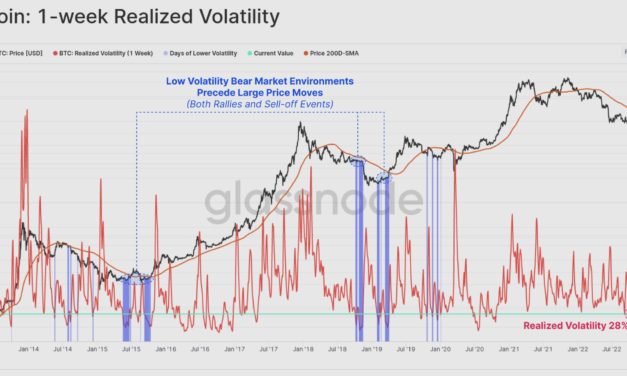
Bitcoin’s (BTC) lack of volatility has been the dominant discussion point among traders for the past two weeks and the current sideways trading within the $18,000 to $25,000 range has been in effect for 126 days. A majority of traders agree that a significant price move is imminent, but exactly what are they basing this thesis on? Let’s take a look at three data points that predict a spike in Bitcoin volatility. Muted volatility and seller exhaustionAccording to Glassnode research, the “Bitcoin market is primed for volatility,” with on- and off-chain data flashing multiple signals. The researchers note that 1-week realized volatility has fallen to 28%, a level that is typically followed by a sharp price move. Bitcoin 1-week realized volatility. Source: glassnodeExploration of Bitcoin’s aSOPR, a metric which “measures an average realized profit/loss multiple for spent coins on any given day” shows: “A large divergence is currently forming between price action, and the aSOPR metric. As prices trade sideways or decline, the magnitude of losses that being locked in are diminishing, indicating an exhaustion of sellers within the current price range.”Bitcoin adjusted SOPR. Source: glassnodeIn addition to the divergence between the price and the adjusted SOPR, short-term Bitcoin holders are approaching their breakeven level as the short-term holder SOPR approaches 1.0. This is significant because a reading of 1.0 during a bear market has historically functioned as a level of resistance and there is a tendency for traders to exit their positions near breakeven. If the aSPOR were to crest above 1.0 and turn the level to support, it could be an early sign of a fledgling trend change within the market. Bitcoin short term holder SOPR. Source: glassnodeTrading indicators are also at pivot pointsMultiple technical analysis indicators are also flashing a signal that a strong directional move is in the cards, a point noted by independent market analyst Big Smokey. According to the analyst: Bitcoin price range, SuperGuppy and Bollinger Bands are getting real tight. ETH looks the same. You know what that means. pic.twitter.com/e7s6ScG7jz— Big Smokey (@big_smokey1) October 18, 2022Crypto research firm Delphi Digital recently issued a similar perspective, citing “compression” within the Guppy Multiple Moving Average as a sign of “shorter-term momentum and the potential for a rally as this cohort attempts to flip the longer-term moving averages.” On Oct. 10, Delphi Digital researchers referenced the Bollinger Band Width Percentile (BBWP) metric and suggested the possibility of “a big move brewing for BTC.” The researchers explained that “historically, BBWP readings above 90 or below 5 have marked major swing points.”BTC price and Bollinger Band Width Percentile. Source: Delphi DigitalRelated: Bitcoin mirrors 2020 pre-breakout, but analysts at odds whether this time is differentThe state of Bitcoin derivativesCrypto derivatives markets are also flashing multiple signals. Bitcoin futures open interest has reached an all-time high of 633,000 contracts, while trading volumes have plummeted to a multi-year low of $24 billion daily. Glassnode notes that these levels were “last seen in December 2020, before the bull cycle had broken through the 2017 cycle $20K ATH.” Bitcoin futures open interest. Source: glassnodeAs one would expect during a bear cycle, liquidity, or the amount of money flowing in and out of the market, has declined, re-enforcing the reason for believing that an eventual spike in volatility could result in a sharp price move. While derivatives metrics like futures open interest, long liquidations and coin margined futures open interest are breaking multi-year records, it’s important to note that neither provide absolute certainty on market directionality. It’s difficult to determine whether a majority of market participants are positioned long or short and most analysts will suggest that the surge in open interest is reflective of hedging strategies that are in play. One thing that is certain is that on-chain data, derivatives data and basic technical analysis indicators all point toward an impending explosive move in Bitcoin price. Bitcoin’s current prolonged period of low volatility is somewhat unusual, but reviewing the data presented by glassnode and Delphi Digital could provide valuable insight on what to expect when certain on-chain metrics hit specific thresholds and this should give investors some ideas on how to position. The views and opinions expressed here are solely those of the author and do not necessarily reflect the views of Cointelegraph.com. Every investment and trading move involves risk, you should conduct your own research when making a decision.

Čítaj viac

Will bulls take charge now that Bitcoin price trades above a long-term trendline resistance?

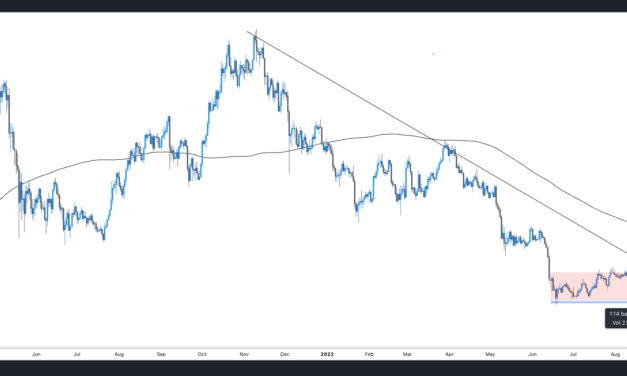
On Oct. 4 and 5, Bitcoin (BTC) took another step through the $20,000 mark, bringing the price above a long-term descending trendline that stretches all the way back to April 22 or Nov. 15, depending on one’s style of technical analysis.Some traders might be feeling a bit celebratory now that the price trades outside of the descending trendline, but have any relevant metrics or macro factors changed enough to support a bullish point of view for Bitcoin price? In reality, BTC price simply “consolidated” its way through the trendline by trading in a sideways manner where price has been range bound between $18,500 and $24,500 for the past 114 days. BTC/USDT. Source: TradingViewDirection-wise, Bitcoin and Ether (ETH) tend to trade in tandem with equities, and BTC’s Oct. 4 rally to $20,365 comes as the Dow, S&P 500 and Nasdaq closed the day with 2% to 3% gains.BTC, ETH and S&P 500 correlations. Source: Coin MetricsAs a reminder that short-term price action is not necessarily reflective of a larger trend change, Coin Metrics said: “Correlations among BTC, ETH and with the S&P 500 have increased recently as the benchmark index fell in price to 3600, which had not been breached since December of 2020.”Despite the Oct. 4 “all-in rally” in stocks and crypto markets, larger fears of global runaway inflation, rising interest rates and other economic concerns continue to suppress investors’ appetite for interacting with markets, a fact that is clearly reflected in Q3 results. Q3 2022 asset performance. Source: Coin MetricsOn Oct. 5, OPEC announced plans to cut oil production by 2 million barrels per day, which is roughly equivalent to 2% of the global oil demand. Oil stocks rallied at the announcement, but the White House is likely concerned that the reductions will complicate the Federal Reserve’s fight against inflation and possibly contribute to higher petrol prices. Generally, institutional investors like Citi and Goldman Sachs expect volatility in equities markets to continue, and both have revised down their end-of-year targets for the S&P 500, while investors are still predicting a down year in 2023. All said, inflation remains high across the globe, corporate earnings expectations are being adjusted to the downside, and the Fed appears confidently resolute in its current plans for reducing inflation. None of these developments are conducive to boosting investors’ risk sentiment, and given Bitcoin’s correlation with equities markets and sensitivity to bearish economic news flow, it seems unlikely that BTC breaking through the descending trendline is a sign of a trend change. A more convincing development would be a range-break and a series of daily closes above $25,000. The views and opinions expressed here are solely those of the author and do not necessarily reflect the views of Cointelegraph.com. Every investment and trading move involves risk, you should conduct your own research when making a decision.

Čítaj viac

Bitcoin miner profitability under threat as hash rate hits new all-time high

The Bitcoin hash rate hit a new all-time high above 245 EH/s on Oct. 3, but at the same time, BTC miner profitability is near the lowest levels on record. With prices in the low $20,000 range and the estimated network-wide cost of production at $12,140, Glassnode analysis suggests “that miners are somewhat on the cusp of acute income distress.”Bitcoin network hash rate. Source: Hashrate IndexGenerally, difficulty, a measure of how “difficult” it is to mine a block, is a component of determining the production cost of mining Bitcoin. Higher difficulty means additional computing power is required to mine a new block. Utilizing a Difficulty Regression Model, the data shows an R2 coefficient of 0.944 and the last time the model flashed signs of the miners’ distress was during BTC’s flush out to $17,840. Currently, it hovers near $18,300, which is not far from the price range seen in the past two weeks. Bitcoin: Difficulty regression model. Source: glassnodeThe hash rate hitting a new all-time high effectively means that miner margins will be further squeezed and outfits that are unprofitable can either mine at a loss, assuming that BTC’s future price will eventually make up for the cost difference, or they can unplug and wait until either the difficulty drops or energy costs improve. With the recent rise in hash rate, the difficulty is also likely to rise in the next week, with estimates pointing to a 6% to 10% adjustment.Bitcoin network hash rate (left) and projected difficulty adjustment (right). Source: BTC.comShown below are estimations of miner profitability assuming an electricity rate of $0.08 kw/h. Bitcoin ASIC profitability. Source: DxPoolDepending on a miners’ capital costs and operational costs, the profit stats above clearly illustrate the tightrope some miners are attempting to balance on at the moment. Despite the stress on profitability, independent market analyst Zack Voell suggested that miners with healthy balance sheets are constantly looking for ways to expand their operations and the recent surge in hash rate could be related to Bitmain’s newest S19 XPs coming online. Miners who aren’t broke or suing each other continuing to deploy what they can. Every month has a couple headlines (at least ) about new facilities being planned or energized. And a lot of the new hashrate is from XPs coming online— Zack Voell (@zackvoell) October 3, 2022Is Bitcoin in the clear? What investors really want to know is whether or not Bitcoin price is in the clear or whether there is an elevated risk of another sell-off driven by miner capitulation. According to Colin Harper, the head of research at Luxor Technologies: “Miners are still selling in the current environment (for example, Riot sold 300 BTC last month and Bitfarms sold 544 BTC). By my estimation, we’re more likely to be driven lower by general selling, not miner selling particularly. If BTC price does go to $10,000, in addition to more miners capitulating via BTC sales, there would also be a lot of rigs flooding the market. We are not trying to single out Riot or Bitfarms, these are just the current updates we have, besides Hut 8, which didn’t sell any BTC.”On the other hand, Joe Burnett, the head analyst at Blockware Solutions, said that the bulk of miner selling has likely passed, which reduces the possibility of another capitulation level sell-off. Burnett told Cointelegraph: “I think the small miner capitulation Bitcoin experienced this summer knocked out some weak and overleveraged players. I do not think we will see another significant drop in hash rate without Bitcoin making new lows below $17,600. It doesn’t mean individual weak miners won’t drop off this year and next, but the new gen rigs getting plugged in will likely be enough to keep hash rate trending upward.”When asked about the surge in hash rate placing pressure on higher difficulty adjustments and the knock-on-effect on miner profitability, Burnett said: “For sure. Individual weak players may drop off and get knocked out, but it won’t be a significant and sudden “miner capitulation” without a drop in BTC price. Margins are definitely tight.”According to Glassnode, their model of the “implied income stress of the Puell Multiple, with the explicit stress observation of the Difficulty Ribbon Compression” recently exited the zone where “miner capitulation is statistically likely,” suggesting that another miner-driven sell-off is unlikely at the moment.Bitcoin miner capitulation risk. Source: glassnodeThe analysts, however, were careful to stress that the aggregate size of Bitcoin held by miners is near 78,400 and any sharp downside move in BTC price could trigger selling from distressed mining outlets.The views and opinions expressed here are solely those of the author and do not necessarily reflect the views of Cointelegraph.com. Every investment and trading move involves risk, you should conduct your own research when making a decision.

Čítaj viac

Bitcoin price fails to hold $20K again, but there is a silver lining

Markets briefly flashed green on Sept. 27 as equities markets bounced back from Sept. 26’s pullback, bringing the Bitcoin (BTC) price back to the long-term descending trendline resistance, which currently resides at $20,100. Unfortunately for bulls, the positive momentum for stocks and cryptocurrencies rapidly eroded and Bitcoin price gave up a majority of the intraday gains as it slipped back below $19,000. As has been the case since March 25, BTC price has been unable to kick above the resistance for more than a few hours and the Sept. 27 breakdown at the trendline continues the trend of successive bear flags that see a continuation to the downside. BTC/USD 1-day chart. Source: TradingViewAccording to Arcane Research, Bitcoin’s tight rally above $20,000 is relatively insignificant, given that futures premiums are still low and it “contributes little to improving the market risk appetite.” BTC perpetual contract funding rate versus Bitcoin price. Source: Arcane ResearchAdditional data from Arcane Research shows funding rates flipping neutral for the first time since Sept. 13, but generally, traders are reluctant to add longs, given the concerns over macro challenges and the continuous threat of unfriendly crypto regulation. There is a silver liningAs mentioned in previous analysis, despite the breakouts and breakdowns, BTC price is simply trading within the exact same $24,300 to $17,600 range of the past 103 days. To date, a catalyst to set off a breakdown below swing lows or to push price above resistance and confirm the former hurdle as support has yet to occur. Fortunately, it’s not all doom and gloom for Bitcoin. A positive bit of news comes from on-chain analytics provider Glassnode, who noted that more mature investors have decided to hunker down and hold their positions rather than sell at the current price. According to the Revived Supply 1+ Years metric, an indicator that tracks the “total amount of coins that come back into circulation after being untouched for at least 1 year,” the flow of latent supply shifting back into the active supply pool is “extremely low.” Revived Supply 1 year+ Z Score. Source: glassnodeThe compression in mature spending seen in the last stages of the 2018 bull market is not present during the most recent revisits below $20,000, suggesting that long-term holders are well accustomed to volatility and unwilling to sell at the current prices. Revived Supply 1 year+ Z Score. Source: glassnodeGiven that BTC is 72% down from its all-time high and a portion of investors expect prices to crumble toward $10,000 in the next unexpected capitulation event, one could interpret the lack of panic selling from mature investors as positive. The views and opinions expressed here are solely those of the author and do not necessarily reflect the views of Cointelegraph.com. Every investment and trading move involves risk, you should conduct your own research when making a decision.

Čítaj viac

Získaj BONUS 8 € v Bitcoinoch

nakup bitcoin z karty

Registrácia Binance

Burza Binance

Aktuálne kurzy