Autor Cointelegraph By Rachel Wolfson

Organizations look toward multiparty computation to advance Web3

Protecting user data and private keys is crucial as Web3 advances. Yet, the number of hacks that have occurred within the Web3 space in 2022 alone has been monumental, proving that additional security measures, along with greater forms of decentralization, are still required. As this becomes obvious, a number of organizations have started leveraging multiparty computation, or MPC, to ensure privacy and confidentiality for Web3 platforms. MPC is a cryptographic protocol that utilizes an algorithm across multiple parties. Andrew Masanto, co-founder of Nillion – a Web3 startup specializing in decentralized computation – told Cointelegraph that MPC is unique because no individual party can see the other parties’ data, yet the parties are able to jointly compute an output: “It basically allows multiple parties to run computations without sharing any data.”Masanto added that MPC has a history that runs parallel to blockchain. “Around the same time that blockchain was conceptualized, a sibling technology purpose-built for processing and computation within a trustless environment was being developed, which is multiparty computation,” he said. It has also been noted that the theory behind MPC was conceived in the early 1980s. Yet, given the complexity of this cryptographic method, practical uses of MPC were delayed. Understanding how MPC will transform Web3It was only recently that blockchain-based platforms began to implement MPC to ensure data confidentiality without revealing sensitive information. Vinson Lee Leow, chief ecosystem officer at Partisia Blockchain – a Web3 infrastructure platform focused on security – told Cointelegraph that MPC is a perfect ideological match for the blockchain economy. Unlike public blockchain networks, he noted that MPC solves for confidentiality through a network of nodes that computes directly on encrypted data with zero knowledge about the information. Given this, companies focused on digital asset security began leveraging MPC in 2020 to ensure the security of users’ private keys. Yet, as Web3 develops, more companies are starting to implement MPC to create a greater level of decentralized privacy for various use cases. Masanto added:“The evolution of Web2 to Web3 focuses on creating methods where people and organizations can collaboratively work on different data sets in a manner that respects privacy and confidentiality while maintaining compliance. Blockchains are not purpose-designed for this because they are typically inherently public, and smart contracts are often run by one node and then confirmed by others. MPC breaks down the computation across the network of nodes, making it a truly decentralized form of computation.”The promise of MPC has since piqued the interest of Coinbase, which recently announced its Web3 application functionality. Coinbase’s new wallet and DApp functionalities are operated with MPC in order to secure the privacy of senders and receivers while ensuring the accuracy of a transaction. Rishi Dean, director of product management at Coinbase, explained in a blog post that MPC allows users to have a dedicated, secure on-chain wallet. “This is due to the way this wallet is set up, which allows the ‘key’ to be split between you and Coinbase,” he wrote. Dean added that this provides a greater level of security for users, noting that if access to their device was lost, a DApp wallet is still safe since Coinbase can assist in the recovery. While Coinbase released this feature in early May 2022, the crypto wallet provider ZenGo was equipped with MPC from the company’s inception in 2018. Talking with Cointelegraph, Tal Be’ery, co-founder and chief technology officer of ZenGo said that the wallet applies MPC for disrupted key generation and signing, also known as threshold signature scheme (TSS). He explained that the key is broken up into  two “secret shares” split between the user and the company server.Related: Blockchain and NFTs are changing the publishing industryAccording to Be’ery, this specific type of MPC architecture allows a user to sign an on-chain transaction in a completely distributed manner. More importantly, Be’ery added that both secret shares are never joined. “They are created in different places, and used in different places, but are never in the same place,” he explained. As such, he noted that this model remains true to the original MPC promise: “It jointly computes a function (the function in this case is key generation or signing) over their inputs (key shares), while keeping those inputs private (the user’s key share is not revealed to the server and vice versa).”Be’ery believes that using MPC for signatures is complementary to blockchain technology, since a private key is also required to interact with blockchain networks. However, the TSS method leveraged by ZenGo allows users to distribute their private key, adding an additional layer of security. To put this in perspective, Be’ery explained that private keys for non-custodial wallet solutions are typically burdened by an inherent tension between confidentiality and recoverability:“Because a private key is the only way to access the blockchain in traditional wallets, it also represents a singular point of failure. From a security perspective, the goal is to keep this private key in as few places as possible to prevent it from getting in others’ hands. But from a recoverability perspective, the goal is to keep the private key as accessible as needed, in case there is a need to recover access.”However, this tradeoff is not an issue for most MPC-powered systems, as Be’ery noted that this is one of the main challenges MPC solves for crypto wallet providers. Moreover, as Web3 develops, other multiparty computation use cases are coming to fruition. For example, Oasis Labs – a privacy-focused cloud computing platform built on the Oasis network – recently announced a partnership with Meta to use secure multiparty computation to safeguard user information when Instagram surveys asking for personal information are initiated. Vishwanath Raman, head of enterprise solutions at Oasis Labs, told Cointelegraph that MPC creates unlimited possibilities for privately sharing data between parties: “Both parties gain mutually beneficial insights from that data, providing a solution to the growing debate around privacy and information collection.”Specifically speaking, Raman explained that Oasis Labs designed an MPC protocol together with Meta and academic partners to ensure that sensitive data is split into secret shares. He noted that these are then distributed to university participants that compute fairness measurements, ensuring that secret shares are not used to “learn” sensitive demographic data from individuals. Raman added that homomorphic encryption is used to allow Meta to share their prediction data, while ensuring that no other participants can uncover these predictions to associate them with individuals:“We can say with confidence that our design and implementation of the secure multiparty computation protocol for fairness measurement is 100% privacy-preserving for all parties.”MPC will reign supreme as Web3 advancesUnsurprisingly, industry participants predict that MPC will be leveraged more as Web3 advances. Raman believes that this will be the case, yet he pointed out that it will be critical for companies to identify logical combinations of technologies to to solve real-world problems that guarantee data privacy: “These protocols and the underlying cryptographic building blocks require expertise that is not widely available. This makes it difficult to have large development teams designing and implementing secure multiparty computation-based solutions.”It’s also important to highlight that MPC solutions are not entirely foolproof. “Everything is hackable,” admitted Be’ery. However, he emphasized that distributing a private key into multiple shares removes the singular attack vector that has been a clear vulnerability for traditional private key wallet providers. “Instead of getting access to a seed phrase or private key, in an MPC-based system, the hacker would need to hack multiple parties, each of which has different types of security mechanisms applied.”While this may be, Lior Lamesh, CEO and co-founder of GK8 – a digital asset custody solution provider for institutions – told Cointelegraph that MPC is not sufficient by itself to protect institutions against professional hackers. According to Lamesh, hackers simply need to compromise three internet-connected computers to outsmart MPC systems. “This is like hacking three standard hot wallets. Hackers will invest millions when it comes to stealing billions,” he said. Lamesh believes that an MPC enterprise-grade approach requires a true offline cold wallet to manage most digital assets, while an MPC solution can manage small amounts. Related: Ethereum Merge: How will the PoS transition impact the ETH ecosystem?Masanto further claimed that traditional MPC solutions may be superior to a solution that “stores sensitive data across many different nodes in the network as a group of unrecognizable, information-theoretic security particles.” As the result, hackers would need to find each particle without any identifiable footprint connecting any of the nodes. Masanto added that to make the particle recognizable again, the hacker would need a large proportion of “blinding factors,” which are used to hide the data inside each particle in an information-theoretic security manner.Those are just some example of how MPC-based solutions will advance in the future. According to Masanto, this will create access to even more MPC use cases and, for example, utilizing the network itself for authentication: “We consider this a form of ‘super authentication’ – a user will authenticate based on multiple factors (e.g., biometrics, identity, password, etc.) to a network without any of the nodes in the network knowing what they are actually authenticating because the computation of authentication is part of MPC.”According to Masanto, such a form of authentication will lead to use cases within identity management, healthcare, financial services, government services, defense and law enforcement. “MPC enables systems to be made interoperable while also respecting peoples’ rights and giving them control and visibility over their data and how it is used. This is the future.”

Čítaj viac


Reinventing yourself in the Metaverse through digital identity

The Metaverse has become one of the biggest buzzwords of the year as a number of brands, companies and even countries begin to explore virtual worlds to conduct business. Even though Metaverse development is still underway, a recent report from the technology research and advisory firm Technavio found that the Metaverse will hit a market share value of $50.37 billion by the year 2026. Another report predicts that the growth of the Metaverse will be driven by e-commerce, which is expected to reach a market share of $60.47 billion by the year 2026. E-commerce across social media platforms is also expected to increase over the coming years, which may suggest that the Metaverse will advance as the next generation of social networking. Therefore, it shouldn’t come as a surprise that a number of Millennials and Gen Zs are currently showing interest in the Metaverse. Digital identity is key to the MetaverseFindings from the “Digital Ownership Report 2022” from the Metaverse platform Virtua report show that younger generations are particularly excited by the potential for reinventing themselves in virtual worlds that allow for the creation of digital identities and ownership. For instance, the report found that 63% of American millennials expect the Metaverse to help them reinvent themselves, while 70% of Americans surveyed agreed that digital items like clothing and artwork are already an essential part of their identity. Jawad Ashraf, CEO and co-founder of Virtua, told Cointelegraph that the ability for individuals to reinvent themselves is a key feature of the Metaverse:“Many people today have reinvented themselves on social media, as they are projecting an image that is still personable and interactive. The Metaverse allows users to express themselves through an avatar, allowing each person to be themselves without the fear of face-to-face interaction.” According to Ashraf, people will be able to express themselves much more freely in the Metaverse in comparison with Web2 social media platforms like TikTok and Instagram. He believes this is the case due to the fact that users will be able to customize avatars to portray themselves while leveraging digital assets that they own. He added that every aspect of Virtua’s metaverse is customizable, allowing users to create their own avatars to reflect their “digital identities.”Example of a customizable avatar in Virtua’s Metaverse. Source: VirtuaJanice Denegri-Knott, professor of consumer culture and behavior at Bournemouth University and a researcher behind Virtua’s digital ownership report, told Cointelegraph that there is not yet an official definition for digital identity within the context of the Metaverse. However, she believes that if digital identity is thought about pragmatically, it can be defined as “the unique, identifiable information that is connected to a person when online.” As such, the concept of digital identity, in this case, extends much deeper than customizing an avatar to resemble oneself. Denegri-Knott elaborated: “The Metaverse with its blockchain infrastructure affords users the potential to assume greater ownership rights over their own data, giving them more control over the information they share with others. The beauty of the Metaverse is that a user can have different digital identities, such as a workplace identity, sporting identity and personal identity, while all still being based on the user’s real-world identity.”Denegri-Knott added that she believes the idea of individuals extending themselves digitally is an instructive one. “Rather than thinking of digital identity as being separate from, but rather connected to an ‘offline/real’ identity is helpful. This will allow us to see how our sense of self may be ‘digitally’ extended in our ability ‘to do’ and to ‘express ourselves,’” she explained. With this in mind, Denegri-Knott pointed out that the digital items that users own in the Metaverse will play a fundamental role in the development and expression of self, just as material items help people achieve intentions and goals in the physical world. This was highlighted in Virtua’s report, which found that 70% of consumers feel their digital items help create the perception of who they want to be. Moreover, 75% of surveyors expressed that they were emotionally attached to the digital items they own in the Metaverse. Related: NFTs and intellectual property, explainedEchoing this, Chris Chang, co-CEO of ZepetoX — an Asia-based metaverse initiative – told Cointelegraph that similar to how real-world objects encapsulate a person’s physical space, digital assets in the Metaverse provide clues about a person’s tendencies. “The Metaverse is a setting wherein one can explore relationships and identities different to the physical realities that one is born with,” he said. This aspect is particularly important, as Denegri-Knott further explained that avatars within the Metaverse can help individuals achieve goals that are perhaps inconceivable in the real world:“One of the first cases I reported for Virtua was that of an avid Second Life member who lived in squalor, but who in Second Life led a successful life and lived in a palatial home. In our digital avatars we can realize the blocked goals in our physical lives and achieve the status that is denied to us.” Trust and privacy challenges of digital identity Although digital identity is a key feature behind the appeal of the Metaverse, a number of security issues are still associated with this concept. Andreas Abraham, project manager of Validated ID — a project collaborating with the European Commission on their blockchain identity initiative — told Cointelegraph that reinventing who you are means reconsidering values, activities and possibly changing behavior. Given this, he believes that the Metaverse will allow every person to define from scratch who they are and who they wish to be. Yet, this could lead to multiple issues including trusting if an avatar is who they claim to be. Fortunately, there are solutions to combat these challenges. Fraser Edwards, CEO of cheqd.io, told Cointelegraph that self-sovereign identity, or SSI, may come to the rescue. According to Edwards, SSI is often known interchangeably as “decentralized identity,” which allows individuals to have ownership and control over their data. In the case of avatars within the Metaverse, Edwards noted that these are moving data points capable of forming decentralized reputations. “Avatars in the Metaverse will collect online social proofs, meaning the interactions between them can act as proof for determining which ones represent good individuals (or not) while staying anonymous,” he said. In other words, this allows for anonymity while creating an element of trust: “Even if an anonymous developer exists solely in a Metaverse they could build social proofs through interactions and hence reputation with SSI.”Related: Blockchain and NFTs are changing the publishing industryMoreover, Edwards pointed out that while some Metaverses allow users to customize their avatars based on fictional 3D characters, some are leveraging “photo realistic” avatars. For example, Union Avatars, a Barcelona-based virtual identity Metaverse platform, is applying real-life images to represent a user’s avatar in the Metaverse. Cai Felip, CEO of Union Avatars, told Cointelegraph that a photo-realistic avatar is a 3D virtual representation of a user’s real-world self-based on their actual image: “By leveraging computer vision technology, we have created a solution that can generate a full-body avatar from a single selfie taken with your webcam or uploaded to our webapp.” Tina Davis, chief creative officer of Union Avatars, added that photo-realistic representational avatars are used in industries where it is crucial to present oneself as they are in real life. “These fields are typically those of medicine, business, education and travel,” she remarked. However, Davis noted that the gaming industry is starting to witness broader use cases as more people adopt their virtual identities.Photo realistic avatar of Cai Felip. Source: Linking Realities While innovative, protecting user data also becomes an issue in the Metaverse. Dawn Song, founder of Oasis Labs and a professor at the University of California at Berkeley, told Cointelegraph that seemingly anonymous metaverse platforms may still be able to collect user data. “As an example, in our research, we have shown the new privacy risks of the Metaverse. We need new technical solutions to better protect users’ privacy,” she said. In order to combat this, Song explained that Oasis Labs recently developed a decentralized anonymous credential system with an on-chain verification to enable users to prove the properties of their identity while maintaining privacy. “In our system, we can provide practical on-chain verification for the first time, achieving both privacy and accountability. The system, known as SNAC, has the ability to allow users to show know your customer certificates while remaining private.” SNAC uses zk-SNARKs and smart contract capabilities to verify anonymous credentials, she explained. Song added that Oasis Labs created a new solution called “metaguard” to provide an incognito mode for users in the Metaverse.How digital identity will advanceDespite challenges, digital identity in the Metaverse will continue to progress in meaningful ways. For example, Sebastien Borget, co-founder and chief operating officer of The Sandbox, told Cointelegraph that digital identity in the Metaverse will expand to allow for interoperability within other virtual ecosystems: “Users will want to bring more than just the visual appearance of their avatar from one virtual world to another. They will also want to carry their online reputation, progression and achievements with them.”According to Borget, digital identity will continue to build as users spend more time within the Metaverse, whether that be within gaming environments, through virtual events or in online workplaces. “Users should be able to use all their data as proof of who they are online. This will contribute to defining an individual’s true digital identity (or multiple ones since there can be many),” he remarked. Borget added that a user’s digital footprint will soon become important within other sectors, like decentralized finance (DeFi): “Even in DeFi, a crypto exchange can loan you more to buy a land if you prove you actually spend time building and playing in the metaverse. And you don’t want that data to be held in just one virtual world — in the true spirit of Web3, users shouldn’t have to be locked in one walled garden platform to carry out their history and reputation.” Moreover, while it’s too early to tell, the importance placed on a user’s digital identity may help decrease the amount of illicit activities expected to take place in the Metaverse. For instance, Song noted that having a decentralized identity attached to other aspects of life like bank accounts could add far more functionality to the Metaverse: “Still, we need to ensure better privacy and data sovereignty for individuals if they are to use the Metaverse truly.”

Čítaj viac

Blockchain and NFTs are changing the publishing industry

Web3 has become the most sought-after investment sector of 2022, as use cases for nonfungible tokens (NFTs), the Metaverse and other blockchain applications come to fruition. Therefore, it shouldn’t come as a surprise that different segments of the publishing industry have begun to use Web3 technologies to transform traditional models. For example, the textbook publishing giant Pearson recently announced plans to use NFTs to track digital textbook sales to capture revenue lost on the secondary market. Time magazine, which was founded 99 years ago, has also been using NFTs to create new revenue streams, along with a sense of community within the publishing industry. Keith Grossman, the president of Time, told Cointelegraph that the magazine is demonstrating the new possibilities of engagement that Web3 brings to the publishing industry. He said:“Web3 can evolve one’s brand in a world where individuals are moving from online renters to online owners, and privacy is beginning to move from platforms to the individual.”Web3 enables a community of content ownersWhile it may seem non-traditional for one of the oldest, most renowned magazine publishers in the industry to host an NFT gallery, Grossman explained that Time has dropped nearly 30,000 NFTs to date. He added that these have been collected by over 15,000 wallet addresses, 7,000 of which are connected to Time.com to remove the paywall without having to provide personal information. “Along the way, the TIMEPiece community has grown to over 50,000 individuals,” Grossman pointed out. To put this in perspective, Grossman explained that in September 2021, Time launched a Web3 community initiative known as TIMEPieces. This project is a digital gallery space hosted on the NFT marketplace OpenSea, which has brought together 89 artists, photographers and even musicians. “The number of TIMEPiece artists has grown from 38 to 89. It includes the likes of Drift, Cath Simard, Diana Sinclair, Micah Johnson, Justin Aversano, Fvckrender, Victor Mosquera and Baeige, to name a few,” Grossman said. Isaac “Drift” Wright’s piece from the Slices of Time Collection. Source: Keith GrossmanWhile notable, the more important aspect of this growth lies within the distinction of “audiences” vs. “communities.” According to Grossman, very few people in the publishing sector distinguish between these two groups, yet he noted that Web3 provides a “tremendous opportunity for those willing to explore this oversight.” For instance, Grossman explained that an audience simply engages with content for a moment. However, he pointed out that a community aligns around shared values and is provided with the opportunity for constant engagement. He said:“Healthy ‘communities’ have moats making them harder to disrupt or circumvent. However, they take a lot of work to develop and nurture. The long term benefit of a community is stability — and publishing is anything but stable.”Indeed, NFTs may be key for providing the publishing world with the stability and audience interaction it requires to advance. As Cointelegraph previously reported, brands are using NFTs in a number of ways to better engage with customers over time.Other sectors of the publishing industry are starting to employ NFTs for this very reason. For example, Royal Joh Enschede, a 300-year-old Dutch printing company, is entering the Web3 space by providing its clients with an NFT platform for “crypto stamps.” Gelmer Leibbrandt, CEO of Royal Joh Enschede, told Cointelegraph that the postage stamp and philately world is very traditional, noting that nonfungible tokens will allow for expansion. He said: “The crypto stamp opens up a global market that will appeal not only to the classic stamp collectors but also to collectors in their teens, twenties and thirties who buy, save and trade NFTs. This is naturally very appealing for our main customers — over 60 national postal organizations worldwide.”The crypto postage stamps are launched as NFT collectibles, but they can naturally also be used to mail documents. Source: Royal Joh EnschedeAccording to Leibbrandt, Royal Joh Enschede started thinking about ways to use blockchain technology over two years ago, yet the Dutch printing firm decided to start with crypto stamps due to the utility and market fit. Leibbrandt explained that not only will stamp collectors be able to own a unique NFT, but the nonfungible tokens will also serve as “digital twins” intended to provide an extra layer of security and authentication to its physical products.Leibbrandt also pointed out that linking physical objects with their digital counterparts offers customers additional features. While he noted that crypto stamps are just the beginning of Royal Joh Enschede’s Web3 journey, he explained that the company has started developing “notables,” which are meant to rival secure printed banknotes. He explained:“Through the use of special printing techniques, we can add, among other things, augmented reality, which in turn provides access to special online promotions and a communication platform. Notables are unique and the NFT element can be used as a collector’s item, along with a means of payment in the Metaverse.” Like Time, crypto stamps and notables are enabling Royal Joh Enschede to build a community of collectors capable of engaging with the platform and each other. “All kinds of new applications can be linked to these, such as access to real-life events like Formula 1 or Tomorrowland, where only a few notes give entitlement to VIP packages. We are building our business for the next 100 years,” Leibbrandt added. Furthermore, independent news organizations are starting to apply Web3 technologies to solve one of the biggest challenges facing the media industry today — “fake news.” For example, Bywire is a decentralized news platform that uses artificial intelligence (AI), machine learning and blockchain to identify false or misleading news content. Michael O’Sullivan, CEO of Bywire, told Cointelegraph that the platform has built and deployed a “trust or not” algorithm. “This can provide readers with an ‘at-a-glance’ reassurance that the content served on the Bywire platform is trustworthy, and those who produce it are indeed accountable,” he said. O’Sullivan explained that Bywire’s AI technology is capable of “reading” an article in a matter of seconds before it goes live to determine the trustworthiness of the content. Once this has been established, the algorithm generates a recommendation, along with the reasoning behind its determination. “The why is vital because it helps consumers become conscious of the motives and intentions of content producers,” O’Sullivan remarked. While innovative, O’Sullivan pointed out that any independent news organization can aggregate their news content to Bywire, exposing it to tens of thousands of readers per month. Like other publishers using Web3 technology, O’Sullivan noted that Bywire has a community of readers associated with the platform, noting that these individuals are incentivized to read the content. “Every reader gets a free EOS account and can start earning token rewards immediately, which can be later used in the democratic oversight of the network.”Will Web3 advance the publishing industry?Although Web3 has the potential to transform the publishing industry by allowing various sectors to reach and interact with new audiences, the impact remains questionable. For instance, it’s been noted that there is still a lack of clarity among publishers regarding how blockchain can and should be used.Lars Seier Christensen, chairman of Concordium — the Swiss blockchain firm powering Royal Joh Enschede’s NFT platform — told Cointelegraph that nonfungible tokens currently mean nothing to most organizations. However, he believes that NFTs and other Web3 technologies will soon become the norm:“Let’s take one step back from the acronym NFT because it can be confusing. What has been proven is that a blockchain can store immutable data — i.e., the records are final and unbreakable, and this data is fully transparent to everyone by simple access to the chain search engine.” Regarding consumers, Grossman also mentioned that individuals should not be using the word “NFT,” adding that they certainly do not need to know what blockchain platform is powering these applications. “They should be engaging with brands based on the experiences being provided,” he said. Grossman further remarked that the rise of computers sparked constant discussion around technology until Steve Jobs explained that the iPod could hold “1,000 songs in your pocket.” Grossman believes that a moment similar to this will happen for Web3 but has yet to come:“Most people’s perceptions of NFTs and blockchains are defined by the extremes — extreme good and extreme bad. The reality is that an NFT is just a token that verifies ownership on a blockchain, and education is needed to provide companies and individuals with the many ways in which it can be used to provide value.”

Čítaj viac

Education and aesthetics: Bringing more women into the Metaverse

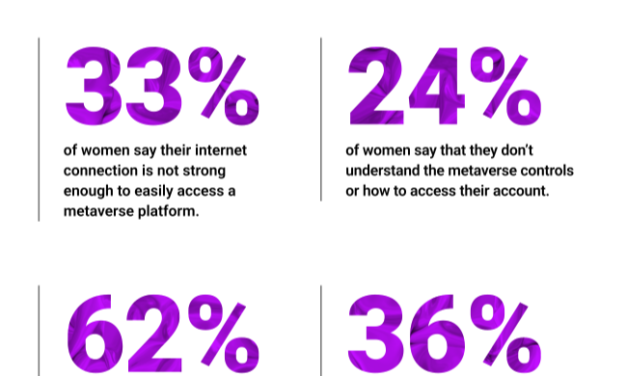
Interest in the Metaverse is growing rapidly and fashion brands across the globe are taking note. A new report from the technology research and advisory firm Technavio found that the Metaverse will hit a market value of $50.37 billion by 2026. Findings from Technavio further show that the Metaverse in fashion market share is expected to increase by $6.61 billion from 2021 to 2026. Given this, a number of major brands have begun participating in Web3 initiatives. For instance, Metaverse Fashion Week hosted in Decentraland this year attracted more than 70 brands, artists and designers including Tommy Hilfiger, Estée Lauder, Philipp Plein, Selfridges and Dolce & Gabbana. Luxury jewelry brand Tiffany & Co also recently stepped into the Web3 space with the sale of 250 diamond and gemstone encrusted pendants for CryptoPunk nonfungible token (NFT) holders. Understanding what women want from a Metaverse platformWhile these initiatives are notable, new findings from The Female Quotient (The FQ) and the media company EWG Unlimited show that metaverse experiences are still largely geared toward men. The report titled “What Women Want in Web 3.0” also found that 62% of women surveyed have never heard of or are unfamiliar with NFTs, while 24% of females don’t understand the Metaverse. Findings from “What Women Want in Web 3.0” reportShelley Zalis, CEO of The FQ — an equality services and advisory firm — told Cointelegraph that while there is a tremendous interest for women to become involved in Web3, the experiences offered by brands need to cater more toward what women want. She said:“We know that 85% of purchase decisions are made by women, so if brands want to get this right they need to design experiences that are relevant for women by creating the types of experiences they want to participate in. For example, from a visualization perspective many metaverse visuals are clunky and not beautiful, so this needs to be improved.” To Zalis’ point, The FQ and EWG Unlimited report found that one in four women would revisit a Metaverse platform if it contained better aesthetics. Yet, understanding visually appealing elements for women may be challenging, as the report notes that only 16% of Web3 creators currently identify as women. “The FQ wants to set the stage by encouraging more women to be on the business side of Web3 initiatives. If women can design these spaces for women then we can ensure that females will want to spend more time in the Metaverse,” Zalis explained. Echoing this, Sam Huber, founder and chief operating officer at metaverse provider LandVault, told Cointelegraph that from the perspective of metaverse builders, change starts from within. “Female developers are best placed to know what appeals to a female audience, so diversifying developer talent is key,” he said. This appears to be the case, as women-led Metaverse platforms like DressX have witnessed increased involvement of women over time. Natalia Modenova, founder of DressX, told Cointelegraph that the digital fashion platform has been promoting creativity since day one, noting that the first designers on the platform were women. Recent: Borrowing to buy Bitcoin: Is it ever worth the risk?“Female creators are dominating the DressX platform,” she said. Modenova added that DressX has launched numerous projects created and executed by women. “One of the most notable being our ‘Feminine Future’ NFT drop created by the innovative creative director, VFX artist and virtual fashion designer Katie McIntyre and multimedia artist Nina Hawkins recently named ‘the world’s leading female VFX artists’ by Time magazine,” she said. According to Mondenova, the project provided a glimpse as to how women can collaborate and create their own aesthetics within the Metaverse.Poster from the Feminine Future NFT drop. Source: DressXFrom a brand’s perspective, a spokesperson from the luxury fashion industry told Cointelegraph that aesthetics should be the number one priority when it comes to marketing in the Metaverse. “The aesthetics should be cohesive to the brand, replicating elements such as color schemes and patterns,” she said. Even with visually appealing aesthetics, she pointed out that women’s engagement in the Metaverse remains low, noting that many luxury fashion consumers still don’t understand what Web3 means. “People need to understand this space before we can engage. We also have an older clientele at our store, which won’t easily be pulled into the digital world.”Although the “What Women Want in Web 3.0” report found there to be a 15% increase in interest from women in the Metaverse month-over-month, findings indicate that only 30% of women are truly familiar with virtual worlds. In order to combat these challenges, the report emphasizes that brands must focus on accessibility and education when it comes to attracting women consumers. “Only 14% of women have access to Metaverse platforms like Decentraland or Roblox. Education will reign supreme in order to get everyone on board,” Zalis remarked. Specifically speaking, she explained that The FQ has found social media to be one of the most helpful tools for educating women on Web3. “Women require social interaction and community building. Social media is the best way for brands to engage with consumers of all ages.” Jenny Guo, co-founder of Highstreet — a retail-focused metaverse platform — further told Cointelegraph that individuals who are well-versed in Web3 often use rhetoric that is not easily understood by the mainstream. As such, she believes that traditional consumers do not typically understand how these ecosystems work, resulting in brands hesitating to enter the space. “With more education, easier access, and a brand’s willingness to experiment within the metaverse, we will see more brands, especially boutique brands, expanding their market to the Web3 world,” she said. In the meantime, Guo pointed out that Web3 initiatives being taken by brands today may still appeal mainly to male consumers. For example, Guo noted that Tiffany’s recent collaboration with CryptoPunks is a great example of how companies are leaning into female focused-labels. Yet, she remarked that most CryptoPunk holders are male. She said:“By default, Web3 is very much dominated by men, and we do not see many female-focused brands getting into the space right now. But, similar to the tech industry, more and more women creatives will join the industry with time.”Metaverse platforms must cater to women moving forward Although findings show that metaverse experiences are largely geared toward men, the tables are bound to turn as more brands become involved in the sector. Brian Trunzo, metaverse lead at Polygon Studios – the platform catering to Web3 projects built on the Polygon protocol – told Cointelegraph that the Metaverse is becoming a new hub for expanding product and service offerings. He said: “Brands can now engage with their consumers in a more direct way that doesn’t involve travel to physical locations or staff to man operations. Consumers can simply access digital hubs for their favorite brands and partake in their unique metaverse experiences or purchase what they have to offer.”According to Trunzo, this level of engagement would never be possible in the real world or within Web2 platforms, which is why it is now becoming critical for brands to migrate to Web3. Given this, Trunzo pointed out that combining representation and inclusivity with aesthetics could be the key to drawing more women into the Metaverse. “This could also allow them to partake in this ecosystem without accessibility barriers,” he said. Recent: Beyond the headlines: The real adoption of Bitcoin salariesGiven this, Zalis believes that now is the time for women to become involved with building out Metaverse platforms. “We want to make sure women are first in Web3 before it becomes an all boys club. Women need to get in early in order to write the rules of the road, not only as creators but also as business leaders.”In order to ensure this, Zalis shared that The FQ hosts a number of in-person events along with meetings in the Metaverse to help educate women on Web3 through social interaction and community building. “We connect with women in over 100 countries,” she said. Shapovalova said that DressX will be hosting a number of events and launches, partnering with renowned traditional brands to create in-house 3D fashion collections. “We are exploring the Metaverse through all the possible (and impossible) directions,” she remarked. 

Čítaj viac

Decentralized storage providers power the Web3 economy, but adoption still underway

The promise of owning and managing one’s own data is revolutionary, creating increasing interest in Web3 platforms and applications. For instance, recent findings show that the Web3 market was estimated to be worth around $2.9 billion last year, yet this number is expected to reach $23.3 billion by 2028. Web3 is also capturing the interest of venture capitalists, as Cointelegraph Research found this sector to be the most sought-after investment deal in 2022. The rise of Web3 has also resulted in the need for decentralized storage solutions, which will ultimately allow users to archive, retrieve and maintain their own data. Findings from Huobi Research Institute further show that increasing global storage data volume will elevate the cost of security and high power consumption, which will fuel the trend toward decentralized storage. The report states, “World storage system demand has progressed from remote storage to instant cloud storage, and now blockchain decentralized storage which we shall call Web3 storage.” Breaking down decentralized storageIn order to better understand the potential behind decentralized storage, it’s important to explain what these solutions provide and how they differ from centralized platforms. Marta Belcher, president and chair of the Filecoin Foundation — the organization facilitating governance of the Filecoin network — told Cointelegraph that decentralized systems offer an alternative to centralized systems for storing data and making websites available. She said:“Today’s internet is centralized — right now, the majority of data making up the many websites we use every day sits in data warehouses owned by just three companies: Amazon Web Services, Microsoft Azure and Google Cloud. We have often seen these companies suffer blackouts, and swaths of the Web go down for hours — that’s the problem with having single points of failure.” With these challenges in mind, Belcher explained that decentralized storage providers like Filecoin are capable of creating a better version of the Web by combining the storage capacity and computing power of many individual devices into a supercomputer-like network that can store multiple copies of data. “On this decentralized version of the internet, websites stay up even if some nodes fail, and the availability of information is not dependent on any one server or company,” she said. To facilitate this, Belcher explained that Filecoin uses a programmable money concept to create a decentralized storage network. “If a user has extra storage space on their computer hardware then they can ‘rent’ it out to others who will pay them with Filecoin tokens. We think of this as a foundational technology for the next generation of the web,” she remarked. Belcher elaborated that Filecoin is based on an incentives model, which means users get paid each time they store information on the network. To date, the Filecoin model has been successful, as Belcher shared that the network has 18 exabytes of storage capacity and over 4,000 storage providers powering more than 1,460 new projects. While this may sound unbelievable, Belcher pointed out that centralized storage providers like AWS are dependent on a particular server or company to store and provide information. Yet, Filecoin is built on top of the InterPlanetary File System, or IPFS. “Rather than retrieving content where it is located, the IPFS retrevies content by what it is through leveraging content addressing with a cryptographic hash,” she explained. As such, content availability is no longer dependent on one server or company, meaning information can be retrieved faster while also decreasing latency in networks. Belcher explained the Filecoin Foundation recently announced a partnership with defense contractor Lockheed Martin to make InterPlanetary networking possible from space. She said: “Imagine there is a satellite on the moon and there is a multi second delay with data going back and forth from the moon to earth. IPFS could allow satellites to retrieve data from the closest locations without having a delay. This makes networking across systems faster.” We’ve got news! @FilFoundation is working with @LMSpace to bring @IPFS to space! pic.twitter.com/o1JeHYjoik— Filecoin Foundation (@FilFoundation) May 23, 2022John Gleeson, chief operating officer of decentralized storage network Storj, told Cointelegraph that decentralized infrastructure is the most credible disruptor for the centralized internet:Although the concept is revolutionary, Belcher noted that the project is currently in an exploratory phase. “We are still identifying the right demonstration mission that will make this viable for space technology.” In terms of data storage, Belcher pointed out that many users may not even realize that they are using the IPFS today, noting that the vast majority of nonfungible tokens (NFTs) are stored on IPFS. She added that Starling Lab — a project from Stanford University and the University of Southern California’s Shoah Foundation research center — uses the Filecoin network to house sensitive digital records of human history. “Starting a service to compete with AWS, Google or Microsoft in Web2 requires billions of dollars. Through crowd-sourced capacity, trustless abstraction layers and token-based incentives, decentralized infrastructure can provide more private, secure, performant and economical infrastructures than Web2 hyperscalers.”Similar to Filecoin’s incentive model, Gleeson explained that the Storj network consists of “storage nodes” that are used to store data for others. Contributors are paid for allocating their storage and bandwidth. “All data stored on storage nodes is client-side encrypted and erasure-coded,” he said. Gleeson added that Storj uses “uplink clients” to enable developers to house information on Storj decentralized cloud storage. Files are then split into 80 pieces and distributed across the network of storage nodes. “Each of the 80 pieces is stored on different diverse storage nodes with different operators, power supplies, networks and geographies, etc., yielding tremendous security, performance and durability advantages,” Gleeson explained. While the features provided by Filecoin and Storj are very different from those offered by centralized systems, a number of Web3 platforms specifically require these solutions. For example, the decentralized Web3 infrastructure provider Ankr Network helps a number of blockchain companies run their node infrastructure. Greg Gopman, chief marketing officer of Ankr, told Cointelegraph that 17 of the top 20 proof-of-stake blockchains use Ankr’s remote procedure call (RPC) service to allow access to their blockchain data. Every time Ankr handles an RPC request, a node is required to fulfill it, which Gopman mentioned is Ankr’s core service. According to Gopman, Ankr uses both Filecoin and Storj to store images of nodes, along with blockchain transactions. He said:“BNB Chain, Polygon and Avalanche use our solution, and behind the scenes we use decentralized storage providers to make our operations faster. When we need to spin up a new node we can do it 90% faster using decentralized storage providers versus AWS.”To put this process in perspective, Gopman explained that Ankr manages archive nodes for different blockchains. “The ‘archive node’ is all the historical data of every transaction that happened on a blockchain network,” he said. Ankr manages these archive nodes for different blockchains, meaning the platform needs to have a snapshot of all transactions that have occurred on a specific network. This information is then put on a server and spun up to create a new node. Gopman added that Ankr initially used AWS for this process but that the platform was slower and more expensive. “AWS wasn’t optimized for Web3. AWS is set up for distributed systems, yet we run profiles on servers for decentralized infrastructure. Moreover, AWS only has 13 geo-locations and we have around 30.” The rise of decentralized web servicesIn addition to storage, other solutions are being offered to ensure an entire suite of decentralized web services for the Web3 economy. For example, Akash Network is a marketplace for underused compute resources. Greg Osuri, CEO of Akash, told Cointelegraph that the core of Akash consists of an auction marketplace that allows users to place an ask with providers who have endless amounts of computing power. According to Osuri, prices are market-driven, making cost savings 97% less expensive than AWS. In terms of use cases, Osuri mentioned that Equinix Metal — one of the world’s largest data center and infrastructure providers — integrates with Akash to offload their compute resources in a decentralized manner. Web3 projects are also taking advantage of decentralized computing platforms. For example, Colin Pape, CEO of decentralized search engine Presearch, told Cointelegraph that users could run nodes for their platform on top of Akash. According to Pape, Presearch user nodes collect search results from across the web and are used to power the Presearch network. Like other incentive-based models, node operators are rewarded with Presearch’s PRE tokens when they successfully handle a user query.Pape shared that there are more than 70,000 user nodes around the world powering the Presearch network. Although many of these nodes are running in data centers using a virtual private server (VPS), he pointed out that Presearch encourages node operators to use as many different platforms as possible to run their nodes. He added that decentralized cloud providers are helpful for ensuring an additional layer of resilience to the network since they are more distributed than nodes that operate in a single instance.It’s also interesting to point out that solutions capable of aggregating different types of decentralized storage networks are coming to fruition, highlighting market growth. For example, Max Li, chief operating officer and founder of Computecoin, told Cointelegraph that the company aims to provide all key AWS services such as computing, storage and machine learning in a decentralized manner. “Our storage solution — Oortech Storage Service (OSS) — provides a decentralized storage solution with a Web2 user experience. Rather than building the infrastructure from scratch, OSS aggregates all types of decentralized storage networks such as Filecoin, Storj and Crust — similar to Expedia, which aggregates hotels,” he explained. According to Li, OSS aims to simplify the process of leveraging decentralized storage solutions. He believes this is necessary, noting there is a steep learning curve for end users utilizing decentralized web solutions. “Developers require at least a few weeks to understand how to deploy a website on Filecoin. It may take less than one hour to deploy a website on AWS,” he said. Li added that non-crypto native users need to learn how to use crypto wallets for purchasing Filecoin tokens on exchanges and then leveraging them for data storage. Will decentralized storage solutions overtake centralized web services?Yet, the benefits provided by decentralized web solutions may outweigh any issues associated with utilizing these platforms — at least for Web3 projects. For instance, Gleeson pointed out that decentralized storage solutions offer enhanced privacy, performance, durability and cost-efficiencies. “All data stored on the Storj DCS service is encrypted (both data and metadata) and users own their own encryption keys. This means that users are in control of their data and that data can’t be compromised or mined,” he explained. Gleeson added that decentralized cloud storage takes a completely different approach by crowd-sourcing capacity via operating expenditures rather than capital expenditures. He said: “By tapping into massive latent capacity all around the globe and paying only for what’s used, decentralized cloud storage delivers comparable durability and availability to centralized cloud storage, at a price that is 80% lower than AWS.”Given this, the question remains if centralized storage solutions will soon become irrelevant. According to Gleeson, as the decentralized tech matures, the use cases will crystalize and the benefits will be realized by enterprises. In turn, he believes that adoption will accelerate, especially as the rest of the decentralized stack evolves with compute and tool kits for common integration patterns. However, Gleeson is aware that decentralized storage and other services are still new technologies and must therefore undergo development. “IPFS for instance provides content addressing and is innovative, but some of the largest IPFS pinning services store data on centralized providers,” he remarked. Wilson Wei, co-founder and chief operating officer of CyberConnect — a decentralized social graph protocol — further told Cointelegraph that AWS as a whole provides a much wider range of services beyond storage. Therefore he believes that AWS won’t die out. Wei added that most current decentralized storage systems are only robust when providers work under some economic incentives. Yet, he noted that these incentives could become extremely volatile and lead to performance/data availability degradation. He said: “It’s easy to host a simple front-end page using IPFS, but if the website needs some complex computing environment, developers still need to spawn a computing instance on cloud providers like AWS since the centralized servers can offer the most efficient and performance computing resources. Choosing between centralized and decentralized storage always carries trade-offs.”

Čítaj viac

Získaj BONUS 8 € v Bitcoinoch

nakup bitcoin z karty

Registrácia Binance

Burza Binance

Aktuálne kurzy