Autor Cointelegraph By Rachel Wolfson

Love in the time of crypto: Does owning cryptocurrency make daters more desirable?

Cryptocurrency has become one of the most widely discussed topics of 2022. As such, it shouldn’t come as a surprise that mentioning “crypto” in an online dating profile may generate additional attention. A newstudy from brokerage firm eToro found that 33% of Americans who were surveyed would be more likely to go on a date with someone who mentioned crypto assets in their online dating profile. Out of the 2,000 adult residents in the United States between the ages of 18 and 99 surveyed, more than 40% of men and 25% of women indicated that their interest in a potential date is stronger when crypto is written on a dating profile.Crypto: What’s love got to do with it?Callie Cox, U.S. investment analyst at eToro, told Cointelegraph that the findings from eToro’s inaugural “Crypto & Culture” survey demonstrate the crossover between money, culture and identity. “We talked a lot about identity in the survey and how this has a strong place in the crypto community. The genesis of this campaign was to better understand how people think of big life projects and finding that perfect partner,” said Cox.With this in mind, Cox explained that one of the most notable findings in the report was that 33% of respondents would be open to dating someone who mentioned crypto in their profile. “This shows there is a connection between money, love and identity when people look for a partner on a dating app,” she remarked. Cox added that it was also interesting to see that nearly 74% of survey respondents noted they would likely go on a second date with a person who paid the first date’s bill in Bitcoin (BTC). “We also wanted to test the environment to see how people felt about using crypto as a currency. We were surprised to see this percentage so high, which also speaks to identity.”While these findings suggest that publicly open crypto holders and enthusiasts may attract more attention across dating apps, Cox shared that Millennials and Gen Z respondents were the majority of people who participated in the survey. “Everyone had to self-identify and most of the respondents were from the younger generation,” she said. Regarding using crypto as a currency, Cox further mentioned that eToro’s findings show that paying a bill in Bitcoin is of greater interest to men than to women.The crypto community and online datingAlthough eToro’s survey suggests that crypto terminology may make daters more desirable, some crypto community members find mentioning the trait to be a double-edged sword.For instance, Hailey Lennon, law partner at Anderson Kill and founder of Crypto Connect, told Cointelegraph that she didn’t initially have “Bitcoin” anywhere in her online dating profile, but that she eventually added it since the digital asset has been a long-time passion of hers. While Lennon didn’t notice an increase in responses to her profile from adding Bitcoin, she’s had some matches that have piqued her interest due to commonalities:“There is a commonality between people that are interested in Bitcoin. For example, if I post a photo in a Bitcoin hat, that will likely attract others interested in the space. I’ve also jokingly tweeted before when I find someone with ‘Bitcoin’ mentioned in their dating profile that I’ve found my soulmate. But, it really does show a common interest and that we can connect and talk about a common passion.”However, Lennon also pointed out that including crypto terminology in your online dating profile can backfire. “Sometimes I will reframe things and say that I’m an attorney in financial technology, without mentioning Bitcoin or cryptocurrency to not make the entire conversation become about Bitcoin and what I do for a living. You also have those people who still associate cryptocurrency with this false narrative of it being used only for criminal activity and money laundering, so it can be interesting to try to explain how you are a lawyer in the digital asset space,” said Lennon.Moreover, while Lennon finds eToro’s survey results to be interesting, she noted that many people in the crypto community focus so much on digital assets in their day-to-day lives that they may want to have non-crypto-focused conversations in romantic settings. “Sometimes a date can only consist of wanting to talk about Bitcoin and how it works when people find out what you do for a living. That can get kind of old and take the romance/fun out of the date.”Echoing this, Ivan Perez, owner at Multiplied — a crypto-focused PR firm — told Cointelegraph that since adding “investing and working in crypto” to his online dating profiles, he’s connected three times with women who also work in the cryptocurrency space. While Perez mentioned that the commonality can be an added plus, he shared that each date he went on with someone in the crypto sector felt more like work than pleasure. “All we did was talk about crypto,” expressed Perez.Perez further explained that having “crypto” in his online dating profile has also attracted the wrong attention at times:“Some girls will like my profile and then start off by saying ‘you work in crypto, how cool.’ Then, when we go on a date, the first 10–20 minutes usually focus on how crypto works and what I do. Some women focus on the money aspect only. I’ve had many experiences where I go on dates and crypto becomes the whole topic of conversation.”In turn, Perez explained that working in crypto can make dating frustrating. “Now that NFTs are generating more mainstream attention, I’ve had women at conferences start to look for crypto-rich individuals. This is frustrating because it puts you in a place of doubt. Are these women interested in me or the industry I work in,” questioned Perez.From a woman’s perspective, adding crypto to their online dating profile can also result in challenges. Jessica Salama, community lead at GoodDollar Foundation — a non-profit initiative focused on financial education in digital assets — told Cointelegraph that while she thinks adding crypto to her profile has increased her desirability, it hasn’t necessarily been for the right reasons:“Yes, I got more matches, but then came the ‘mansplainers.’ Working in Web3 — which still very much feels like a man’s world — has no shortages of challenges. Dodging mansplainers in and out of work and on Tinder is exhausting.”According to Salama, “mansplainers” are patronizing men who assume that women don’t understand the basics of the blockchain industry. Unfortunately, the crypto space is still largely male-dominated and can, therefore, be frustrating for some women. On the upside, Salama is aware of the fact that she is part of a transformative industry, which can also be beneficial in terms of finding romance. “I met a great guy at a friend’s dinner who is a crypto day trader and took a genuine interest and respect in my work and passion for Web3. We spent the whole night talking. I can’t say it was love since the relationship slowly fizzled out (we forked?) but he gave me that extra push to speak up for and own what I do and love,” explained Salama.NFTs: Personalized love for the digital ageCrypto and dating aside, eToro’s study also found that 8% of respondents would be interested in receiving a nonfungible token (NFT) as a Valentine’s Day gift this year. According to Cox, this statistic wasn’t much of a surprise given the rise of the NFT market. Yet, Cox noted that this finding was interesting since it demonstrates that Millennials and Gen Z’s value identity-themed products. “The younger generation wants to own something in real life or in the Metaverse and that shows who they are — NFTs represent this.”As a result, a number of identity-themed Valentine’s Day NFTs are being offered this year. For example, jewelry designer MYKA has created a limited edition NFT collection consisting of digital drawings on three of their best selling jewelry pieces.Ronnie Elgavish, vice president of global marketing at MYKA, told Cointelegraph that he believes more couples will give NFTs this Valentine’s Day due to the rise of the Metaverse and desire for a digital identity. Ivan Sokolov, founder of Mintmade — a platform that offers programmable templates for NFTs — agrees with Elgavish. He told Cointelegraph that he thinks more couples will give tokenized Valentine’s Day cards this year.Sokolov said that Mintmade allows users to mint a pair of custom NFTs with their and their partner’s names on them. “These NFTs are user generated, meaning it is created by the buyer. The buyer simply enters two names on the platform and can mint the NFT with these names on it,” explained Sokolov.In addition to NFT Valentine’s Day gifts, eToro’s study found that nearly 20% of singles would be more interested in dating someone if they used an NFT as a profile picture on a social platform or dating site. “So, if your gift of an NFT doesn’t pan out, you can always use it to find a new date for March,” joked Cox.Crypto may be sexy, but safety concerns remainAlthough eToro’s findings suggest that crypto terminology and features may make online dating profiles more attractive, safety is a major factor that must also be considered when publicly mentioning cryptocurrency. Keeping a user’s crypto safe has become a main concern as the industry goes mainstream.To put this in perspective, a recentreport from blockchain analysis firm Chainalysis found that the intersection between cryptocurrency and crime grew to become a $14 billion industry in 2021. Justin Maile, manager of investigations at Chainalysis, told Cointelegraph that it’s best not to flaunt that you own crypto — especially investing or any holdings — on your dating profile to avoid making yourself a target. Maile added that scams are not confined to dating apps. “Meta (Facebook), Instagram, LinkedIn, Quora, Discord, WeChat and others are all platforms scammers use to find their victims,” he said.Maile further noted that while he believes it’s okay to publicly mention an interest in crypto, additional details shouldn’t be revealed. “Similar to how you wouldn’t publicly share that you have a savings account and how much is in it, it’s safest to not publicly share that you own crypto to avoid making yourself a target.”Moreover, Cox remarked that eToro’s findings demonstrate that adding the term “crypto” to a dating profile helps hone in on a user’s identity, but that online daters must be wise and prudent about what they reveal. “There are good and bad actors everywhere, so individuals must be careful whether or not ‘crypto’ is mentioned in their profiles.” 

Čítaj viac

Music in the Metaverse creates social and immersive experiences for users

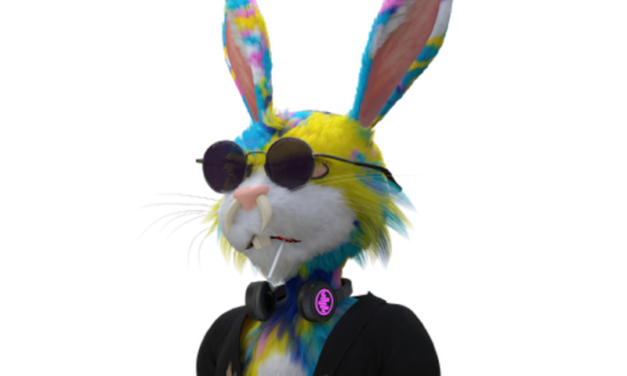
The Metaverse is quickly becoming one of the biggest trends of 2022. Recent data found that the metaverse sector currently has a market capitalization of over $26 billion. While impressive, new capabilities are also being added to virtual worlds to create more immersive experiences.For example, metaverse communities that cater to creatives are starting to unfold, allowing users to customize their own interactive experiences. Although this is still an emerging concept, the incorporation of music appears to be one of the defining characteristics of social metaverse environments.Music as NFTsFor instance, music in the form of nonfungible tokens (NFTs) is starting to be used in a number of virtual ecosystems to offer social experiences for both artists and fans.To put this in perspective, Fluf World — a metaverse community consisting primarily of 3D-avatar rabbits — relies heavily on music to create user experiences. Brooke Howard-Smith, co-founder of Fluf World, told Cointelegraph that its metaverse was launched in August 2021 as a platform for creators, artists and musicians to connect using NFTs. Howard-Smith explained that there is a “scenes and sounds” feature that enables community members to combine different soundtracks and backgrounds with their avatar NFTs:“Users can add a background behind their avatar that serves as a different location, many of which we are building in our part of the Metaverse. A user’s 3D-animated rabbit can also move to different music soundtracks that a user chooses to incorporate.”Although the concept may sound complex, Fluf World uses a variety of multimedia NFTs to allow users to customize their Metaverse experiences. “This week Fluf World is launching phase 1 of their ‘Burrows,’ a metaverse space within Fluf World where soon, avatars will be able to walk around and hear other Avatar’s music when their ‘proximity feature’ is turned on. You can also see a visual representation of their music called a Nimbus floating near their avatar when you approach them,” Howard-Smith explained.Fluf World 3D avatar rabbit. Source: Fluf WorldAt the same time, a number of benefits for artists and fans also emerge from this model. For example, “Gino The Ghost” — a grammy award-winning producer and multiplatform songwriter — told Cointelegraph that he is a metaverse music executive for Fluf World. Gino said that he was initially drawn to the project through its incorporation of music, explaining that audio NFTs offer musicians a new way to package music as a crypto asset. He added that sound clips living on a blockchain network solve a number of problems for musicians:“The sobering reality is that music labels are making more money today than ever before through streaming platforms but producers and songwriters are making considerably less. For instance, 100 million streams only generate $7,000 dollars if you own about 30% of a label and most individuals earn much less. Royalties are also paid slowly and you need to audit publishers to see if income is accurate.”With these challenges in mind, Gino said that music NFTs enable artists to generate instant income that is controlled directly by an artist without any intermediaries. In regard to fans, Gino said that those who own music NFTs are not only investing in their favorite artists but are also capable of using those soundtracks to create their own remixes. “Creatives can consume music and do different things with the soundtracks,” he said. In turn, users are also able to sell their unique music NFTs to generate revenue.It’s also interesting to point out that music NFTs can come in the form of digital wearables. For example, wearable music NFTs were recently launched on The Dematerialised, an experimental marketplace for digital fashion. The collection known as “Defend the Metaverse” was created by Teflon Sega, a singer and producer who claims to have been born in the Metaverse. The different NFTs that are available come in the form of t-shirts, sunglasses and shoulder plates and feature a 15-second sound clip from Teflon Sega’s music video, “Unreal Engine.”Teflon Saga shoulder plate. Source: The DematerialisedSega told Cointelegraph that he believes that the relationship between music and fashion has always been very close. “The two intertwined creative cultures have often played off of each other in music videos, which is why it felt so natural to release the outfits and props from my own music videos into the world as wearable NFT’s,” he remarked. Sega added that this year, he thinks people will be introduced to new features that allow for self-expression within metaverse environments. “Whether it be music, fashion, entertainment or storytelling, all forms will have no limitation aside from one’s own creative boundaries.”In addition to music NFTs, decentralized audio files are also being used to personalize metaverse environments. For example, Audius is a music streaming service built on the Solana blockchain that is partnering with different metaverse platforms. Roneil Rumburg, CEO and co-founder of Audius, told Cointelegraph that anyone is able to pull content from the Audius platform due to its decentralized nature. “Fans and developers are running this ecosystem for the benefit of everyone. Therefore, anyone can build using our platform,” he said.According to Rumburg, Audius music files were initially applied in gaming metaverses but recently, the platform has partnered with the real estate NFT project “Ethereum Towers” and Solana-powered “Portals Metaverse” to provide streaming music. “Portals Metaverse allows users to play their own choice of music within their room inside the Metaverse through the Audius API. The community has even built an Audius lounge for concerts,” explained Rumburg.Rumburg further noted that while Audius provides a catalog of decentralized audio files combined with metadata, some developers have built wrapped NFTs around Audius files. “We are just a decentralized repository of content without rights, so third-party developers can pull from the platform’s catalog without any issues.” As such, Rumburg explained that the main benefit of Audius in the context of the Metaverse is that developers can freely pull content without being sued by third parties. Related: Blockchain streaming platform Audius announces Solana NFT integrationMetaverse music: Here to stay or just a trend?Although the concept is relatively new, industry experts believe that music for metaverse environments will continue to gain traction. Sebastien Borget, chief operations officer and co-founder of the Sandbox — a popular gaming metaverse ecosystem — told Cointelegraph that he believes music will be used more often. “It’s defining a new format of entertainment beyond music clips. It’s more social and immersive,” he said. Sticking to this trend,the Sandbox recently announced a partnership with Warner Music Group to create a musical theme park and concert venue within the platform.Famous musicians are also becoming more involved with NFTs. American singer and songwriterJohn Legend recently announced his involvement in launching an NFT music platform that will allow artists to tokenize and sell their work. In addition, American rapper and songwriter Snoop Dog recently announced that he is a Fluf World holder by tweeting out his customized “Snoop Dogg Party Bear” NFT, which features music produced by Gino The Ghost.While it’s clear that music is making an impact in virtual worlds, challenges remain that could hamper adoption. For instance, Rumburg mentioned that other platforms are attempting to do the same as Audius, but some are facing criticism for using APIs from platforms like Spotify from which to pull music. Most recently, the NFT platform called HitPiece was criticized by musicians for selling music NFTs without their permission. In addition, buying and selling NFTs are expensive due to high gas fees and minting costs which could impact the growth and diversity of communities that pride themselves on self-expression. Howard-Smith is aware of this challenge, noting that he doesn’t want a barrier of entry to exist within Fluf World:“We have a plan that will ensure in the next two years anyone will be able to come into Fluf World and create. I think that the biggest challenge now is creating an even playing field as we continue to build new technologies and layer together information. Any artist can join the Fluf community for free with or without an avatar, and many are already making money creating music with Fluf existing owners. it’s essential that the industry creates ecosystems that are as inclusive as possible, enabling new artists and those with smaller fan bases as well as already successful musicians to join.” 

Čítaj viac

No precedent: IRS court settlement doesn't clarify crypto staking taxes

In May 2021, a Nashville couple known as the Jarretts filed a lawsuit against the United States Internal Revenue Service (IRS) over taxes they had paid on unclaimed and unsold Tezos (XTZ) staking rewards. At the beginning of February,news broke that the lawsuit filed by the Jarretts had come to an end, resulting in the IRS issuing the couple a tax refund for $3,793. Confusion among crypto holdersNot long after this news made headlines, confusion among the crypto community piqued. One crypto media publication sent a tweet from its official account on Feb. 2, 2022, saying, “BREAKING: IRS will not tax unsold staked crypto as income.” The tweet generated over 4,000 retweets and over 18,000 likes, as Crypto Twitter rejoiced over the assumed notion that the IRS would not tax unsold staked crypto.More confusion resulted as mainstream media outlets proceeded to publish articles implying that the IRS would not tax passive income from staked crypto. For example, a recent Forbes article published by a senior contributor stated:“This is a huge win for crypto holders in the U.S. In light of this new information, even without this formal court ruling, some taxpayers might decide to follow a bit aggressive approach and not report staking income at the time of receipt.”Clearing the air: A ruling was never madeSeth Wilks, head of government relations and SME at TaxBit — a platform specializing in cryptocurrency taxation — told Cointelegraph that a slew of misinformation was spread and false conclusions being made regarding the lawsuit:“In the eyes of the IRS, nothing has changed. Their position on staking income is the same as it has been for the last several years. This case was really more about a legal procedure than anything else. There was no court ruling that another taxpayer could point to as precedent. Settling this case was the only thing in contention here.”Wilks said that a court ruling is still to be made, as the IRS has only settled the dispute by paying the couple a refund. He added that assuming the plaintiffs don’t come up with an unexpected legal argument to keep the case moving forward, the likely outcome would be for the judge to fully dismiss the case. “From a legal standpoint, I envision the Department of Justice — which is the law firm for the IRS in these matters — will file a motion with the court to have the case dismissed, citing mootness, meaning it’s no longer applicable since a refund was issued.”On the other hand, Wilks pointed out that the Jarretts may continue to push the case forward, noting that the couple is working with a team of savvy lawyers while also receiving support from the Proof of Stake Alliance (POSA), which is an industry advocacy group. Given this, the Jarrett’s recently released a statement indicating their goal to have the IRS clarify its position on taxing staking and block rewards “for both proof-of-stake and proof-of-work” systems. This is important since no clear guidance currently exists for taxing unclaimed staking rewards. As of now, the IRS only asks taxpayers whether they have “received, sold, exchanged or otherwise disposed of any financial interest in any virtual currency.”Alison Smith Mangiero, a member of the POSA board of directors and president and founder of Tocqueville Group — an asset management firm — told Cointelegraph that the Jarretts’ case may represent the first legal opinion to be written on the subject of taxation of crypto staking rewards. “This is huge, as POSA has been working on this issue since we started almost three years ago,” she remarked. According to Mangiero, many taxpayers are in similar positions as the Jarretts. Therefore, she thinks it’s crucial for legal arguments to be made around this issue. “This is an argument backed by over 100 years of tax law, and it’s important for people to understand this is a viable position,” she said.Mangiero added that the POSA worked with law professor Abraham Sutherland in 2019 to initially make the argument around taxation for block rewards. As a result, a detailed report was published by Sutherland in the SSRN, formerly known as Social Science Research Network. The report’s abstract notes that Sutherland “concludes that for both proof-of-work and proof-of-stake cryptocurrencies, the best approach is to tax reward tokens only when they are sold or exchanged.”With this in mind, Mangiero remarked that the IRS does not determine what is taxable income, but rather its job is to enforce the tax code. She further noted that Sutherland is a legal advisor for the POSA, who also serves as a counsel in the Jarretts’ case.Next steps: Clarification on stakingEven if the case does progress, Wilks said that the IRS must still issue clear guidance around the definition of staking before an official court ruling can be made. As of now, there is no specific IRS guidance on the definition of staking, resulting in added confusion. Wilks said:“The IRS needs guidance on delegating staking rewards and staking on DeFi [decentralized finance] networks, for example. I’m guessing they are trying to sort this out now, which is why it’s also inaccurate to say that the IRS has just given up on the matter entirely.”As such, Wilks believes crypto staking rewards and taxation will remain a crucial issue for the IRS, noting that advocacy groups like the POSA will keep pushing for clarity. Indeed, Mangiero noted that the POSA has been working on educating Congress around the issue of how staking rewards should be treated. She explained that the POSA worked with leaders from the Congressional Blockchain Caucus to help write a letter to the IRS in 2020 on issuing formal guidance detailing why staking rewards should be treated as created property. She added:“We will continue to fire away on all fronts. In terms of defining staking, we are focused narrowly on people participating in securing PoS [proof-of-stake] blockchains and being rewarded for creating those tokens. That is what the focus is for The Jarretts’ case, and this is where we are trying to focus first since it’s one of the least complicated staking situations.”While educational initiatives from the POSA may help with clarity on the topic, Wilks pointed out that the IRS guidance on mining could also potentially support tax implications for staking activities. He mentioned that this may be likely due to the similarities the IRS perceives between staking crypto rewards and mining.“It is very unlikely that the IRS would make a policy change on staking without taking into consideration mining,” said Wilks. Although it’s difficult to predict what such a policy would entail, Wilks wrote in a recent TaxBit blog post, “If you follow and apply IRS Notice 2014–21, the guidance on mining income, a staking reward is taxable as ordinary income at its fair market value on the date you receive it.”In the meantime, Wilks believes that even if the Jarretts’ court hearing doesn’t provide legal precedent, it may result in some insight into the IRS’ current position on the issue. Mangiero added that it’s notable that the U.S. Department of Justice said it would issue a refund after a year and a half into the case:“This is a good sign and an early signal that these legal arguments are now reasonable positions. However, this remains a complicated issue, and we need to be careful against spreading misinformation.” 

Čítaj viac

Chainalysis report finds most NFT wash traders unprofitable

Nonfungible tokens (NFT) have taken the world by storm, resulting in mainstream interest and greater adoption of cryptocurrency. According to blockchain analysis firm Chainalysis, NFT popularity skyrocketed in 2021. Chainalysis’ “NFT Market Report” shows a minimum of $44.2 billion worth of cryptocurrency sent to Ethereum smart contracts associated with NFT marketplaces and collections last year. The report notes that this number was $106 million in 2020.While impressive, increasing scams and fraudulent activities have infiltrated the NFT space. For instance, major NFT marketplace OpenSea recently announced that its free minting tool was prone to misuse. As a result, OpenSea shared that 80% of NFTs created using this tool were either plagiarized, fake or spam. If that wasn’t bad enough, Chainalysis’ latest blog post highlighting its “2022 Crypto Crime Report” found that the NFT sector is vulnerable to wash trading and money laundering.Wash trading in the NFT sector growsAccording to the blog post, wash trading refers to a transaction in which a seller is on both sides of the trade in order to paint a misleading picture of an asset’s value and liquidity. Unsurprisingly, wash trading has become a major concern within the NFT sector. Most recently, data generated from the LooksRare NFT marketplace found the platform to be very prone to wash trading.Yet as wash trading becomes more common across NFT marketplaces, new solutions are being developed to detect fraudulent activity. Kim Grauer, head of research at Chainalysis, told Cointelegraph that the firm has created a potential tool capable of detecting individuals who are self-funding their own crypto wallets to conduct misleading transactions:“By using Chainalysis software, we can see when a person buys a token using funds from the same person who sold them that very token. This is the definition of wash trading.”The Chainalysis blog post further explains that by using blockchain analysis, the firm is capable of tracking NFT wash trading by analyzing sales of NFTs to addresses that were self-financed, meaning they were funded either by the selling address or by the address that initially funded the selling address.Interestingly enough, while Chainalysis found that some NFT sellers have conducted hundreds of wash trades, Grauer pointed out that most NFT wash traders are in fact unprofitable. She said:“Overall, we found that it’s not profitable to wash trade NFTs because you end up paying a lot in gas fees. Many wash traders came out negative due to the amount spent on gas versus the amount generated from their sales.”More specifically, Chainalysis’ findings indicate that 152 Ethereum addresses associated with wash traders resulted in losses of $416,984. On the other hand, Grauer pointed out that some wash traders have been successful. Data from Chainalysis shows that 110 Ethereum addresses received $8.9 million in profits from wash trading.According to Grauer, successful wash traders tend to be individuals conducting multiple NFT trades across a number of platforms. However, she noted that overall, it’s not a good idea to wash trade due to the high costs of gas fees coupled with the fact that all transactions can be seen across the Ethereum blockchain network. “This is a risky type of crime to carry out, and even riskier given that people have to pay large gas fees. Those who do this at scale have to be experienced,” remarked Grauer.How NFT platforms can keep users safeAlthough wash trading NFTs have proven to be risky and unprofitable for most, Grauer believes this activity will become more common as the NFT space continues to grow. “Anyone can easily engage in wash trading — if you can download an ETH wallet and purchase an NFT, you can do it,” she remarked. With this in mind, it’s becoming increasingly important for NFT platforms to enforce initiatives to help keep users safe from fraudulent activities.Alex Salnikov, co-founder and head of product at NFT marketplace Rarible, told Cointelegraph that in terms of what the platform has seen in the broader NFT ecosystem, there tends to be a pattern of users wash trading on platforms that provide incentive rewards for trading. To Salnikov’s point, the LooksRare platform planned to offer user rewards in the form of the platform’s native token, which could have added to the amount of wash trading on the platform.Salnikov explained that after realizing this vulnerability, the Rarible decentralized autonomous organization voted to stop RARI token distribution to Rarible users. As a result, “the issue is no longer relevant for our marketplace,” he said, adding that in order to further protect Rarible users, the platform has released a verification system that allows the Rarible team to manually review a creator’s profile. Salnikov elaborated:“If this process is successful, the user will earn a yellow checkmark on their Rarible marketplace profile. It is important to note that collectibles from unverified creators do not appear in our search results or the explore feed. Users are also warned if they are about to purchase a collectible by an unverified creator or collection.”While Rarible has taken a number of steps to ensure user safety across the platform, Grauer mentioned that Dapper Labs, a blockchain platform that offers NFT-based products and decentralized apps, is working closely with Chainalysis to monitor wash trading and other illicit activities. Additionally, OpenSea published a blog post on Jan. 17 introducing its new “NFT Security Group.” According to the post, members will be expected to share and learn about vulnerability reports that have not been publicly announced in order to fix problems before users are impacted. Members will also focus on creating solutions to ensure greater security around blockchain consensus, smart contacts, wallets and metadata, along with awareness for interoperability implications.Will regulations keep users safe?In addition to these measures, discussions around NFTs and compliance are coming to fruition. Joseph Weinberg, co-founder of Shyft Network — a compliance-focused blockchain network — told Cointelegraph that while it’s hard to say if NFTs should be regulated, he believes that the space needs oversight:“I think trading platforms that accept funds — like an OpenSea, for example — will inevitably become regulated as VASPs, as they are in the business of matching to counterparties and they accept fees. As far as how NFTs could be regulated, you can do things like multi-address hop detection and address screening to cluster and determine if there’s a likelihood that people are wash trading.”However, Weinberg remarked that NFTs are still a grey area when it comes to regulations. “Regulators haven’t even been able to give us clear guidance on DeFi [decentralized finance], so I think they’re waiting to see how it plays out,” he said, adding that the biggest challenge currently facing regulators is the fact that art is not a regulated environment:“Historically, it’s known that art markets are not subject to KYC [Know Your Customer] and AML [Anti-Money Laundering] requirements. It’s also widely known that the art world is where a lot of money laundering takes place — and has for a long time. The question that needs to be asked is if the ‘form’ is different from the ‘function’ because a token has a different set of use cases than a piece of paper.”As such, Weinberg believes that regulators first need to focus on how NFTs should be approached before coming up with guidance. In the meantime, some industry experts believe that the NFT community will take its own set of actions. Jack O’Holleran, chief operating officer of Skale Labs — a platform developing solutions for Ethereum scalability — told Cointelegraph that he believes free markets will ultimately prevail. “End users will not want to purchase NFTs from sites that don’t clearly remove or call out overt wash trading numbers. NFT traders and purchasers will move their business to exchanges and data aggregation sites that give them real views of market data.”NFT scams will continue to rise, even with solutionsUnfortunately, even with compliance solutions, initiatives from NFT platforms and possible regulations, Grauer predicts that there will be a rise in criminal activity in the NFT space before there is a decline.Moreover, while Chainalysis found money laundering associated with NFT addresses to be relatively low in 2021, Grauer expressed concerns that the space will only continue to worsen. “My prediction is that the sector will get worse in many ways before it gets better with industry solutions. It’s possible that some NFT platforms will adopt compliance to help things progress.” 

Čítaj viac

Blockchain startups grow as global VC funding generated $25.2B in 2021

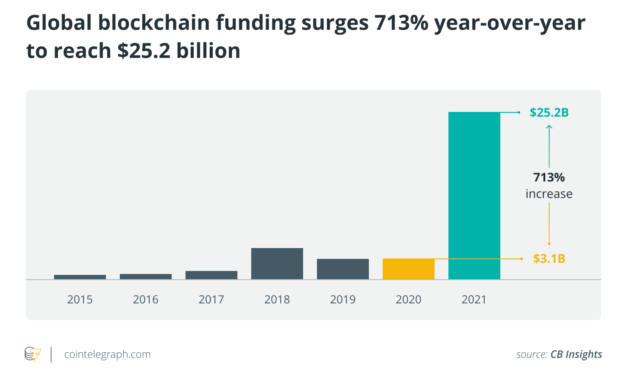
Last year was impressive for blockchain startups, as research from CB Insights found that venture capital funding reached new heights during every quarter of 2021. According to CB Insights’ “State Of Blockchain 2021” report, $25.2 billion worth of venture capital funding went to global blockchain startups last year, demonstrating a 713% increase from $3.1 billion in 2020.The report also found that the United States led the greatest amount of funding deals in Q4 of last year, generating $6.26 billion for 157 deals. The document notes that global growth was driven by increasing consumer and institutional demand for crypto-related products and services. VC funding focused on crypto adoptionChris Bendtsen, a senior analyst at CB Insights, told Cointelegraph that CB Insights’ report contains data aggregated from private marketing funding from over 3,000 blockchain and crypto companies that the firm regularly tracks. Bendtsen further explained that while the title of the report references blockchain, this serves as an overarching category that includes cryptocurrency, nonfungible tokens (NFT), enterprise blockchain and decentralized finance (DeFi). Bendtsen pointed out that the majority of VC funding mentioned throughout the report was allocated to crypto-focused startups. The report states:“Over $100M mega-rounds (worth $100m+) were the driving force behind blockchain’s record funding year. The 59 mega-rounds in 2021 accounted for just 5% of total deals but 60% of total funding. The biggest mega-round deals went to crypto exchanges, brokerages, NFTs, gaming, and payments.”According to the report, $1 out of every $4 worth of funding went to crypto exchanges and brokerages, which also equates to a quarter of all global blockchain funding in 2021. Bendtsen remarked that while the biggest deals went to major crypto exchanges such as FTX — which ranked as the second-largest equity deal for brokerages and exchanges in Q4 of 2021 — funding for country-specific exchanges has also been on the rise. For instance, CoinSwitch Kuber, one of the largest crypto trading platforms in India, ranked No. 4 for top equality deals for brokerages and exchanges in Q4 of 2021, generating over $260 million in its recent Series C funding round. “Based on these findings, it’s become evident that we are seeing the globalization of crypto, as more country-specific exchanges are raising impressive rounds,” said Bendtsen.Bendtsen further pointed out that global VC funding for crypto custody and wallet providers reached $6.3 billion last year. “Toward the beginning of 2021, a lot of funding was going to consumer-driven exchanges, but there was a shift later in the year that saw major funding rounds go to crypto custody providers and custodians,” he remarked.For example, the New York Digital Investment Group (NYDIG) ranked as the top equity deal in Q4 of 2021 under the category of custody and wallet providers. In December 2021, the institution specializing in Bitcoin (BTC) financial services secured a $1-billion equity investment led by WestCap Group. Fireblocks, the digital asset custody platform, ranked directly under NYDIG with its $550-million raise from Sequoia Capital.Michael Shaulov, CEO of Fireblocks, told Cointelegraph that he believes investors are paying more attention to custody and wallet providers because this has been the biggest barrier to entry for institutional participation. “Having a direct custody solution and technologies that can plug and play into the crypto capital markets is a game-changer for businesses and individuals alike,” he said.“Our investors see us as the picks and shovels of the crypto industry. This includes everything from direct custody wallets and settlement networks to compliance integrations with Chainalysis and Elliptic, along with access to staking providers.”In regard to the company’s latest funding round, Shaulov said that Fireblocks plans to expand its offerings to include securing high-value transactions around DeFi and NFTs. This is important, especially now as the number of scams and fraudulent activities within the DeFi and NFT sectors has increased.Although criminal activity within the NFT space has started to quickly unfold, the CB Insights report found that funding allocated to NFT startups grew by a margin of 130 times. In 2020, NFT startups generated $37 million in VC funding, which reached $4.8 billion in 2021. “Gaming, marketplaces, and infrastructure are the top 3 NFT categories driving the funding craze,” the report highlighted.Animoca Brands, which ranked as the No. 1 investor by company count in Q4 of 2021 according to CB Insights, made at least 49 investments in blockchain projects last year. Yat Siu, co-founder and executive chairman of Animoca Brands, told Cointelegraph that NFT and blockchain gaming overall were major drivers of the growth in funding last year:“We have always believed that NFTs, and in particular gaming, are key to the mass adoption of blockchain, and I think what happened in 2021 strongly suggests that this thesis will be realized in 2022. It’s interesting to note that in 2021, many new blockchain users entered the world of crypto not because of cryptocurrencies but because they were seeking to acquire NFTs.”Traditional VCs take an interest In addition to where funds are going, Bendtsen noted that the CB Insights report found that more traditional investors started taking interest in blockchain startups last year:“Over the course of 2021, Andreessen Horowitz jumped out as a smart-money investor. They are one of the biggest VC firms in the world and announced a huge crypto-focused fund in June of last year.”As Cointelegraph previously reported in June 2021, the Silicon Valley venture firm launched “Crypto Fund III,” a $2.2-billion venture fund co-led by Andreessen Horowitz general partners Chris Dixon and Katie Haun. According to the CB Insights report, Andreessen Horowitz was ranked as the No. 3 blockchain investor in 2021, falling under Coinbase Ventures and China’s AU21. “Our numbers show that Andreessen Horowitz invested in 46 blockchain startups last year, the third-most of any investor out there, including the crypto-focused funds. This shows that we are seeing more traditional firms coming into the crypto space,” remarked Bendtsen.While this may be, Siu noted that Andreessen Horowitz has had a much longer history with blockchain investments. For instance, the venture firm invested in blockchain-company Dfinity in 2018. As such, Siu remarked that while Andreessen Horowitz isn’t new to the space, the company did ramp up its investments in Web3 startups throughout 2021. “It is very clear that A16z and other major investors like Sequoia China understand the enormous potential of Web3 and of the value that the application of blockchain can deliver, and they are investing accordingly,” he said. Given this, Siu believes that more well-known venture capitalists and firms will continue to invest in blockchain startups, particularly those innovating with NFTs.Will crypto price volatility impact funding?While recent growth for blockchain startups has been impressive, crypto price volatility and unclear regulations may create challenges for companies looking to raise funds in the future. For instance,rising inflation in the United States may further impact the price of Bitcoin. Also, unclear regulations around NFTs could be detrimental for new companies entering the space.Although these challenges should be carefully considered, Bendtsen explained that none of the data recently generated from CB Insights indicates any type of slowing down for funding. “The fact is that these investors view crypto as a long-term play. I, therefore, don’t think the lower crypto prices today will affect startup funding in the future.” Shaulov added that he believes there will be growing agreement around cryptocurrency regulation around the world, which will ultimately fuel retail and institutional adoption. 

Čítaj viac

Získaj BONUS 8 € v Bitcoinoch

nakup bitcoin z karty

Registrácia Binance

Burza Binance

Aktuálne kurzy