Autor Cointelegraph By Rachel Wolfson

Genomics company explores NFTs in hopes of advancing precision medicine

It’s predicted that nonfungible tokens (NFTs) will have a vast impact on society. Given this, it shouldn’t come as a surprise that the trillion-dollar healthcare sector has begun to explore NFTs tokens to advance medicine.It’s also important to point out thatblockchain technology can play an increasingly important role within the healthcare sector. This was recently highlighted in a report from the European Union Blockchain Observatory, which specifically documents how blockchain applications can solve challenges facing the healthcare industry. For example, the paper notes that patient engagement and transparency of how data is stored, along with the effective distribution of knowledge and data remains problematic for the healthcare sector. Yet, as the blockchain space continues to advance, tokenization in the form of nonfungible tokens may serve as a solution to many of the challenges facing today’s healthcare industry.GeneNFTs aim to revolutionize precision medicineFor those unfamiliar with the term, precision medicine refers to “an emerging approach for disease treatment and prevention that takes into account individual variability in genes, environment, and lifestyle for each person,” according to the Precision Medicine Initiative.Specifically speaking, Cao believes that tokenizing genetic profiles can help patients maintain data ownership and transparency into their insights while receiving many benefits that are not typically associated with traditional genomic testing. He explained:For example, Genetica, a genomic company catering to the Asia Pacific region, recently partnered withOasis Labs, a Web3 data management firm, to tokenize genomic profiles. Tuan Cao, Genetica’s CEO and co-founder, told Cointelegraph that the goal behind this partnership is to advance precision medicine by giving patients data ownership and rights through GeneNFTs.“This may be one of the most important NFT applications in the world. Our genetic profile is unique and it should be represented by an NFT. GeneNFTs are the tokenized ownership of one’s genetic data. This enables each of us to truly take control and benefit from our data contribution.”According to Cao, traditional genetic testing companies like 23andMe, for example, rely on intermediaries to collect patient data for research. As such, users must trust centralized entities to safely store sensitive health information. Moreover, users do not receive any incentives for opting to share their data with third parties. Yet, tokenizing genomic data in the form of an NFT has the potential to transform this model entirely.For instance, Cao explained that Genetica’s partnership with Oasis Labs enables users to perform a traditional genetic test and receive a GeneNFT afterward that represents true ownership of their genetic profile. More importantly, Cao noted that GeneNFT holders become the gatekeepers of their data, meaning they must grant access to third-party entities that wish to use that information. He elaborated:“A user holding a GeneNFT also holds the private key for that data. If a pharmaceutical company for instance wants to run a genetic study, they must send a proposal for access. A user can then sign the proposal to approve the access.”Cao further explained that there are both financial and medical benefits associated with GeneNFTs. “Financial benefits involve revenue sharing, so users will get paid when third parties request to access their data. We are able to issue these payments automatically due to blockchain technology and smart contracts,” said Cao. Cao believes that the medical benefits achieved from GeneNFTs outweigh the financial incentives. “When users participate in a genetic study, a smart contract is leveraged to ensure patients will receive treatment first if they contribute to a clinical trial. Precision medicine profiles for treatments of certain diseases based on genetic variants, which is how this model is ultimately advancing precision medicine,” he said.Dawn Song, founder of Oasis Labs, told Cointelegraph that GeneNFTs can be viewed as data-backed nonfungible tokens. “Typically people think of NFTs as JPEG images, but data-backed NFTs combine blockchain with privacy computing to utilize certain pieces of data while still complying with data usage policies like the EU’s data protection regulations, or GDPR,” she said. Technically speaking, Song explained that Genetica will use Oasis Network’s Parcel, a privacy-preserving data governance application programming interface (API), to tokenize genomic profiles. She elaborated:“Given that genomes are the quintessential identity of individuals, it is critical that any platform that stores and processes genomic data provides confidentiality to the data at rest, in motion and, more importantly, in use. Parcel provides these capabilities via the use of encryption of data at rest and in motion and trusted execution environments to maintain data confidentiality in use.”Given the size of genomic data and the complexity of the computations that run on them, Song further explained that Parcel’s use of off-chain storage and off-chain secure execution environments makes it possible to store genomic data and run analyses on them. “Parcel also supports a policy framework that is used by data owners, or individuals as owners of their genomes, to specify who can use their data and for what purposes,” she added. To date, Oasis Lab’s technology has enabled the tokenization of 30,000 genomic profiles, and the partnership with Genetica will increase this number to 100,000.Healthcare industry already uses tokenizationWhile NFTs are an emerging concept for the healthcare sector, it’s interesting to recognize that tokenization in an entirely different sense from NFT) is becoming more common as patient privacy becomes critical.For example, Seqster, a healthcare technology company founded in 2016, provides tokenized data to address privacy needs across the healthcare industry. Ardy Arianpour, CEO and founder of Seqster, told Cointelegraph that the company tokenizes various forms of patient data, including genomic DNA data, for healthcare providers:“Seqster tokenizes a patient’s personal information fields such as their name, address, phone, date of birth and email into a set of unique tokens that a company can then use to identify a patient within its network. Tokenization allows each organization, provider, payer and researcher to have their own internal unique ID representing a real patient without revealing to the other party in a transaction whom the patient actually is.”According to Arianpour, tokenization in this regard is essential to avoid exposing personal health information about a patient without their explicit consent, which would be a violation of the Health Insurance Portability and Accountability Act (HIPAA). On the other hand, Arianpour explained that while tokenization is helpful, it is not always necessary. “In certain environments, like clinical trials, the sponsoring organization can generate a ‘subject_id’ that uniquely identifies the patient. That ID can be shared within their organization or with partners without revealing the patient’s actual identity. This is a more widely used standard among the clinical trial space and also meets FDA compliance,” he said.Datavant, a healthcare data company, has also been leveraging tokenization to ensure patient information is private yet accessible. McKinsey & Company recently featured aninterview with Pete McCabe, CEO of Datavant, in which he explained how tokenization is used. According to McCabe, Datavant defines tokenization as “cutting-edge, patent-pending de-identification technology that replaces private patient information with an encrypted token that can’t be reverse-engineered to reveal the original information.” McCabe added that tokenization in this regard “can create patient-specific tokens in any data set, which means that now two different data sets can be combined using the patient tokens to match the corresponding records without ever sharing the underlying patient information.”Education is criticalWhile it’s notable that NFTs are starting to be applied to healthcare, a handful of challenges may hamper adoption. For instance, Robert Chu, co-founder and CEO of Embleema — a data platform for personalized medicine — explained in the EU Blockchain Observatory’s healthcare report that data must be de-identified in the United States without the possibility of reidentifying patient information in order to comply with HIPAA. But, Chu explained that this becomes challenging once only a few patients participate in the dataset:“In this example, it may be impossible for any method to completely de-identify the data. Should we then forbid any research for rare diseases, even if patients agree to share identified data? In our opinion, it should not. This example demonstrates well that there needs to be a balance between privacy and innovation.”To Chu’s point, Cao mentioned that people using GeneNFTs to participate in a clinical study will receive treatment first if they contribute their data. This would also mean that their data would be identifiable, which may result in regulatory concerns in specific regions like the U.S.Moreover, Cao shared that 90% of Genetica users are non-crypto natives. Therefore, Cao believes that the biggest challenge for the adoption of GeneNFTs is education. “We have to put in extra work to educate almost all of our users on the benefits of GeneNFTs, explaining how these provide data ownership, accessibility and utilization,” he said. Echoing Cao, Song commented that user education is indeed the biggest hurdle for adoption. “Many users understand what an artwork NFT is, but they are not familiar with data-backed NFTs.”Although this is currently the case, Song believes that data-backed NFTs have the potential to transform society as the world’s economy becomes data driven. “This approach could grow fast, but we first need to get users to understand this model better. Compared to a few years ago, user awareness has fortunately been much higher in regards to emerging data protection methods.”

Čítaj viac


Go green or die? Bitcoin miners aim for carbon neutrality by mining near data centers

Bitcoin (BTC) mining has always been a controversial topic. But, Bitcoin’s proof-of-work (PoW) model has reached new levels of concern as senior decision-makers and investors pay closer attention to environmental, social and governance factors. As such, manycrypto miners are highlighting environmentally friendly practices by acquiring carbon offsets. Yet, some would argue that this isn’t enough to guarantee green Bitcoin mining. Other risk factors may also be involved with carbon credits. For instance, Kevin O’Leary — the Canadian entrepreneur better known as “Mr. Wonderful” for his role on Shark Tank — told Cointelegraph that he typically indexes public mining companies like Marathon Digital Holdings, Riot Blockchain Inc. and others. However, O’Leary pointed out that once these companies claimed carbon neutrality through carbon offsets, their stocks dropped drastically. O’Leary believes this is because the United States Securities and Exchange Commission (SEC), may soon plan to audit carbon credits. O’Leary expressed his concern, stating:“Carbon offsets are unauditable. So indexers like me dumped those shares — we had to sell. The only way institutions will now invest in Bitcoin mining is for those companies to claim there is no carbon involved at all.”Bitcoin mining and data centersIn order to ensure zero carbon mining, O’Leary explained that Bitcoin miners should build in parallel with data centers. This would then allow mining companies to efficiently use excess energy omitted from data centers to mine Bitcoin, resulting in “zero carbon displacement,” a process that produces zero carbon emissions.Bitcoin mining company Bitzero began implementing such a model two years ago in Norway. Akbar Shamji, CEO and founder of Bitzero, told Cointelegraph that the company initially built an infrastructure partnership with Norway’s local government two years ago that prompted the region to release unused hydroelectric power generation for Bitcoin mining:“This was the perfect opportunity for us to test this idea. At the same time, big data companies started to use renewable energy sources in places like Norway, but this wasn’t profitable for the region. We’ve built a long-term, low-cost 100% zero carbon displacement power source to have an edge over the market. We hit revenue when we mined our first Bitcoin in December 2021.”Being aware of the massive demand for data storage today, Shamji further explained that electricity generated from data centers should be properly harnessed. “We call this the ‘Norway model.’ Electricity generation is there but it remains stuck at high voltage. So, we executed the electrical step down from high voltage to low acquiring transformers and substation, allowing us to drive containers full of ASIC miners efficiently,” he remarked.In other words, Bitzero draws power directly from surplus capacity at local hydro plants, resulting in zero carbon displacement. At the same time, Shamji explained that Bitzero is delivering fixed data centers made of sustainable and local materials that consist of heat capture technology. “In the case of Bitcoin mining, when electricity passes through these computers, the PoW algorithm doesn’t take much energy to generate. If this wasn’t implemented, the heat generated from these computers would go back into the air and be lost entirely,” he said. Although a zero carbon displacement model is yet to be widely adopted, Shamji said that Bitzero typically mines 129 Bitcoin per month, using 40 megawatts of power. He added that this will eventually grow to 110 megawatts.The crypto mining company Argo Blockchain also plans to open a data center in West Texas to conduct mining operations. While Argo isn’t taking a zero carbon displacement approach, Peter Wall, CEO of Argo, told Cointelegraph that the company aims to become carbon neutral:“There’s an enormous amount of renewable power in West Texas, and Argo’s mission is to mine Bitcoin in the most eco-friendly way possible. We chose Dickens County in particular because there is a substation that is adjacent to the property we chose to build Helios, which is our new flagship mining facility.”Like Shamji, Wall is aware that clean power running through the substation located in Dickens County, Texas, is stranded and is not being utilized. “There is not a lot of local demand or local load to use that power, so we felt that this was a strong opportunity to help stabilize the grid,” he remarked.Interestingly enough, energy and gas companies are also setting up shop in areas where energy is emitted. For example, Alex Tapscott, author and co-founder of the Toronto-based Blockchain Research Institute, told Cointelegraph that energy producerExxonMobil has been quietly mining Bitcoin in North Dakota’s Bakken region for a year as part of a plan to curb emissions from flared gas. North Dakota gas flare. Source: Joshua Doubek“The pilot project has been enough of a success that the company plans to roll it out on a much wider basis. ConocoPhillips is reportedly working on a similar project,” said Tapscott. In addition, the energy company Grid Share recently announced plans to open a Bitcoin mining data center next to a hydroelectric dam on New Zealand’s south island to support 100% renewable energy in the region.According to Tapscott, these initiatives may be surprising to many individuals who believe that Bitcoin mining is carbon-intensive. He explained that models such as these can be helpful for reducing carbon footprints:“A typical Bakken well produces oil but also natural gas which is burned off or flared into the atmosphere. This is a significant source of carbon entering the atmosphere. Instead of flaring the gas, Exxon has partnered with Denver-based Crusoe Energy to capture gas and divert it to generators where it mines Bitcoin.”Tapscott added that Crusoe found Bitcoin mining to reduce the world’s carbon footprint by as much as 63%. “Gas that had no way to get to market and would have been burned straight into the atmosphere instead gets a useful purpose as the fuel for minting new Bitcoin.”Zero carbon emissionsWhile green Bitcoin mining has always been a “buzzword,” some would argue that these initiatives, along with zero carbon displacement, have become critical for mining operators that wish to stay in business. For instance, lawmakers are seeking to pass legislation to ban non-green crypto mining operations entirely. This was recently exhibited by the State of New York, aslawmakers aim to restrict Bitcoin mining operations with a proposed bill currently making its way through the state capitol in Albany. Meanwhile, the government ofKazakhstan recently proposed requirements for cryptocurrency mining operators to report the electricity consumption and “technical specifications” for connection to the power grid before operating.Although initiatives like the Crypto Climate Accord aim to achieve net-zero emissions from electricity consumption from the companies involved by 2025, this also raises concerns in terms of how this may be achieved. Tapscott pointed out:“This is a laudable goal, so long as it does not force Bitcoin to be something it’s not. To wit, some have suggested changing Bitcoin’s underlying code so that it uses the less energy-intensive proof-of-stake consensus mechanism. This would be a mistake. Proof-of-work is a feature that gives the network resiliency and strength.”From an investors perspective, O’Leary added that he will only invest in Bitcoin mining firms and data centers that can prove to be a sustainable source of energy moving forward:“Private capital must be compliant with environmental, social and governance factors. ESG was once a marketing term, but now it’s a real thing. I can’t be subject to an SEC audit, and can’t find an auditor who will sign these statements anyway. The crypto industry is at an interesting inflection point.”To O’Leary’s point, Bitcoin miners are, indeed, facing an inflection point, yet regulatory clarity remains questionable. Bill Tapscott, CEO of CarbonX — a fintech carbon trading company — told Cointelegraph that the SEC’s proposed disclosures are similar to those that many companies already provide based on broadly accepted disclosure frameworks, such as the Task Force on Climate-Related Financial Disclosures and the Greenhouse Gas Protocol. He elaborated:“Disclosure creates a baseline from which a government or regulator’s next move is to introduce a carbon tax or an emissions cap and trade system, such as the ARB’s California Quebec Market or RGGI. Carbon credits are part of these programs and have been ‘audited’ for years.”Given this, Tapscott explained that mining operators will need to report their emissions, which will likely be high if energy originates from fossil fuels even flare gases, or low if these are from green sources like hydroelectric. “Yet, these companies can de-risk future carbon costs by investing long in carbon credits,” he said. 

Čítaj viac

'Regulations are in place to help crypto businesses understand operations,' says The Bahamas PM Philip Davis

The Bahamas Prime Minister Philip Davis told Cointelegraph that the region has a regulatory regime in place that will enable crypto businesses to operate within its jurisdiction. During an interview at SALT’s Crypto Bahamas conference, Davis shared that The Bahamas recently published a white paper framework that will allow crypto businesses to “grow and prosper,” while letting companies understand the region’s expectations. He added:“The policy also takes into account the balance between concerns people have about cryptocurrency and the risks that come along with it. [The] policy is to protect consumers, [the] integrity of the space and at [the] same time, ensure that we minimize all risks that may be associated with these businesses.”Davis pointed out that crypto innovation is already well underway in The Bahamas with the establishment of FTX, Sam Bankman-Fried’s cryptocurrency exchange, which moved its headquarters from Hong Kong to The Bahamas in September 2021. Its anticipated that more crypto companies will do the same. Anthony Scaramucci, the founder of the hedge fund SkyBridge Capital, told Cointelegraph that he expects the Bahamas to “become a crypto-centric region that will be known in five years as one of the most forward-thinking and economic visionary countries.”In regards to this, Davis further commented that he hopes the Sand Dollar — the digital iteration of the Bahamian Dollar and a fully operational retail central bank Grayscale GVTC and ETHE digital currency — will be leveraged internationally.Check out the full interview on our YouTube channel, and don’t forget to subscribe!

Čítaj viac

SkyBridge Capital’s Anthony Scaramucci expects a pro-crypto presidential candidacy

Anthony Scaramucci, the founder of the hedge fund SkyBridge Capital, thinks that the next United States presidential candidacy will likely be pro-cryptocurrency given that the U.S. Securities and Exchange Commission (SEC) recently announced the approval of a fourth Bitcoin  (BTC)futures exchange-traded fund (ETF).During an interview at SALT’s Crypto Bahamas conference, Scaramucci told Cointelegraph that he is bullish on a pro-crypto presidential candidate since the SEC approved Bitcoin futures under the Securities Act of 1933 (‘33 Act) and the Securities Act of 1934 (’34 Act). He added: “The congress is indicating that they are more crypto friendly. You now also have 73 million people that own cryptocurrency. Lots of these people are single-issue voters, which will circulate through Congress. Positive regulation ahead is a prediction from SkyBridge.”Given this, Scaramucci also hopes that a Bitcoin spot ETF will be approved by the end of 2022. “If this happens, it will force all major financial services institutions to have a Bitcoin cash offering,” he said. While it’s hard to predict the future, Scaramucci shared that SkyBridge Capital remains ahead of most financial institutions, noting that the hedge fund’s portfolio consists of Bitcoin, Ethereum (ETH) and other layer-1 tokens including Solana (SOL) and a fund dedicated entirely to the blockchain protocol Algorand. [embedded content]Scaramucci further remarked that 20% of his net worth is in Bitcoin, while 4-5% is in Algorand’s ALGO token. “I bought my first Bitcoin in 2020 when the price was between $12,000 to $16,000, but I’ve also bought BTC when the price was at $65,000. I’ve made a macro bet on Bitcoin. I probably have a quarter of my net worth in this stuff.”Check out the full interview on our YouTube channel, and don’t forget to subscribe!

Čítaj viac

Everything gets politicized, including crypto, says former POTUS candidate Andrew Yang

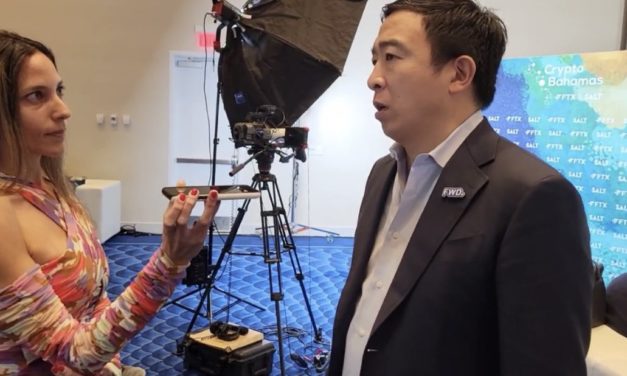
Although cryptocurrency may still be misunderstood on Capitol Hill, crypto is becoming more political as its influence gains traction. For instance, lobbying by those involved in the cryptocurrency industry has reached new heights. A report from the nonprofit consumer advocacy group Public Citizen found that the number of lobbyists for cryptocurrency-related issues rose from 115 in 2018 to 320 in 2021. The report further indicated that the number of representatives within the cryptocurrency industry increased from 47 to 157 during that time period. The United States midterm elections — set to take place on November 8, 2022 — are further demonstrating the politicization of crypto. This has become evident as a number of crypto holders continue to invest big in political campaigns across the country. For example, Sam Bankman-Fried, CEO of crypto exchange FTX, has helped raise over $14 million for “Protect Our Future,” a political action committee supporting candidates running for seats in the U.S. House of Representatives. The influence crypto is having on politics was also recently demonstrated at the SkyBridge Alternatives Conference (SALT), which took place in The Bahamas this year. The event, which attracted over 2,000 attendees, featured a number of global leaders during panel discussions, including former U.S. presidential and New York City mayoral candidate Andrew Yang. Cointelegraph senior reporter Rachel Wolfson speaking with Andrew Yang at Crypto Bahamas.Yang conducted a keynote at the SALT conference entitled “How Governments Can Empower the People with Crypto.” Following this discussion, Cointelegraph spoke with Yang about his views on crypto being leveraged for political campaigns and universal basic income (UBI). Yang also mentioned his plans for the future of crypto in politics, discussing how this ties into his newly formed Forward Party, which aims to unite America’s political parties. For context, Laura Del Savio, senior communications strategist of the Forward Party, told Cointelegraph that the organization is working to reform America’s political system so that incentives don’t push people toward extremes to prevent compromise:“Other political parties thrive by dividing America. We are bringing them together, and are looking to put political power in the hands of the people. That goal is shared by the crypto community. Blockchain technology makes new governance structures possible, and this will provide stronger representation.”Cointelegraph: Mr. Yang, can you please explain why crypto is so important for political campaigns today? Andrew Yang: In America today, everything is getting politicized and crypto is no exception. There are a lot of people in the crypto community that dislike politics or would like to avoid the subject, but I think that more people are realizing this is not an option anymore. If we are going to be interacting with Washington, D.C., then we will want to have effective, intelligent and forward-looking treatment. I speak with so many people in the crypto sector that are just now becoming more activated politically. The fact is that this community is still maturing in terms of the way it wants to operate politically. Yet, if we want to get the approach right, we have to spend time investing in and educating regulators, lawmakers and the public about the possible benefits and applications of cryptocurrency. CT: How does cryptocurrency relate with universal basic income? AY: The cryptocurrency community was one of the first to embrace my presidential campaign, so I’m suggesting that universal basic income can be received in fiat, but also in crypto or a new currency. If our goal is to alleviate poverty, then crypto is an enormously powerful toolkit. That’s the way we should be approaching UBI. CT: What are your plans for getting crypto regulation pushed forward? AY: I’m currently working on this with my team at Lobby3, which is a newly formed decentralized autonomous organization (DAO). We have been having productive conversations with people who are interested and, in some cases, skeptical of crypto, but at least everyone is open to learning about it. I also think that many people involved in crypto are Libertarians or Independents in their political orientation and, therefore, don’t feel like either the Democratic or Republican party is a natural home. This is one reason I’ve started the Forward Party, so I can help activate the millions of Americans who want an alternative to the two-party system. Some of the people who have been most excited about this have been my friends in the crypto sector. CT: Any additional comments you’d like to share? AY: Yes, if we want to build the future that we want, we have to become activated and smart in the way others have previously been. If we do this, then I think we are going to be able to accomplish our goals.

Čítaj viac

Získaj BONUS 8 € v Bitcoinoch

nakup bitcoin z karty

Registrácia Binance

Burza Binance

Aktuálne kurzy