Autor Cointelegraph By Rachel Wolfson

Web3 activists fight for reproductive rights with NFTs, DAOs and protests

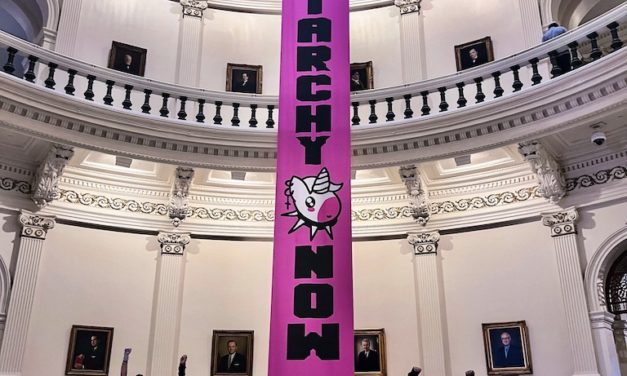
Web3 community members are fighting back against the United States Supreme Court’s ruling to overturn Roe v. Wade. On June 24, 2022, the landmark court case that previously assured the right to have an abortion was overturned, sparking a backlash among reproductive rights activists in the U.S.Some activists have turned to Web3 solutions, creating decentralized autonomous orginzations (DAOs) and nonfungible token (NFT) projects focused on raising awareness for women’s reproductive rights. One of the earliest of these efforts was demonstrated by Nadya Tolokonnikova, a member of the performance activist group Pussy Riot. Tolokonnikova told Cointelegraph that about three weeks ago, members of Pussy Riot and UnicornDAO — a group redistributing wealth and visibility for women-identified and LGBTQ+ people — staged a protest at the Texas State Capitol in response to the leaked draft opinion demonstrating the Supreme Court’s eventual decision to overturn Roe v. Wade. She said:“The protest was called ‘Matriarchy Now.’ We dropped a giant 45-foot banner from the third floor of the Texas Capitol building in Austin displaying this message. We then minted this an NFT, which was the first political performance art piece we used to raise funds for women’s reproductive rights.” “Matriarchy Now” protest. Source: Pussy RiotCrypto fundraising to support reproductive rightsYet, this effort was just a start for Pussy Riot and UnicornDAO. Tolokonnikova said that the groups launched another NFT collection on July 7 to further support reproductive rights — this time in response to the official overturning of Roe v. Wade. Known as Proof of Protest, John Caldwell, co-founder of UnicornDAO, told Cointelegraph that this NFT collection allows users to “buy feminism” in order to demonstrate their “proof of protest.” “Proof of Protest” NFT project. Source: Pussy RiotAccording to Tolokonnikova, the visual “bottles of feminism” purchased from this NFT drop stay on the blockchain forever, becoming an integral part of a person’s digital identity. She said:“Years from now, no one will be able to tell you that you did nothing when womb-owners’ rights were taken away from them. Own your proof of protest. Burn the patriarchy. Rage at the systems of oppression that tell you they own your body. If you don’t have a womb, rage for the rights of your mother, I bet you have one.”The Proof of Protest NFTs, which launched on Lens Protocol — a Web3 social graph built on the Polygon blockchain — have already been collected by over 1,300 individuals, demonstrating the importance of women’s reproductive rights within the Web3 community. Bradley Freeman, social growth manager at Aave — the development team behind Lens Protocol — told Cointelegraph that the Pussy Riot NFTs were minted as publications on Lens Protocol and become NFTs once they are collected, which is essentially the same concept as liking a social media post. “Lens Protocol believes in ‘collecting’ content across the web, which makes NFT minting as simple as posting or liking a post,” he explained. Recent: Hardware crypto wallet sales increase as centralized exchanges scrambleAll funds raised for Pussy Riot’s Proof of Protest NFT drop will support reproductive rights organizations through LegalAbortion.eth, the Ethereum wallet created by UnicornDAO, and Endaoment, a public charity foundation. Alexis Miller, head of donor engagement and strategic partnership lead at Endaoment, told Cointelegraph that the foundation distributes crypto proceeds to seven organizations across America that support reproductive rights. She explained:“LegalAbortion.eth is a Web3 Ethereum wallet that any NFT creator, decentralized application or decentralized finance protocol can use to donate crypto. The wallet contains a multisignature feature that requires multiple private ‘keys’ or users to sign a transaction, ensuring that multiple key holders remain accountable to one another. All multisig signers for LegalAbortion.eth have agreed upon the ultimate destination of all funds received, Endaoment’s Protect Reproductive Rights fund.”✅ Trusted Multi-Sig Signers @pussyrrriot@StaniKulechov @amandacassatt @ix_shells @pplpleasr1 @unicorndao_xxx @JuanPaDulanto @vegsurfer @rahilla @endaomentdotorg 100% of funds dispersed to these orgs:https://t.co/plCfy2430N pic.twitter.com/ccBWYOSqVm— LegalAbortion.eth (@legalabortion_x) June 26, 2022Miller shared that Endaoment’s reproductive rights fund raised $55,000 from crypto donors immediately following the leaked draft opinion calling for the overturn of Roe v. Wade. “The foundation then distributes these funds equally to the nonprofits we partner with, which include the Center for Reproductive Rights, Fund Texas Choice, SisterSoung Women of Color Reproductive Justice Collective and others,” she added.Although crypto fundraising for women’s reproductive rights organizations only began in May, Miller mentioned that Endaoment has already granted a total of $425,000 to various nonprofits dedicated to helping women. “We have raised this amount between individual donors and through our community. Endaoment’s Protect Reproductive Rights fund has raised $87,000, which includes $17,000 raised through LegalAbortion.eth, along with $42,000 raised through CowgirlDAO, which is selling an NFT collection to support abortion access,” she said. Although this number is considerably low when compared to other crypto fundraising initiatives — like efforts to support Ukraine in its current conflict, which have already raised millions in crypto donations — Miller believes that funds from donors and partner projects will continue to flow. “We also have a Ukraine fund where we have raised much more in funds, but when the draft opinion was leaked we saw incredible activity, and we saw even more activity when Roe v. Wade was overturned,” she said. Moreover, the difference these funds are making for recipient nonprofit organizations is noteworthy. Rebecca Dreke, chief operating officer of Fund Texas Choice, told Cointelegraph that when the six-week abortion ban took effect in Texas last year, the organization saw an increase in donors. She added that there were a handful of individuals asking if Fund Texas Choice accepted crypto donations as well. She said: “We started to look at accepting crypto donations at that time, but it felt overwhelming. So it was serendipitous when Endaoment reached out to us asking if they could help provide us with crypto donations as a third-party nonprofit intermediary. We have received almost $100,000 in funds since they set up crypto donations for us.” Dreke added that all funds received are distributed in U.S. dollars, making it easy for the nonprofit to accept. In regard to how the funds will be spent, Dreke explained that donations received will be put toward enabling the mission behind Fund Texas Choice. “We are still dedicated to ensuring equitable abortion access to any Texan that needs it, but we now must examine how this relates in terms of complying with the law.” In addition to funds currently being raised to help women navigate their reproductive rights, a number of other projects are in the works. For example, Web3 enthusiasts and a community of activists recently launched ChoiceDAO. Sahar Afrakhan, a core member of ChoiceDAO, told Cointelegraph that the project launched in response to the overturning of Roe v. Wade and aims to help nonprofits and grassroots organizations dedicated to women. “Our first mission is to raise over $1,000,000 in 26 days for frontline organizations fighting for access to reproductive healthcare. We know this is a decade long fight and we also know that to win, we are going to have to activate new people and new ideas,” she said. Afrakhan mentioned that ChoiceDAO will soon start accepting crypto donations.Adriana Arce, chief operating officer and founder of the media company Hauss, also told Cointelegraph that she is launching an NFT project to raise funds for both women creators and the National Network of Abortion Funds organization. The project is called Nice F*cking Titties, or NFTs for short. “This project allows women to showcase their breasts or be fully nude in order to demonstrate liberty over their bodies,” Arce said. According to Arce, 5% of the profits generated from “NFTs” will be donated to the National Network of Abortion Funds, while 20% of the profits will go back to the women participants. Challenges may hamper fundraising While it’s notable that the Web3 community is launching initiatives to help support reproductive rights, it remains questionable as to how these projects will be received. For example, the male-dominated culture of the crypto community may find these projects less critical in comparison to other fundraising initiatives. Tolokonnikova is aware of this. However, she believes women’s rights are something the entire Web3 community should take into account:“We were aware of this reality when we decided to choose crypto as one of our tools for activism. But this isn’t only about women’s rights. It’s human rights. It’s everyone’s right.”The current bear market is also cause for concern, as donors may be less capable or willing to donate due to bad market conditions. Fortunately, Miller remarked that LegalAbortion.eth hasn’t seen any changes with their endowments. Part of this is due to the fact that LegalAbotion.eth accepts donations in Circle’s native stablecoin USD Coin (USDC). “Many of the funds we opened last year contain USDC, so people haven’t lost money. People donating in USDC also have the same amount of money to grant to us since the stablecoin is tied to the U.S. dollar,” she noted. And, although ChoiceDAO hasn’t begun accepting crypto donations, Afrakhan mentioned that the community behind the project believes that women’s reproductive rights will be a decade-long fight. Therefore, they are “looking far past the current market conditions.”How effective will crypto donations prove to be?Challenges aside, it’s important to examine the overall effectiveness of crypto donations being raised to support women’s reproductive rights. For instance, while crypto donations reached new heights in 2021, industry experts believe that more can be done to help ensure women’s voices are heard. Tolokonnikova, for example, explained that she believes the best course of action would be for women to form a nationwide strike. Recent: How the Metaverse can revolutionize the fashion industry“All women in America should stop working to show the world what it would be like without women’s participation. Everyone could then see how the world would suffer without women,” she remarked. Although a general strike would surely make an impact, Tolokonnikova thinks that crypto fundraising is a good initiative at the current moment. “I think this fundraising is effective because it helps real people solve real problems,” she said.Echoing this, Afrakhan noted that she hopes ChoiceDAO and other social-impact DAOs like UkraineDAO will define the upcoming generation of activists. She said:“Our hope is that this new model of activism goes beyond reproductive healthcare. Think Fundraising 3.0. Many nonprofits and social movements are hamstrung by capital. We hope to change that by unlocking the potential of the global community in Web3. Any movement can and should tap into this.”

Čítaj viac

Hardware crypto wallet sales increase as centralized exchanges scramble

Blockchain analysis firm Glassnode recently characterized the 2022 bear market as the worst on record. This seems to be the case due to events such as the war in Ukraine and rising inflation, coupled with serious problems among centralized crypto exchanges. Yet, the bear market hasn’t negatively impacted all players in the crypto ecosystem. Hardware wallet providers seem to be benefiting from the massive amount of crypto withdrawals from centralized exchanges. Pascal Gauthier, CEO of hardware wallet crypto firm Ledger, told Cointelegraph that the company’s revenue dropped about 90% during the 2018 crypto winter, but this hasn’t been the case this year. He said:“Every quarter we are doing as much revenue as the whole of 2020, which was a very good year for Ledger. Right now year-on-year we are still up, which tells us that this bear market is different. It’s not a real bear market, but rather a bear market for centralized value propositions.”To put this in perspective, Gauthier shared that the company shipped the most units of Ledger hardware wallets to date following Coinbase’s declaration of losses, which further suggested that users are not protected in the case of bankruptcy. “We did $2 million a day in revenue following the release of this report, but it was just a peak because nothing bad actually happened to Coinbase. People just realized that their crypto wasn’t safe,” he said. Gauthier elaborated that once Celsius froze users’ funds and rumors began circulating that BlockFi may do the same, Ledger, yet again, saw a major boost in business. “People were rushing to our products to move funds to somewhere secure. We have now been seeing about six-times an increase in revenue week-on-week,” said Gauthier. Ariel Wengroff, head of global communications and marketing at Ledger, further told Cointelegraph that the company recently formed a partnership with Best Buy, allowing consumers to buy Ledger products directly in-store, which has also increased sales. “We are launching in 256 more stores this July,” she said. Ledger isn’t the only hardware wallet provider witnessing revenue gains in this bear market. Josef Tětek, Bitcoin (BTC) analyst at Trezor, told Cointelegraph that the firm has also seen a significant surge of interest in Trezor devices. “People are finding out that keeping their coins on exchanges and with custodians can be very risky, so they are naturally looking for self-custody options,” he said. Tětek added that Trezor believes the liquidation cascade centralized lenders and exchanges are undergoing hasn’t fully played out yet. In turn, he noted that Trezor is urging clients of exchanges and custodians to consider withdrawing their coins into their own wallets, at least for the time being. He added: “As Warren Buffett famously said, we don’t know who’s swimming naked until the tide goes out — and the outflow has only just begun.”Hardware wallet provider GridPlus has also seen an uptick in sales, which is mainly being generated by the nonfungible token (NFT) community. Justin Leroux, CEO of hardware wallet GridPlus, told Cointelegraph that the firm has struggled to meet consumer demand recently, noting that they are ramping up production. He explained:“The NFT community has been the largest sustained source of growth for us: New users drawn to crypto’s application layer need to immediately jump into self-custody to participate in NFT markets since centralized options are not readily available.” Risks to considerAccording to findings from the research firm Mordor Intelligence, the global hardware wallet market was valued at $202.40 million in 2020. This market is expected to be valued at $877.69 million by 2026, but today’s increasing demand for hardware wallets may influence this amount to equate to more. While it’s noteable to see the hardware wallet market thriving during a bear cycle, it’s also important to mention that these products are not foolproof. Alejandro Munoz-McDonald, a smart contract engineer at Immunefi — a bug bounty platform for Web3 products — told Cointelegraph that holding funds in a hardware wallet does not mean they are 100% safe. He said:“A user can still fall victim to a phishing attack. They sign some transaction thinking it will do something else and then they get their NFT or tokens stolen. Another attack vector could be through an infinite approval a user made to a contract that turns out to have a critical vulnerability. If a compromised contract has permission to transfer your funds, they’re as good as gone.” Munoz-McDonald pointed out that Ledger and Trezor do a relatively good job of preventing attacks on surfacing a user’s private key. However, he noted that hardware wallets are still vulnerable to physical attacks. “If an attacker gains physical access to your hardware wallet, it’s game over,” he said. Moreover, hardware wallets are also vulnerable to data breaches, allowing attackers to access user information. Ledger witnessed a data breach on June 17, 2020, which prompted competing popular hardware wallet provider Trezor to issue the coupon code for consumers looking to move funds from Ledger to Trezor.Munoz-McDonald still encourages users to self-custody their funds, noting that a hardware wallet is the best way to do so. “But, they also need to be educated on phishing schemes and have general online awareness,” he said. Gauthier added that users must understand how Web3 works in order to securely self-custody their crypto assets. “Web3 gives ownership to users, whereas Web2 doesn’t. Decentralization may seem harder, but there is a price to pay for self-sovereignty,” he said.Shedding light on this, Gauthier explained that while some crypto investors may find it easier to purchase and hold cryptocurrency through centralized exchanges, there could be fake underlying sentiments that are hard to initially catch. “No one reads the fine print associated with these exchanges, therefore no one understood the Celsius business model to begin with. Scams are generally easy to use, so users need to do more due diligence,” he said. Fortunately, as more crypto investors migrate to hardware wallets, a number of providers have started putting a large emphasis on user education. Adam Lowe, creator of Arculus — a cold storage wallet solution — told Cointelegraph that it’s become clear that there are strong tailwinds driving the need for hardware wallets. Given this, he believes that first-time crypto users should evaluate hardware wallets based on best-in-class security features and ease of use. “If it looks too complicated to use, you will either stop using it or worse, lose access to your crypto,” he said. In order to help users navigate this, Lowe mentioned that Arculus features an extensive FAQ page, along with how-to-videos to help users get started. Recent: Does the Metaverse need blockchain to ensure widespread adoption?Leroux also stated that the most important security tool is education. According to Leroux, common attack vectors for hardware wallet users are social engineering and phishing attempts rather than sophisticated technical approaches. “While we have seen browser extension scripts that hijack user wallets, it’s far more common to see users lose funds through fundamental missteps like improperly storing their seed phrase or being tricked into sharing it,” he said. While much of this may sound daunting, it’s important to point out that many providers offer 24/7 support centers in addition to educational content. It’s also noteworthy that both Ledger and Trezor wallets allow users to recover access to their wallets through a seed phrase by using another hardware wallet. This feature can be extremely helpful if a user loses or has their wallet stolen. If this were to happen, a user could recover their funds on another Ledger, Trezor or SafePal hardware wallet. Veronica Wong, CEO of SafePal, told Cointelegraph that the firm stresses the importance of keeping private keys safe and has seen an obvious growth curve in the last 30-days due to the troubles at the centralized crypto firm. She added:“As crypto penetration and user base continue to grow, decentralized wallets will become the most important blockchain entrance to new users. In the long run, wallets could even become an on-chain identity manager, protecting all your on-chain data and authorizations.” Accommodating new growth Risks aside, the phrase “Not your keys, not your coins” has become more apparent to the crypto community than ever before. “The current challenges of accessing crypto on exchanges highlight the need for secure ownership of your private keys,” Lowe emphasized. As a result, hardware wallet providers are preparing to accommodate a sudden surge in users. In order to do so, many are developing new products while ensuring that existing features meet market demands. For example, Lowe shared that Arculus recently announced NFT support and WalletConnect integration, allowing consumers the ability to browse NFTs and DApps all within the Arculus ecosystem. Gauthier also explained that Ledger has been focused on evolving its products for Web3, noting that the company just announced “clear signing” technology for NFTs. While the Ledger Nano S Plus was designed with NFT collectors in mind, Gauthier explained that the clear signing functionality was officially implemented during “Ledger Op3n,” an event that took place on June 22 this year in New York. “No one is doing clear signing for NFTs – everyone is just sending NFTs blindly left and right, which is a terrible thing to do,” he commented. Clear signing aims to provide all the details on a transaction. In turn, Gauthier added that hardware wallet providers must focus on certain features moving forward such as bigger screens, more memory, and additional connectivity. Recent: Liquid markets are healthy markets, says Kairon Labs co-founderWhile accommodating NFT growth is critical, Tětek mentioned that Trezor is exploring options to implement Lighting Network capabilities for its users, which will help make Bitcoin transactions faster and cheaper. According to a Trezor blog post, this will ultimately make Bitcoin more convenient to use as a means of payment. This all boils down to the urgency for crypto investors to take personal security more seriously. “Self-custody is a fundamental requirement for both financial self-sovereignty and using permissionless decentralized systems. If you’re using centralized exchanges exclusively, you’re not using crypto, you’re just spot trading IOUs on a company’s database,” Leroux remarked.

Čítaj viac

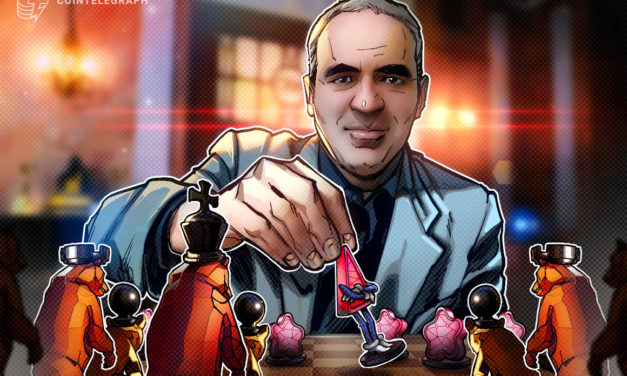
Bear market? “So what,” says World Chess Champion Garry Kasparov

Garry Kasparov, the Russian chess grandmaster and chair of the Human Rights Foundation, doesn’t appear at all bothered by the current crypto bear market. Kasparov, who is also a long-time Bitcoin supporter, told Cointelegraph during Consensus 2022 “so what” in regards to his thoughts on the bear market. Kasparov added that he thinks 99% of all coins are “crap,” yet he expressed that both Bitcoin (BTC) and Ethereum (ETH) are already integrated into traditional financial markets due to recent price fluctuations. He said:“They’ll lose a bit more, but they’ll also gain more, which shows that these are already being integrated into the financial system. This is what the whole history of the stock market is about. It’s about people making tons of money and then losing a lot of money. But right now,even without recognizing it, the financial markets have already incorporated Bitcoin and Ether and other related currencies into the system.”NFT market will reboundKasparov also remains confident that the market for nonfungible tokens, or NFTs, will make a comeback as the world becomes more digital. While the market for NFTs has certainly slowed from its peak, a recent industry report from DaapRadar showed NFT sale volumes at $3.7 billion in May. Although volumes were down 20% from April, Kasparov believes that the NFT market will rebound as the world continues to rely on digital transactions. Kasparov further shared his thoughts on why he launched an NFT collection last December with the NFT marketplace 1Kind. According to Kasparov, he wanted to understand how the process worked in addition to having his life digitally displayed. He said: “I think the collection is pretty unique. It’s probably the first attempt to have my entire life displayed from the early days of my childhood, to the shift of my career from being a professional chess player to a political and human rights activist.”According to Kasparov, the scoresheet from the game he played and won against Soviet chess grandmaster, Anatoly Karpov, sold for 51 ETH. “The big item in my collection was my score. November 9, 1985 was when I became the World Chess Champion.” Check out the full interview on our YouTube channel, and don’t forget to subscribe!

Čítaj viac

Ashanti aims to bring women to Web3, says “owning is important” at NFT music meetup

The billion-dollar music industry is undergoing a major transition as artists begin to understand the potential of owning their work through nonfungible tokens (NFTs). Ashanti, the multi-platinum-selling singer, actress and co-founder of EQ Exchange — a women-led Web3 platform — recently shed light on this during a Cotton Candy Records meetup that took place on June 20 in New York. Speaking on a panel alongside Janice Taylor, founder and CEO of EQ Exchange, Ashanti went into detail about how important ownership is for creators today. Drawing from personal experience, Ashanti said:“It is incredibly important to continue the narrative that owning is the way to go. Who wants to wake up and pour their heart, blood, sweat and tears into a project and have someone else next to you reap all the benefits while you do all the work? That was the way my contract was set up years ago, but now I have the right 20 years later to go in and re-record and own new masters of my first album.”Kayley Hamilton moderated a panel with Ashanti and CEO of EQ Exchange, Janice Taylor, at a music NFT meetup presented by Cotton Candy Records.  Photo Credit: @darnopolisWhy owning is important for creatorsAshanti told Cointelegraph that the process of creating an album prior to Web3 and the launch of music NFTs was very “disheartening,” noting that an artist would sign a record deal and create an album that would then sell for about $15. “Out of that amount, an artist would only receive about $0.38, which was on the high-end,” the R&B legend said. Once Ashanti began to realize that this was a common process, she started looking into alternative ways to own her intellectual property. On March 25, 2022, almost 20 years after her debut album was released, Ashanti formed a partnership with EQ Exchange, making her the first Black female artist to co-found a Web3 company. Following this, Ashanti released an NFT collection with EQ Exchange on April 6, 2022, which launched on the artist’s 20-year anniversary of her first album titled Ashanti. According to Taylor, Ashanti sold her first five NFTs in minutes. While impressive, Ashanti noted that the underlying message behind music NFTs is “that owning your work is so important.”In addition to ownership, Ashanti explained that her NFT collection is meant to benefit her fans in a number of ways. “Fans will receive exclusive rights to hear my music first, meaning they get to own the music as well. They will also receive percentages of royalties for new records, along with tickets to shows, vacations and access to limited merchandise drops,” she said. Women in Web3 aim to inspireAshanti further remarked that she aims for her NFT collection and role in the Web3 space to inspire greater female involvement. This is incredibly important, as the media company EWG Unlimited and The Female Quotient recently found that men continue to dominate Web3. According to the report, only 16% of creators in Web3 identify as women, which has led to inherent male bias. This in mind, Ashanti said:“I never thought in a million years I’d be in the Web3 space. But, diving into this sector as an independent artist was necessary. The Cotton Candy Records meetup is the first crypto-focused event I’ve spoken at, and I hope to do more of these to continue to inspire other female creators and women of color to become involved.”Ashanti with CEO of EQ Exchange, Janice Taylor, at a music NFT meetup presented by Cotton Candy Records. Photo Credit: @darnopolisTaylor added that education and events are critical for bringing more women into the Web3 space, noting that she was initially told to hire a crypto-native male co-founder for EQ Exchange in order to appear “legitimate.” “Some of my first investors told me this because they thought it would help me appear as if I understood the crypto industry better, even though I am a three-time tech founder.” Fortunately, Taylor ignored this comment and brought Ashanti on as EQ Exchnage’s co-founder. “I specifically wanted a woman and a woman of color to be my partner because that’s the message that needs to be heard here,” she said. Recent: Integrating blockchain-based digital IDs into daily lifeEchoing Taylor, Sarah Omolewu, founder of Access Abu Dhabi — a program designed to encourage women and minorities to enter UAE’s business ecosystem — told Cointelegraph that joining the crypto community offers an opportunity for women to build new career paths regardless of their age or financial status. She said:“Women in America weren’t able to receive credit from a bank until 1974 when the Equal Credit Act was passed. Fast forward to 2022 and less than 2% of venture funding goes to women-led businesses. Web3 could become the equalizer that changes this narrative by getting women involved at the very beginning of blockchain technology, a space where currently 93–95% of all cryptocurrency users are male.”Although women still make up the minority of Web3 users, Omolewu explained that Access Abu Dhabi recently partnered with Unstoppable Domains — a platform that grants ownership of NFT domains — to provide all nationalities of women living in Abu Dhabi free blockchain domains. “Partnering with Unstoppable Domains to provide for the first time ever a gifting of free blockchain domains to all women in the country is the first step in our longer-term goal of disrupting this space for women in the region,” she remarked. Access Abu Dhabi founder Sarah Omolewu moderates a panel session with supermodel turned businesswoman Tyra Banks and Abdulla Abdul Aziz Al Shamsi, Acting Director-General of the Abu Dhabi Investment Office. Source: Sarah OmolewuAdding context to this, Sandy Carter, senior vice president of Unstoppable Domains, told Cointelegraph that Unstoppable Domains represents a user’s digital identity, making it easy for non-crypto natives to enter Web3. “For example, users don’t have to enter a complicated wallet address to send and receive crypto transactions, as they can just use their NFT domain.” According to the Unstoppable Domains website, Coinbase Wallet, ShapeShift and other crypto wallets are supported applications. “We have over 300 partnerships. In fact, Paris Hilton recently changed her Twitter handle to ParisHilton.NFT,” Carter added. Paris Hilton’s twitter handle. Source: TwitterNow is the time for women to enter Web3Even with the benefits of music NFTs and encouragement from influencers, women may still find it challenging, or intimidating, to enter the Web3 sector. However, Carter advised that women should get started sooner rather than later, pointing out that the space is still very early. “I like to say that we are in a dial-up phase of Web3 — we are recrafting what the internet is and we need diverse voices now.” Recent: How to start a career in crypto? A beginner’s guide for 2022In terms of financial inclusion, Taylor added that EQ Exchange is helping provide a sustainable financial system that allows artists — particularly women — to thrive. Although the platform was established in March of this year, Taylor shared that other women creators are already planning to launch NFT collections. For example, Monifah, the recording artist, actress and producer, told Cointelegraph that she will be launching an NFT collection with EQ Exchange in July 2023, to mark the 25-year anniversary of her single Touch It.Monifah also mentioned that she believes music NFTs are the future of the industry, noting that artists should do their own research and get involved now. “I think it would be crazy if I did something in a traditional way at this point. I would tell artists to really focus more on Web3 and figuring out how to command this space,” she said. Yet Monifah also shared that she still finds Web3 to be challenging. “I am still navigating the Web3 space, but it’s exciting. I want to help introduce the younger generation to Web3.”

Čítaj viac

Layer-1 blockchains: How crypto winter could slow the challenge to Ethereum

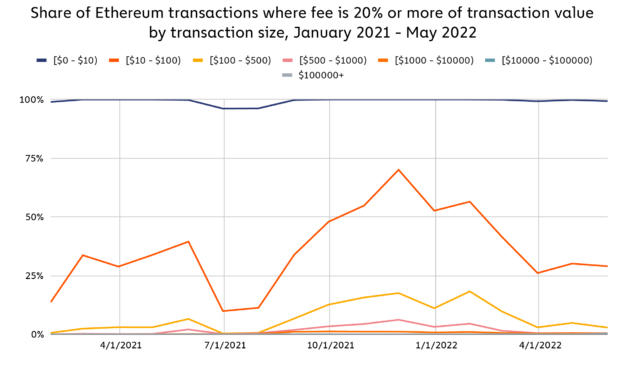
Given Ethereum’s dominance coupled with the current crypto bear market, it remains questionable if L1s will flourish. This was recently highlighted in a Chainalsys blog post entitled “New layer 1 blockchains are expanding the DeFi ecosystem, but no ETH killers yet.” Ethan McMahon, an economist at Chainalysis, told Cointelegraph that Chainalysis published this report to raise awareness for the current L1 ecosystem:While Ethereum allowed decentralized finance (DeFi) to flourish in 2020, a number of layer-1 blockchains (L1s) have since been developed to address the challenges associated with the network. For instance, as Ethereum’s proof-of-work (PoW) consensus mechanism and high gas fees continue to impact transaction speed and scalability within its ecosystem, L1s like Algorand, BNB Chain, Avalanche and others aim to solve these problems.“Chain comparison is important because it seems as if most crypto services are only offered on Ethereum, but this isn’t true. There are a few different blockchains with competitive offerings that have advantages Ethereum doesn’t provide.” In order to demonstrate this, McMahon explained that Chainalysis gathered data from different blockchains to determine the strengths and weaknesses of the networks. For example, the post points out that with gas fees running high on Ethereum, many developers have chosen to build decentralized applications (DApps) on Algorand. Binance Smart Chain, or BNB Chain, is also recognized for its capability to support new tokens and DApps without the high gas fees of Ethereum. “It’s interesting to see that people are paying exuberant gas fees on Ethereum’s network. Our findings show that transactions less than $1,000 result in a significant amount of money spent on gas fees,” McMahon said. Source: ChainalysisBased on Chainalysis’s overall findings, however, the post concludes that none of the L1-blockchains analyzed have been successful in solving all challenges associated with the Ethereum network. This also raises the question if L1s will survive long-term. For instance, the current crypto winter may slow down investments in these ecosystems. In addition, the merge of Ethereum 2.0 — which is set to take place this year but may be pushed to 2023 — could lead to improvements in the Ethereum ecosystem that may impact alternative L1 uses. L1 developments to drive adoption In order to determine how L1s will advance, it’s important to take a closer look at recent developments within the various ecosystems mentioned by Chainalysis. For example, the report categorizes Algorand as a top-10 L1 blockchain by market capitalization, stating:“During Q3 2021, Algorand saw its transaction volume grow 65%, while Bitcoin and Ethereum saw volumes drop 37% and 45% respectively. This may have reflected Algorand’s growing hype — having launched in April 2019, Algorand was a relatively new blockchain, and reached an all-time price high in September 2021.”Findings also show that 10% of Algorand’s transaction volume comes from retail investors, compared with 5% for Bitcoin (BTC) and 8% for Ether (ETH). Given this, the report notes that this could signify Algorand’s success in enabling a high volume of smaller transactions. Source: ChainalysisStaci Warden, CEO of the Algorand Foundation — the organization behind Algorand’s monetary supply economics, governance and ecosystem — told Cointelegraph that Algorand uses a Pure proof-of-stake (PPoS) consensus mechanism, allowing the network to specifically solve problems that require scale. “The most fundamental difference between Algorand and other L1s is the network’s ability to deliver financial inclusion to the two billion people in the world that don’t have access to modern financial systems,” she said. Warden elaborated that Algorand’s PPoS consensus mechanism enables this due to its low staking requirements. According to the Chainalysis post, only 1 Algorand (ALGO) token is needed to stake on the network. Warden also pointed out that Algorand is very focused on decentralized finance (DeFi) development, noting that the network is capable of settling about 1,200 transactions per second, with gas fees equating to .001 ALGO. Recent: Integrating blockchain-based digital IDs into daily life“These requirements are necessary for networks to scale,” said Warden. In comparison, the Chainalysis report mentions that Ethereum can only handle roughly 15 transactions per second. Yet, it’s been noted that Eth2 aims to increase this considerably to about 150,000 once upgrades are completed. In order to stay competitive, Warden shared that Algorand is in the process of rolling out a new feature that would allow the network to settle transactions in 2.5 seconds, compared with the 4.5 seconds it currently takes. Moreover, as multichain networks become more important, Algorand plans to deliver “state proofs” that will allow users to move tokens from one chain to another. “Algorand could end up being a router for all transactions across chains, since it can handle fast transactions, with little carbon footprint for sub-penny fees,” explained Warden. While state proofs and other developments won’t be rolled out immediately, it’s notable that FIFA recently announced that it will use Algorand to develop its digital asset strategy. “FIFA is building their own wallet on Algorand and creating an NFT marketplace that can accomodate secondary ticket sales,” added Warden. BNB Chain is also mentioned in the Chainalysis report and is praised for its capability to support new tokens and DApps without high gas fees. In fact, DappRadar found there to be more L2 projects built on BNB Chain than any other blockchain. Gwendolyn Regina, investment director of BNB Chain, told Cointelegraph that the goal behind the network is to help builders create DApps that scale for massive crypto adoption. She said:“This year, BNB Smart Chain will have 30 times the computing power of Ethereum and will also work on decentralized storage solutions. As a result, blockchain technology will be increasingly integrated into real-world applications.” According to Regina, the key focus areas for BNB Chain’s 2022 roadmap include decentralization, faster transaction speed, multichain integration and an increased focus on supporting developers and sustainability. Specifically speaking, Regina shared that the BNB Chain community recently released plans for further decentralization via the BEP-131 proposal, which will introduce candidate validators to BNB Smart Chain. “This proposal would increase the number of BNB Smart Chain Mainnet validators from 21 to 41, providing more decentralization and incentives for validators to constantly innovate their hardware and infrastructure,” she said. While this may create more decentralization, there has been criticism regarding whether or not DeFi is decentralized following Solend’s spontaneous governance proposal related to one of the whale wallets at risk of liquidation. Decentralization aside, it’s notable that BNB Beacon Chain — a blockchain developed by Binance and its community that implements a decentralized exchange for digital assets — recently became open-sourced. “BNB Beacon Chain is now accessible for developers to build on,” said Regina. She further explained that the benefits of the BNB Beacon Chain are broad, noting its high-speed order book based decentralized exchange to ensure quick transactions. “Harnessing native secure cross-chain support will open doors for blockchain interoperability, meaning users can seamlessly navigate the chains they use,” she remarked. In addition to Algorand and BNB Chain, Avalanche was mentioned in Chainalysis’s findings. According to the report, Avalanche specializes in customizability, scalability and interoperability. John Wu, president of Ava Labs — the lead developer of the Avalanche blockchain — told Cointelegraph that the network specifically aims to solve a number of problems within Web3 ecosystems. He said:“Avalanche has the fastest time to finality in the industry at about 500 milliseconds to 2 seconds. This means that all cross-chain and subnet transactions are immortalized in a blink. Financial institutions building DeFi products and Web3 gaming studios developing AAA shooters and RPGs need near-instant finality. It is a precondition to success. Without it, their apps cannot work.” To Wu’s point, finality is extremely important as more institutions enter the DeFi sector. In fact, Avalanche’s quick finality time could be much greater in comparison with Eth2 finality time, which some believe may never reach under 15 minutes. Ethereum currently processes 15–30 transactions per second with over one-minute finality.Wu added that regardless of market conditions, the Avalanche community will continue to build. For example, Wu shared that subnets — a set of validators working together to achieve consensus on the state of a set of blockchains — will open new doors for DeFi. For example, he mentioned that a subnet’s ability to incorporate Know Your Customer (KYC) requirements and circumvent the bottlenecking that might occur on a chain shared with third-party applications appeals to institutions. “The first Subnet engineered specifically for institutional DeFi is in production right now,” he said. Survival of the fittest? Although L1 blockchains are advancing, the Chainalysis report still notes the possibility of Ethereum becoming the “dominant player” due to market conditions and expected upgrades to the network. For instance, Raul Jordan, one of the core devs working on the Eth2 merge, told Cointelegraph that soon anyone in the world will be able to run an ETH node, which demonstrates the true power of decentralization.It’s critical that we give power to people all over the world, especially in developing countries, to run full nodes on consumer software. Full nodes preserve the security of the protocol by enforcing its rules #ethereum https://t.co/UVucpOQnzM— rauljordan.eth (@rauljordaneth) April 21, 2022Alex Tapscott, author and co-founder of the Toronto-based Blockchain Research Institute, further told Cointelegraph that there are two reasons to question the longevity of L1s:“First, bear markets generally see a drop in interest for crypto-native applications, so if gas fees drop on their own on Ethereum, why use a newer or less proven chain when you can use Ethereum? Second, the merge to proof-of-stake will improve Ethereum’s performance, so even if demand returns, it may be able to handle new growth.”However, Tapscott added that he believes any decreasing interest in L1s will be short-lived. “Long term, there will be surging demand for block space, with some developers and users willing to trade off between security (Ethereum) for speed and convenience. Also, I think many alternative L1s for all their potential are still pretty early stage tech, and as they mature they will become more reliable, useful and broadly adopted.” Recent: How to start a career in crypto? A beginner’s guide for 2022Tapscott further pointed out that “L1s were initially successful not because they attracted investor capital, but because they drove user adoption and interest.” And, if history has taught the crypto space anything, it would be that bear markets are a perfect time for projects to build. “A bear market would be a fantastic way to assess and support projects that actually make a difference in the blockchain ecosystem as long as innovative teams keep emerging to solve real-world problems using blockchain technology,” Regina pointed out. On the other hand, a number of projects also tend to fail in bear markets. Warden commented that there will indeed be fallout for several L1 blockchains: “Crypto winter is a time when every component of the crypto ecosystem is going to be questioned and tire-kicked, and not just DApps, but all aspects of crypto infrastructure, including L1s.” However, Warden added that projects that can scale and handle transactions will continue to accelerate, posing a challenge to Ethereum: “Businesses or projects that are building for long-term utility and real-world adoption will accelerate and garner attention during this period.”

Čítaj viac

Získaj BONUS 8 € v Bitcoinoch

nakup bitcoin z karty

Registrácia Binance

Burza Binance

Aktuálne kurzy