
Autor Cointelegraph By Prashant Jha

Tether lauds Myanmar shadow government for making USDT an official currency

Tether, the issuer of the eponymous stablecoin, has praised the decision of Myanmar’s parallel government, The National Unity Government (NGU), to use USDT as an official currency.Myanmar’s NUG is a shadow government run by the supporters of Nobel Peace Prize winner Aung San Suu Kyi. As Cointelegraph reported on December 13, NUG announced Tether’s USDT as official currency for local use in an official Facebook post. The finance minister claimed that USDT would offer much needed trade and transaction efficiency.In an official blog post, Tether commended the decision taken by the NUG, a government that is recognized by the European Union and has received commendations from the United States:“The fact that it has chosen to recognize USDT as an official currency is a commendation to the strength of the US dollar and its ability to provide a safe haven to citizens of the world. The significance of this moment goes far beyond the potentials of cryptocurrency to provide financial security but points to long-standing confidence in the US dollar for those who do not have confidence in their own governments or national currencies.”Related: Two firms account for the majority of Tether received: ReportThe NUG’s USDT adoption came as a surprise to many given the controversies surrounding the stablecoin issuer’s reserves. However, from a transaction point of view, USDT is still one of the primary choices on crypto exchanges around the globe.The NUG is currently raising funds to the tune of $1 billion U.S. dollars and the adoption of the USDT comes as a measure against the current military regime. Cryptocurrency use was prohibited by the Myanmar central bank in May last year, and NUG’s adoption of the crypto stablecoin shows how these digital assets are not just reshaping financial markets, but also serving as political tools. 

Čítaj viac
Beijing court rejects monetary compensation in Bitcoin mining contract plea

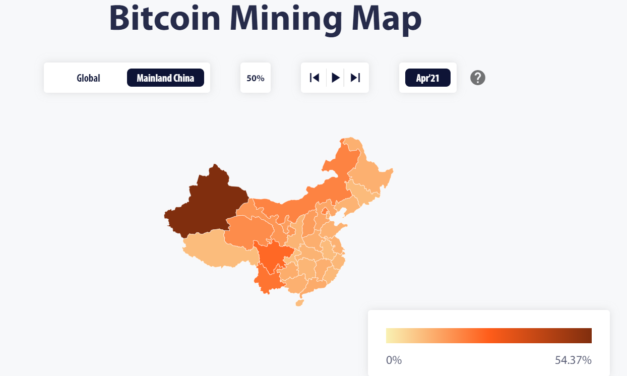
A district court in Beijing has rejected monetary compensation in a Bitcoin (BTC) mining contract plea against a blockchain company.The Chaoyang District People’s Court on Wednesday deemed the Bitcoin mining contract between the plaintiff and the blockchain firm “invalid,” the South China Morning Post reported on Dec. 16. The plaintiff in the case reportedly paid 10 million yuan ($1.6 million) to the blockchain firm for deployment of mining machines, but incurred losses on his investment.The Beiijng based plaintiff claimed he earned only 18.5 Bitcoin on his investment and demanded an additional 217.17 BTC in compensation for his losses. The court rejected the plea and also directed the Sichuan branch of the National Development and Reform Commission to look into any illegal mining going on in the province. China started its crypto mining crackdown last summer, which resulted in the migration of some of the biggest Bitcoin mining companies from the country. China’s Bitcoin hash rate share fell from over 60% to near zero in the aftermath of the mining crackdown. However, even after eradicating crypto mining almost completely, Beijing announced a massive policy drive against crypto trading and mining again in September, prohibiting even small-scale operations at home and banning all foreign crypto exchanges.China bitcoin mining share April 2021. Source: CCAFChina bitcoin mining share July 2021. Source: CCAFThe Beijing-led crypto crackdown policies have only become stricter with time. Even though Chinese traders have found ways to bypass crypto trading bans on numerous occasions, crypto mining is almost extinct in mainland China.The latest court case regarding a Bitcoin mining contract highlights China’s stand on crypto-related activities. It sends a clear message to the public that the judicial system won’t protect or recognize crypto-related cases.

Čítaj viac

$33.5 billion worth of ETH ‘trapped’ in largest Ethereum contract

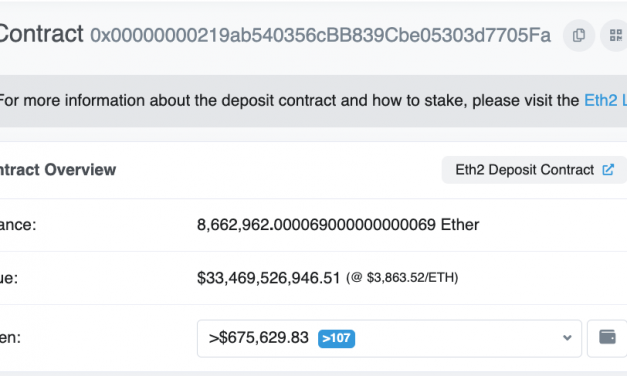
The single largest Ethereum contract containing 8,641,954 Ether (ETH) worth $33.5 billion is sitting idle because it cannot be spent or sent.A Twitter user highlighted the Beacon chain contract claiming it to be the largest Ethereum contract with billions of dollars worth of ETH “trapped” inside it. BREAKING: 8,641,954 ETH ($32 billion) trapped in single largest Ethereum contract and unable to be sent or spent. Will require hard fork that hasn’t been written or specified yet. Timing and terms of hard fork still unknown.https://t.co/xcXPwbS93v— Tomer Strolight | Not interested in your trades. (@TomerStrolight) December 14, 2021The contract in question is an Ethereum 2.0 Beacon Chain staking contract launched in November 2020, and it cannot be spent without a hardfork.Beacon chain staking contract. Source: EtherscanWhat makes this even more astonishing is the fact that the terms of the hard fork are yet to be decided and people sending their ETH into the contract were well aware of the fact. The terms of the hard fork could be decided once the Beacon chain merges with the Ethereum mainnet.The Beacon chain is the first key step in Ethereum’s move from a proof-of-work mining consensus to a proof-of-stake (PoS) one. In order to become a validator in Eth 2.0, a trader must stake a minimum of 32 ETH. Thus, the $33.5 billion worth of ETH in the largest Beacon chain contract shows the high demand and trust in the upcoming Eth 2.0.At the start of December, Ethereum developers called upon community members to test the merger to PoS based ETH 2.0. The testing phase has been divided into three phases, namely for non-technical users, developers with limited experience in blockchain, and highly technical and experienced blockchain developers.The merger of the Beacon chain into the Ethereum mainnet would complete the transition to PoS Eth 2.0. The official Ethereum.org page for Eth 2 suggests the merger could complete by Q1 or Q2 of 2022.

Čítaj viac

Wells Fargo partners with HSBC to settle FX transactions using blockchain

Wells Fargo has partnered with HSBC to use its blockchain tools for the settlement of bilateral foreign exchange (FX) transactions.Wells Fargo would use the HSBC-developed FX Everywhere platform for interbank FX transactions. Developed by HSBC in 2018, the blockchain settlement platform is primarily used to settle transactions between banks within the HSBC group. The latest partnership would be the first use case outside the HSBC group.The partnership would make way for settlement in U.S. dollar (USD), Canadian dollar (CAD), British pound sterling (GBP) and Euro (EUR) transactions. The official press release said that the platform would expand to include more currencies in the near future. The FX Everywhere platform has settled three million transactions to date worth $2.5 trillion.Mark Williamson, global head of FX Partnerships & Propositions at HSBC, said:“The platform enables participants to efficiently settle bilateral cross border obligations across multiple onshore and offshore currencies, coupled with the added flexibility of extended settlement windows to optimize PvP risk reduction opportunities.”The use of blockchain technology for interbank settlement increases transaction efficiency and cuts the cost per transaction. During the initial stages of the partnership, the platform would settle about 100 transactions every week and gradually increase the rate with time.Related: Central Bank of Sri Lanka completes proof-of-concept KYC platformThe use of decentralized technology for bank settlements is nothing new. Over the past few years, some of the biggest names in the banking sector have turned to blockchain tech for cross-border remittance and settlement. While Central banks are looking to incorporate CBDC use, private banks use commercial bank money. A recent report from the Juniper group has shown that cost-saving for commercial banks using blockchain technology will grow up to 3,330% by 2030.

Čítaj viac

The Sandbox co-founder wants to defend metaverses against Big Tech

The Sandbox co-founder Sebastien Borget wants to defend the metaverse from Big Tech giants aiming to make a foray into the nascent market. In a recent interview, Borget said that he is not very keen on Big Tech companies such as Meta joining the metaverse. He explained further that major technology companies could threaten the decentralization of the metaverse as their business model goes against it.The Sandbox co-founder went on to add that it’s not about the competition, rather more about an open, decentralized future. Tech giants have a monopoly over Web 2.0, something Web 3.0 technologies, such as the metaverse and crypto, are trying to break. Borget explained:“We don’t think those companies can build something truly fun that’s catered to the users because they’ve been so focused on their key business model and how to satisfy shareholders rather than satisfy users who own the asset, who own the governance of their own platform.”Facebook rebranded itself as Meta to acknowledge its focus on the virtual world. The social media giant has shifted its focus to be the leading tech giant in the nascent virtual reality metaverse after a failed attempt at launching a universal stablecoin. Related: Just did it: Nike enters the metaverse game following RTFKT acquisitionFacebook’s record with user data mismanagement has created distrust among the masses, and the company’s business model worries The Sandbox co-founder.The Sandbox closed a $93-million funding round led by Japanese banking giant SoftBank. It also launched the first metaverse game where people can buy virtual land, and the game has already attracted many headlines over a $4.3-million virtual land sale. Metaverse projects combine the best of crypto and virtual reality-based gaming ecosystem, making them among the most sought-after projects in the crypto world.

Čítaj viac

Získaj BONUS 8 € v Bitcoinoch

nakup bitcoin z karty

Registrácia Binance

Burza Binance

Aktuálne kurzy