Autor Cointelegraph By Prashant Jha

SEC reportedly probing crypto lending products by Gemini and Celsius

The United States Securities and Exchange Commission (SEC) is reportedly reviewing some of the high-yield crypto lending products offered by Gemini, Celsius Network and Voyager Digital.According to a report published in Bloomberg, the SEC is conducting an inquiry into digital asset lending services. The main focus of the inquiry is reportedly around whether the crypto lending services could be considered securities and therefore must be registered with the commission. Gemini and Celsius did not immediately respond to Cointelegraph’s request for comment.The SEC’s main concern reportedly lies with the high-yield offering by crypto lending services which are often considerably higher than most saving banks. The interest rates offered by crypto lending services range anywhere from 3% to 18%, while traditional banks’ savings accounts offer less than 0.1%. Banks’ savings accounts are insured by the Federal Deposit Insurance Corporation, which means investors are protected against bank failure and theft. However, crypto lending services lend customers’ digital assets to other investors, which according to the SEC raises investor protection concerns. It is important to note that the SEC has not accused the firms of any wrongdoing.Related: Crypto lending firms on the hot seat: New regulations are coming?Crypto lending services have faced a regulatory crackdown in the U.S. since September 2021. State regulators from New Jersey and Texas issued cease and desist orders against Celsius Network.In October 2021, the New York Attorney General (NYAG) office cracked down on Celsius and BlockFi, ordering them to close their services. The NYAG alleged wrongdoing and issued a cease and desist order against the platforms. Coinbase, the leading American crypto exchange had to shut their crypto yield product even before launch after SEC threatened a lawsuit.

Čítaj viac

Thai regulators team up to issue guidelines on digital assets payments

The Bank of Thailand (BOT), the Securities and Exchange Commission (SEC) and the Ministry of Finance (MOF) have come together to review and issue guidelines on the use of digital; assets as a payment tool.In a joint press release on Tuesday, Thailand’s top regulatory bodies said that it has become necessary to review and regulate digital assets as a means of payment for goods and services. After careful consideration and assessing all the pros and cons, the joint committee said that the use of digital assets as a widespread payment tool could pose a risk to the financial-economic stability.Sethaput Suthiwartnarueput, Governor of the BOT, said:“At present, the widespread adoption of digital assets as a means of payment for goods and services poses risk to the country’s economic and financial system. “The joint regulatory committee highlighted three risks associated with the use of digital assets as a means of payment:Volatility risk: digital asset volatility could lead to for merchants and users alike. The conversion fee could add an extra burden.IT risk: Consumers may face cyber theft, personal data leaks, or opportunity cost in instances of system failure.Compliance and legal risk: digital assets could pose a legal risk due to the anonymity factor.The joint committee believes the current payment infrastructure in the country is efficient enough, and digital assets add no feasible benefits to consumers or businesses.[embedded content]Thai SEC has conducted a public review after its discussion with the BOT and MOF. The top regulatory body has sought the public’s opinion on the matter in order to derive a conclusive framework for the use of crypto as a payment instrument.Related: Thailand to define ‘red lines‘ for crypto in early 2022The joint committee also said that further guidelines will be issued for specific digital assets that don’t pose any systematic risk, which could be an indication of the use of stablecoin or central bank-issued digital currency (CBDC). The official statement noted that the final decision on the guidelines will be made only after taking feedback from stakeholders and the general public.At a time when the top regulatory bodies in Thailand are working on crypto payment regulations, the country’s government executives are divided on the crypto taxation proposal. Many current and former government executives have come forward to warn against the implementation of strict taxation policies as it could deter foreign investors and pose a risk to the growth of the nascent industry.

Čítaj viac

Indonesian regulator takes cue from Islamic NGOs, bars crypto sales for institutions

Indonesia’s financial watchdog the Otoritas Jasa Keuangan (OJK) warned financial institutions in the country against offering or facilitating crypto-asset sales.On Tuesday, the official Instagram account for OJK posted a warning against the growing number of crypto Ponzi schemes and risks of crypto investments owing to the market’s volatility. The official post also quoted the chairman Wimboh Santoso who said financial institutions are strictly prohibited from offering crypto sale services in any form. The official post read:“OJK has strictly prohibited financial service institutions from using, marketing, and/or facilitating crypto asset trading.”The current warning against crypto investments and prohibition of crypto trading services for financial institutions comes on the heels of several calls for a ban on crypto use from the country’s leading Islamic non-government organizations (NGOs). As Cointelegraph reported earlier, a total of three Islamic organizations have issued a fatwa against crypto use by Muslims, deeming it haram.In October 2021, major Islamic organization the Nahdlatul Ulama deemed crypto haram due to its allegedly speculative nature. A month later, the Indonesian Ulema Council, declared crypto haram as a transactional tool. However, it noted that cryptoassets can be used as an investment tool if they abide by Sharia tenets. Muhammadiyah became the third Indonesian Islamic organization to issue a fatwa against cryptocurrency use as a payment and investment tool.Indonesia over the years has grown to become one of the leading crypto economies in Asia. The total crypto transaction reached 859 trillion rupiahs ($59.83 billion) in 2021, up from 60 trillion rupiahs ($4.18 billion) in 2020. Related: Vibe killers: Here are the countries that moved to outlaw crypto in the past yearCrypto assets are regulated as tradable commodities in Indonesia, governed by the trade ministry and the Commodity Futures Trading Regulatory Agency. The ministry is currently working on setting up an independent market for digital assets called the Digital Futures Exchange, expected to be launched in the first quarter. However, crypto as a form of payment tool is illegal in the country. 

Čítaj viac

The Beatles and John Lennon music history collection to be auctioned as NFTs

John Lennon’s eldest son Julian is selling some of the rarest pieces of music history from his private collection. John Lennon’s coat from the “Magical Mystery Tour” film, his cape from “Help!,” three guitars and Paul McCartney’s handwritten arrangement notes for “Hey Jude” are some of the most sought after memorabilia from music history up for nonfungible token (NFT) auction.The NFT series, called “Lennon Connection: The NFT Collection,” has opened up for bidding on Monday and will commence on February 7 in collaboration with NFT marketplace YellowHeart and Julien’s Auctions. A portion of the sale from the NFT auction will be donated to Lennon’s White Feather Foundation. Registration and Bidding is now open for Lennon Connection: The NFT Collection. In collaboration with @JuliensAuctions x @YellowHeartNFT , a portion of the proceeds will be donated to @TWFFofficial to offset carbon via @nori. Learn more at https://t.co/6l5nzO1CHJ pic.twitter.com/bvG7EHAX88— Julian Lennon (@JulianLennon) January 24, 2022Julian would keep the original physical items and the buyer would own the rights to the unique NFT. Each NFT in the collection would be offered as an audio-visual collectible, narrated by Julian Lennon himself.The most notable item that is expected to attract the highest bid is said to be the hand-written note by Paul McCartney for Hey Jude. The NFT for the item has a starting price of $30,000.Related:  There’s a browser plugin that autoblocks Twitter NFT profile picturesJulien’s Auctions has previously sold other Beatles memorabilia fetching millions of dollars in the auction. Some of the most notable items include one of John Lennon’s acoustic guitars that fetched $2.4 million, Ringo Starr’s drum kit was sold for $2.2 million, the drum head Ringo used on the “Ed Sullivan Show” in 1964 was sold for $2.1 million.NFTs have become the latest trend in crypto and many believe it would disrupt the art industry. Mainstream artists and celebrities have ditched traditional auctions for NFTs as it has become the latest trend in the art industry.

Čítaj viac

NFT marketplace bug undervalues tokens, helps exploiter nab $750,000

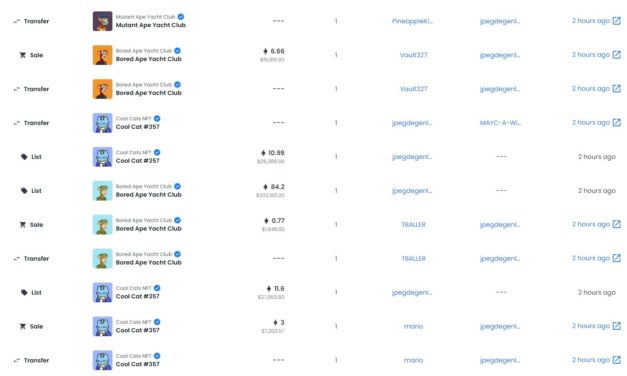
A bug in the front end of popular nonfungible token (NFT) marketplace OpenSea has reportedly led to an exploit allowing users to buy popular NFTs at their previous listing price.The bug seems to be prevalent with Bored Ape Yacht Club (BAYC) and Mutant Ape Yacht Club (MAYC) NFT collectibles, where the exploiter managed to buy them at their old listing price and then sold them for the current market price. The affected NFTs include BAYC #9991, BAYC #8924, MAYC #4986.Opensea User Activity Tab Source: OpenSeaA user named jpegdegenlove is suspected of exploiting the current bug and has reportedly profited 332 Ether (ETH) ($754,000). OpenSea didn’t immediately respond to Cointelegraph’s request for comment.Reported exploiter Ether wallet balance Source: EtherscanAn earlier exploit on Dec, 31 saw a similar scenario, wherein a bug seems to arise from the transfer of assets from the OpenSea wallet to a different wallet without canceling the listing.Related:  Nifty News: FLUF World and Snoop Dogg fundraise, Adidas and Prada NFTs, WAX gifts 10M NFTsOne Twitter user explained that, when a user lists their collectible for auction on the OpenSea and decides to cancel it for some reason, the marketplace charges a significant fee and the floor price of the collectible also decreases. Users found a way around it and instead of canceling their sale, they transfer their asset to a different wallet which automatically removes the listing from OpenSea, However, the bug keeps the listing active through OpenSea’s API. 1/ Recently there’s been an @opensea exploit that has allowed for assets to be purchased at greatly discounted prices, including 3 freshdrops passes, a BAYC https://t.co/8pEgeXkOBo, multiple MAYCs, and more. I did some research this morning and here’s what’s happening – > a — cap10bad.ΞTH | freshdrops.io (@cap10bad) December 31, 2021Users can check whether their listing has been removed on Rarible, another NFT marketplace that uses OpenSea’s API. The user claimed that the bug was flagged after the December incident, but the platform didn’t take any measures to address the issue.NFTs exploded in popularity in 2021 with major brands and celebrities all hopping on the bandwagon, which has attracted an increasing number of scams. 

Čítaj viac

Získaj BONUS 8 € v Bitcoinoch

nakup bitcoin z karty

Registrácia Binance

Burza Binance

Aktuálne kurzy