Autor Cointelegraph By Prashant Jha

Wonderland’s treasury saga exposes the fragility of DAO projects today

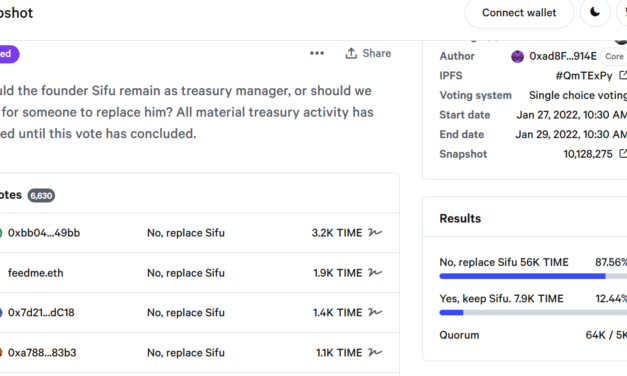
The Wonderland protocol became the talk of the decentralized finance (DeFi) world after the platform was found at the center of a brewing controversy. On Jan. 27, DeFi analyst zachxbt revealed that one of the anonymous co-founders of Wonderland happened to be QuadrigaCX co-founder Michael Patryn, who has been operating under the name of Sifu.QuadrigaCX is a defunct crypto exchange from Canada which closed when Gerald Cotten, the exchange founder and sole person with knowledge of the exchange’s wallet keys, passed away. Following his death, $169 million worth of user funds were irreversibly lost.Cotten’s passing led to a wave of litigation as former exchange users sought to recover their funds. Others in the crypto community claimed that Cotten faked his death to get away with the allegedly stolen crypto.Who is Sifu?Zachxbt claimed in a series of tweets that Patryn has been a serial offender of the law and prior to his stint at QuadrigaCX, he helped run an identity theft ring called shadowcrew, to which he later plead guilty.According to a Bloomberg report citing California court records, Michael Patryn is Omar Dhanani, who was sentenced to 18 months in federal prison for running a credit card fraud ring and admitted burglary, grand larceny and computer fraud in three separate criminal cases.The DeFi analyst questioned Wonderland founder Daniele Sestagalli’s motive to work with a convicted scammer and give him responsibility for a billion-dollar treasury comprising investors’ money.1/ This needs to be shared @0xSifu is the Co-founder of QuadrigaCX, Michael Patryn. If you are unfamiliar that is the Canadian exchange that collapsed in 2019 after the founder Gerald Cotten disappeared with $169mI have confirmed this with Daniele over messages. pic.twitter.com/qSfWNnQPhr— zachxbt (@zachxbt) January 27, 2022After the true identity of the anonymous chief financial officer was revealed, Sestagalli came out with his side of the story. He claimed that he was aware of Sifu’s true identity almost a month prior but didn’t judge him for his past. But, Sestagalli’s clarification seemed too little too late, and after community backlash, Wonderland decided to put Sifu’s removal to a community vote, which was passed with an overwhelming majority.Wonderland Sifu removal voting Source: SnapshotAfter the removal of the treasury manager, Sestagalli decided to hand over the treasury to the community and wind down the project. The proposal received a divided vote with 55% voting against it and 45% voting in favor. Regardless, the founder decided to pull the plug on the project until a better solution comes up.Wonderland wind-down proposal voting Source: SnapshotImmediately following his dismissal from Wonderland, Sifu sent out 3,000 Ether (ETH) to a coin mixer called Tornado Cash in three different batches. While he claimed that it was his own money, community members were skeptical. One user pointed out that a wallet associated with Sifu received nearly $400 million in funds in just a month and right after his doxing, $200 million was moved away from the wallet.Around 200 million was just transferred from this wallet after this tweet. It’s value is now ~235M USD. Holy shet.— Zappyboi (@Zappyb0i) January 27, 2022

Sestagalli believes the community is strong and the project can move forward. In his last tweet addressing the issue, he said:“I am working more closely with our Wonderland and WAGMI community moderators and supporters to ensure a better top-down level of communication and infos. We will continue building together as a community and get out of the FUD together. SoonTM next proposal ;).”In the original winddown proposal, Sestagalli has included a deadline of five days to propose a new pathway if the current proposal is voted down:“If the proposal is voted against, and no counter proposal within 5 days is made by the community with relevant people who are willing to take over the multisig and willing to take on this challenge, we will still unwind the treasury.”Among numerous proposals put forward by the community, one from dcfgod has caught the crypto community’s eye. The proposal demanded a rage quit process that would halt all trading and remove all liquidity to start from scratch, involving only those who wanted to be associated with the project.Another notable proposal would return investors’ original investment and allow Skyhopper, a crypto trader, to manage and advise the Wonderland treasury. However, there hasn’t been any final decision on which proposal would be accepted and put forward.So, what went wrong?To begin with, Wonderland’s decentralized autonomous organization (DAO) wasn’t as decentralized as many would have believed. A DAO is an autonomous organization run through software and smart contracts and community voting, allowing them to operate without being led by a central party.While, ideally, a DAO should be free from individual or organizational control, the case of Wonderland seems to have proved otherwise, as it highlighted the possibility of a single individual making decisions on behalf of thousands of community members.Vincent Choy, an ecosystem architect at DeFi infrastructure provider Oz Finance, told Cointelegraph that just because a project has a few governance protocols doesn’t necessarily mean they are decentralized:“How is Wonderland a DeFi project? Yes, there are certain governance protocols in place for the application of DAO, but it is essentially a centralized disbursement of funds in the Wonderland treasury. As the industry progresses, I think we as an industry need to give deeper thought into how DeFi actually works to fulfill the promises we made.”“Enabling situations like this to develop is definitely a step back in the wrong direction. Daniele knowingly working with a convicted felon that has a history of fleecing and Ponzi schemes shows how little care he has for the management of his community’s funds and cannot be good for the confidence of the industry,” Choy added.Sestagalli’s changing story has also raised suspicion. First, he claimed to be aware of Patryn’s identity and decided to continue without informing the community but after the voting proposal for his removal was passed, he tried to distance himself from the tainted co-founder:5/I am not in any support of the actions that have been taken by Sifu in Discord, I am with the team and I’ve worked on the proposal of winding down Wonderland too. At that time my belief was that nobody wanted to have anything to do with me cause of my mistakes.— Daniele never asks to DM (@danielesesta) January 30, 2022

What DAOs can do betterIn order for DAOs to become truly autonomous, decentralization should be introduced in stages. However, a certain level of control is also required to maintain the core values of the company. Most successful DAOs use various gatekeeping mechanisms in which ideas pass through several phases before being accepted. Being a decentralized ecosystem, the core team doesn’t have any say on who can join the community and thus their concern over the trust in the community is understandable. However, it should not be used as an excuse to make the ecosystem more centralized.DAOs are meant to be community driven. So, in order for a true autonomous governance to succeed, the level of control from the core team should be minimal: They should act as the gatekeepers instead of sole decision-makers. While, ideally, DAOs are supposed to be autonomous governance, managing a company or a firm requires different human touches and interventions which can’t be programmed. This is where gatekeepers or a core team can come in along with the community to resolve certain issues that cannot be automated.Talking about the supposed decentralization in DAOs and the Wonderland saga, Burnt Banksy, founder of DeFi platform Burnt Finance, told Cointelegraph:“The nature of the crypto industry is that everyone usually has some skin in the game, so it’s sometimes best to assume that everyone’s nefarious until proven trustworthy — which can happen for projects in many ways, like by taking security seriously and implementing multisignature wallets or time locks for admin functions. Being anonymous in order to build something larger than yourself is one thing, but it’s another to use that anonymity to commit crimes.”

Čítaj viac

QR Assets launches DeFi ETF on Brazilian Stock Exchange

Brazilian crypto asset manager QR Assets has launched a decentralized finance exchange-traded funds, or DeFi ETF, on the Brazilian Stock Exchange.The DeFi ETF called QDFI11 would track the Bloomberg Defi index and make 100% of its investment in real DeFi assets. The DeFi index tracks Uniswap (UNI), Aaave Decentralized Lending Pools (AAVE), MakerDao (MKR), Compound (COMP), Yearn.finance (YFI), SushiSwap (SUSHI), 0X (ZRX), Synthetix (SNX) and Curve (CRV). The ETF would be offered through Gemini Fund Solution, a platform built specifically for Crypto ETFs.The ETF would act as a regulated alternative for investors who were looking for crypto exposure beyond traditional crypto assets such as Bitcoin (BTC) and Ethereum (ETH). The ETF would be the first of its kind and promises to bring safe exposure to the nascent industry. While crypto investments are getting more mainstream, Defi is still out of reach for many traditional investors. The ETF shares would be available at an initial trading price of around R$10 (ten reals).Related: Nasdaq will list Valkyrie’s ETF linked to Bitcoin mining firms on Feb. 8QR Capital CEO Fernando Carvalho asserted that the first DeFi ETF would play an instrumental role in diversifying the reach of traditional investors and a major step towards maturing the crypto market. He explained:“Bitcoin and Ethereum ETFs were just the front door to an investment universe that is more rich and diverse. Now it’s time for QDFI11 and decentralized finance. More and more investors will gain access to innovative and disruptive investment products with the endorsement of regulators.”DeFi became quite a popular crypto industry in 2021, with an estimated $200 billion locked up in thousands of protocols. Within two years of its existence, the industry is already creating waves in the banking sector, and more investors are looking to join the DeFi revolution. However, unregulated and security vulnerabilities have pushed traditional investors away from the market, and a regulated ETF would definitely help investors get that exposure without the risk.

Čítaj viac

Polygon stablecoin QiDAO exploited for $13M on Superfluid vested contract

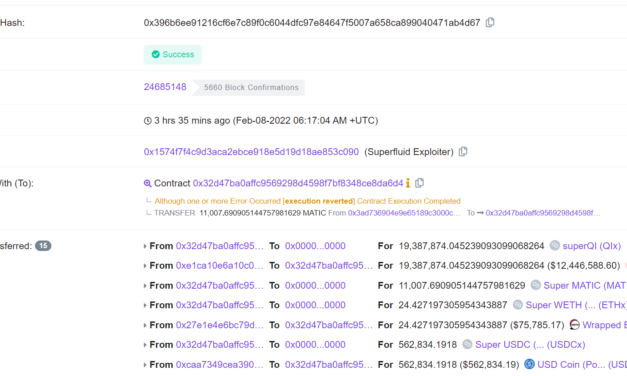
Polygon’s native stablecoin protocol QiDAO faced an exploit on its Superfluid vesting contract leading to a 65% drop in the price of the governance token QI. QI price fell from $1.24 to $0.18.QiDAO took to Twitter on Tuesday to acknowledge the exploit on the Superfluid vesting contract but assured that users’ funds are safe and no funds from QiDAO have been affected. Superfluid also confirmed the exploit on QiDAO and said they are investigating the situation and will update accordingly. The protocol enables users to move assets on-chain in a constant flow in real-time from one wallet to another.Today at 6.48am GMT we were notified of a potential exploit of the QiDAO vesting contract that leverages Superfluid code. We are investigating the incident and will keep you updated in this thread and our Discord server.— Superfluid (@Superfluid_HQ) February 8, 2022While there was no impact on the user’s funds, the hackers behind the attack managed to get away with $20 million worth of tokens including 24 WETH, 562,000 USDC, 44 SDT, 1.5 million MOCA, 23,000 STACK and nearly 40,000 sdam3CRV. Early information suggested that the stolen funds belonged to some of the early backers of the project and included team vested tokens as well.Reported Hacker Wallet Activity Source: PolygonscanCrypto analytic group SlowMist created a fund tracker with the balance of each token stolen. After analyzing the wallet transaction data, they estimated that the hackers managed to steal about $13 million worth of cryptocurrencies.Hacker’s reported balance Source: SlowMistThe hackers behind the attack started dumping stolen QiDAO on Quickswap DEX with high slippage, leading to a 65% decline in the price of the governance token. The Polygon community took the opportunity to buy the dip which has already helped the governance token reach up to $0.6 after falling below $0.18. It is important to note that the exploit was carried out using a vulnerability in Superfluid, and QiDAO wasn’t exploited.Contract for $QI under superfluid was exploited (only funds from early investors locked are exploited) All vaults are safe. Funds are safuBought the dip/exploit, strong team + strong fundamentals, will buy the whole freaking pool if not for liquidity issue. https://t.co/NDBm3cNzxo— Jasper (@JunHao_yo) February 8, 2022

QiDAO had temporarily paused its bridge after the exploit and hoped to resolve the issue soon. The exploit comes within 24 hours of Polygons’ $450 million fundraise, however, the community showed immense support in the native stablecoin protocol and stressed that it was because of the third-party vulnerability rather than an issue with stablecoin protocol.

Čítaj viac

Simple math says Russia could collect up to $13B in crypto tax each year

The Russian government is expected to collect up to 1 trillion rubles ($13 billion) in crypto tax each year, as per an estimation by the authorities.The Bell, a local Russian publication, reportedly got its hands on the government analytic note that estimated the yearly tax revenue. According to the letter’s authors, Russians hold 12% or nearly $214 billion in crypto. The number of users on foreign exchanges is estimated to be about 10 million, added with the significant number of over-the-counter (OTC) crypto trades. The government agency believes even the most straightforward tax imposition can generate anywhere from 146 billion rubles to 1 trillion in crypto tax revenue.The note suggests two possible taxation methods: One for the crypto platforms such as exchanges, intermediaries, and OTC desks, another tax for investments and income from crypto. According to the estimates by the analytical group, the state could see revenue of 90 to 180 billion rubles ($2.4 billion) a year from crypto platforms with base taxation of 6% and generate another 606 billion rubles ($8 billion) in revenue by taxing crypto investments and income.Assuming a basic tax of 6% at present, the total crypto market of $200 billion would generate an estimated $12 billion in revenue without the mining industry. It is also important to note that Russians hold only 1% of global wealth compared to 12% of global crypto holdings.Related: Central bank overkill: Russia’s proposed crypto ban and why everyone’s against itThe government report also notes the highly scattered and unregulated crypto mining industry, most of which are unaccounted for. The note reportedly said that the estimation is purely based on the simple tax bracket, and the original taxation could look very different based on the actual size of the market.Russia is moving ahead with its plan to regulate the large crypto market after the central bank proposal for a blanket ban on crypto mining and trading was declined. As Cointelegraph reported earlier, the Russian finance ministry has already submitted a crypto framework for review and new regulations are expected to make their way soon.

Čítaj viac

Former Manchester United players to launch soccer-centric DAO

Former Manchester United legends Gary Neville and Paul Scholes are teaming up to launch a one-of-a-kind sports-centric DAO (decentralized autonomous organization) that would allow fans to make investments alongside these legends.The sports investment DAO would be called CO92 DAO, named after the legendary squad from 1992, and it would focus on strategic investment focused soccer-related firms and projects. The two soccer legends have teamed up with Singapore billionaire Peter Lim and his son Kiat Lim to create the DAO.“We are currently already reviewing a range of professional football project opportunities, and will announce developments in the months ahead,” said Kiat Lim.This would be the second blockchain sports venture for the father-son duo. They have already launched another football venture g ZujuGP—a digital platform endorsed by Manchester United’s Cristiano Ronaldo. The billionaire duo has a particular interest in sports which is reflective of their ownership in two football clubs, they bought the Spanish club Valencia C.F. in 2014 and are a shareholder of English club Salford City F.C.The details of the project are yet to be revealed publicly, but it is expected to hold a public sale soon, as per a Bloomberg report. The management team would include Neville and Scholes along with some former teammates namely Nicky Butt, and Ryan Giggs. The football-centric venture aims to bring sports ownership to the masses using DAOs.Related: AssangeDAO raises $38M in donations to help free WikiLeaks founderDAOs over the years have become quite popular in the decentralized space, but it has their fair share of critics as well. The decentralized governance model sees participation from the community and investors of the project in the critical decisions of the ecosystem. However, these DAO projects have come under scrutiny for centralization in the decision-making process in recent times.

Čítaj viac

Získaj BONUS 8 € v Bitcoinoch

nakup bitcoin z karty

Registrácia Binance

Burza Binance

Aktuálne kurzy