Autor Cointelegraph By Prashant Jha

Legal DAOs: Why are the Marshall Islands betting on a decentralized future?

The Republic of the Marshall Islands made history in the second week of February after it formally recognized decentralized autonomous organizations (DAOs) as legal entities. The Marshall Islands revised its Non-Profit Entities Act 2021, making it possible for any DAO to register and commence operations in the country. The amendments to the law mean DAOs can now incorporate as nonprofit LLCs with bylaws and membership that can be recorded on the blockchain.The Pacific state nation on-boarded MIDAO Directory Services Inc., a domestic organization to help other DAOs register in the Republic. This led to the registration of the first legal DAO in the form of Admiralty LLC for Shipyard Software, a decentralized finance- (DeFi-) focused infrastructure developer. MIDAO co-founder Adam Miller explained the reasons behind their decision to work with the Marshall Islands government and help other entities register their legal DAO in the country:“I spent months researching what technology could make it easier to launch and operate DAOs. Any solution would cost $10s of millions and over a year to build. Then, the Marshall Islands law emerged, and I realized I could help solve an even bigger problem for DAOs, costing only single-digit ETH and taking days to implement per DAO. That’s when I knew starting MIDAO would be the best way for me to have a positive impact on the DAO community.”Admiral DAO will be the organizational entity in charge of regulating Clipper — a decentralized exchange (DEX) developed by Shipyard — on behalf of the community and future DEXs built by Shipyard.What made the Marshall Islands a good destination?Many existing laws and institutions creating legal entities have not yet taken the unique legal implications of DAOs into account.As a result, implementing a DAO is not an easy task, even in regions with favorable regulations for nascent technology such as blockchain.Many jurisdictions require bylaws to be recorded in a specific manner with the government, while blockchain code may be irreversible. In addition, many legal corporations are required to keep track of membership using a ledger of names, whereas DAOs often use tokens. This means that most well-known options only provide partial options for token-holder-based governance.Take Wyoming in the United States, for example. The U.S. state legally recognized DAOs in July 2021, but this came with caveats. First, the regulations require a minimum of 50% approval in community voting, which some see as an impractical target to achieve. Second, it’s not a sovereign nation thus it must adhere to changes in federal law.A beach scene in the Marshall Islands. Source: Erin Magee/AusAIDThis is what led Shipyard Software to turn to the Marshall Islands, a jurisdiction that enjoys several advantages over others in terms of sovereignty and stability as a Freely Associated State of the United States. The nation boasts the reliability of U.S.-aligned banking and financial systems and a fast-moving adaptable legislative process that can keep up with evolving markets. David Paul, Minister-in-Assistance to the President and Environment Minister of the Republic of the Marshall Islands, played a key role in formulating and pushing the DAO legislation. Speaking to Cointelegraph, Paul explained why the country has bet its money on becoming a hub for DAOs:“The Republic of the Marshall Islands sees DAOs as the first major step toward becoming an internationally recognized and premier hub for the blockchain industry. In whatever shape or form, the digital economy is the way of the future and we want to position ourselves as the jurisdiction of choice. We specifically recognize DAOs at this moment as an early-stage innovation in the blockchain sector, and the Marshall Islands wants to be a leader in the DAO sector.”“Laws and regulations will be created and ratified, based on what the market will require as this space evolves. To remain competitive, Marshall Islands must continue to adapt to changes swiftly and also responsibly at the same time,” he stated.The sovereign nation has utilized blockchain technology in the past to simplify cross-border payments and has also begun developing a sovereign digital currency. The nation first revealed its plans of launching a sovereign national currency in 2018 and developments began in 2020. The sovereign currency called the Marshallese Sovereign (SOV) is based on the Algorand blockchain and development works have been ongoing. The sovereign nation received a warning from the International Monetary Fund for its digital currency development program back in June 2021.Mark Lurie, founder and CEO of Shipyard Software, told Cointelegraph that they have weighed in various factors including regulations, cost, sovereignty and clear DAO treatment before zeroing on the Pacific island state.Lurie took note of the vulnerabilities involved with DAO networks as well, stating that security and decentralization were key parts of the legislation for incorporating DAOs.Talking about awareness around the blockchain industry and DAOs in particular, Lurie said:“I hope the mainstream media recognizes that not all things related to blockchain are financial. DAOs are a very different thing than cryptocurrency, just as a company is a very different thing from the U.S. dollar.”Are DAOs the future?DAOs are decentralized governance systems run by smart contracts and some form of human intervention like community decision-making. Since the first-ever DAO was released in 2016, the concept has gained significant traction, particularly in 2021 amid the growing popularity of decentralized finance.In the Information Age, traditional corporate employment is rapidly becoming obsolete as a means of coordinating activities, as evidenced by the growth of other kinds of earning such as influencers, contractors, producers, gig economy participants and more. These are all examples of people acting as individual value providers in complicated networks and receiving cash for their efforts, even if they don’t feel like “work.”The previous paradigm of a corporation with rigid internal and external borders made sense 50 years ago, but now, this approach leads to unbalanced incentives and unsustainable extraction. This is where decentralized systems like DAOs will act as the coordination layer for this new world.the future of daos feel more like co-ops and artist collectives and less like a corporate sponsored “open source” event.— fiii.eth (@fionais__online) July 23, 2021DAOs are no longer just an optimistic notion, even though they are still in their early stages of development. They are genuine businesses that manage billions of dollars in assets, provide real products and services to millions of people and invent new methods for people to make money.Assange DAO is one of the most recent examples that highlight the growing popularity and power of DAO systems. As the name suggests, the DAO was created for anyone looking to help Julian Assange using Ether (ETH). Donors then received a proportional amount of its governance token JUSTICE, allowing them to vote on how the raised funds will be spent and on future initiatives aimed at supporting the cause of the whistleblower. The DAO raised a whopping $53 million.Major governments around the globe have been experimenting with blockchain technology in various sectors, but the decentralization aspect of the tech often takes a back seat. Thus, the Marshall Islands’ decision to offer LLC status to DAOs shows the legislator’s understanding of the technology and how it could shape the future of traditional corporate for good.

Čítaj viac
NCA wants regulation for coin mixers, but the crypto industry is already one step ahead

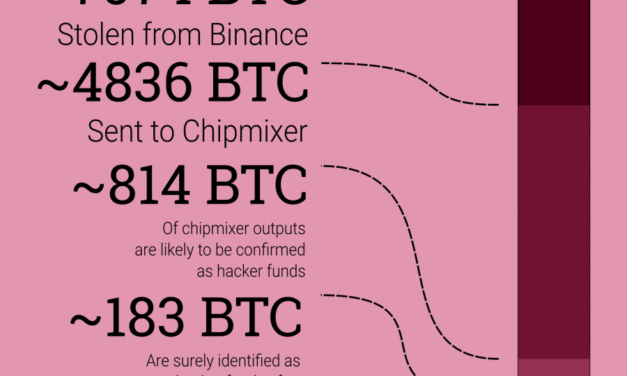
The United Kingdom’s National Crime Agency (NCA) seeks to regulate the crypto coin mixers under the country’s laws against money laundering.Coin mixing tools are popular in the decentralized world as they maintain the privacy of transactions. These tools often mix several transactions to obscure the origin of a particular transaction. Then the recipient receives the transactions from a mixing “black box” comprised of hundreds of transactions from various wallets. While privacy-focused, these tools often face regulators’ ire as they are also a known way for hackers and criminals to wash their funds.Gary Cathcart, the NCA’s head of financial investigation, claimed that these transaction mixing tools offer a layer of anonymity to criminals that can be used for “churning criminal cash, obscuring its origins and audit trail.” Cathcart called upon regulators to bring these open-source mixing tools under money laundering regulations. This would ensure such service providers carry out mandatory Anti-Money Laundering checks and audit transactions passing through their platforms, reported the Financial Times.NCA didn’t respond to Cointelegraph’s request for comments at the time of publishing.Another hurdle for regulators is the open-source and decentralized nature of such services, where thtracking and auditing of funds could become a complex task. This issue was highlighted during the Candian Freedom trucker movement, where non-custodial wallet service provider Nunchuck explained that they hold no info on their users, which is by the design of the decentralized tech.Related: New PlusToken Report Shows KYC May Be Smoke and MirrorsThe crypto services providers have been relatively compliant with regulations around the globe and have made amendments to their services to keep up with regulators. In this case, some are even a step ahead. Wasabi, a popular privacy-focused wallet that offered crypto mixer services via CoinJoin, announced on Monday that they would be blocking transactions with illicit ties.It is also important to note that despite obscuring the source of the transactions, these transactions can be eventually traced back to the source account with several powerful analytic tools as was the case in Binance’s $40 million hack. Tracking of stolen Binance BTC Fund Source: ClainEven though the perpetrators behind the hack used a chip mixer to launder the stolen funds, the increased activity in the mixing tool gave away their identity and later the majority of the funds were traced.

Čítaj viac

Deus Finance exploit: Hackers get away with $3M worth of DAI and Ether

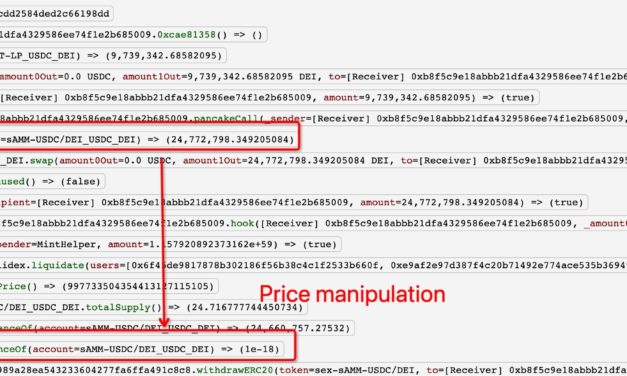
Multi-token decentralized finance (DeFi) marketplace Deus Finance has become the latest victim of an exploit resulting in over $3 million losses in DAI and Ether (ETH).DeFi analytic firm PeckShield took to Twitter to explain the cause and manner in which the funds were exploited. The hackers behind the attack managed to exploit and manipulate price oracle for flash loans, resulting in the insolvency of users’ funds. 1/ @deusdao Deus Finance was exploited in https://t.co/bfYCQcz5rZ, leading to the gain of ~$3M for the hacker (The protocol loss may be larger), including 200,000 DAI and 1101.8 ETH— PeckShield Inc. (@peckshield) March 15, 2022The hackers manipulated the price from the pair of StableV1 AMM – USDC/DEI, using which the protocol used to set price oracle for its flash loans.Example of Price Manipulation Source: PeckShieldPeckShield revealed that hackers managed to steal 200,000 DAI and 1101.8 ETH, and the total amount of stolen funds could be larger than the early estimates of $3 million. The hacker behind the attack then funneled the stolen funds using the coin mixer tool Tornado cash via Multichain protocol (previously known as AnySwap).Stolen Funds Washed through TornadoCash Source: EtherScanRelated: Altcoin Roundup: DeFi token prices are down, but utility is on the riseDeus Finance acknowledged the exploit on its lending protocol and claimed it has closed its $DEI lending contract. The DeFi protocol also claimed that both $DEUS and $DEI are unaffected by the exploit.We are aware of the recent exploit reports regarding the $DEI lending contract.Contract has been closed, both $DEUS & $DEI are unaffected. Devs are working on a summary of the events, all information will be communicated once we have assessed the full situation.— DEUS Finance DAO (@DeusDao) March 15, 2022

Deus Finance provides DeFi infrastructure to help others create financial instruments including synthetic stock trading platforms, options and futures trading.Lafayette Tabor, the CEO of Deus Protocol took to Twitter to inform the community about the reimbursement plans. He said that the developers would create a new contract where affected users would be able to repay their loans. He explained:“We will create a contract you will be able to repay your DEBT on it and get your sAMM that were liquidated, we will also implement a feature that lets you swap DEI against a small MUON allocation. (paying from my team allocation).”

Čítaj viac

Binance temporarily halts Polygon deposit and withdrawal to sync nodes

Binance, the world’s biggest crypto exchange by trading volume, announced earlier on Tuesday that it will be temporarily pausing deposits and withdrawals for Polygon (MATIC) Network.The announcement came in the wake of the Polygon network’s outage since March 11 after a network upgrade. The crypto exchange noted that it would reopen the deposit and withdrawal features once the network becomes stable.Polygon network is a layer-2 Ethereum scaling solution that boasts millions of users and an evolving ecosystem. The network underwent an essential upgrade on one of the three layers on March 11, but due to a suspected bug, the three layers didn’t reach a consensus post the upgrade, leading to the downtime.Polygon developer account on Twitter noted that the bug issue had been fixed, and the network is stable. It also clarified that Binance is currently upgrading its nodes and syncing data, hence the temporary halt.Polygon PoS network is stable, and working fine. All funds are safe. Binance is upgrading its nodes, and currently syncing the block data, hence they have paused the deposit and withdrawal.https://t.co/hnhXp3AWga— Polygon Developers (@0xPolygonDevs) March 15, 2022The Polygon network is made up of three layers, each of which serves a distinct purpose. The Ethereum layer runs smart contracts while the Bor layer aids in generating blocks. The fault lies in the third Heimdall layer.Related: Polygon’s focus on building L2 infrastructure outweighs MATIC’s 50% drop from ATHThe suspected bug caused different Heimdall validators to be on different versions of the chain, thereby not reaching 2/3 consensus. While the outage for a few hours was expected and was also notified by the Polygon team, the 11-hour extended outage became a reason for concern for many projects as well as traders.Polygon network has fixed another upgrade bug back in December 2021 after a security partner discovered a vulnerability that could have put $24 billion worth of funds at risk. According to the latest Polygonscan data, the network has started producing timely blocks and the team has assured that the network bug has been taken care of.

Čítaj viac

No crypto for criminals: Coinjoin BTC mixing tool to block illicit transactions

CoinJoin, a popular Bitcoin (BTC) mixing tool, will block transactions associated or flagged as illegal. The announcement came from the official Wasabi Wallet Twitter account, which Coinjoin is a part of.The zkSNACKs coordinator will start refusing certain UTXOs from registering to coinjoins. pic.twitter.com/X3kBuQwieO— Wasabi Wallet (@wasabiwallet) March 13, 2022The official announcement noted that CoinJoin services would start blocking certain unspent transaction outputs (UTXOs) from registering with the CoinJoin with the help of the zkSNACKs coordinator. A zkSNACKs coordinator is a virtual machine used to mix the origin of the transitions. Privacy-focused mixing tools are primarily used to obscure the origin of the transactions and are often seen as a medium to wash illicit funds. However, blockchain being a public ledger as well as, with several forensic tools developed by the likes of Chainalysis, money laundering via mixing tools has become quite difficult over the past few years.The latest announcement from the firm had riled up many privacy advocates who accused the privacy-focused wallet of bowing down to law enforcement. However, a Wasabi developer who goes by the Twitter name of Rafe explained that they haven’t compromised on their core values, but have to adhere to certain benchmarks.No one has infiltrated Wasabi, since we wouldn’t be having this conversation if that were the case.There’s no need to spy when banning inputs.Many would be happy to sink with the ship when needed. Is it better to have no zkSNACKs coordinator or to keep it running for majority?— Rafe ⚡ (@BTCparadigm) March 14, 2022

Related: What are Bitcoin mixers, and why do exchanges ban them?Rafe also pointed out that the blocking of UTXOs is limited to the ZkSNACKs coordinator and people using any other coordinator can still feel private and secure. Adam Fiscor, the founder of Wasabi wallet however acknowledged that blacklisting has come to the privacy wallet and believes it could prove to be a threat to Bitcoin’s fungibility.Blacklisting arrived to coinjoins. IMO it is a major setback to Bitcoin’s fungibility.— nopara73 (@nopara73) March 14, 2022

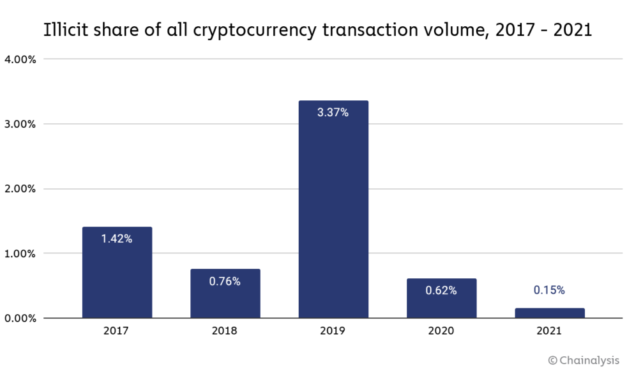
Most governments and centralized entities have perpetuated a narrative around the use of cryptocurrencies for illicit activities and the role of privacy wallets and mixing tools in aiding them. However, research and data analytics have shown from time to time that using crypto for illicit activities comprises a very small fraction of the total transaction activity and it has been on a constant decline with the emergence of more powerful analytical tools. According to data from Chainalysis, the illicit share of all crypto transactions volume has declined to 0.15% in 2021.Share of illicit transaction in crypto. Source: ChainalysisThe recent arrest of the husband-wife duo found to be trying to launder money from Bitfinex multi-billion dollar hack is another prominent example, where the hackers were not just caught while trying to launder the stolen funds, the authorities managed to recover the majority of the hacked BTC as well.

Čítaj viac

Získaj BONUS 8 € v Bitcoinoch

nakup bitcoin z karty

Registrácia Binance

Burza Binance

Aktuálne kurzy