Autor Cointelegraph By Prashant Jha

European watchdog lists crypto next to lawyers, accountants as an AML threat

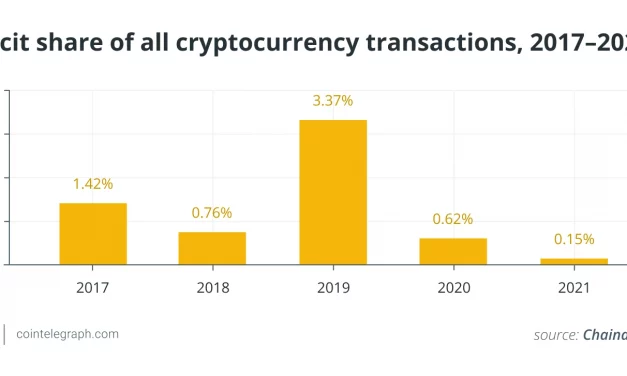
Europe’s Anti-Money Laundering and Combatting the Financing of Terrorism (AML/CFT)  watchdog, MONEYVAL, has listed monitoring the crypto sector along with “gatekeeper” professionals, such as lawyers and accountants, as priorities in European nations’ push to combat money laundering.In a media release based on the findings of its annual report, MONEYVAL called upon European jurisdictions to assess compliance with international standards and implement stricter regulatory policies to combat money laundering facilitated by crypto assets.Elżbieta Frankow-Jaśkiewicz, chief of MONEVYAL, cited the Pandora Papers as an example of how professionals serving as “gatekeepers” could aid the rich and corrupt to launder their money. She also claimed that the popularity of crypto assets for money laundering is on the rise:“A newer money laundering trend is related to the emerging virtual assets sector, the increasing global use of cryptocurrencies, and other components of the rapidly evolving ecosystem of so-called “decentralized finance” (DeFi).”Moneyval is an AML oversight body of the Council of Europe, spanning 47 European jurisdictions. The task force is responsible for reviewing and recommending policy changes that influence national legislative reforms.Related: Blockchain and crypto can be a boon for tracking financial crimesThe report concluded that the median level of compliance with the Financial Action Task Force (FATF) standards is below the satisfactory threshold among its supervised jurisdictions. Eighteen out of the 22 jurisdictions evaluated by MONEYVAL showed an insufficient level of compliance with AML standards.The European watchdog will also conduct a separate study to examine money laundering trends related to virtual assets later this year.While regulatory authorities continue to raise concerns around the use of cryptocurrencies for money laundering and other illicit activities, the latest data from blockchain analysis firm Chainalysis suggest that less than 1% of the total circulating supply of crypto was used for illegal activities in 2021.

Čítaj viac

Solana developers share 3 key mitigation steps to make the network robust

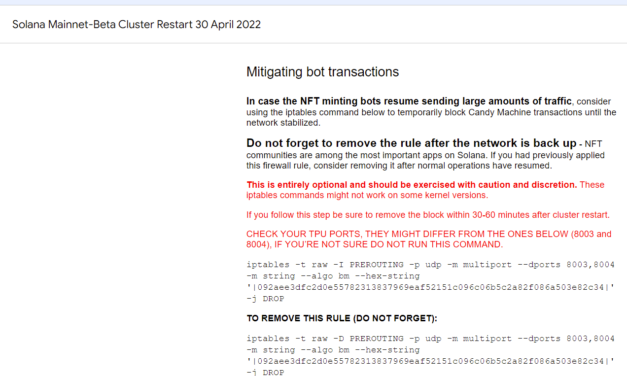
The Solana network faced its seventh outage on Saturday, resulting in a downtime of over seven hours. The developer team has released an outage report, along with three key mitigation steps to make the network more stable.The network outage on Solana was caused by a significant surge in the number of transactions due to nonfungible token (NFT) minting bots. The bots used Candy Machine, a popular application used by Solana NFT projects to launch collections.The transaction volume reached six million per second, overflowing individual nodes with 100 Gbps data. As a result, validators ran out of data memory, leading to a loss of consensus among them.The developers ruled out distributed denial of service (DDoS) attacks and blamed NFT minting bots for the congestion. The network came online at 3:30 am UTC on Sunday.The official report highlighted three key mitigation steps that are in work to make the Solana network more resilient against such congestion issues. The first major step is to move from its current data transfer protocol called user datagram protocol (UDP) to Google-developed quick UDP internet connection (QUIC). QUIC offers fast asynchronous communication like UDP, but with sessions and flow control like transmission control protocol. The second key step is the integration of stake-weighted transaction processing instead of its current first-come-first-serve basis. The developers claimed a stake-weighted transaction processing along with QUIC would be more robust.The third mitigation step is to introduce “fee-based execution priority,” where users would have the option to add an additional fee on top of the base fee. The fee prioritization is set for the v1.11 release. Related: Solana DAOs can now bug you to vote with phone calls and textsApart from the Solana network outage, an even bigger controversy was the beta cluster restart instructions, reportedly issued by validator operators. The said instructions asked validators to block NFT minting bots manually at the layer-1 layer.Solana Beta Cluster Restart Instructions Souce: TwitterHowever, Solana’s head of communication Austin Federa said that the majority of validators kept their distance from censoring and a new update is being introduced on the Candy Machine with additional anti-bot features.This is factually inaccurate – for starters these instructions weren’t issued by Solana Foundation.Second, very few validators have adopted this. Third, @metaplex is deploying an update to Candy Machine with additional anti-botting.— Austin Federa (@Austin_Federa) May 1, 2022

Čítaj viac

Indian IT Ministry directs crypto exchanges to store user data for 5 years

The Indian Computer Emergency Response Team (CERT-in), which falls under the Ministry of Electronics and Information Technology, issued a new directive on Thursday, forcing crypto exchanges, virtual private network (VPN) providers and data centers to store a wide range of user data for up to five years.Under the newly issued directive, crypto exchanges operating in India will be required to store customers’ names, ownership patterns, contact information and various other data. Crypto exchanges and VPN services providers are also required to report any cyber incident within six hours of its occurrence and must hand over the collected data to the authorities upon order. The official directive read:“When required by order/direction of CERT-In, for the purposes of cyber incident response, protective and preventive actions related to cyber incidents, the service provider/intermediary/data center/body corporate is mandated to take action or provide information or any such assistance to CERT-In.”The new directives will come into force on June 22, which may force many VPN service providers and privacy-focused crypto platforms that don’t collect or store critical user data to shut their operations.Related: Brain drain: India’s crypto tax forces budding crypto projects to moveCERT-in claims the new directives are intended to help them take action against cyber crimes within six hours, however, the range of data they are asking platforms to store and hand over has raised eyebrows owing to privacy concerns among users. One user wrote:”Our government wants to control the private life of the people and our constitution does not allow this, but to be honest no one in India is much conscious about personal data.”However, some crypto exchange owners welcomed the step, saying it will help prosecute tax evaders. Unocoin CEO Sathvik Vishwanath told Cointelegraph:“This is a good move and helping crypto players to have clarity about the data that they would be storing. The data would help prosecute tax evaders and any crimes happening using crypto.”At this point, it is not clear whether the new rules would be applicable to crypto exchanges’ operating in India only or to foreign exchanges offering their services to Indians as well. However, looking at the earlier crypto directives, it could well be applicable to all the platforms.The new data collection directives come at a time when the regressive crypto tax policy in the country has already led to a steep decline in trading volume and user activity on Indian crypto exchanges.

Čítaj viac

Finance Redefined: Samson Mow's DeFi question, Fireblocks expands to institutional and more

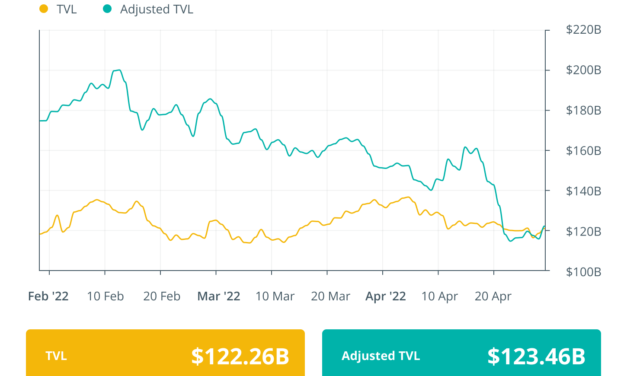
The week was filled with several new project developments and key updates from leading decentralized applications (DApps) and decentralized finance (DeFi) protocols. Fireblocks has expanded its institutional access to Terra’s DeFi ecosystem and Solana partnered with the Notifi network to improve the abysmal participation rates in governance votes.We will also look into the Cointelegraph research into the Terra ecosystem’s future and see if it can sustain the current growth. Samson Mow, the former executive at Blockstream, questions the decentralized aspect of the DeFi ecosystem.Top DeFi tokens saw another week of bearish price action despite several new developments and barring a few, the majority of the tokens in the top-100 registered double-digit losses over the past week.Fireblocks expands institutional access to Terra’s DeFi ecosystemFireblocks, a digital asset custody platform, announced that it has enabled institutional decentralized finance access to Terra, the second-largest DeFi protocol by total value locked (TVL). As per the announcement, Fireblocks users can now securely access all the decentralized applications built on the Terra blockchain.The launch is in response to Fireblocks’ early access program users, who invested over $250 million into the Terra DeFi ecosystem within the first 72 hours of its integration going live.Continue reading‘DeFi is not decentralized at all,’ says former Blockstream executiveSamson Mow, former chief strategy officer at Blockstream and founder of JAN3, is convinced that most decentralized finance protocols can’t compete with Bitcoin (BTC) when it comes to providing an effective monetary network because of their lack of decentralization. As Mow pointed out, DeFi projects are governed by entities that can modify the protocol at will.“Bitcoin, at the fundamental level, is money, and it should be immutable,” explained Mow. “If you can change it at will, then you’re no better than a fiat currency governed by the Fed.”Continue readingSolana DAOs can now bug you to vote with phone calls and textsThe Notifi Network is banking on this concept to help improve the abysmal participation rates in governance votes. Launching with Solana decentralized autonomous organizations, or DAOs, it combines popular centralized methods used by the Web3 community such as Telegram and Discord pings with more traditional and harder to ignore notifications like phone calls, text messages or emails.Backed by crypto venture capital firms Race Capital and Hashed, on April 24, Notifi applied its notification service to all DAOs that launched on the Solana Realms DAO platform.Continue readingCan Terra blockchain sustain its growth? Research report digs deeperCointelegraph Research fundamentally evaluates Terra in its 50-page report to provide an in-depth analysis of its recent updates, including Columbus-5, the Bitcoin acquisition and others.Decentralized algorithmic stablecoins, blockchain integration in real-world payments and 20% annual percentage yields (APYs) on DeFi protocols — what is all of this, and is it really doing this? The team of experienced cryptoanalysts from the Big Four and the best universities worldwide dives deep into the blockchain’s ecosystem, community and underlying technology, assessing the potential regulatory, market and technological risks.Continue readingDeFi market overviewAnalytical data reveals that DeFi’s total value locked dipped by one billion dollars, falling to $123.08 billion. Data from Cointelegraph Markets Pro and TradingView reveals that DeFi’s top 100 tokens by market capitalization registered a week filled with volatile price action and constant bearish pressure.Majority of the DeFi tokens in the top-100 ranking by market cap traded in red, barring a few. Kyber Network Crystal v2 (KNC) was the biggest gainer with a 25% rise over the past week, followed by Kava (KAVA) at 17% and Curve DAO Token (CRV) at 8%.Thanks for reading our summary of this week’s most impactful DeFi developments. Join us again next Friday for more stories, insights and education in this dynamically advancing space.

Čítaj viac

Eth2 deposit contract now holds 10% of the circulating ETH supply

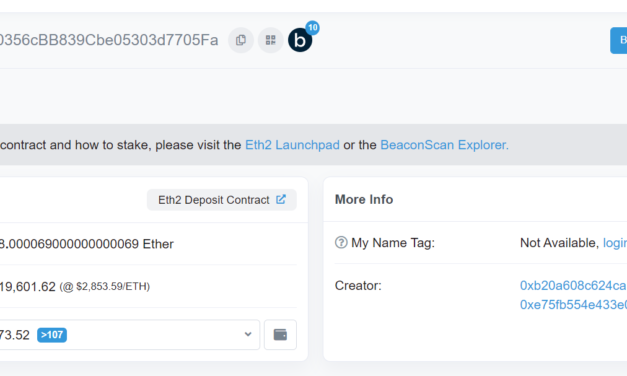
The deposit contract for staking Ethereum (ETH) on the Beacon chain reached a balance of 12 million ETH on Friday. The total locked value of Ether in the Eth2 contract is worth about $34.5 billion.The deposit contract was launched in November 2020 and currently holds around 10% of the total circulating supply of ETH. Beacon chain staking contract. Source: EtherscanThe Beacon Chain is the first major step in Ethereum’s transition from a proof-of-work (PoW) to a proof-of-stake (PoS) consensus model. A trader must invest a minimum of 32 ETH to become a validator in Eth2. Thus the largest Beacon Chain contract, valued at $34.5 billion highlights the enormous demand and trust in the future Eth2, despite several delays over the past year.ETH devs started the community testing of the PoS network in December itself, however, the tentative merger date of June 2022 was postponed again, without offering any certain date for the merger.Related: Ethereum price ‘bear flag’ could sink ETH to $2K after 20% decline in three weeksEthereum’s biggest upgrade since its inception has faced numerous challenges and continuous delays along the way. However, despite all that, the deposit contract has grown significantly with over 2 million ETH deposited over the last two months. Ethereum’s move to PoS has generated varied sentiments in the crypto market, where on one hand the energy-conscious group has lauded the move claiming it would bring down the network’s consumption by 90%, on the other hand, Bitcoin proponents such as Jack Dorsey believe PoS mining consensus is more centralized and less secure than PoW. less security, more centralization— jack⚡️ (@jack) May 20, 2021The merger of the Beacon chain into the Ethereum mainnet would complete the transition to Eth2. The upcoming merger is expected to put the Ethereum network on par with centralized payment processors, increasing its payment processing speed by several magnitudes with the help of sharding (parallel processing).

Čítaj viac

Získaj BONUS 8 € v Bitcoinoch

nakup bitcoin z karty

Registrácia Binance

Burza Binance

Aktuálne kurzy