Autor Cointelegraph By Prashant Jha

Bancor 3 goes live with impermanent loss protection for liquidity providers

Bancor, the first decentralized finance protocol to introduce liquidity pools, has come out with a new liquidity solution with the launch of its v3, called Bancor 3.Bancor 3 went live with a promise to offer protection against impermanent loss to liquidity providers. The new architectural changes promise to bring sustainable on-chain liquidity and make decentralized finance (DeFi) staking simpler for decentralized autonomous organizations (DAOs).The v3 project has attracted more than 30 projects and tokens — including Polygon’s MATIC, Synthetix Network Token (SNX), Yearn.finance’s YFI, Brave’s Basic Attention Token (BAT), Flexa’s AMP and Enjin Coin (ENJ) — and several DAOs for its new protocol launch. The single-sided staking was first introduced with Bancor v2 to protect traders against impermanent losses; however, the last version suffered from a high barrier of entry and high gas fees. With v3, Bancor promises full impermanent loss protection and minimal gas fees.Liquidity is the backbone of the DeFi ecosystem, but many leading protocols have faced a severe crisis in maintaining a long-term liquidity mining strategy. Talking about the key architecture changes and the new liquidity solution, Mark Richardson, product architect at Bancor, told Cointelegraph:“In Bancor 3, the protocol utilizes an improved set of operations that allows the network to better manage its liabilities, resulting in a more cost-efficient method of providing impermanent loss compensation.”Bancor 3 introduces several new architectural changes and features, including Omnipool, instant impermanent loss protection, auto-compounding rewards, dual rewards and superfluid liquidity. Omnipool is a single virtual vault for token liquidity. Richardson explained that Omnipool can use protocol-earned fees from one pool to compensate a user’s impermanent loss in another pool. This should cut down the transaction fee slippage and ensure efficiency.Related: Chainlink set to power Latin American real estate platformThe auto-compound earning mechanism ensures that trading fees and rewards are auto-compounded with zero transaction fees simultaneously used as liquidity inside the pool from day one. This mechanism ensures dual-earning for third-party projects.

Čítaj viac
Deribit and OKX attract significant traffic from China despite a blanket ban: Report

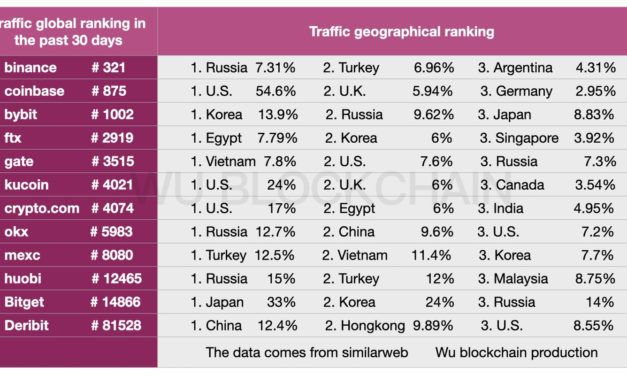
Data from website traffic metric provider Similarweb shows that Deribit and OKX continue to attract significant traffic sources from China despite a blanket ban on crypto transactions and foreign exchanges last year.China has banned the use of cryptocurrencies more than a dozen times in the last decade. However, the one imposed in September last year was considered the harshest one. Several crypto exchanges including Huobi and Binance had shut doors for the Chinese traders in fear of regulatory action. The strict regulatory reforms ensured that Chinese traders mainly shifted their focus to decentralized exchanges (DEXs) and protocols.Chinese crypto traders have always found a way to bypass strict crypto regulatory measures imposed by the government. While many believed the blanket ban on crypto use would be a death sentenc for the largely underground crypto market in China, geographical traffic data shows otherwise.A Cointelegraph exclusive report highlighted the rise in the use of VPNs among Chinese traders after the blanket ban. Recent data from Similarweb verifies that Chinese traders are still flocking to centralized derivatives platforms such as OKX and Deribit.Related: Residents of 3 Chinese cities paying taxes and charges with digital yuanHuobi was the primary choice of Chinese crypto traders as they accounted for more than 30% of the trading volume on the exchange before the blanket ban. However, now Deribit leads the chart in terms of Chinese traffic with a 12% share, followed by OKX with 9.6%.Geographical Traffic Source For Crypto Exchanges Source: SimilarwebAnother prominent reason for the rise in traffic on derivative exchanges could be the lack of strict Know Your Customer (KYC) measures when compared to the likes of Huobi and Binance.The geographical data shows that Russia, South Korea, the United States and Turkey were the biggest traffic source on centralized exchanges like Binance and Coinbase. Bybit and FTX were the most visited crypto exchanges in the month of April.

Čítaj viac

Finance Redefined: DeFi protocols lost $1.6B, EU to rethink DeFi approach and more

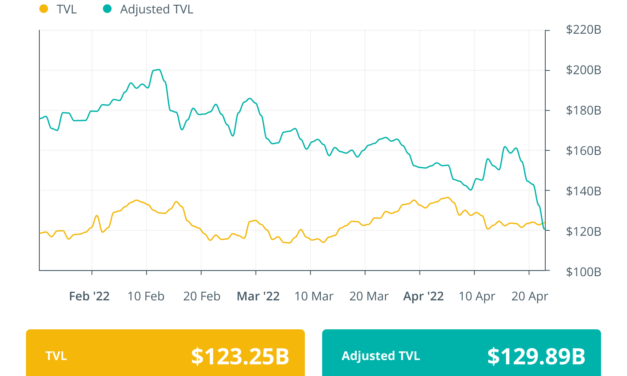
The past week in the decentralized finance (DeFi) ecosystem saw many new developments from an adoption perspective and protocol developments. The European Commission added a new chapter on DeFi, showing the growing impact of the nascent ecosystem, while a county in the United States State of Virginia wants to put its pension fund in a DeFi yield.DeFi exploits became the center of attention again as recent research shows that in the first two quarters of 2022, DeFi protocols have lost $1.6 billion to various exploits. Rari Fuze hacker, who got away with $80 million worth of funds, was offered a $10 million bounty.The DeFi tokens also made a bullish comeback toward the end of the past week. However, the overall weekly performance remained in the red.European Commission report suggests rethink of the regulatory approach to DeFiAnalysts from the European Commission showed an unexpected understanding of how DeFi functions, having defined it as something different from the traditional financial system and acknowledging that it would require rethinking the approach to regulation. On Monday, crypto venture adviser at Presight Capital and a long-term expert on European regulation Patrick Hansen shared some crucial details from the European Commission’s “European Financial Stability and Integration Review 2022.” The report, dated April 7, contains a 12-page chapter on DeFi, in which the authors demonstrate a sensible approach to the topic.Continue readingVirginia county wants to put pension funds into DeFi yield farmingThe Northern Virginia county of Fairfax has already invested a part of its pension funds in crypto and blockchain startups. Now, it’s mulling over deeper involvement with the DeFi yield farming.The Fairfax County Police Pension System’s chief investment officer Katherine Molnar said on Tuesday at the Milken Institute Global Conference that the system aims to fund two new crypto-focused hedge fund managers in the next three weeks. The next few days will see a decision made, which, if approved, would be the first time pension fund money was used in DeFi.Continue readingRari Fuze hacker offered $10M bounty by Fei Protocol to return $80M lootDeFi platform Fei Protocol offered a $10 million bounty to hackers in an attempt to negotiate and retrieve a major chunk of the stolen funds from various Rari Fuse pools worth $79,348,385.61 — nearly $80 million.On Saturday, Fei Protocol informed its investors about an exploit across numerous Rari Capital Fuse pools while requesting the hackers to return the stolen funds against a $10 million bounty and a “no questions asked” commitment.Continue readingMore than $1.6 billion exploited from DeFi so far in 2022DeFi space has been rife with hacks, exploits and scams so far this year, with over $1.6 billion in crypto stolen from users, surpassing the total amount stolen in 2020 and 2021 combined.Analysis from blockchain security firm CertiK revealed the statistics on Monday showing the month of March having the most value stolen at $719.2 million, over $200 million more than what was stolen in all of 2020. The March figure is largely due to the Ronin Bridge exploit where attackers made off with over $600 million worth of crypto.Continue readingSolana and Moonbirds help NFT market reach $6.3B monthly trading volume: Report According to the monthly DappRadar report, the NFT market recorded a multi-month trading volume high of $6.3 billion, surging by 23% from March, breaching the $6 billion mark only for the third time in its history.Moonbirds contributed half a billion worth of trading volume while Solana blockchain recorded nearly $300 million in NFT trades with a 91% month-on-month increase.Continue readingDeFi market overviewAnalytical data reveals that DeFi’s total value locked remained in a similar range to last week with $123 billion, despite a bullish surge toward the end of the week. Data from Cointelegraph Markets Pro and TradingView reveals that DeFi’s top 100 tokens by market capitalization registered a week filled with volatile price action and constant bearish pressure.Majority of the DeFi tokens in the top-100 ranking by turned green on the daily chart, but their weekly performance remained bearish, barring the Curve DAO Token (CRV) that surged by 4% over the past week.Thanks for reading our summary of this week’s most impactful DeFi developments. Join us again next Friday for more stories, insights and education in this dynamically advancing space.

Čítaj viac

Eager to work: Bitcoin switch to proof-of-stake remains unlikely

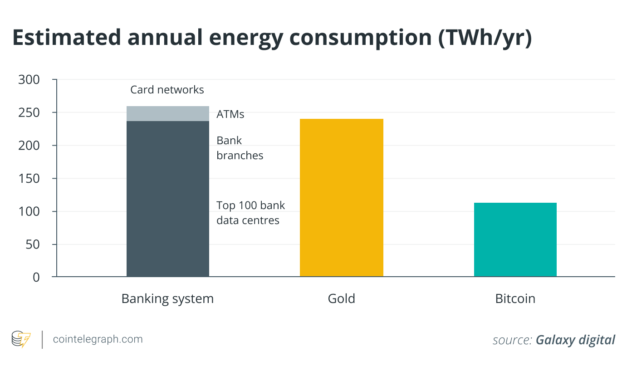
Bitcoin (BTC), the original cryptocurrency that started it all and even today continues to drive the market sentiments, has faced numerous challenges along the way. The latest challenge seems to be around its mining consensus, proof-of-work (PoW) and its consequent impact on the environment.Bitcoin network’s high energy consumption was one of the hottest topics last year, with the likes of Elon Musk fueling the sentiment that BTC in its current form is bad for the environment. Luckily enough, the mining companies for some time have been exploring the use of renewable energy, and the latest reports suggest that 58% of the BTC network’s energy comes from renewable sources.In 2022, the debate seems to have shifted from clean energy usage to a complete change in mining consensus, with a lobby composed of billionaires and proof-of-stake (PoS) proponents calling for a change in the code of Bitcoin. The sentiment is also fueled by Ethereum’s change from PoW to proof-of-stake, slated to be completed by the end of 2022.PoW is the original crypto mining consensus that was popularized by Bitcoin and adopted by several early crypto projects. PoS came into existence with the launch of Peercoin in 2013, and although not very popular at first, scalability and energy efficiency made it a popular choice for new crypto projects. William Szamosszegi, CEO of Bitcoin mining platform Sazmining, told Cointelegraph that “the fundamental mistake that Greenpeace, Larsen, and other critics of Bitcoin’s energy consumption make is that they judge Bitcoin by its ‘ingredients,’ rather than its value proposition.” He further added:“We ought to judge a novel invention by the degree to which it solves a problem in society. PoW enables sound money and a decentralized currency backed by real-world energy. PoS can not possibly achieve this.”Recently, Bitcoin Mining Council (BMC) responded to a letter sent to the United States Environmental Protection Agency (EPA) clearing that proof-of-stake and proof-of-work are qualitatively different. Thus, it’s misleading to refer to proof-of-stake as a more “efficient” form of proof-of-work, since it does not achieve the same thing.Proof-of-work offers true decentralizationPoW is touted as the most reliable method of reaching consensus on a blockchain. It aids in the decentralization of transactions while removing intermediaries and assuring transaction validity. The mining consensus offers equal opportunity to everyone and new miners are incentivized to add more hardware and spend more energy to receive their share of the mining rewards.PoS, on the other hand, uses a staking system where a certain amount of capital in the form of the network’s tokens is required to become a validator. Its security is meant to be derived directly from the perceived economic value of the network or how expensive it is to purchase a majority stake.While a lot is made out of Bitcoin’s energy consumption, which is definitely on the higher side when compared to other crypto projects, crypto naysayers often see the energy consumption as an independent metric. Meanwhile, Bitcoin’s energy consumption is directly proportional to its security, making it truly decentralized.A lot of efforts are being made to turn Bitcoin mining greener even in its current form, however. According to a study by Galaxy Digital, the Bitcoin network consumes nearly half of the energy used by banks and gold mining.Critics often assume that the energy used by Bitcoin miners is either stolen from more productive use cases or results in increased energy consumption. However, research studies have shown that Bitcoin miners utilize nonrival energy that may otherwise be wasted or underutilized.Demand for changes to the core principles of the Bitcoin network is nothing new. During the Bitcoin block size war from 2015-2017, many exchanges and miners supported a Bitcoin hard fork but the Bitcoin community fought back to keep the network true to its value, as created by Satoshi Nakamoto himself. Joe Burnett, mining analyst at Blockware Solutions, believes that any attempt to change Bitcoin’s consensus algorithm “will certainly fail,” telling Cointelegraph:“Bitcoin users, or node operators, were able to resist consensus-altering changes and upgrade the network in a backward-compatible way. This war set the precedent that Bitcoin is highly resistant to any changes that could alter its value proposition of being perfectly scarce, portable, durable, divisible and fungible.”Looking back at some of the forks from 2018, when the block size debate was at its peak, gives a true picture of why Bitcoin shouldn’t alter its codes. The two blockchain networks that came out during the “block size war” were Bitcoin Cash (BCH) and Bitcoin SV (BSV). Both the networks have faced significant centralization and security issues and development on these networks has declined over time. Another prominent endorsement of the PoW mining consensus is the Chinese mining ban last year. China contributed more than 60% of the Bitcoin mining power, but the blanket ban led to a complete shutdown, as miners had to cease their operations. The Bitcoin network hashing power declined overnight by more than 50%. Within a couple of months, however, the mining strength was back to pre-ban levels, showing the true power of decentralization.Top PoS networks are reeling with issuesThe biggest argument in favor of PoS is its energy efficiency and scalability. However, those advantages come at the cost of decentralization — the founding principle of cryptocurrencies. For example, Bitcoin was created with a principle of equality, promising to offer equal opportunity to anyone looking to participate. However, PoS creates a staking barrier where the highest staker has the first say in the decision-making process.While it is true that PoS verification is less energy-intensive than the PoW system currently in place, there are fundamental roadblocks with the PoS model that significantly lower the chances of Bitcoin altering its consensus mechanism any time soon. One of the major concerns with PoS networks is the level of centralization and its subsequent impact on the security of the network. Noble Drakoln, podcast host of Accredited Investor Journal, told Cointelegraph that “PoS networks might be ‘environment friendly’ but they are not decentralized.”This is evident from several protocol breaches on several PoS-based decentralized finance protocols and nonfungible token (NFT) games. Even the biggest PoS network such as Solana, which has seen a significant rise in adoption, has faced numerous outages over the past year. Most of the outages were caused by distributed denial of service (DDoS) attacks, resulting in a loss of consensus among validators.Related: ​​Everything gets politicized, including crypto, says former POTUS candidate Andrew YangEther (ETH), the second-largest cryptocurrency by market cap, has decided to switch to PoS to resolve scalability issues on its platform. The transition, however, has been delayed on numerous occasions and even a switch to PoS won’t guarantee seamless working. Drakoln explained further:“Moving to POS jeopardizes that security without looking at secondary solutions to make POW work. The environmental concerns around the Bitcoin network have created a lobby calling for a change of code from proof-of-work to proof-of-stake. However, PoW is key to Bitcoin’s decentralization.”The need for consensus mechanisms is to not only secure the network but allow for scalability. Ether, for example, has different use cases in comparison to Bitcoin and needed to scale differently as a result, leading to Eth2 adopting PoS moving forward. Related: Mixing reality with the Metaverse: Fashion icon Phillip Plein goes cryptoBitcoin, on the other hand, only needs to process the transactions on the network allowing for PoW to build toward maximum network security while leveraging layer-2 applications such as the Lightning Network or Stacks to make up for that scalability as the mining aspect moves toward more energy-efficient options.

Čítaj viac

Solana and Moonbirds help NFT market reach $6.5B monthly trading volume: Report

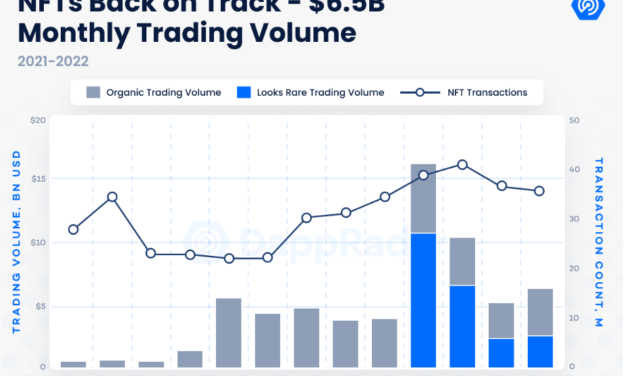
Solana (SOL) and Moonbirds came to the rescue of the bearish nonfungible token market after a six-week cooldown phase. According to the monthly DappRadar report, the NFT market recorded a multi-month trading volume high of $6.5 billion, surging by 23% from March, breaching the $6 billion mark only for the third time in its history. Source: DappRadarMoonbirds contributed half a billion worth of trading volume while Solana blockchain recorded nearly $300 million in NFT trades with a 91% month-on-month increase.Many new hyped NFT projects also contributed to the growing trading volume, especially Otherdeeds which generated $760 million within 24-hours. The success of Otherdeeds turned out to be bittersweet as it led to high gas fees of upto 2.5 ETH at the time of minting.The daily unique active wallet count interacting with decentralized apps reached 2.36 million in April, a slight 0.2% increase from March. BNB Chain and Wax saw the highest average of wallets connected with 568,000 and 492,000 daily unique active wallets.Related: Opera browser enables direct access to BNB Chain-based DApp ecosystemWhile the NFT market made a remarkable recovery, the total value locked in decentralized finance dipped by 12% due to volatile token prices. However, Terra (LUNA) defied the common market trend to register a 15% surge in TVL dominance with a total of $30 billion locked in the protocol.Falling TVL and volatile token prices didn’t bound the DeFi market to continue its expansion, as the ecosystem registered remarkable growth beyond the Ethereum (ETH) blockchain. Ethereum’s TVL dominance declined from 94% a year ago to 59% in April.Blockchain games continued their dominance in April despite major breaches such as the Ronin bridge hack. Gaming DApps accounted for 52% of the industry’s unique active wallets. Major gaming blockchain networks such as Polygon and BNB also topped the chart of on-chain activity.

Čítaj viac

Získaj BONUS 8 € v Bitcoinoch

nakup bitcoin z karty

Registrácia Binance

Burza Binance

Aktuálne kurzy