Autor Cointelegraph By Prashant Jha

Indian government's ‘blockchain not crypto’ stance highlights lack of understanding

Indian crypto businesses are struggling with the new tax policies as trading volumes have dried up and many established crypto firms are looking to relocate to more crypto-friendly jurisdictions.While many developed countries and even several of its Asian counterparts are actively studying and formulating better crypto regulations, the Indian government has maintained a “blockchain, not crypto” stance. It might seem like the government is taking a cautionary step to focus on the underlying technology while keeping its distance from the volatile and risky crypto market. However, going by the recent policies and statements from the finance minister as well as sitting parliamentarians, the issue seems to be more of a lack of understanding.The newly introduced crypto tax laws, for example, are highly motivated by the country’s gambling laws and were introduced and passed hurriedly without any input from the stakeholders in the ecosystem. As many crypto pundits have warned, the harsh tax policy has driven traders away from Indian exchanges. Many ministers in the ruling government have propagated false narratives against crypto without offering any evidence to back their claims. Sushil Kumar Modi, a member of parliament from the ruling party, has compared crypto to “pure gambling” and called to “impose more tax on it so that the government can get revenue and people can be discouraged from investing in this volatile asset.” The statement is a clear example not only of a lack of understanding but of a contradiction, in that he is talking about discouraging people from investing in crypto while believing it would bring more revenue to the government.Sathvik Vishwanath, co-founder and CEO of Indian crypto exchange Unocoin, told Cointelegraph:“The government continues to see crypto as a betting and gambling alternative due to which they are only ready to support its technology but not tokens on top of it.”It is important to understand the fact that crypto and blockchain are somewhat inseparable. Crypto tokens play a pivotal role in the functioning of blockchain projects and blockchain-based rewards.Shivam Thakral, CEO of BuyUcoin, explained that a fundamental lack of understanding is one of the key reasons for such flawed policies and advocated for dialogues with specialized groups. He told Cointelegraph:“Any attempt to create an isolated policy by any country will defeat the whole purpose of blockchain technology, which is aimed at liberating the financial systems of the world. The Indian government must create specialized groups to discuss and debate finding a more accurate way to regulate the booming crypto sector in India. The time is right for India to take the lead and become the blockchain capital of the world.”While many blame the government’s lack of understanding of the nascent tech to be the key reason behind its “blockchain, not crypto” stance, others feel that India’s fintech and payments network are mature enough and that a crypto layer wouldn’t really add much utility. Thus, the government is more focused on the core technology.Trevor Goott, director of Africa and India at Unlimint — a digital financial interface provider — told Cointelegraph:“The Indian fintech and payments sector is mature and well-serviced, and crypto would just be another layer on top, so the net benefit to India would be less when compared to another country that has a less developed payment sector. Crypto will have its place in India in the medium-term, but the short-term benefits of the other blockchain products must be realized first if a choice has to be made between crypto or blockchain.”Recent: ‘DeFi in Europe has no lobby,’ says co-founder of Unstoppable FinanceIndian government sees crypto as a threatThe Indian government clearly sees crypto as a threat to its current financial system. The Indian central bank has recently warned against crypto adoption and said it could lead to the dollarization of the economy.The Reserve Bank of India said, “Crypto will seriously undermine the RBI’s capacity to determine monetary policy and regulate the monetary system of the country.”In the early days of crypto, most countries thought digital assets posed an inherent risk to their fiat ecosystem; however, as the industry matured, it has been proven that cryptocurrencies can co-exist with traditional financial markets.Siddhartha, founder of Intain — a blockchain solution firm — told Cointelegraph:“Having spoken with several people in government, they understand blockchain but are reacting in the short term to a surge of marketing dollars and campaigns that have caused a lot of noise on behalf of some crypto exchanges. These campaigns are worrisome due to the broad exposure they create among the general public. It is our view that government officials are generally supportive of blockchain that works in a manner that brings trust and transparency to the financing of non-bank financial companies.”By approving the use of blockchain, India can use it to create its own centralized cryptocurrency without any competition from other cryptos if it successfully bans other coins. Sukhi Jutla, co-founder of MarketOrders — a blockchain-based online jewelry marketplace — told Cointelegraph:“I think it’s more about the Indian government wanting to impose greater controls on how this new technology can be used, and they are clearly concerned with how it will impact their current financial system. The more controlling governments are around cryptocurrencies, the more fearful they are of the impact it will cause on their current financial systems.”Governments can either have a supportive and collaborative approach that allows innovation to occur or they can stifle and shut down progression and innovation if they remain too fearful of this technology, and it seems as though the Indian government may be taking the latter approach.Popular crypto influencer and trader Scott Melker, who is known by his Twitter name The Wolf Of All Streets, told Cointelegraph:“As of today, crypto and blockchain are now legal and encouraged in the country, but a 30% tax on all cryptocurrency trading hinders the growth. Following this disastrous tax policy, some exchanges have reported up to a 70% decline in trading activity. For now, it truly seems like India only has an interest in what blockchain can do for the country and not what Bitcoin can do for its citizens.”India’s struggle with crypto regulationsThe Indian finance ministry was first tasked with drafting a crypto bill in 2018, and the first draft copy was introduced in 2019, demanding a complete ban on all activities associated with cryptocurrencies. Since then, the government has changed its stance on crypto on several occasions, going from a blanket ban to regulating the crypto market as an asset class. However, none of the proposals have been finalized or introduced in parliament for discussion.The crypto ecosystem in India has managed to self-regulate for quite some time now. However, the hesitant stance of the Indian central bank, in addition to regulatory uncertainty, has made many crypto firms reconsider their future in the country.Recent: Madeira ‘embraces’ Bitcoin, and how its president met Michael SaylorNitin Agarwal, founder and chief revenue officer of FV Bank — an international digital bank — told Cointelegraph:“The job of regulators is difficult and is even more complex in the crypto space due to its inherent nature of being censorship-resistant coupled with grappling with the rapid pace of innovation. Regulators the world over are working hard on creating a regulatory framework that can be applied to digital assets and crypto. The Indian government’s approach is pragmatic in that they don’t want to over-regulate and see all users and companies move to a non-regulated or more lightly regulated jurisdiction.”He added, “The government is waiting to see a regulatory framework come out of the United States and European Union, which they can imbibe upon and take best practices to apply to the people of India.”While a majority of ministers in the ruling party have toed the line of the finance ministry, many opposition leaders have called for reconsideration of the flawed tax policy. They have also opposed the idea of banning crypto, claiming it would be similar to banning the internet.

Čítaj viac

South Korean watchdog reportedly fines Terraform Labs $78M for tax evasion

Terraform Labs and co-founder Do Kwon continue to attract more legal trouble in the wake of the collapse of the Terra ecosystem. After early reports of a possible congressional hearing and an investigation from ‘Grim Reapers’ financial crimes unit, the crypto firm has now come under the radar of the national tax agency.According to a report published in Naver news, South Korea’s national tax agency has slapped the Terraform Labs and its co-founder with a 100 billion won ($78 million) penalty for tax evasion charges.The report highlighted that the Kwon was unhappy with crypto taxation in the country since last December and tried to liquidate Terra’s domestic operations just before the infamous LUNA crash set in.Terraform Labs reportedly first came under the radar of tax authorities in June last year on suspicion of evading corporate and income tax. The investigation into Terraform Labs and its various subsidiaries revealed that the company was registered in the Virgin Islands as well as Singapore.Related: Analysts assess the aftermath of the Terra (LUNA) collapseAlthough both the subsidiaries were registered abroad, the ‘place of actual management’ was South Korea itself. According to Korea’s corporate tax act, the place of actual management is considered for tax purposes than the registered country. The tax authorities were alerted after Terraform Labs sent Luna from Terra Singapore to Luna Foundation Guard (LFG) to avoid taxations or make up for the losses of anchor protocol. Earlier in October, Virgin Islands subsidiaries of Terra were fined 4.66 billion won ($3.6 million) income tax and 44.7 billion won ($34.7 million) in corporate tax.South Korea’s law enforcement agencies and policymakers have come down heavily on Do Kwon and his associates in the aftermath of the LUNA crash. A special financial crime investigation unit called “Grim Reapers of Yeouido” was recalled after 2.5 years to look into the project.

Čítaj viac

Axie Infinity's Discord bot compromised, hackers issue fake minting message

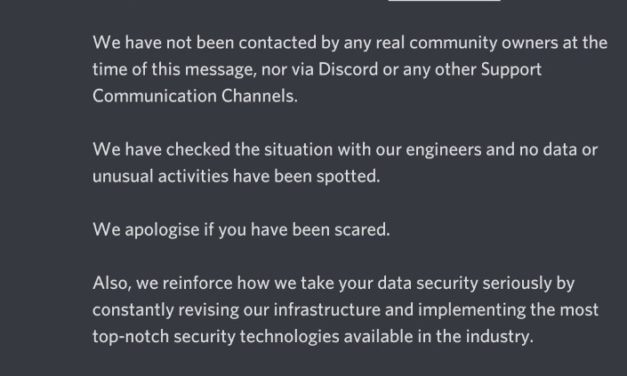
Axie Infinity, the popular play-to-earn nonfungible token game, faced another attack on its Discord server earlier on Wednesday, leading to a compromise of its MEE6 bot.MEE6 is a popular discord bot mainly used for automating roles and messages and is used by numerous crypto projects. The attackers used the compromised bot to add permissions to a fake Jiho account, and later issued a fake announcement regarding a mint.The developers managed to remove the compromised MEE6 bot from the main server and deleted the fake messages as well. However, the official Twitter account of the project warned that many users might still see the fake message until they restart their Discord.2/ The announcements have been deleted but some users may still see the message until they restart their Discord.We have removed the Mee6 bot from the server and will never do a surprise mint.— Axie Infinity (@AxieInfinity) May 18, 2022The developers also claimed that the compromise of MEE6 is not a new phenomenon and many projects have faced similar issues. However, the official MEE6 Discord support channel denied allegations of a hack and claimed they have verified with their engineers and didn’t see any unusual activity.MEE6 Official Discord Channel MessageMany believe that the hackers compromised the admin accounts first and then got access to the alternate admin account using MEE6. This helped them to send out webbook messages while hiding the compromised administrator account.Related: The aftermath of Axie Infinity’s $650M Ronin Bridge hackThe Discord bot compromise comes within a month of one of the biggest heists on Axie Infinity’s Ronin bridge resulting in a loss of over $600 million worth of crypto assets. The recent slew of security breaches has brought down the confidence of the community in the game, which was once seen as a revolutionary project for the gaming world.

Čítaj viac

US agencies warn against the influx of North Koreans in IT and crypto jobs online

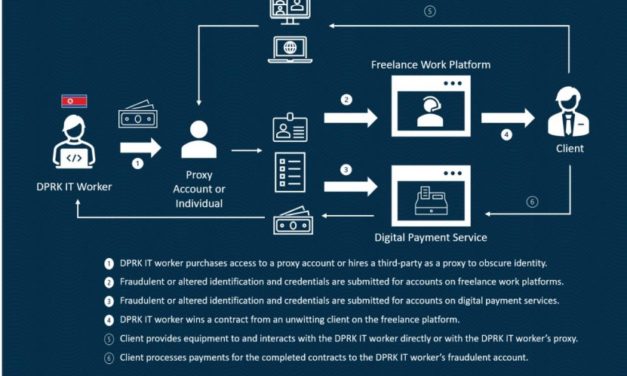
The United States Department of Justice, State and the Treasury issued a joint advisery warning against the influx of North Korean workers in various freelance tech jobs, especially in the crypto industryThe public advisory was released on Friday, highlighting the critical red flags and identifiers for private firms to avoid hiring North Korean workers. The U.S. agencies warned that these workers pose a range of risks including theft of intellectual property, data and funds that could be used to violate sanctions.There has been a significant increase in the freelance job market due to the pandemic, and crypto being a decentralized sector, offers some of the most lucrative IT jobs in the current industry. This is the reason for concern for the U.S. agencies who are wary of North Korea’s interest in the crypto sector.Overview of North Korean Worker OperationsThe advisory noted that North Korean workers often use virtual private networks (VPNs) to purchase third-country IP addresses and stolen identities to hide their origin country. The advisory further read:“These workers develop applications and software spanning a range of sectors, including, but not limited to, business, cryptocurrency, health and fitness, social networking, sports, entertainment and lifestyle.”To identify and weed out such workers from the U.S.-based companies, the advisery listed various red flags to be wary of, including inconsistencies in name spelling, nationality, claimed work location, contact information, educational history, work history and other details across a developer’s freelance platform profiles.Request for payments in cryptocurrency and frequent transfer of money to People’s Republic of China-based bank accounts were other critical red flags listed in the advisory.Related: North Korea-obsessed Ethereum dev gets 5 years for breaking sanctionsNorth Korea has been infamous for stealing money through various ransomware attacks and hacks and is home to one of the most notable hacking groups called Lazarus. The recent Axie Inifity’s Ronin Bridge hack that resulted in a loss of over $600 million worth of crypto was also tied to the same hacking group.

Čítaj viac

FTX CEO sees no future in Bitcoin payments, community fires back

Sam Bankman-Fried, the founder of crypto exchange FTX, has criticized the efficiency of Bitcoin (BTC) as a payment network, only to meet heavy backlash from the crypto community.During an interview with the Financial Times, Bankman-Fried fueled environmental concerns associated with the Bitcoin network’s mining consensus, proof-of-work (PoW), and claimed it’s not scalable enough to accommodate millions of transactions.He advocated for the use of proof-of-stake mining consensus instead and claimed it is better suited for blockchain payment networks. He said:“Things that you’re doing millions of transactions a second with have to be extremely efficient and lightweight and lower energy cost. Proof of stake networks are.”Bankman-Fried comments resonated with the recent calls for a complete ban on PoW by a group of billionaire lobbyists comprising Ripple co-founder and several other environmental groups. However, Bitcoin proponents have been actively fighting against the ongoing narration calling for a change in the code of the Bitcoin network’s mining consensus. Related: Eager to work: Bitcoin switch to proof-of-stake remains unlikelyThe likes of Jack Dorsey have already made it clear that PoS is more centralized and less secure than PoW.The crypto community was not very pleased with FTX CEO’s recent comments. Many claimed the Bitcoin network is not intended to be a payment network, but rather a settlement one and layer-2 solutions such as the Lightning Network act as the main payment gateway. One user wrote:“Either SBF or FT lying here. What happens to L2 (Lightning Network)? The Bitcoin Lightning Network handles up to 1,000,000 transactions per second!” Others reminded him of high centralization and concurrent shutdowns of PoS networks such as Solana. One user wrote:“Thanks god we have Soylana that we can switch off and on every other week!”Another user on Reddit wrote:”He doesn’t have a friggin’ clue what he is talking about (or the journalist interviewing him doesn’t). Scaling has NOTHING to do with the consensus algorithm and hence whether it is POW or POS is completely irrelevant to the scaling issues.”The FTX CEO took to Twitter himself to clear the air around his comments and said that he also talked about the Bitcoin network’s potential as a store of value. He said:“To be clear I also said that it does have potential as a store of value. The BTC network can’t sustain thousands/millions of TPS, although BTC can be xfered on lightning.”The PoW vs PoS debate started last year when the Ethereum network outlined its plan to move to the PoS mining consensus. The likes of Elon Musk fueled the sentiment that BTC needs to use more clean energy to be a viable option. However, in 2022, the debate seems to have shifted towards a complete change of mining consensus for the BTC network.

Čítaj viac

Získaj BONUS 8 € v Bitcoinoch

nakup bitcoin z karty

Registrácia Binance

Burza Binance

Aktuálne kurzy