Autor Cointelegraph By Prashant Jha

Legal troubles mount for Terraform Labs as Seoul police investigative

Terraform Labs, the parent company behind the collapsed Terra ecosystem, is currently under multiple investigations from the South Korean authorities.The latest investigation revolves around the alleged embezzlement of Bitcoin (BTC) from the company’s treasury. According to a report published in a local daily, the Seoul Metropolitan Police Agency received an intelligence tip last month informing them of possible embezzlement of BTC by one of the employees of the firm.The police stated that the investigation into the alleged embezzlement of BTC from the company’s treasury had no direct connection with tainted co-founder Do Kwon and they are investigating individual embezzlement charges at this point. Authorities managed to freeze the stolen funds with the help of a crypto exchange until the investigation is complete. However, the amount of the stolen funds wasn’t disclosed.Luna Foundation Guard (LFG), a fund set up by the company that held over $3 billion in Bitcoin reserves, became the focus of interest in the aftermath of the collapse. The BTC fund was used to help balance the algorithmic stablecoin Terra USD (UST). The firm claimed all its BTC reserves were used in a futile attempt to stabilize UST.In a recent interview with the Financial Times, Terraform Labs co-founder Daniel Shin denied any allegations of malpractice or fraud. He said:“There was no intention of deception as we just wanted to innovate the payment settlement system with blockchain technology,”South Korean authorities have launched a full-scale investigation into the recent collapse of the Terra ecosystem and the role of Terraforms Labs employees and co-founder Do Kwon.Related: Chinese state media signals tighter crypto regulations in Terra aftermathThe first investigation began in the second week of May after 81 investors collectively filed two complaints against the firm for deceiving investors with a flawed token.As Cointelegraph reported earlier, South Korea’s feared investigative and prosecutorial team called “Grim Reapers of Yeouido” was reformed by the new president to look into Terraform Labs. Later, the South Korean Conservative Party requested a parliamentary hearing on the matter.In the last week of May, Korean authorities subpoenaed all Terraform Labs employees to investigate any internal role in market manipulation. Authorities also requested crypto exchanges to freeze funds associated with LFG.The national tax agency of South Korea fined Terraform Labs $78 million on tax evasion charges, which came to light in the aftermath of several investigations into the firm post-collapse.The collapse of the $40 billion Terra ecosystem didn’t just invite legal troubles for the creators of the project, it has also forced regulators around the globe to rethink their crypto regulatory strategy. Korea formed a new crypto oversight committee, while Japan passed new regulations permitting only trust companies and banks to issue stablecoin.

Čítaj viac
Major South Korean crypto exchanges delist Litecoin

Major cryptocurrency exchanges in South Korea have delisted Litecoin (LTC) weeks after flagging its privacy-focused MimbleWimble (MWEB) upgrade.In a public announcement on Wednesday, Upbit cited the Act on the Reporting and Use of Specific Financial Transaction Information, which prohibits anonymous transactions as the key reason for ending support for LTC. The delisting comes in the light of the much-awaited MWEB upgrade that made LTC transactions private, hiding some of the key identifiers. The upgrade was released earlier this year, nearly two years after its first proposal.The crypto exchange reached out to the Litecoin Foundation to understand the privacy-focused upgrade, and after a thorough review, the exchange decided to end support for LTC transactions. Exchange users have 30 days to withdraw their LTC funds. Upbit in its official report said:“We decided to terminate the transaction support for Litecoin (LTC), as it was determined that the optional function that does not expose transaction information included in this network upgrade corresponds to an anonymous transmission technology under the Specific Financial Information Act.”According to a report from the 8BTC, five major crypto exchanges namely Upbit, Bithumb, Coinone, Korbit and Gopax have now delisted LTC from their platform.Five major South Korean #crypto exchanges – Upbit, Bithumb, Coinone, Korbit and Gopax announced to delist #Litecoin (LTC)https://t.co/p1SdMr1Gu5— 8BTCnews (@btcinchina) June 8, 2022Upbit and other major crypto exchanges have issued a warning for investors in the last week of May, advising them about the regulatory risks associated with confidential transactions. Related: South Korea ramps up crypto investigations and regulationsSouth Korea has some of the most stringent crypto regulations worldwide, and the Specific Financial Information Act is one of them. Under said rule, crypto exchanges are required to enforce strict know your customer and anti-money laundering policies, and anonymous transactions are prohibited.The delisting of LTC was highly anticipated especially after a warning by exchanges earlier this year. Korean exchanges have delisted several other privacy coins in the past as well.

Čítaj viac

Leaked copy of US draft bill shows DeFi and DAOs under regulatory lens

A leaked copy of a United States draft bill concerning cryptocurrency started doing the rounds on Twitter earlier on Tuesday. The 600-page copy of the leaked bill highlights some of the key areas of concern for regulators including decentralized finance (DeFi), stablecoins, decentralized autonomous organizations (DAOs) and crypto exchanges.here you go(plz RT) pic.twitter.com/UOVhIUiUBu— slam (@bot_slam) June 7, 2022User protection seems to be the primary focus of regulators, with policies intended to require any crypto platform or service provider to legally register in the U.S, be it a DAO or DeFi protocol. This could highly curtail chances for anonymous crypto projects to progress in the United States. Any crypto platform not registered in the country would be liable for taxes, and the definition of DeFi still seems vague.The leaked draft bill also tries to offer more clarity on securities laws as they relate to digital assets, a demand that has been persistent from the crypto community and lawmakers alike. According to the Commodity and Futures Trading Commission’s definition of a commodity, if there is any debt, equity, profit revenue or dividend of any variety, then it is expressly not a digital asset commodity.  Related: 30% crypto tax becomes law in India following Finance Bill approvalThe new draft bill proposes to increase exchange compliance costs, which in turn could lead to an increase in exchange fees. Any protocol or platform that trades a single digital asset would be categorized as an exchange, meaning that automated market makers would fall under the same category.The bill further ensures that exchanges cannot liquidate users’ funds in cases of bankruptcy and adds that they must issue terms of services for consumers to agree to before using their services.The leaked draft bill proposes clear policies to bring the nascent crypto market under the purview of the law. Many experts have pointed out that even though the listed policies seem to encourage strict oversight, it’s only a draft.13/12PS- Since this is just the first form of a bill, this is when lobby groups will start to get involved and help try and shape it and iron out some of the clunky language that would be problematic, so it isn’t all hope lost. There is good intent here.— Adam Cochran (adamscochran.eth) (@adamscochran) June 7, 2022

Dogecoin co-founder Billy Markus also commented on the leaked bill and suggested that the new policies would be tough on DeFi, DAOs and anonymous projects. all they really gotta do is go hard after exchanges and the party is over— Shibetoshi Nakamoto (@BillyM2k) June 7, 2022

Čítaj viac

Finance Redefined: Maker founder proposes endgame, Singapore explores DeFi and more

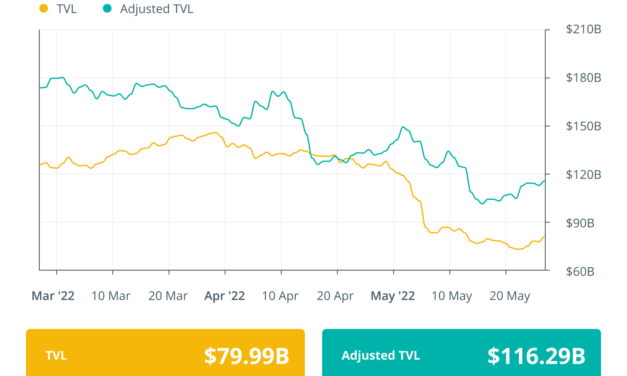
The past week in the decentralized finance (DeFi) ecosystem saw many new developments, including the rebirth of the Terra 2.0 blockchain. Meanwhile, Binance’s incubation platform Binance Labs launched a $500 million fund to support and promote Web3 adoption.Singapore’s central bank partnered with JP Morgan to explore DeFi applications in wholesale funding markets by establishing tokenized bonds. KuCoin launched its very decentralized wallet with DeFi and nonfungible token support.The top-100 DeFi tokens showed signs of a breakout from a month-long bearish trend, with most of the tokens showing overall gains in the past seven days.Maker founder proposes MetaDAOs and synthetic ETH in ‘Endgame Plan’MakerDAO co-founder Rune Christensen has issued a new monumental proposal to push the project into its final form called The Endgame Plan. Across 3,000 words, including 35 detailed infographics, Christensen explained that the current model of governance at Maker creates a deadlock, making it difficult for the protocol to effectively process “complicated real-world financial deals” and compromising its competitiveness with financial institutions.Continue readingBinance Labs’ $500M fund to catalyze crypto, Web3 and blockchain adoptionBinance Labs, the investment arm of crypto giant Binance, launched a $500 million fund in partnership with global investors including DST Global Partners and Breyer Capital to drive innovation across the crypto, Web3 and blockchain landscape.Binance Labs plans to allocate the latest $500 million fund to projects across various stages: incubation, early-stage and late-stage growth.Sharing his take on accelerating the adoption of the crypto ecosystem, Binance CEO Changpeng Zhao noted the importance of a connection between values, people and economies.Continue readingSingapore to explore digital asset tokenization on public chainsThe Monetary Authority of Singapore (MAS) has launched Project Guardian, a blockchain-based digital assets trial that will use tokenization. The project will include regulated financial institutions serving as “trust anchors,” with a pilot involving JP Morgan, DBS Bank and Marketnode, the SGX joint venture for bonds.The Project Guardian initiative, which was announced during the Asia Tech x Singapore Summit on Tuesday, was spearheaded by Deputy Prime Minister and Coordinating Minister for Economic Policies Heng Swee Keat. It will see MAS explore DeFi applications in wholesale funding markets by establishing a liquidity pool of tokenized bonds and deposits to execute borrowing and lending on a public blockchain-based network.Continue readingKuCoin plugs into Web3 with new decentralized walletCryptocurrency trading platform KuCoin has launched a new decentralized wallet platform as interest in Web3 continues to gather steam. KuCoin Wallet is now live for users, with the browser-based platform paving the way for a mobile application, which is still in development.The platform plugs into the KuCoin ecosystem and features cross-blockchain integration. Users will be able to buy, sell, trade and send a variety of cryptocurrencies, including Bitcoin (BTC), Ether (ETH) and Tether (USDT), in addition to other tokens.Continue readingDeFi market overviewAnalytical data reveals that DeFi’s total value locked saw a trend reversal, with the value reaching above $80 billion again. Data from Cointelegraph Markets Pro and TradingView reveals that DeFi’s top 100 tokens by market capitalization registered a week filled with volatile price action but broke out of the bearish trend over the past couple of days.The majority of the DeFi tokens in the top-100 ranking by market cap traded in the green, Aave (AAVE) was the biggest gainer with a 10.42% surge, followed by CurveDAO (CRV) with 10%. Theta Network (THETA) registered an 8% price rise, while Chainlink (LINK) grew 7%. The relaunched Terra 2.0 network, which was listed by major exchanges following its revival on May 28, has seen a volatile price action since then. The Terra (LUNA) price fell by 70% on the first day of its trading and currently trading at one-third of its listing price.Thanks for reading our summary of this week’s most impactful DeFi developments. Join us again next Friday for more stories, insights and education in this dynamically advancing space.

Čítaj viac

Terra 2.0: A crypto project built on the ruins of $40 billion in investors' money

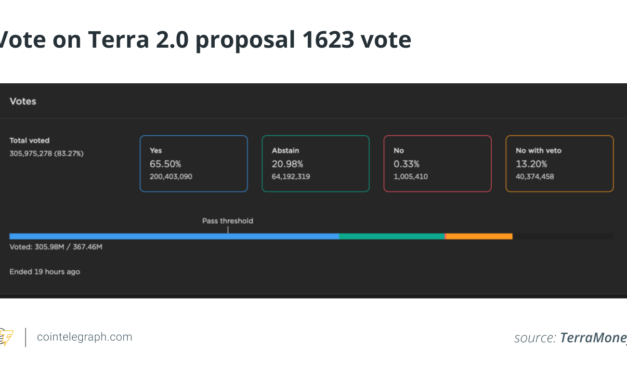
Terra remained the focus of the majority of headlines throughout May for its spiral collapse leading to a loss of over $40 billion in investors’ money. Despite some early resistance from the community and heavy backlash from the likes of Binance CEO Changpeng “CZ” Zhao, Terra co-founder Do Kwon managed to relaunch the collapsed network with a new chain called Terra 2.0 (Phoenix-1).The amended proposal for the relaunch of the network by increasing the genesis liquidity, which introduces a new liquidity profile for pre-attack Luna Classic (LUNC) holders and decreases the distribution to post-attack TerraUSD Classic (USTC) holders, was approved by the community with a 65% vote in favor.The new blockchain went live on May 28 after a hard fork. The new token stays Terra (LUNA) and the old one was rebranded to Luna Classic. With the new network launch, the holders of LUNC, USTC and Anchor Protocol UST (aUST) were eligible to receive the new tokens.Despite industry-wide outrage against Do Kwon — the co-founder and the parent company Terraform Labs are facing lawsuits and investigations in South Korea — major crypto exchanges including Binance, Kucoin, FTX, Bitfinex and several others announced support for the Terra 2.0 chain.Cointelegraph reached out to Binance to inquire about the reasoning behind its listing of the LUNC on its platform, especially when the market is still recovering from the after-effects of the $40 billion collapse. A Binance spokesperson told Cointelegraph:“Binance listed LUNA on the Innovation Zone, which is a dedicated trading zone where users can trade new tokens that may have increased volatility and pose a higher risk than other tokens. Before being able to trade on the Innovation Zone, every user has to visit the web version of the Innovation Zone trading page and complete a questionnaire after reading the Binance Terms of Use.”Binance claimed that the purpose of the Terra 2.0 was to compensate those who had lost a significant amount of funds during the crash of the main network. As a platform, “Binance decided to let people trade the airdropped tokens to realize their assets.”CZ has also said that he is not very optimistic about the future of the Terra 2.0 ecosystem and that the decision to list the new token was based on helping investors recover some of their losses. Speaking to Cointelegraph, Zhao said:“We still need to ensure continuity of people’s access to liquidity. We have to support the revival plan hoping that it may work.”Kraken CEO Jesse Powell also defended listing LUNA, saying it’s the community’s demand. However, he did mention that a listing doesn’t necessarily equal an endorsement for the controversial token.Related: ​​Kraken CEO defends listing LUNA 2.0: ‘Bitcoin traders don’t pay the bills’Customer satisfaction seems to be a common concern for the continued listing fo the asset. Bitrue crypto exchange research analyst Whitney Setiawan told Cointelegraph:“As an exchange, Bitrue’s main priority is customer satisfaction, as it’s only right that we give our Bitruers the freedom to invest in assets of their choice. We are still closely monitoring developments from the Luna Foundation Guard investigation and would take immediate action should the situation get worse.”Terra 2.0 sees heavy volatilityThe launch of the new network was nothing less than a frenzy. To begin with, many investors claimed that they were not appropriately compensated for the new airdrop. The Terra 2.0 team acknowledged the issue and said they are working to resolve the issue soon.Many users also joked about how the new airdrop is a mockery, given that people have lost hundreds of thousands of dollars and received about $50 worth of new tokens in return:Lost $300k in $LUNA Got an airdrop of $59 Thank you do kwon and team— Ash WSB (@ashwsbreal) May 29, 2022The new airdropped token started trading across multiple crypto exchanges on May 28. However, as warned by many, the new token showed very high price volatility on the very first day of the relaunch, dropping by over 70%. Many investors who received the new LUNA started selling as soon as they received it, showing a lack of confidence in the new ecosystem.LUNA was listed for $18.85 on the relaunch day but subsequently plummeted to $5.71 before recovering half of its losses a day before the Binance listing. The token is currently trading at $6.44, according to Cointelegraph data, nearly one-third of its listing price.Justin Hartzman, CEO of crypto trading platform Coinsmart, told Cointelegraph, “Precaution is always better than cure. Why list a project with some very noticeable flaws, noted by many well-known folks on Twitter, and then ignore them? Exchanges must make their listing process more secure and rigid. Too much money and too many lives are at stake here.”A user who reportedly lost a significant amount of money investing in LUNC wrote:“I don’t see any fundamentals here & I see whatever I get as a bonus since I already wrote everything off as a loss & $0. If not that the others are vesting, I’ll sell ‘em all.”Do Kwon has a track record of failed projectsThere is a famous meme going around on Crypto Twitter that compares the fate of two fund managers, who each lost investors billions of dollars. One is Bernie Madoff, the notorious financier who was sentenced to 150 years in prison after running a $60 billion Ponzi scheme — the world’s largest — and Do Kwon, who managed to relaunch a new network just two weeks after losing billions of dollars.In 2009, Bernie Madoff lost investors $60 billion. He was sentenced to 150 years in prison.In 2022, Do Kwon lost investors $60 billion after Luna collapsed to $0. He then created Luna 2.0. pic.twitter.com/CkCC8AKPVR— Fintwit (@fintwit_news) May 29, 2022

The meme highlights the lack of regulatory oversight in the crypto space, where multi-billion-dollar mistakes and scams have little to no checks or balances. Terra’s algorithmic stablecoin collapse was not the first time Kwon has launched a failed experimental project. At the peak of the Terra collapse saga, it was revealed that Do Kwon was also behind another failed stablecoin project called Basis Cash (BAC).Many experts also believe that even though exchanges are liable to listen to the community and list the new token, a future project led by Do Kwon would be hard to accept. Zachary Greene, who runs crypto-investing and finance website the Greenery Financial, told Cointelegraph:“I believe Do Kwon heading operations will hold Terra 2.0 from being accepted and seen as a legitimate reboot. Whether he was responsible for the mismanagement of the reserves or not, he seems to be blamed by the community and crypto space for the disaster that was the collapse of LUNC and USTC. In my opinion, any project with him as the lead, at least for the next few years, will be dogged on by the crypto community.”The Terra and Terra 2.0 story is still unfolding. Whether anything malicious happened with the stablecoin or if it was just a failed experiment, only time will tell. Even in traditional markets, however, we’ve seen time and time again how failed executives hop from one executive position to another. It’s not shocking to see Do Kwon at the helm of Terra 2.0, but it should definitely make investors pause and think twice before investing.What makes the case against Kwon is his reluctance to foresee the problems and act accordingly. Many have been warning against USTC’s peg being backed by volatile assets and Terra using community funds to buy Bitcoin (BTC), but most of it went unnoticed amid tall promises from the project’s management.The Terra co-founder and the majority of the employees at Terraform Labs is currently under investigation on various charges including tax evasion, market manipulation and more. While the community can’t be blamed for approving the relaunch plan since they hoped to recover some of their funds with the airdrop, Kwon’s leading the charge once again could prove problematic for the community in the long term.

Čítaj viac

Získaj BONUS 8 € v Bitcoinoch

nakup bitcoin z karty

Registrácia Binance

Burza Binance

Aktuálne kurzy