Autor Cointelegraph By Prashant Jha

UAE launches the world’s most expensive modern postage stamp

The United Arab Emirates has launched the world’s most expensive modern postage stamp to celebrate the 50th anniversary of the country’s Foundation Day.Emirates Post Group, a government-owned post office launched the first edition of the modern postage stamp with four editions. Each physical stamp in the collection comes with a digital version.[embedded content]The most expensive edition is the “Golden Jubille 2021,” which has a total of 2021 pieces and costs a 2021 AED ($550 USD). Each stamp contains one gram of gold.The second stamp is called the “Spirit of the Union — 1971,” which symbolizes the establishment of the UAE by the founding fathers. Guess what, the third stamp is “Year of the 50th — 2021” while the fourth is the “Projects of the 50th 2071,” representing the futuristic vision of the UAE. The other three collections are relatively cheaper and cost about 250 AED ($68) for each nonfungible token (NFT postage stamp. Related: Crypto.com gets nod in Dubai and FTX launches in JapanCointelegraph reached out to the CEO of the post group Abdullah Al Ashram to understand the idea behind the launch of digital collectible postage stamps. Ashram explained that the decision was made to celebrate the anniversary of the Founding Day and anyone from around the world can buy it.“It’s definitely a part of the broader strategy and blockchain will be the key to many projects at Emirates Post roup.”The launch of the NFT postage stamps made the Emirates Post Group the only p in the Middle East and North Africa to do so. Blockchain has become a key part of UAE’s business strategy over the past year.

Čítaj viac


NFT platforms in China grow 5X in four months despite government warnings

The popularity of nonfungible tokens is on the rise as recent data shows that the number of digital collectible platforms in China has grown to over 500, a 5X increase from February 2022, when the total number of NFT platforms was just over 100.According to a report published by a local Chinese daily, the sharp rise in the number of NFT platforms comes amid the growing hype and popularity of the digital collectibles in the country. Major tech giants including Tencent and Alibaba have shown interest in the nascent space and have filed multiple trademark patents.The rise in interest in digital collectibles in China comes despite several warnings from the local authorities from time to time. The government agencies believe the Chinese NFT market is filled with speculations with a focus on the secondary market that poses inherent risks for investors.NFTs also became a way for people to express themselves digitally during the strict covid-19 induced lockedowns in China. Shanghai residents listed hundreds of NFTs on Opensea in May at the peak of the government lockdown.Due to a lack of regulatory supervision, individuals and businesses continues to engage with digital collectibles but with a cautionary approach to avoid any direct conflict with authorities. Recently, Alibaba launched a new NFT solution and then promptly deleted all mentions of it online.Alibaba-affiliated companies such as Ant Group and Tencent Holdings have moved to avoid any potential regulatory pushback in the past by branding their listed NFTs as “digital collectibles.” They are also offered on private blockchains and are traded/purchased using Chinese fiat currency.Related: China-based regulatory and trade associations target NFTs in latest risk noticeSimilarly, several internet giants and leading social media platforms in China are conflicted over regulatory clarity on NFTs and decided to remove several marketplaces from their platforms fearing a government crackdown. The strict stance of the Beijing government towards the crypto market is well known, however, the ban on decentralized tech has proved futile. The crypto mining ban which once led to a 50% decline in BTC network hash rate couldn’t eclipse the mining industry in the country completely and currently, China is back in the second spot after the United States in terms of hash power contribution to the Bitcoin (BTC) network.

Čítaj viac

Regulations and exchange delistings put future of private cryptocurrencies in doubt

The core principles of cryptocurrency were based on financial independence, decentralization and anonymity. With regulations being the key to mass adoption, however, the privacy aspect of the crypto market seems to be in jeopardy.In 2022, even though no particular country has come up with a universal regulatory outline that governs the whole crypto market, most countries have introduced some form of legislation to govern a few aspects of the crypto market such as trading and financial services. While different countries have set different rules and regulations in accordance with their existing financial laws, a common theme has been the strict implementation of Know Your Customer (KYC) and Anti-Money Laundering (AML) regulations. A majority of crypto exchanges operating with a license obtained from the government body or government-affiliated bodies have discouraged any form of anonymous transactions. Even in countries where there is no particular law on privacy coins, there is a ban on private transactions over a certain threshold.The governments of the United States and the United Kingdom have also demanded regulatory action against the use of coin mixing tools, a service used to obscure the origin of a transaction by mixing it with multiple other transactions. Coinjoin, a popular crypto mixing tool, recently announced they would block illicit transactions amid-regulatory heat. Related: Crypto mixers’ relevance wanes as regulators take aimThe recent delisting of Litecoin (LTC) by several crypto exchanges in South Korea owing to its recent privacy-focused MimbleWimble upgrade is another example of how the privacy aspect of the cryptocurrency is the first to fall on the road to regulatory acceptance. Apart from South Korean exchanges delisting LTC, many global exchanges including Binance and Gate.IO also refused to support transactions using the MimbleWimble upgrade.Most regulations focus on making cryptocurrencies more transparent so that consumers and businesses feel at ease with them. This may be good news for institutional and corporate investors, but it could be a blow for privacy-focused coins.At a time when regulatory oversight is at its highest, there is a special threat to privacy coins such as Monero (XMR) and ZCash (ZEC), which are already banned on several leading exchanges. However, experts believe that despite the ongoing case against privacy coins, people will continue to use them.Privacy tokens are a red flag for many regulators, who often prefer that blockchain transactions are auditable, verifiable and take place on a public chain. Under regulatory scrutiny around the worldPrivacy coins obscure the key identifiers of transactions such as the address of the sender or receiver, a feature that regulators believe could be misused by miscreants. Even some nations like Japan, which was once seen as the leading country in terms of progressive crypto regulations, decided to do away with privacy coins.Japan banned the use of privacy-focused cryptocurrencies in 2018, after which several registered crypto exchanges in the country delisted privacy coins from their platform. Similarly, South Korea has not just banned privacy coins, but any form of private transactions is prohibited on Korean crypto exchanges.In the United States, privacy coins remain legal. However, the Secret Service recommended that Congress regulate privacy-enhanced cryptocurrencies. In August 2020, Australian regulators forced many exchanges to delist privacy coins. The Financial Action Task Force (FATF) has similarly listed the use of privacy coins as a potential red flag for money laundering through virtual assets.Some cryptocurrency exchanges have also stopped offering privacy coins as a result of AML guidance. In January 2021, Bittrex, the eighth largest cryptocurrency exchange by volume, announced that it would drop Monero and Zcash from its platform. Kraken, the fourth largest exchange, delisted Monero in the United Kingdom in November 2021 following guidance from the United Kingdom’s financial markets regulator.Ankit Verma, chief investment officer at crypto investment platform Mudrex, told Cointelegraph:“While some exchanges periodically prohibit trading privacy coins, most of the largest privacy coins are currently available for trading across major exchanges in different jurisdictions. Yet, the institutional skepticism around the adoption of privacy coins persists. It is difficult to predict the usage of privacy coins on a wider scale primarily because of the strict enforcement of KYC and AML guidelines. Our belief is the absence of institutional affinity for privacy coins combined with the fact they are unregulated further dampens the possibility of widespread adoption of privacy coins.”Regulatory pressure has mounted to such a level where even privacy features of particular cryptocurrencies come under scrutiny, even if the crypto itself is not solely focused on privacy. Thus, experts believe the real winners will be those who combine the best of privacy and regulatory compliance. Fennie Wang, CEO at Humanity Cash — a community-based currency development platform — told Cointelegraph:“The winners will be protocols that balance between user privacy and regulatory compliance using a combination of cryptographic techniques and sound policy translation. Decentralized identity primitives alongside zero-knowledge Proofs, homomorphic encryption and multi-party computation will be central to this equation.”Can privacy coins survive the regulatory onslaught?Privacy coins remain a gray area in several countries where they are not banned but governments have discouraged their use.Chris Kline, chief operating officer at Bitcoin IRA — a crypto retirement plan provider — believes privacy coins can co-exist despite the current regulatory downturn. She explained:“Privacy coins can co-exist in a regulatory environment. This coexistence will take place alongside new rules and challenges as the CFTC takes the lead on standards ahead.”Many other experts believe that, while privacy coins will find it hard to get regulatory approval, regulators will become more sophisticated toward privacy coins and bring them under their regulatory purview.Nikos Kostopoulos, a blockchain adviser at European Union IT infrastructure firm NetCompany, told Cointelegraph:“While it is foreseen that privacy coins might not have a position in regulated cryptocurrency exchanges, the privacy coins will not be evaporated from the market cap, but rather will find audiences and venues where privacy is fundamental while regulators will become more sophisticated towards their approach to privacy coins — for example with imposed KYC/AML once there is a transaction with fiat currencies or cryptocurrencies.”Recent: Consensus 2022: Web3, unpacking regulations, and optimism for crypto’s futurePrivacy is still a key concern for many in the crypto community, and this concern is amplified when it comes to sensitive information such as financial transactions. This is why privacy coins are so important for preserving and securing users’ interests. They ensure that sensitive user data is not accessible to just anybody and that transactions are conducted privately. Some privacy coins such as Zcash and Dash (DASH) let users choose whether or not to encrypt their transactions, giving them complete control over their data. Multiple reports have shown that less than 1% of crypto transactions account for criminal activity and cash still remains the currency of convenience for criminals. Given all these positives of privacy coins, declaring a full ban on them might cause a threat to user privacy and, ultimately, the underlying technology.

Čítaj viac

Huobi to permanently shut crypto operations in Thailand

Huobi’s Thailand unit is set to wind down operations by July 1, after its operating license was revoked by the Thai Securities and Exchanges Commission (SEC).The Thai SEC revoked Huobi’s license in May after it failed to comply with the local regulations. The permanent closure orders come nearly eight months after the regulators suspended the exchange’s services in September.The exchange claimed it has tried to fix the regulatory issues but would have to wind down operations owing to SEC orders. “Due to the SEC decision, Huobi Thailand is no longer an authorized digital asset exchange in Thailand. We will be shutting down the platform permanently on July 1, 2022.”The official statement from the Thai SEC revealed that the crypto exchange was first warned about its inadequate system measures in March last year. The crypto exchange was also granted multiple extensions to fix its trading system, customer asset retention system. and information technology systems, but despite multiple extensions and assurances, the crypto exchange failed to comply with SEC regulations.Thus after a thorough review of the series of violations and failure to fix the issues, the regulatory body decided to revoke the digital asset business license permanently on May 17, 2022.“The Finance Minister, on the recommendation of the SEC, considered that Huobi still violated and failed to comply with the SEC’s order conditions. Digital asset business license in the category of a digital token trading center of Huobi is revoked, effective from May 17, 2022.“Related: Thailand SEC bans crypto payments, seeks disclosure of system failure from exchangesThe crypto exchange has put out a notice on its official Thai platform website, reminding customers to withdraw their funds and also left a refund address to contact in case users fail to withdraw their funds before the permanent closure. Huobi didn’t respond to requests for comments from Cointelegraph at press time.Thailand is considered as one of the progressive crypto nations in Asia with tax exemptions for traders and a regulated environment for crypto exchanges. However, many crypto exchnages in the past have faced issues with the regulatory guidelines including Binance.Earlier in March this year, the Thai SEC banned crypto as a means of payment and also announced that crypto exchanges must disclose their system failures to ensure user protection.

Čítaj viac

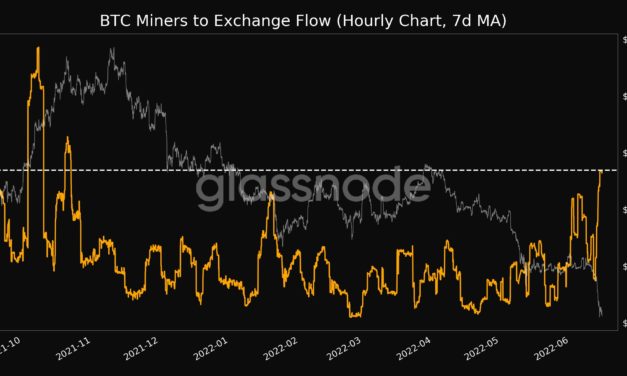
Bitcoin miners' exchange flow reaches 7-month high as BTC price tanks below $21K

Bitcoin’s (BTC) price tanked to a 52-week low of $20,800 earlier on Wednesday, down by over 70% from its all-time high of $68,788. Although the price has since recovered above $21,000, key market indicators point toward bears having a significant hold on the current market.Bitcoin Miners to Exchange flow, a metric that indicates the volume of BTC sent by miners to crypto exchanges, rose to a seven-month high of 9,476. The rise in exchange flows indicates miners are currently selling their BTC in anticipation of the price going down.The actions of the BTC miners often reflect the larger market sentiment as they mostly sell BTC to ensure they don’t incur losses on their mining rewards. The rise in Bitcoin miners selling activity is backed by the significant decline in mining profitability. Related: Biggest Bitcoin exchange inflows since 2018 put potential $20K bottom at riskMining profitability has dropped over 75% from the top, and Bitcoin’s hash price currently sits at $0.0950/TH/day, which is the lowest point since October 2020.Bitcoin Hashprice Index one-year chart. Source: Hashrate IndexThe miner netflow to exchanges has also turned positive. When the miner netflow is positive, it signifies that more coins are being sent to exchanges than are being sent to personal wallets. Such behavior would indicate that miners are bearish on the price and are under pressure to sell.Many BTC mining rigs have turned unprofitable with the price dropping below $21,000 and risk being shut down if the price doesn’t recover. The rest of the crypto market followed BTC in its price action as the overall market cap dipped below $1 trillion.Over the course of the past decade, BTC has seen numerous bull cycles followed by an 80%-90% decline from the top, however, the BTC price has never fallen below the all-time-high of the previous cycle. Currently, BTC is trading very close to its 2017 high of $19,783, and any possible sell-off from here could push it to 2017 territory.

Čítaj viac

Získaj BONUS 8 € v Bitcoinoch

nakup bitcoin z karty

Registrácia Binance

Burza Binance

Aktuálne kurzy