Autor Cointelegraph By Prashant Jha

Bitcoin miners sold their entire May harvest: report

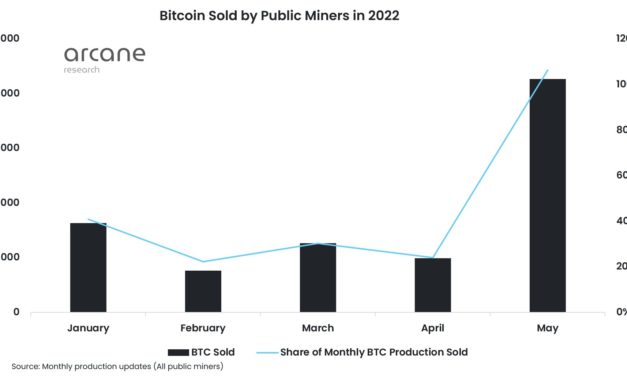
The cryptocurrency market entered a sell-off phase in the first week of June, seeing a market-wide route with the majority of cryptocurrencies falling to a 4-year low.The deteriorating market conditions have also affected Bitcoin (BTC) mining profitability adversely, forcing miners to liquidate their BTC holdings.New data from Arcane research shows that public Bitcoin mining firms sold 100% of their BTC production in May compared to the usual 20-40% earlier.In the first four months of 2022, public BTC mining firms sold 30% of their mined production, which increased 3X folds in May and is expected to rise even further in June.While public BTC miners only make up to 20% of the total network hashrate, their behavior often reflects the sentiments of private miners as well. Miners collectively hold 800,000 BTC, making them one of the biggest whales in the market. Out of these, public miners hold 46,000 BTC and their selling spree could push the price further down.Related: Bitcoin price taps 5-day highs as Shiba Inu leads altcoin gainsThe condition has only worsened in June with the Bitcoin price falling below the 2017 high of $20,000 and recording a new 4-year low of $17,783. Miner’s to exchange flow, a data metric that shows the volume of BTC sent by miners onto exchanges has reached a new high in June, reaching a level not seen since January 2021.As Cointelegraph reported earlier, BTC miner’s to exchange flow ratio has hit a new 7-month high when BTC price tanked below $21,000. The decline in the price of BTC has also made many mining machines unprofitable, forcing miners to leave the crypto market. Bitcoin hash price is a mining metric that represents the miner revenue on a per terahash basis. It is the average value — in fiat currency — of the daily rewards a miner gets per each terahash calculation (USD/TH/s per day), which has fallen to a new 1.5-year low.Bitcoin Hash Ribbon, an indicator that tries to identify periods where BTC miners are in distress and may be capitulating, has crossed, indicating many miners are unplugging their machines due to lack of profitability.At a time of BTC price decline and miner crisis, many believe it is a strong price bottom signal as well, especially when miners start giving up.⚠️Hash Ribbon Indicator: $BTC miners are capitulating⚠️This distress signal occurred 9 days ago, possibly indicating that the price bottom is near!“When miners give up, it is possibly the most powerful Bitcoin buy signal ever” -@caprioleio #BTC #Cryptocrash #cryptocurrency pic.twitter.com/SWJjzUEICB— El Baranito ₿ (@ElBaranito) June 18, 2022BTC slumped below $21,000 again and was trading just above $20,000 at press time, seeing a 6% decline over the past 24 hours.

Čítaj viac


Crypto exchange BlockFi secures $250M credit from FTX amid bear market

BlockFi, a cryptocurrency exchange and digital wallet service provider, has secured a $250 million credit from leading crypto platform FTX.Today @BlockFi signed a term sheet with @FTX_Official to secure a $250M revolving credit facility providing us with access to capital that further bolsters our balance sheet and platform strength.— Zac Prince (@BlockFiZac) June 21, 2022BlockFi has signed a term sheet with FTX crypto exchange to secure a $250 million revolving credit facility. A revolving credit facility is a type of credit that enables you to withdraw money, use it to fund your business, repay it and then withdraw it again when you need it.Zac Prince, the CEO of BlockFi, confirmed the news in a Twitter thread, claiming the new flow of capital would bolster the firm’s balance sheet and strengthen the platform. Prince said:“The proceeds of the credit facility are intended to be contractually subordinated to all client balances across all account types (BIA, BPY & loan collateral) and will be used as needed.”The $250 million credit for BlockFi comes amid market-wide turmoil that has seen many crypto firms cut their workforce and make crucial changes to their operations to remain afloat. Many crypto platforms also had to shut their operations and pause withdrawals owing to the bearish dominance in the market.Related: CeFi interest on the wane: Will BlockFi, Ledn and Nexo rates trend lower?Prince lauded the efforts of his team during the ongoing volatility in the crypto market and stated that the new line of credit will be put toward safeguarding users’ funds across all accounts type.BlockFi was fined $100 million in February this year for its high-yield interest accounts, which were deemed as security products by the United States Securities and Exchange Commission. 

Čítaj viac

Bitcoin S2F model gives false sense of certainty, says Vitalik Buterin

Ethereum co-founder Vitalik Buterin has criticized the controversial Bitcoin (BTC) stock-to-flow (S2F) model, popularized by a pseudonymous Dutch institutional investor known as PlanB.The BTC stock-to-flow model gained a lot of attention during the bull run as it got several price predictions right, however, the model deviated on a number of occasions during the bull market as well.Buterin joined the growing list of critics of the model that aims to predict the price of BTC:Stock-to-flow is really not looking good now.I know it’s impolite to gloat and all that, but I think financial models that give people a false sense of certainty and predestination that number-will-go-up are harmful and deserve all the mockery they get. https://t.co/hOzHjVb1oq pic.twitter.com/glMKQDfSbU— vitalik.eth (@VitalikButerin) June 21, 2022The S2F model quantifies an asset’s price based on its scarcity and was primarily used for popular metals such as gold and silver. PlanB’s popularized BTC S2F model suggests that BTC’s price will continue a steady and impressive path upward with approximately tenfold returns every four years.The critical problem with the S2F model that many critics have pointed out is the one-sided estimation, where it only takes into account the supply side of BTC while assuming that demand will continue to grow. Related: Vitalik Buterin shares his thoughts on non-financial use-cases for blockchainWhile BTC demand has shown significant growth, other factors such as inflation aided by the Fed money printing spree have significantly affected the buying power of consumers. Thus, the S2F model doesn’t take into account several macroeconomic factors that mostly affect the market sentiments.Correct, the model only accounts for scarcity/s2f-ratio, that is the only model input. All the rest, demand, macro, crypto, covid, war etc, causes deviation. The model is VERY rough. Also, current extreme macro backdrop causes all metrics (rsi, 200wma etc) to show extreme values.— PlanB (@100trillionUSD) June 20, 2022

Plan B responded to Buterin’s criticism claiming “people are looking for scapegoats for their failed projects or wrong investment decisions.”After a crash aome people are looking for scapegoats for their failed projects or wrong investment decisions. Not only newbies but als “leaders” fall victim to blaming others and playing the victim. Remember those who blame others and those who stand strong after a crash. https://t.co/4nJdHq84pm— PlanB (@100trillionUSD) June 21, 2022

According to the S2F model, BTC was slated to touch the $100,000 mark by the end of December 2021. While he had admitted in the past that there would be certain flaws driven by external factors, the popularity of the model during peak bull run pushed down most criticism.We will know by end 2021: S2F predicts btc has to have been over $50k (even $100k if you use the new model), where Dave’s model is below $30k. Also Dave predicts next top at $81k, where S2F points at a (3x) multiple of $50-100k.https://t.co/yQk6GZvTdb— PlanB (@100trillionUSD) September 3, 2019

The debate around flawed financial models comes at a time when BTC has recorded a new four-year low of $17,748. The price of the top cryptocurrency was trading at $21,321 at the time of publishing, registering a 4% rise over the past 24 hours.

Čítaj viac

Bancor pauses impairment loss protection citing ‘hostile’ market conditions

Bancor, a decentralized finance (DeFi) protocol often credited as the pioneer of the DeFi space, paused its impairment loss protection (ILP) function on Sunday, citing “hostile” market conditions.In a blog post on Monday, the DeFi protocol noted that the ILP pause is a temporary measure to protect the protocol and the users. The blog post read:“The temporary measure to pause IL protection should give the protocol some room to breathe and recover. While we wait for markets to stabilize, we are working to get IL protection reactivated as soon as possible.”When a user gives liquidity to a liquidity pool, the ratio of their deposited assets changes at a later moment, potentially leaving investors with more of the lower value token, this is known as impermanent loss. Bancor’s protocol-owned liquidity was used to fund ILP: the protocol staked its native token BNT in pools and used the collected fees to reimburse users for any temporary loss. The process effectively burned excess BNT when generated trading fees are more than the cost of impermanent loss on a given stake.The ILP function was first introduced in 2020 and was upgraded with more refinements with the launch of Bancor 3 in the second week of May this year. However, the recent market turmoil leading to a 70% decline from the top for most of the cryptocurrencies had an adverse effect on the DeFi market as well, leading to several critical changes made by DeFi protocols.While Bancor hopes the pause in the IRL would help the protocol take a breather, many in the crypto community were unhappy with the decision. Cobie, host of crypto podcast Uponly Tv, criticized Bancor for pausing the IRL when liquidity providers need it the most.what is the point of impermanent loss protection if it just disappears when u most need it LOL pic.twitter.com/GAJyhr6Tib— Cobie (@cobie) June 19, 2022Hasu, a research collaborator at Web3 investment-focused firm Paradigm, dug a little deeper into the impairment loss protection claims made by Bancor and how it could lead to another “spiral collapse.” Related: Sweeping layoffs, hiring and firing as crypto prices take a massive downturnHasu questioned the strategy behind the ILP compensations and claimed Bancor’s shell game of IL hiding is collapsing.  He added:“They print new BNT to compensate underwater LPs and call it ‘IL protection’. The cost is transferred to BNT holders via inflation, which causes further IL to all other BNT pairs, and leads to further inflation. A death spiral.”You can see it clearly in the price performance of these DEX tokens:UNI -20% SUSHI -20%BNT -61%Now Bancor is pulling the plug to stop the bleeding. Didn’t even take three weeks for my prediction to play out. More reading: https://t.co/WZGiTV4Pa3— Hasu⚡️ (@hasufl) June 20, 2022

He went on to add that the failure of the ILP program is visible from the price action of their native token BNT over the past two weeks, where decentralized exchange (DEX) tokens such as SushiSwap (Sushi) and Uniswap (Uni) had dropped by nearly 20% while BNT has registered a 66% decline in the same time frame owing to high inflation caused by ILP compensations.

Čítaj viac

Finance Redefined: Three Arrow Capital and Celsius fall brings a tsunami of sell-off in DeFi

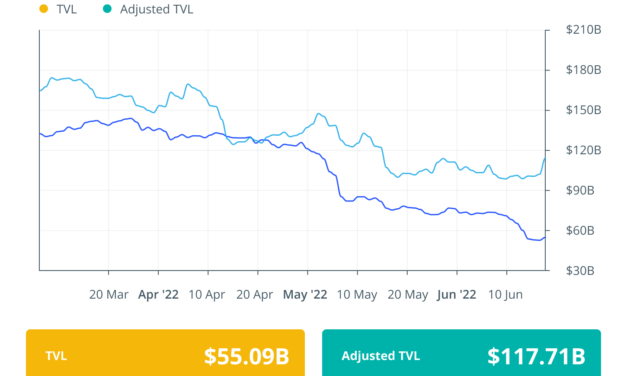
This past week, the decentralized finance (DeFi) ecosystem faced the brunt of the bears fueled by liquidation rumors of Three Arrow Capital (3AC) and Celsius liquidations. MakerDAO decided to cut off Aave (AAVE) from its direct deposit module as a safeguard in light of the possibility that Celsius folds and crashes the price of staked Ether (stETH).Trading firm 8 Blocks Capital called out to platforms holding funds owned by 3AC to freeze the assets as rumors of 3AC’s insolvency stay afloat. Micheal Saylor believes Bitcoin (BTC) and the Lightning Network can solve many of the DeFi ecosystem problems.The top 100 DeFi tokens were hit hard by bears, with the majority of tokens registering multi-month low along with double-digit losses over the past week.Crypto crash wreaking havoc on DeFi protocols, CEXsA heavy cryptocurrency sell-off in the markets on Monday caused significant ripples for projects and entities alike. DeFi ending protocol Aave’s utilization rates have fallen across nearly all stablecoin borrowings. Most notably, borrowings for Binance USD (BUSD) now stand at a mere 30% compared to a high of 80% back in May. The utilization rate is the ratio of borrowed to deposited funds. Since borrowers are required to post digital asset collateral before taking out a loan on Aave, users are likely withdrawing en mass in light of Monda’s sell-off to prevent liquidation. Data from DefiLlama indicates that Aave’s total value locked has fallen from $33.51 billion last October to $8.11 billion.Continue readingSu Zhu’s cryptic statement as rumors swirl of 3AC liquidations and insolvencySu Zhu, the co-founder of Singapore-based crypto venture capital firm Three Arrows Capital (3AC), has put out a cryptic statement on Twitter in response to swirling rumors that the company is battling against insolvency.Online chatter about 3AC being unable to meet a margin call began after 3AC started moving assets around this week to top up funds on decentralized finance platforms such as Aave to avoid potential liquidations amid the tanking price of Ether (ETH) this week. There are unconfirmed reports that 3AC faced liquidations totaling hundreds of millions from multiple positions.Continue reading Maker cuts off Aave’s DAI supply as fallout from Celsius continuesMakerDAO has voted to cut off lending platform Aave’s ability to generate Dai (DAI) for its lending pool without collateral as the risks of Celsius’s liquidity crisis loom large over the entire crypto ecosystem.The decentralized autonomous organization (DAO) made the decision as a means of mitigating the Maker protocol’s exposure to the beleaguered staking and lending platform in case Celsius goes belly up and implodes the stETH peg as well.Continue readingLiquidity provider asks platforms to freeze 3AC funds to recover assets after litigationDanny Yuan, CEO of trading firm 8 Blocks Capital, called out to platforms that are holding funds owned by 3AC to freeze the assets as rumors of 3AC’s insolvency stay afloat. In a Twitter thread, Yuan explained their company’s involvement with 3AC, noting that they are paying the company to use the trading accounts that they own. The agreement included the ability to withdraw funds at any given time.Continue readingBitcoin and Lightning Network can save DeFi from adversity — MicroStrategy CEOIn light of the recent fragility in the DeFi sector, Bitcoin maximalist and MicroStrategy CEO Michael Saylor feels that Bitcoin and the Lightning network can come to the rescue of the DeFi market.With two enormous protocols, Terra and Celsius, facing acute difficulties within a month of each other, the DeFi sector is going through a tough time. And, in a recent tweet, Saylor suggested that Bitcoin and Lightning could help stabilize the industry.Continue readingDeFi market overviewAnalytical data reveals that DeFi’s total value locked registered another week of outflow over the past week, with the value dipping to $55 billion. Data from Cointelegraph Markets Pro and TradingView reveals that DeFi’s top-100 tokens by market capitalization registered a week filled with volatile price action with bears dominating the market trends.The majority of the DeFi tokens in the top 100 ranking by market cap bled in double digits. Theta network showed the biggest resistance falling by 12% over the past week, followed by Basic Attention Token (BAT), which fell by 14%. The remaining the top-100 DeFi tokens fell by more than 20%, with some registering losses as high as 40% over the last seven days.Thanks for reading our summary of this week’s most impactful DeFi developments. Join us again next Friday for more stories, insights and education in this dynamically advancing space.

Čítaj viac

Získaj BONUS 8 € v Bitcoinoch

nakup bitcoin z karty

Registrácia Binance

Burza Binance

Aktuálne kurzy