Autor Cointelegraph By Prashant Jha

Binance to assist Cambodia in developing crypto regulations

Crypto exchange Binance has signed a memorandum of understanding (MoU) with the Securities and Exchange Regulator of Cambodia (SERC), according to a June 30 announcement.Binance and SERC will work together to develop crypto regulations in the country. SERC is looking to leverage Binance’s technical expertise and experience in the field to develop its own legal framework for the digital asset market.Cryptocurrencies are not regulated in Cambodia and any unlicensed activity involving these digital assets is highly prohibited. The partnership could prove pivotal for the South Asian nation where any crypto-linked activity is deemed illegal since 2018.Asia has become a crypto hotspot over the years with several nations in the region adopting a pro-crypto approach. The likes of Thailand, Singapore, Malaysia, Philippines have come up with progressive regulations to promote the use of crypto assets in their respective countries.Binance has paid special attention to good regulatory relations, especially after its 2021 debacle that saw nearly half a dozen countries issuing compliance warning against the crypto exchange. The leading crypto exchange has mended its relations since then and has forged critical partnerships in Asia over the past year in countries such as Thailand, Malaysia and Singapore.The crypto exchange has also made a name for itself when it comes to offering technical expertise to governments about crypto and helping them with regulating the nascent sector, The exchange had signed a $15 million investment agreement in Bermuda to teach and educate the community about crypto.Related: Binance U.S. makes BTC trading fee-free as competitors feel the heatBinance’s regulatory in-roads in the emerging markets have caught the attention of many including the likes of Alex Gladstein, chief strategy officer at Human Rights Foundation. Gladstein lauded Binance’s recent expansion in emerging markets such as Asia, Africa, and the Middle East and said:“While Western cryptocurrency companies are buying Superbowl ads and sports stadium rights, Binance is ruthlessly and custodial taking over emerging markets in Asia, Africa, the Middle East, and Latin America. They are winning.”Earlier in May Binance signed a similar MoU with the government of Kazakhstan, to help them with crypto adoption and regulations. Similarly, it had signed an MoU with the Dubai World Trade Centre Authority (DWTCA) in December last year and later bagged a license to operate in the country as well.

Čítaj viac

Crypto market crash wipes out millions from North Korea's stolen crypto funds

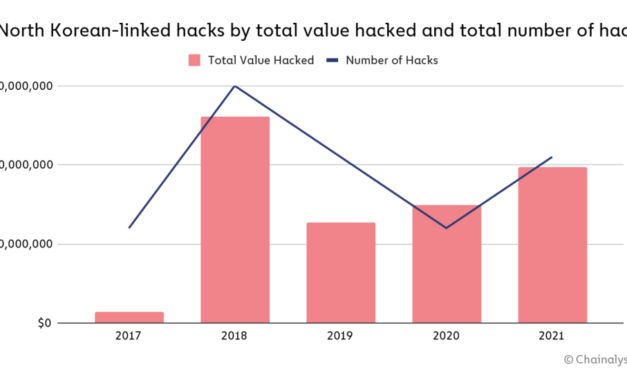
North Korea leads the world in crypto crime, with over 15 documented instances of cyber theft amounting to $1.59 billion in stolen funds. However, the recent crypto market turmoil has wiped out millions of dollars from the country’s stolen crypto portfolio.The crypto market rundown that started in May wiped out hundreds of billions of dollars from the crypto industry, where most of the crypto assets fell by over 70% from their top. As a result majority of stolen crypto funds by the Democratic People’s Republic of Korea (DPRK) hackers have registered a significant plunge as well.A report from Coinclub.com indicates that North Korea has deployed 7,000 full-time hackers to raise funds through cyberattacks, ransomware and crypto protocol hacks. The $600 million Ronin bridge hack in April was also linked to the country’s infamous ransomware group, Lazarus. The value of the stolen Ether (ETH) has plummeted to $230 million in the current market, a decline of over 60%.According to a Chainalysis report, the Democratic People’s Republic of Korea (DPRK) held about $170 million in stolen unlaundered cryptocurrency from 49 hacks over four years. The value of the stolen funds has now declined to $63 million.Related: Crypto mixer sanctioned by US Treasury for role in Axie Infinity hackThe Chainalysis report had estimated that DPRK held some crypto funds as old as 2016, which indicated these hackers were not very quick in laundering the stolen funds. This could be partly attributed to the transparency of blockchain technology where as soon as a hack occurs, the protocol often coordinates with crypto exchanges and stablecoin issuers to freeze the stolen funds, and even the small amount of movement are often tracked down.Another crypto analytic report by CNAS highlighted that stealing is only the first part, finding brokers to exchange it for fiat or Bitcoin (BTC) often leaves Pyongyang with only one-third of the value of the actual stolen funds.North Korea is facing multiple sanctions from around the globe, making it difficult to trade or transact in the international market, and experts believe it has pushed them to look at crypto as an alternative. However, crypto forms only a tiny chunk of funds for DPRK with the majority of its capital coming from coal smuggling and shady deals with China, reported Reuters.With the sheer size of the stolen funds in the recent past added to the growth of analytic tools and government actions, DPRK has found it increasingly difficult to launder their stolen crypto funds.

Čítaj viac

ECB exclusive: Crypto payments 'not currently cost effective,' Amex exec says

Gonzalo Pérez del Arco, the director of government affairs in South Europe for card payment giant American Express, believes that making payments with crypto is not cost-effective at present.Pérez’s comments came during an exclusive chat with Cointelegraph editor Aaron Wood at European Blockchain Convention 2022, where he discussed American Express’ current crypto-related plans and future prospects.Pérez explained that several factors make crypto payments non-feasible in the current market, such as high transaction costs and the willingness of merchants to accept digital payments. However, he noted that crypto payments could become a reality in the future, and his firm is bullish on working in that direction.He added that the firm is interested in crypto payments “Because it’s the right direction that competitors in the market are taking.”Pérez noted that American Express has been betting big on crypto with investments and developments of several crypto use cases through its venture capital arm Amex Ventures. He cited the example of the recently launched crypto reward card in association with Abra, a crypto-focused financial firm.Related: Amex CEO hints at exploring ways to allow credit card holders to redeem points for cryptoHe said that the decision to launch a crypto reward card program instead of delving directly into crypto payments was because of the low risks involved. He cited the upcoming MICA regulations in Europe that prohibit the tokenization of rewards as one of the key reasons that influenced their decision:“If you see the MICA regulation that is about to be published in Europe where tokenization of rewards logic program is something that is already contemplated. Membership rewards are something relatively easy to do and low risk compared to other activities in payments that, involve the crypto.”While American Express is taking cautionary steps in its crypto-approach, other card payment giants such as Mastercard and Visa have been on an expansion spree into nonfungible tokens (NFTs) and Web3. Visa has been actively working on integrating crypto payment with its network, allowing millions of customers to directly spend their crypto at thousands of merchants across the world. The payment processor giant reported $1 billion in crypto spending in the first quarter of 2021. The firm recently launched an immersion program to help creators build their business with NFTs.Mastercard on the other hand has moved beyond crypto payments and recently announced a direct NFT purchase option for 2.9 billion cardholders.

Čítaj viac

Metaverse can’t be built on the corporate business model, says EY innovation lead

Magnus Jones, the innovation lead at big four accounting firm Ernst & Young (EY), believes that the Metaverse would be led by the younger generation and cannot be built on the same principles of the corporate business model.Jones’s comments came during an exclusive interview with Cointelegraph managing editor Alex Cohen at the European Blockchain Convention (EBC) 2022.The EY innovation lead shed light on the company’s investment strategy, explaining why a significant chunk has gone towards younger generation firms and startups. He said that many of these young firms have proven themselves with valuable products and revenues of millions of dollars.He said that the younger generation is currently driving the industry and explained:“We clearly are focusing heavily on understanding sort of the younger generations and also down to the fact that younger generations are building several key elements of this landscape.”Related: Metaverse fractional ownership to form similarly to property loans: Casper execTalking about innovation, Jones said that the age-old corporate business model won’t succeed in the Metaverse, and corporates and tech giants have to think beyond the existing mindset. “It’s not that easy necessarily to apply a traditional corporate mindset business model structure in this one.”He went on to talk about the nonfungible token (NFT) frenzy i and whether it’s necessary for established brands to experiment with nascent tech. Jones said that established brands didn’t focus on community building and just jumped on the trend, which sort of backfired. He explained:“GAP, for example, the UK clothing company suddenly launched an NFT collection out of the blue by having some golden sweaters, while they hadn’t spent any time on building any community, as far as what I notice from Twitter, people were thinking, is this just a fraud?”Jones said that younger generations would set the trend in the Metaverse and older generations have to sit back and take note.

Čítaj viac

Less than 1% of all holders have 90% of the voting power in DAOs: report

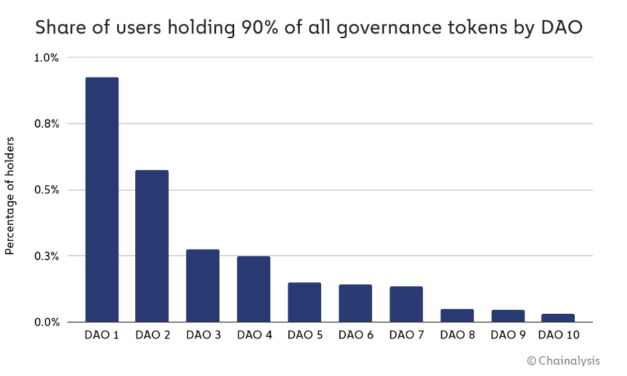
Decentralized autonomous organizations (DAOs) have become a rage in the ever-expanding crypto ecosystem and are often seen as the future of decentralized corporate governance. DAOs are organizations without a centralized hierarchy, intended to work in a bottom-up manner, where the community collectively owns and contributes to an organization’s decision-making process. However, recent research data suggests that these DAOs are not as decentralized as it was intended to be.A recent report from Chainalysis analyzed the workings of ten major DAO projects and found that on average, less than 1% of all holders have 90% of the voting power. The finding highlights a high concentration of decision-making power in the hands of a selected few, an issue DAOs were created to resolve.This concentration of decision-making power was evident with the Solana-based lending DAO Solend. Solend team tried to take over a whale’s account and execute the liquidation themselves via over-the-counter (OTC) desks to avoid cascading liquidations across the DEX books.This is pretty wild. The Solend team wants to take over the whale’s account and execute the liquidation themselves. The whale’s position is so degenerate that if SOL drops too low it will create cascading liquidations across the DEX books (and potentially bad debt). “DeFi” https://t.co/TEVKz18NSm pic.twitter.com/2A3t2fOhnl— FatMan (@FatManTerra) June 19, 2022The proposal to take over was passed with 1.1 million “yes” votes to 30,000 “no” votes, however out of these total “yes” votes 1 million came from a single user holding large amounts of governance tokens. The vote was later overturned after a heavy lash back.Related: How a DAO for a bank or financial institution will look likeThe Chainalysis report highlighted that although all governance token holders have voting rights, the right to make a new proposal for the community and to pass it is not very easy for everyone, given the number of tokens required to do so.The report estimated that between 1 in 1,000 and 1 in 10,000 governance token holders have enough tokens to create a proposal. When it comes to passing a proposal only between 1 in 10,000 and 1 in 30,000 holders have enough tokens to do so.Decentralized Finance (DeFi) ecosystem accounts for 83% of all DAO treasury value held and 33% of all of the DAOs by count. Apart from DeFi, venture capital, infrastructure, and NFTs are other ecosystems that have seen a rise in number of DAOs.

Čítaj viac

Získaj BONUS 8 € v Bitcoinoch

nakup bitcoin z karty

Registrácia Binance

Burza Binance

Aktuálne kurzy