Autor Cointelegraph By Prashant Jha

India needs global collaboration to decide on crypto's future, says finance minister

Indian finance minister Nirmala Sitharaman has called for global collaboration on cryptocurrencies, assessing their pros and cons to form a common standard and taxonomy.Addressing a question on cryptocurrency in the Lok Sabha, the lower house of the Indian parliament, Sitharaman said that the Indian central bank had advised the government to prohibit the use of cryptocurrencies as it poses a risk to financial stability. However, the government is looking for a global approach. She said:”Any legislation for regulation or banning can be effective only after significant international collaboration on evaluation of the risks and benefits and evolution of common taxonomy and standards.”She also reiterated the Indian central bank’s stance on crypto’s value is based on speculation. She added that “the value of fiat currencies is anchored by monetary policy and their status as legal tender. However, the value of cryptocurrencies rests solely on the speculations and expectations of high returns that are not well anchored.”Reserve Bank of India (RBI), the Indian central bank, has maintained an anti-crypto stance since 2013, issuing multiple advisories against investing in digital assets and even prohibiting banks from offering services to crypto firms in 2018. The banking ban was eventually overturned after a supreme court ruling in 2020.While the Indian government is yet to decide whether to move ahead with a ban or regulate the nascent crypto sector, the government was relatively quick to propose and implement two crypto tax laws that have wreaked havoc on the budding crypto industry.Related: The regulatory implications of India’s crypto transactions taxDuring the January parliamentary session, the finance minister announced a 30% tax on unrealized gains and a 1% tax deduction at the source (TDS). The laws were heavily inspired by the country’s gambling and betting laws, resulting in an instant decline in trading volume across exchanges just weeks after the new 30% tax came into effect.The trading volumes and trader interests plunged further after 1% TDS came into effect on July 1. Many thriving crypto unicorns hopeful of a positive regulatory approach have started shifting their bases to crypto-friendly legislation, such as Dubai and Singapore.

Čítaj viac
Finance Redefined: DeFi market fell off the cliff in Q2, but there’s hope

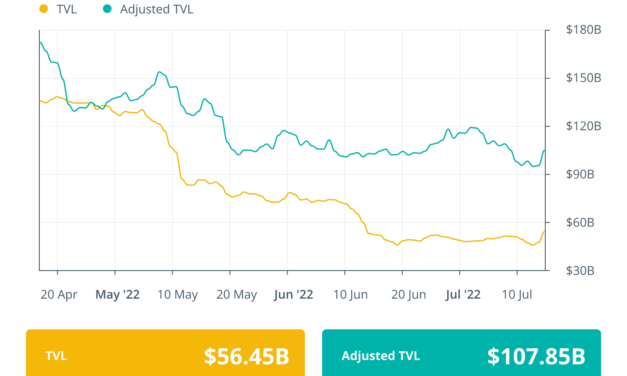
Welcome to Finance Redefined, your weekly dose of key decentralized finance (DeFi) insights, a newsletter crafted to bring you some of the major developments over the last week.This past week, the DeFi ecosystem saw several new developments despite a bearish phase brought on by the lending crisis in the crypto market. Another crypto lender, Celsius, with high stakes in DeFi protocols, filed for bankruptcy. The overall DeFi market fell to new lows in the second quarter. However, a new report indicates users haven’t given up hope.BNB Chain launched a new decentralized application (DApp) platform with an alarm feature. Vermont state regulator opened an investigation into troubled crypto lender Celsius, deeming it deeply insolvent. A DeFi researcher has predicted that Ethereum proof-of-stake (PoS) can help Ether (ETH) overtake Bitcoin (BTC).The DeFi tokens saw a new flow of bullish momentum over the past couple of days owing to a market-wide green momentum after the inflation data release.DeFi market fell off cliff in Q2, but users haven’t given up hope: ReportDespite the DeFi market suffering a 74.6% market cap decline in Q2, user activity has remained relatively resilient, says CoinGecko. In a report published by the crypto data aggregator on Wednesday, CoinGecko reported that the overall DeFi market cap fell from $142 million to $36 million over the second quarter, due mainly to the collapse of Terra and its stablecoin TerraUSD Classic (USTC) in May.Continue readingBNB Chain launches DApp platform with ‘Red Alarm’ to warn users about scamsBNB Chain has launched a new platform, DappBay, to discover new Web3 projects. DappBay is equipped with a novel feature called Red Alarm, which assesses project risk levels in real-time and alerts users of potentially risky DApps, according to a Thursday announcement.Red Alarm is a contract risk scanning tool offered by DappBay that helps users identify high-risk projects to protect their investments from rug pulls and scams. Users can check if a contract address has logical flaws or fraud risks by entering it into the Red Alarm feature.Continue readingVermont becomes the sixth US state to launch investigation against CelsiusVermont’s Department of Financial Regulation (DFR) issued a warning against troubled crypto lending firm Celsius on Tuesday, reminding users that the crypto lending firm is not licensed to offer its services in the state.The DFR alleged that Celsius is “deeply insolvent” and doesn’t possess “assets and liquidity” to fulfill its obligations toward the customers. The state regulator accused the crypto lender of mismanaging customers’ funds by allocating them toward risky and illiquid investments.Continue readingPoS gives Ethereum the economic structure to overtake Bitcoin, says DeFi researcherAs Ethereum shifts into PoS, a DeFi researcher has argued that the platform can overtake Bitcoin’s throne as the top dog in crypto. In a Twitter thread, researcher Vivek Raman highlighted that the upcoming Ethereum Merge could create a better economic structure for the smart contract platform. According to Raman, the shift into PoS lowers Ether inflation, gives better security and positions the crypto as a digital bond.Continue readingDeFi market overviewAnalytical data reveals that DeFi’s total value locked registered a minor dip from the past week, falling to a value of $56.45 billion. Data from Cointelegraph Markets Pro and TradingView shows that DeFi’s top-100 tokens by market capitalization had a mixed week, with several tokens trading in red while a few others registered even double-digit gains.Aave (AAVE) was the biggest gainer among the top 100 with a 30% rise over the past week, followed by Uniswap (UNI) with a 23% surge. Compound (COMP) registered a 19% surge over the past week, while Curve DAO Token (CRV) also saw a 15% rise in price over the past seven days.Thanks for reading our summary of this week’s most impactful DeFi developments. Join us next Friday for more stories, insights and education in this dynamically advancing space.

Čítaj viac

Crypto payments gain ground thanks to centralized payment processors

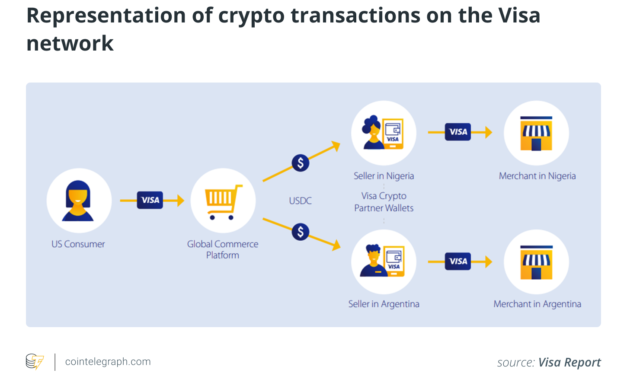
The cryptocurrency market has grown beyond many people’s expectations over the past decade. The nascent industry has managed to change mainstream perception quite significantly, especially in 2021, which saw many traditional financial institutions adopt crypto in one form or another.Some of the biggest public companies such as MicroStrategy started using Bitcoin (BTC) as a treasury hedge, while the likes of PayPal, Mastercard and Visa paved the way for the common public to use crypto as a form of payment. While many experts are still skeptical about the use of crypto as a form of payment, given its price volatility, recent market trends and data indicate that crypto is increasingly being used to buy daily-use items.A recent report from fintech payment infrastructure provider checkout.com that surveyed 33,000 business leaders revealed a rise in consumer interest in paying in crypto. The report indicated that 40% of 18–35-year-old consumers want and plan to use cryptocurrencies to pay for goods or services within the next year. That’s up from less than 30% last year.The rise of digital payments aided by the COVID-19 pandemic has only made it easier for crypto to become more mainstream. People are more familiar with QR code payments today, which makes it easier for mainstream payment processors such as Visa and Mastercard to introduce crypto payments on its network without having to build a separate infrastructure.Miles Paschini, CEO at fintech bank FV Bank, told Cointelegraph:“The use of cryptocurrencies as a form of payment has progressed in the past year but primarily into the area of settlement layers, advancements have been made with stablecoins, in particular with USDC and to some extent XRP. The developments we have seen in the settlement layer are not exactly visible to the retail customer. I think we will see more of this type of settlement layer integration in the future as stable similarly similar become more efficient and programmable than traditional settlement systems.”The growth of crypto payment networks and public interestAccording to a report from Visa, its network processed over $1 billion in crypto transactions in the first quarter of 2021, which increased to $2.5 billion by the first quarter of 2022. The report highlighted that crypto payments have become increasingly popular with the rise in the use of stablecoin payments.Mastercard partnered with USD Coin (USDC) stablecoin issuer Circle to facilitate crypto-based payment options for millions of users.With the rise in crypto-linked debit cards, Nexo has come up with its crypto collateralized credit card in association with Mastercard. Nexo has issued 55,000 cards since its launch in April that could be used at around 92 million merchants worldwide, allowing investors to spend up to 90% of the fiat value of their crypto.Antoni Trenchev, co-founder and managing partner of Nexo, told Cointelegraph about the rise of crypto as a form of payment, claiming crypto-linked cards are making it easier for retail customers to spend their digital assets just like fiat. He explained:“The concept of HODLing is well understood in crypto, but with crypto-backed cards, it is now possible to hodl your digital assets while also using these to spend on day-to-day transactions. This, in turn, has carved a pathway whereby crypto can be both an investment and a form of payment, increasing its utility as an asset class.”He added, “Crypto cards offer the possibility of spending your crypto directly, which automatically converts your crypto from a linked wallet into the fiat currency needed to pay.”Many analysts also like to point to the rise in stablecoin adoption as a key metric of crypto payments. Brandon Rochon, a data scientist at Web3 infrastructure provider Covalent, explained how the stablecoin USDC has managed to see over a 10% rise in adoption year-on-year (YoY) despite a downturn in the market. He explained:“Looking at USDC, its supply grew from $373 million in July 2019 up to $1.0 billion in July 2020, representing a ~168% increase in the one-year time frame. This same 168% growth was achieved in the first three months by October 2020. Over the next year, the supply grew at a rate of 2500% to ~$25 billion, at which point Mastercard stepped in and launched its simplified payments card offering with Circle in July 2021. Since this point, stablecoin supply has continued to grow at a pace over 120% YoY despite the market downturns in the -50%+ range, signifying strong utility.”Omid Malekan, adjunct professor at Columbia Business School — where he teaches crypto — believes that stablecoin is a fair metric to measure the payment use of crypto at present. He told Cointelegraph:“One way to measure crypto use in payments is to track stablecoin volumes since those serve a much more limited function than pure crypto coins. On-chain volume for payments has been very strong lately. Most of that is to accommodate speculative activity (people buying and selling crypto, borrowing in DeFi, etc) but payment is a payment, and a substantial part of the traditional system’s payments volume is also related to capital market activity.”Crypto payments beneficial for merchants and consumers alikeWhile the infrastructure side of crypto payment has seen tremendous growth, it would not be possible without the willingness of merchants to accept it. Several surveys and reports have highlighted that merchants have benefited equally from the crypto payment integration despite technical barriers and complexities.Another report from PYMNTS highlighted that more than 75% of the customers in the United States are looking forward to using crypto as a form of payment in 2022. While 85% of businesses with over $1 billion in annual sales are integrating crypto payments to gain more customers, many other merchants have said their overseas transactions increased and they found a new customer base after crypto payment integration.The key reasons listed by merchants for accepting cryptocurrencies as payments include significant cuts in transaction costs, elimination of middlemen and on-boarding of new customer bases from around the world.Stablecoins form a significant chunk of expenditure by consumers. However, many analysts also point toward significant growth of layer-2 networks over the past year. For example, the Lightning Network, the secondary layer on top of Bitcoin, has seen tremendous growth over the past year. Bitcoin Lightning Network capacity grew past 4,000 BTC, first breaking the 1,000 BTC barrier in August 2020 and the 2,000 BTC barrier in July 2021. The capacity has doubled in the space of 18 months.Andry Lebedev, co-founder of Web3 payment infrastructure firm Swipelux, told Cointelegraph:“At the moment, there is a rerolling of transactions from L1 to L2 thanks to the introduction of zk-rollups and optimistic rollups. Consequently, we see significant growth in transactions for the protocols and stabilization of transactions for Ether and Bitcoin at 125,000 and 240,000 transactions per day, respectively.”He added that there has been an “upward trend in the structural change of cryptocurrency, which instead of transfer of value becomes a form of payment in the emerging Web3.”Crypto payment’s popularity depends on the overall adoption of cryptocurrencies; the more people that are aware of and understand the nascent financial asset class, the more people will adopt it, as proven by several studies mentioned above. The volatility aspect of cryptocurrencies could be further dialed down by converting them into stablecoins.

Čítaj viac

Ethereum devs confirm the perpetual date for The Merge

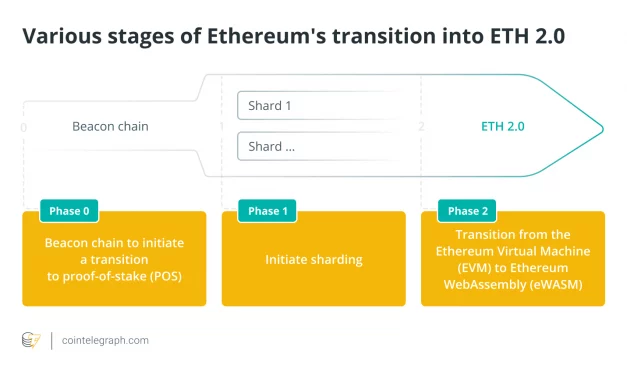
Ethereum network is nearing the merger phase of its crucial transition from proof-of-work (PoW) mining consensus to proof-of-stake (PoS). Ethereum (ETH) devs offered a perpetual merger date during a conference call on Thursday.The conference call saw core Ethereum developer Tim Beiko, who runs core protocol meetings, propose September 19 as the tentative target date for the merger. The proposed target date didn’t face any objection from the core developers.[embedded content]Later, Ethereum developer superphiz.eth tweeted about the roadmap to the merger and also cleared that the proposed target date should be seen as a roadmap rather than a hard deadline.This merge timeline isn’t final, but it’s extremely exciting to see it coming together. Please regard this as a planning timeline and look out for official announcements!https://t.co/ttutBceZ21 pic.twitter.com/MY8VFOv0SI— superphiz.eth (@superphiz) July 14, 2022Ethereum’s transition journey to PoS-based ETH 2.0 began on December 1, 2020, with the launch of Beacon Chain, initiating Phase 0 of the transition. Phase 1 of the program was scheduled to launch in mid-2021 but got delayed to the first quarter of 2022 owing to unfinished work and complexities involved in the code auditing. Earlier in June this year, Sepolia testnet Beacon Chain went live, setting the stage for its Merge dress rehearsal to give Ethereum network developers valuable technical insights. The Sepolia was eventually merged with the network on 7th July. The final trial of the Merge is set to occur on the Goerli network which is scheduled for the second week of August. After its merger, the official Merge slated for the second half of September would become a priority for devs.Ethereum’s transition to PoS based network is expected to reduce its energy consumption by 99% and the introduction of sharding (expected by the first quarter of 2023) would make the network highly scalable and on par with centralized payment processors.Related: Vitalik argues that proof-of-stake is a ‘solution’ to Ethereum’s environmental woesThe PoS vs PoW debate has been a long-running one, where PoS proponents claim it’s more environment friendly and equally secure while PoW proponents including the likes of Jack Dorsey have called PoS centralized and less secure. Ethereum co-founder Vitalik Buterin has been aggressively defending PoS lately, while arguing that quite opposite to common belief PoS does not include voting on protocol parameters, just like proof-of-work (PoW) doesn’t. Buterin also explained that nodes reject invalid blocks in both PoS and PoW.Pro-tip: if there’s a long-established tradition of people debating A vs B based on deep arguments touching on math, economics and moral philosophy, and you come along saying “B is dumb because of a one-line technicality involving definitions”, you’re probably wrong. https://t.co/22N0OaHyz1— vitalik.eth (@VitalikButerin) July 3, 2022

While Buterin continues to bat for PoS, a recent report from HOPR highlighted some of the key vulnerabilities that could prove critical post Merge.“We should stress that this isn’t an emergency: It doesn’t affect any funds today. But this WILL be a major problem post Merge and validators are incentivized to disrupt each other to poach a share of millions of $$$ in MEV.”The report highlighted that validators on the network leak their IP addresses while broadcasting attestations & blocks which are linked to their public key, but these validators are known ahead of time, allowing for highly targeted and selective attacks (DoS or other) against upcoming validators. The @Teku_ConsenSys audit by @Quantstamp even labels the issue as “Mitigated” which in our eyes is incorrect and makes us double down on our efforts to raise awareness for this privacy and resulting security issue5/15— HOPR (@hoprnet) July 12, 2022

The HOPR team noted that an audit report has even labeled the issue as “mitigated,” which is not true because attackers are not limited to (DoS) attacking the Teku node.

Čítaj viac

Tencent shuts down NFT platform as gov policy makes it impossible to thrive

China’s internet giant Tencent has reportedly shut down one of the two nonfungible token (NFT) platforms owing to declining sales aided by the regressive monetary policies of the Chinese government.Tencent shut down one of its NFT platforms on July 1 while the other one is struggling to remain afloat. A report from a local daily indicates that the wind-down process for the same began in May. The tech giant transferred key executives responsible for managing the NFT platform in the last week of May and completely removed the digital collectible section from its Tencent News app by July’s first week.The primary reason for the slow down in sales and ultimate closure of Tencent’s digital collectible platform is being blamed on flawed government policy that prohibits buyers from selling their NFTs in private transactions after purchase, which makes these NFTS not so lucrative. The lack of a secondary market kills any chance of making a profit on these digital collectibles.NFTs gained a lot of traction in China earlier this year with several tech giants such as Tencent and Alibaba showing interest and even launching their own digital collectible platforms.  However, with the rise in popularity, it also got attention from the government which has warned investors to be wary of frauds associated with these NFTs.In March, several Chinese social media giants such as Weibo and WeChat started removing accounts associated with digital collectible platforms fearing a government crackdown. In June, Alibaba launched an NFT platform but soon deleted all mentions of it from the internet.Related: Chinese court rules marketplace guilty of minting NFTs from stolen artworkWhile the Chinese government is known for its anti-crypto stance where it has banned all types of cryptocurrency transactions in the country, there is no such outright ban against NFTs. However, big businesses and tech giants still dwell with caution, fearing strict actions from the Beijing government.Wu Blockchain, a China-focused Twitter handle, told Cointelegraph that citizens still sell their NFTs in the underground secondary markets but large tech firms such as Alibaba and Tencent can’t afford to do so. Tencent, China’s largest internet company, has shut down one of its digital collection (NFT) platforms, and another platform is not doing well. The reason is that the Chinese government does not allow users to conduct private transactions after purchasing.https://t.co/VYWS3TxKUF— Wu Blockchain (@WuBlockchain) July 14, 2022Despite a ban on crypto trading, mining, and subsequent warning against NFTs, Chinese traders have always found a way to bypass strict regulatory crackdowns. For example, after the crypto mining ban in the country last year, China’s share of Bitcoin miners dropped to zero from 60%. However, recent data suggest that China has climbedback to the second spot again, indicating miners found a way despite strict measures taken by the government. Similarly, the number of NFT platforms in the country grew 5X in four months.

Čítaj viac

Získaj BONUS 8 € v Bitcoinoch

nakup bitcoin z karty

Registrácia Binance

Burza Binance

Aktuálne kurzy