
Autor Cointelegraph By Prashant Jha

Huobi co-founder reportedly looks to sell majority stake valued at over $1B

Leon Li, the co-founder of global crypto exchange Huobi, is reportedly in talks to sell the majority of his stake in the company that could be valued at over $1 billion.Li reportedly had discussions with multiple financiers seeking to offload a 60% stake in the crypto company, which could be valued at over $1 billion and some believe could fetch as high as $3 billion, reported Bloomberg. A Huobi spokesperson confirmed to Bloomberg that the co-founder is engaging with numerous international giants to sell his majority share in the crypto exchange, without disclosing details.Li reportedly informed about his decisions to other backers of the company during a shareholder meeting in July this year. Li has transferred his chief executive officer duties to Hua Zhu, in order to focus on his health.The report also claimed that global crypto exchange FTX and Tron founder Justin Sun were some of the early investors in talks with the Huobi co-founder. Huobi didn’t respond to Cointelegraph’s requests for comments at press time.The report also claimed that the deal could be finalized by the end of this month. Once completed, it could be one of the biggest deals since the crypto market turmoil that started in May this year. Related: Huobi Global launches $1B investment arm focused on DeFi and Web3The market downturn has also turned into an opportunity for crypto giants such as FTX, which has committed $1 billion in the bailout to crypto exchanges that are struggling to remain afloat due to heavy losses and lack of capital. Huobi was founded in 2013 and currently accounts for more than $1 billion daily trading volume. The crypto exchange gained popularity following the closure of BTCC and soon became the hub for Chinese crypto traders. The exchange eventually closed its operations for Chinese users after the Beijing government deemed all crypto transitions illegal and banned foreign exchanges from offering their services.Huobi has made significant expansion internationally ever since the Chinese government ban as it acquired licenses in Dubai and New Zealand, followed by a license from the United States Financial Crimes Enforcement Network (FinCEN).

Čítaj viac
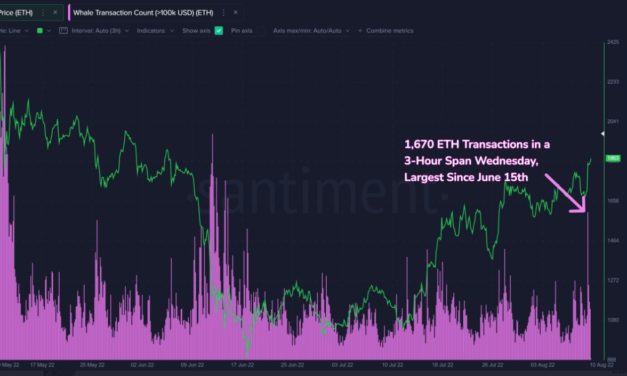

Ethereum whale transactions peak at 2-month high amid Goerli testnet merger

The Goerli testnet was successfully merged to the proof-of-stake (PoS) network, marking the final step before Ethereum’s mainnet transition. The triumphant final testnet merger means the mainnet transition slated for Sept. 19 could go as scheduled.Goerli is the third and final testnet after Ropsten and Sepolia that makes Ethereum’s final rehearsal before its official transition to the PoS network.BREAKING: The Goerli Testnet has activated Proof of Stake Mainnet™— bankless.eth (@BanklessHQ) August 11, 2022The PoS Merge is considered to be one of the most significant updates for the Ethereum blockchain since its inception, and the bullish sentiment behind the event has started to reflect on the altcoin’s price. The native token Ether (ETH) has more than doubled its price since bottoming at $885 in June 2022.ETH price surged over $1,919 on Thursday along with the rest of the crypto market after the government released consumer price index data, which turned out to be lower than expected. ETH outperformed Bitcoin (BTC) in terms of daily gains registering a double-digit surge. Data from crypto analytic firm Santiment revealed that the price momentum was aided by whale transactions valued at $100,000 or more. The increase in whale transactions comes amid a growing accumulation of whales.ETH Whale Transactions Reach Two-Month High Source: SantimentETH also registered a recent uptick in capital inflows into Ethereum-based institutional investment funds. These institutional products attracted $16.3 million from investors in the week ending Aug. 5. Similar funds for Bitcoin witnessed capital outflows worth $8.5 million in the same period, suggesting a growing bullish sentiment among institutional investors.Related: 3 signs Ethereum price is on track toward $2.5K by SeptemberWith the mainnet merger just over a month away, ETH price is seeing a bullish momentum with leading crypto platforms putting their weight behind the Merge. The market seems to be deploying “buy the rumor sell the news” where the ETH price has started to surge in anticipation of a successful transition and could see a substantial price correction after the upgrade in September when traders potentially begin to “sell the news.”

Čítaj viac

Mark Cuban faces class action lawsuit for promoting Voyager crypto products

Mark Cuban, the billionaire entrepreneur who has been quite active in the crypto ecosystem for the past year, is facing a class-action lawsuit over his promotions of the bankrupt crypto brokerage firm Voyager Digital.The Moskowitz Law Firm filed a civil suit in the United States District Court in Southern Florida against Cuban for promoting Voyager’s unregulated crypto products. The lawsuit demanded a jury hearing for the case.The lawsuit alleged Cuban also misrepresented the firm on numerous occasions, making dubious claims of it being cheaper than competitors and offering “commission-free” trading services. Cuban, along with Voyager Digital CEO Stephen Ehrlich, leveraged their years of experience to lure inexperienced customers into investing their life savings in what they called a Ponzi Scheme, the lawsuit allegesAn excerpt from the lawsuit read:“Cuban and Ehrlich, went to great lengths to use their experience as investors to dupe millions of Americans into investing—in many cases, their life savings—into the Deceptive Voyager Platform and purchasing Voyager Earn Program Accounts (‘EPAs’), which are unregistered securities.”The lawsuit further alleged that Cuban continued to hype Voyager’s products and push retail investors to invest in it despite knowing it. Cuban went on record calling the Voyager platform “as close to risk-free as you’re gonna get in the crypto.” The lawsuit read:“Voyager Platform relied on Cuban’s and the Dallas Maverick’s vocal support and Cuban’s monetary investment in order to continue to sustain itself until its implosion and Voyager’s subsequent bankruptcy.”Voyager was one of many crypto lenders to Three Arrows Capital (3AC) that went bust after laters insolvency. The crypto lending firm paused trading activity and withdrawals on July 1 and eventually filed for chapter 11 bankruptcy on July 5. Currently, over 3.5 million American customers have nearly 5 billion dollars in cryptocurrency assets on the platform frozen.Related: Voyager Digital reportedly had deep ties with SBF-owned Alameda ResearchVoyager was cleared to return $270 million in customer funds held at the Metropolitan Commercial Bank (MCB) by the judge presiding over its bankruptcy proceedings in New York. A day later, the lending firm announced that clients with U.S. dollars in their accounts could withdraw up to $100,000 in a 24-hour period starting as early as Aug. 11, with the funds received in 5–10 business days.

Čítaj viac

Voyager Digital reportedly had deep ties with SBF-owned Alameda Research

Voyager Digital, the crypto lending firm that went bust due to the crypto contagion initiated by Three Arrow Capital’s (3AC) insolvency is currently fighting its bankruptcy court battle. The court proceedings and financial documents have shown a deep relation between the crypto lending firm and Sam Bankman Fried-owned Alameda Research.Alameda is a quantitative trading firm that was also one of many borrowers from Voyager and reportedly owed $370 million. However, within weeks of 3AC’s downfall, Alameda moved from a borrower to a lender and offered a $500 million bailout in late June.SBF took to Twitter to give insights on the bailout deal that eventually became the point of conflict for Voyager. The troubled lender’s legal team claimed that the CEO was trying to create leverage for the trade.1) Voyager lost customer assets, but it still has the majority left.Why haven’t those been returned to customers yet?Sad facts from a bankruptcy process.— SBF (@SBF_FTX) July 25, 2022Legal documents and financial papers point toward the ties between the two companies as early as September 2021. The same documents also indicate that Alameda borrowed much more initially than the current amount of $370M. Voyager’s financial books indicate that it lent out $1.6 billion in crypto loans to an entity based in the British Virgin Islands, the same place where Alameda is registered.Related:  Voyager can’t guarantee all customers will receive their crypto under proposed recovery planThe legal documents that verify Voyager’s loan to 3AC also show a “Counterparty A” registered in the British Virgin Islands, owing them $376.784 million. In its bankruptcy presentation, Voyager has shown Alameda owes them $377 million.Alameda was also the biggest stakeholder in Voyager, with an 11.56% stake in the company acquired through two investments for a combined total of $110 million. When it completed the $500 million bailout, its investment was worth $17 million. Earlier this year, Alameda surrendered 4.5 million shares to avoid reporting requirements, bringing its equity down to 9.49%.Voyager CEO Stephen Ehrlich said that after the bankruptcy court proceedings, many crypto holders on the platform would be potentially eligible to get back some of their assets along with common shares in the reorganized Voyager, Voyager tokens, and proceeds from the now-defunct loan to 3AC.As part of this process, the proposed Plan of Reorganization would resume account access and return value to customers. Under this Plan, which is subject to change given ongoing discussions with other parties, and requires Court approval:— Stephen Ehrlich (@Ehrls15) July 6, 2022

The crypto contagion began with the now-defunct Terra stablecoin called TerraUSD (UST), which eventually led to the downfall of the $40 billion ecosystem. Many crypto hedge funds and lending firms exposed to Terra lost millions of dollars, which later led to the insolvency of 3AC, followed by the downfall of crypto leaders such as Celsius, BlockFi, Hodlnaut and Voyager.

Čítaj viac

GameFi and crypto 'natural fit' for game publishers: KBW 2022

South Korea is considered the fourth biggest gaming market and one of the biggest blockchain adopters. However, the country has banned play-to-earn (P2E) blockchain games due to the crypto integration. The new pro-crypto president Yoon Suk-yeol had hinted at lifting the ban, but the government has yet to show any significant effort.Anthony Yoon, managing partner of blockchain investment and accelerator firm ROK Capital, in an exclusive interview with Cointelegraph, said that GameFi is a natural fit for Korean game publishers. Yoon shed light on the current state of GameFi in the country and how game studios are approaching blockchain integration during the Korean Blockchain Week 2022 (KBW)Yoon explained that there are two thought processes among Web2 gaming companies looking to shift to web3 and blockchain gaming. Where one camp is looking for ways to derive value for their projects and create their ecosystem on blockchain from scratch, and token integration is the last step, while the other camp they are ready to launch a token first and outsource the technology. Talking about the popularity of global blockchain projects such as Solana (SOL) and Polygon (Matic)  against the native Korean projects, Yoon explained that their popularity is not just dependent on the amount of capital they bring in but more so on the infrastructure and ecosystem they have to offer. He explained:“From a feasibility perspective, I think something that these gaming studios also look at – are their users on this chain. Is there an ecosystem on this chain? Is there infrastructure on the chain?”Yoon also said that while native chains do play a key role in developing the ecosystem, but the major focus of game studios is to build for a global ecosystem.Related: Web2 adoption key to Metaverse success, Klaytn Foundation — KBW 2022In another chat, WeMade CEO Henry Chang talked with Cointelegraph about current trends in the GameFi sector, its potential future and WeMade’s new gaming blockchain platform Wemix.Chang said that even though crypto-integrated blockchain games are banned in Korea, crypto definitely has a utility in the gaming industry. He added that crypto would find a place in most of the games in the coming years. He concluded by saying – for crypto games to be successful, they must have a formidable in-game economy.

Čítaj viac

Získaj BONUS 8 € v Bitcoinoch

nakup bitcoin z karty

Registrácia Binance

Burza Binance

Aktuálne kurzy