Autor Cointelegraph By Prashant Jha

Crypto lender Hodlnaut seeks judicial management to avoid forced liquidation

Singapore-based crypto lending platform Hodlnaut is seeking judicial management to manage its ongoing liquidity crisis and avoid the forced liquidation of assets in the current bear market.The crypto lender informed its users in a Tuesday announcement that they have applied to the Singapore High Court to be placed under judicial management. The firm said:“We are aiming to avoid a forced liquidation of our assets as it is a suboptimal solution that will require us to sell our users’ cryptocurrencies such as BTC, ETH and WBTC at these current depressed asset prices. Instead, we believe that undergoing judicial management would provide the best chance of recovery.”Judicial management is a law in Singapore that allows financially troubled firms to rehabilitate themselves. Under this law, the court appoints an officer called the judicial manager for the troubled firm who takes over the charge from the company’s director for the time being. The appointment of a judicial manager can take up to a few months. Until the court confirms, the company may apply to appoint an interim judicial manager to act on a temporary basis in the same capacity.Hodlnaut has recommended Tam Chee Chong, director of the financial consultancy firm Kairos Corporate Advisory, as the interim and subsequently judicial manager. The crypto lender said that Chong holds nearly four decades of experience in corporate finance advisory and has taken on the role of a judicial manager in various companies which underwent restructuring. The announcement read:“With his experience and track record, we believe he will be able to execute our recovery plan and restructure the business effectively.”The application is yet to be heard by the court and the firm has given Aug. 19 as the next date for further updates on their judicial management application.If approved the law would also protect Hodlnaut from legal claims and proceedings temporarily which the company believes would provide a “breathing space to focus our efforts on the recovery plan to rehabilitate the company.”Related: Celsius Network coin report shows a balance gap of $2.85 billionHodlnaut became one of the many crypto lenders to fall prey to the crypto contagion initiated by the TerraUSD Classic (USTC) collapse and fueled by the insolvency of multi-billion dollar crypto hedge fund Three Arrows Capital, which had borrowed several million dollars in loans from these crypto lenders. The crypto lender paused all trading activity along with deposits and withdrawals on Aug., 8 citing market conditions and liquidity crisis.Although Hodlnaut avoided any 3AC exposure, multiple reports and on-chain data suggest the firm held about $150 million in USTC at some point. Hodlnaut didn’t respond to Cointelegraph’s requests for comments at press time.

Čítaj viac


Binance distances from WazirX as Indian regulators keep chasing crypto

The Twitter exchange between WazirX co-founder Nischal Shetty and Binance CEO Changpeng “CZ” Zhao over the ownership of the Indian crypto exchange grabbed a lot of headlines in the first week of August. WazirX was reportedly acquired by Binance in 2019, and ever since then, the Indian crypto exchange has been referred to as “Binance-owned”; however, to everyone’s surprise, CZ took to Twitter to claim that the acquisition process never went through and Binance has no ownership in the Indian crypto exchange.2/ On 21 Nov 2019, Binance published a blog post that it had “acquired” WazirX. This transaction was never completed. Binance has never – at any point – owned any shares of Zanmai Labs, the entity operating WazirX.— CZ Binance (@cz_binance) August 5, 2022CZ said that Binance only provides wallet services for WazirX as a tech solution and WazirX is responsible for all other aspects of the exchange, including user sign-up, Know Your Customer (KYC), trading, and initiating withdrawals.Shetty countered CZ’s claim in another tweet thread claiming that Binance indeed owns the Indian crypto exchange WazirX and that the parent company, Zanmai Labs, only operates crypto and Indian rupee pairs in WazirX on a Binance license. Binance, on the other hand, operates crypto-to-crypto pairs and processes crypto withdrawals, which can be verified by the companies’ terms of services.The two co-founders went back and forth for the next couple of days accusing each other of misrepresenting certain facts.2/ Original deal included sale of WazirX Technology (IP)Same Technology was then licensed to Zanmai by Binance for INR marketPost licensing:Binance operates crypto-crypto trading, crypto deposit/withdrawalsZanmai operates INR-Crypto trading, INR deposit/withdrawal— Nischal (Shardeum) ⚡️ (@NischalShetty) August 6, 2022

Based on the tweet exchange between the two co-founders, it is clear that there was indeed an acquisition deal, to begin with, but Shetty claimed the deal was for the technology transfer and not the whole company, and this is the reason WazirX technology is owned by Binance, while Zanmai Labs operate only crypto/INR pairs using a Binance license.When Cointelegraph reached out to Binance to get some clarity on the acquisition deal, the exchange denied Shetty’s earlier claims that the exchange operates crypto-to-crypto trading pairs. A spokesperson from Binance told Cointelegraph:“Binance does not operate crypto-to-crypto trades on the WazirX exchange. The WazirX exchange is wholly run and operated by Zanmai Labs. Further, while we did agree to purchase certain technical assets and intellectual property of WazirX, this agreement was not completed.”In another tweet, CZ claimed that Binance had tried to pursue the acquisition as late as February but was refused by WazirX. Shetty again responded to the tweet, claiming the deal involved an acquisition by Binance’s parent entity, but at the time of the deal, Binance gave an “ambiguous answer that parent entity is under restructuring.”The Binance spokesperson told Cointelegraph, “The agreement between Binance and Zanmai Labs was for the acquisition of certain assets and intellectual property of WazirX, not equity in Zanmai Labs.” They further added, “We had sought the assets that were supposed to be transferred to us under the agreement, but this was not forthcoming, and the agreement was not (and could not be) completed.”WazirX, on the other hand, believes the solution to the current problem is either for Binance to buy out India operations using its parent entity instead of a random entity because it may create risk for users or for Binance to sell back WazirX.Taking three years to disclose the deal never went throughThe core reason for the fallout between the two companies seems to be the alleged money laundering investigation by India’s Enforcement Directorate (ED). The said investigation is from a year ago, and contrary to popular belief, the investigation is focusing on a Foreign Exchange Management Act (FEMA) violation rather than money laundering.ED has issued Show Cause Notice to WazirX Crypto-currency Exchange for contravention of FEMA, 1999 for transactions involving crypto-currencies worth Rs. 2790.74 Crore.— ED (@dir_ed) June 11, 2021

FEMA is one of many capital control regulations that the Indian government has put in place to prevent capital from leaving the country. According to FEMA, an individual is only permitted to send a maximum of $250,000 for specific purposes per year outside of India. However, due to the lack of regulations around the crypto market, FEMA laws don’t cover cryptocurrency transfers. As a result, any users sending crypto transfers of above $250,000 would still violate FEMA laws. That seems to be the case with the ED’s current investigation into WazirX. In total, 10 other crypto platforms are facing similar investigations from the ED.Crypto investment is not one of them. But technically, if to send more than the set amount, even in crypto, it would be a violation of FEMA. Therefore, when transferring funds to an exchange that is not India-domiciled, it is seen as a violation of FEMA regulations.Related: AML and KYC: A catalyst for mainstream crypto adoptionThe year-old investigation made headlines again in 2022 followed by the ED freezing $8.1 million worth of the exchange’s assets. The ED claimed that it couldn’t find on-chain records of transactions amounting to millions of dollars. However, WazirX contradicted ED’s claim and said it has records for every single transaction.The off-chain transactions referred to by the ED are the direct transfer between WazirX and Binance, a feature introduced by the two parties as part of the partnership. The feature allows the transfer of assets between two exchanges without users having to pay any transfer fee.WazirX in its official statement claimed that there was a major misunderstanding surrounding the off-chain transfers. The crypto exchange said that an ED’s press release is trying to deem these transitions as mysterious and untracked, while in reality, only KYC users of the platform can use the services. Thus, there is no question about untraced funds, and WazirX said it was confident in proving ED wrong in the court of law.pic.twitter.com/9GzoNF61yi— WazirX: India Ka Bitcoin Exchange (@WazirXIndia) August 9, 2022

Binance eventually shut down the direct bridge between the two platforms on Aug. 11 and notified its users in advance while reminding them that they can still transfer funds to WazirX using standard wallet transfers.While both Binance and WazirX have assured full cooperation with the investigation, a source familiar with the issue who chose to remain anonymous told Cointelegraph that the investigation spooked Binance, which eventually led to the fallout. Binance later confirmed to Cointelegraph that the ED investigation compelled it to inform its users. A Binance spokesperson described the issues to Cointelegraph:“We encountered issues with Zanmai Labs. We have tried to work with them to find a resolution for some time. The recent news about the ED investigations and notices on Zanmai is also material developments. We felt the need to clarify this in the interests of user protection.”Will the Binance–WazirX saga impact Indian crypto investors?The Binance–WazirX saga created a panic among Indian investors who were using WazirX. Many of these traders liquidate their assets immediately after the war of words between the two co-founders erupted. The sentiment only got worse, with CZ prompting users to transfer their assets to Binance.WazirX told Cointelegraph that there were some signs of liquidation and movement of funds in the aftermath of the tweets, but after assuring users that their funds would be safe, the exchange said the trend has been on a decline.Related: Built to fall? As the CBDC sun rises, stablecoins may catch a shadowIndian crypto entrepreneurs believe that, regardless of who is at fault, the barrage of words on social media did impact investor confidence. Sathvik Vishwanath, the co-founder of the Indian crypto exchange Unocoin, told Cointelegraph that “such fracas affects the crypto market, including its investors.” He added further:“This kind of action in the crypto market poses a negative impression on the whole ecosystem, but the issue seems reversible. Either they need to complete the transaction or undo the transaction and should publicly identify the owners. Transparency is the key here that seems to be missing.”The Indian crypto ecosystem had thrived until now and produced several crypto unicorns over the past few years; however, with the implementation of a 30% crypto tax and 1% tax deduction at source this year, the trading volume on major Indian crypto exchanges has slumped dramatically. The newly implemented tax rules didn’t just deter Indian investors but also prompted several leading crypto services providers to look for crypto-friendlier jurisdictions. The Indian central bank has always called for a ban on crypto use in any form, while the central government has changed its stance over time without offering any regulatory framework. Amid growing complexities for the Indian crypto ecosystem, many market pundits believe the current Binance–WazirX saga could be used by Indian law agencies and the central bank to build a case against crypto regulations.

Čítaj viac

Celsius Network coin report shows a balance gap of $2.85 billion

A new bankruptcy coin report filed on Sunday shows that troubled crypto lender Celsius’ actual debt stands at $2.85 billion against their bankruptcy filing claims of a $1.2 billion deficit.The latest report shows that the company has net liabilities worth $6.6 billion and total assets under management at $3.8 billion. While in their bankruptcy filing, the firm has shown around $4.3 billion in assets against $5.5 billion in liabilities, representing a $1.2 billion deficit.The coin report also noted that of the total 100,669 Bitcoin (BTC) deposited by investors, the company has lost 62,853 BTC and currently holds only 37,926 BTC. Wrapped Bitcoin (WBTC) currently represents 64% of the company’s BTC debt.The company filed for Chapter 11 bankruptcy on July 14 after it became one of the many crypto lenders to perish in the wake of crypto contagion caused by the now-defunct Terra-USD collapse, which was aggravated further after the crypto market collapse.Related: Celsius lawyers claim users gave up legal rights to their cryptoSimon Dixon, a crypto entrepreneur with a keen interest in the Celsius case who had said that the actual balance gap of the crypto lender is $3 billion against their claims of $1.2 billion, took to Twitter to point to the new findings. He said that people were upset when he showed the gaps and the fact that Celsius was misleading and “making up numbers.”People were upset with me when I said #Celsius are missing lots of #Bitcoin & they are making up numbers with fake $CEL valuations. They confirmed they have lost 67,147 #BTC & $WBTC representing 64% of their #BTC debt. $438m of the hole is assuming they can dump all $CEL for $1 pic.twitter.com/KEQg7iu9bP— Simon Dixon (Beware Impersonators) (@SimonDixonTwitt) August 15, 2022While many crypto experts are critical of Celsius’s plans, the community had rallied behind the crypto lender in the hope of getting some of their funds back. The price of the native token has surged several times after the bankruptcy, thanks to a community-driven short squeeze. However, the latest findings seem to have deterred many existing account holders who are not so sure of getting their funds back.

Čítaj viac

Ethereum ICO-era whale address transfer 145,000 ETH weeks before the Merge

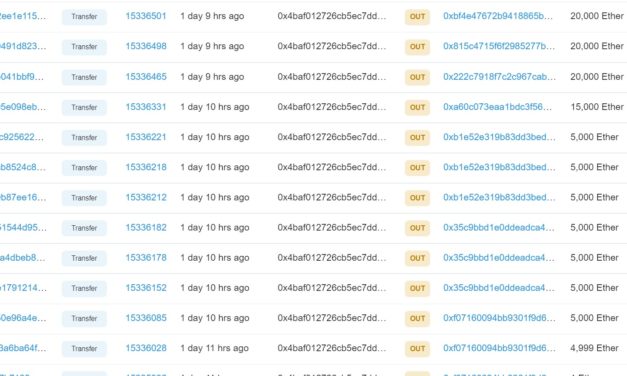
An Ethereum (ETH) whale wallet that participated in the Genesis Initial Coin Offering (ICO) and obtained about 150,000 ETH  in 2014 was activated again on Aug. 14 after three years of dormancy.The whale address transferred 145,000 ETH to multiple wallets as Ether price surged to a new 3-month high of over $2,000. The transfers were made in a batch of 5,000 ETH per transaction and a few transfers of over 10,000 ETH.  The total value of the transferred ETH is over $280 million, and the wallet address currently has a balance of 0.107 ETH. Ethereum ICO era wallet transactions Source: EtherscanThe 145,000 ETH transfer was only the second instance after the ICO when the whale wallet was activated, the first coming in July 2019 when the wallet sent out 5,000 ETH to Bitfinex3 exchange with ETH trading at $219, and the value of the whole transaction was just over a million dollars.The movement of such a high amount of ETH attracted community reactions, with many claiming it could be a possible dump before the Merge, the official transition of the current Proof of Work (PoW) based blockchain to a  proof-of-stake (PoS) one. However, it is important to note that most transactions are to unknown wallets rather than an exchange. Even if the whale eventually decides to dump their 145,000 ETH, a $250 million selling pressure isn’t considered significant enough to initiate a market dump. A few others believe that the whale might be trying to stake their ETH to become a validator on the PoS network and generate passive income.Maybe selling 5000eth to open 5000 future nodes ?— Gary R (@bucko4aFREEusa) August 15, 2022Ethereum’s transition to a PoS-based network is slated for September 15 after a successful merge of the Goerli testnet to the Beacon chain(PoS chain activated in 2020), the final rehearsal before the official transition.Related: 3 cryptocurrencies that stand to outperform ETH price thanks to Ethereum’s MergeThe Merge in September 2022 is considered one of the most significant upgrades for the second largest cryptocurrency since its inception in 2015. The three-phase transition process began in 2020, and after several delays and testnet integration, it is all set for the official PoS transition in the third week of September.

Čítaj viac

Curve Finance resolves site exploits, directs users to revoke recent contracts: Finance Redefined

Welcome to Finance Redefined, your weekly dose of essential decentralized finance (DeFi) insights — a newsletter crafted to bring you significant developments over the last week.This past week, cross-bridge protocols became the center of DeFi discussions as a new report showed RenBridge was used to launder $540 million in stolen funds. Curve Finance, on the other hand, resolved its site exploit and directed users to revoke any recent contracts.Interlay, a London-based blockchain firm, launched a Bitcoin (BTC)-based cross-chain bridge on Polkadot named interBTC (iBTC), DeFi platform Oasis.app says that sanctioned addresses will no longer be able to access the application.The majority of the top-100 DeFi tokens saw a new surge in bullish momentum along with the rest of the market, with several of the tokens registering a double-digit gain on the weekly charts.Curve Finance resolves site exploits, directs users to revoke any recent contractsOn Aug. 9, automated market maker Curve Finance took to Twitter to warn users of an exploit on its site. The team behind the protocol noted that the issue, which appeared to be an attack from a malicious actor, was affecting the service’s nameserver and frontend.Curve stated via Twitter that its exchange — which is a separate product — appeared to be unaffected by the attack, as it uses a different domain name system (DNS) provider. Continue readingCross-chain bridge RenBridge laundered $540M in hacking proceeds: EllipticCross-chain bridges have been the target of more than a few hacks this year, but new data from blockchain analytics provider Elliptic alleges one has been used to launder over half a billion dollars in ill-gotten crypto assets. According to a new report, crypto bridge RenBridge facilitated the laundering of at least $540 million in proceeds of crime since 2020 through a process known as chain hopping — converting one form of cryptocurrency into another and moving it across multiple blockchains.Continue readingInterlay launches trustless BTC stablecoin bridge on PolkadotInterlay, a London-based blockchain firm, launched a BTC-based cross-chain bridge on Polkadot. Named interBTC (iBTC), the bridge allows the use of Bitcoin on non-native blockchains for DeFi, cross-chain transfers and nonfungible tokens (NFTs), among others.interBTC operates as a BTC-backed stablecoin, secured by a decentralized network of overcollateralized vaults, which according to Interlay, resembles MakerDAO’s Dai (DAI) token, a stablecoin on the Ethereum blockchain.Continue readingDeFi platform Oasis to block wallet addresses deemed at-riskAccording to a new community Discord post on Aug. 11, the DeFi platform Oasis.app says that sanctioned addresses will no longer be able to access the application. As a result of the change to the terms of service, wallets flagged as high risk are prohibited from using Oasis.app to manage positions or withdraw funds. Instead, such a category of users must interact directly with the relevant underlying protocol where funds are stored or find another service.Continue readingDeFi market overviewAnalytical data reveals that DeFi’s total value locked registered a rise of 5 billion dollars from the past week, posting a value of $68.94 billion. Data from Cointelegraph Markets Pro and TradingView shows that DeFi’s top 100 tokens by market capitalization had a bullish week, with several tokens registering double-digit gains.Ankr (ANKR) was the biggest gainer among the top 100, registering a 48% surge over the past week, followed by Avalanche (AVAX) with a 20% surge. Oasis Network (ROSE) saw an 18% price rise, and Chainlink (LINK) registered a 16% rise on the weekly chart.Thanks for reading our summary of this week’s most impactful DeFi developments. Join us next Friday for more stories, insights, and education in this dynamically advancing space.

Čítaj viac

Získaj BONUS 8 € v Bitcoinoch

nakup bitcoin z karty

Registrácia Binance

Burza Binance

Aktuálne kurzy