Autor Cointelegraph By Prashant Jha

Crypto market bloodbath leads to over $500M in liquidations in 24 hours

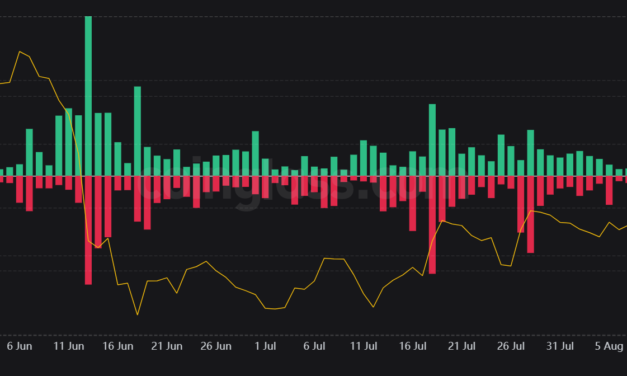
The crypto market registered a major slump on Friday, resulting in major cryptocurrencies losing key support and falling to new monthly lows after a prolonged bullish surge over the past month.Bitcoin (BTC), which was looking to break through $25,000 resistance last week, fell below $22,000 to register a new two-week low of $21,747. Ether (ETH), the second largest cryptocurrency, has surged past $2,000 in the run to the Merge but slumped by 6% over the past 24 hours to register a new weekly low of $1,726.The flash crash after weeks of bullish momentum also saw 157,098 traders getting liquidated in the past 24 hours resulting in liquidation of over $551 million. Data from Coinglass indicate Bitcoin traders lost over $203 million in liquidations, followed by Ethereum traders at $140 million.The following liquidation chart indicates that the number of liquidated long positions outnumber the short ones by a significant margin, indicating the market sentiment was highly bullish until the flash crash. The value of short positions liquidated was only $41 million against $398 million in long positions.Total Liquidation Source: CoinglassBTC futures long liquidations reached an 8-month high of $84,934,697.05 on OKX (formerly known as Okex), breaking the previous high of $48,630,183.66 observed on May 5, 2022.The sudden plunge in the crypto market is being attributed to the Fed’s expected interest rate hike in September. August consumer price index (CPI) data came lower than expected, leading to a bullish surge in crypto and forex markets alike. Related: Bitcoin ‘very bearish’ below $22.5K says trader as BTC price dives 6%Federal Reserve Bank of St. Louis president James Bullard said he would favor a 75 basis points increase. An interest hike by the fed next month could lead to another downturn. A similar interest rate hike of 75 basis points in June led to crypto market turmoil after an initial price surge.

Čítaj viac

Coinbase would rather shut down staking than enable on-chain censorship — Brian Armstrong

In light of the recent ban on crypto mixing tool Tornado Cash and the subsequent arrest of the Tornado Cash developer, there has been a growing debate around what crypto services providers would choose between decentralization and censorship in form of compliance.The question has become more prominent as Ethereum (ETH) is moving from its current proof-of-work (PoW) blockchain to a proof-of-stake (PoS) mining consensus. With the transition less than a month away, a user pointed out that more than 66% of validators on the Beacon chain (Ethereum PoS chain) will adhere to the United States Department of the Treasury’s Office of Foreign Assets Control (OFAC) regulations.Start with the big, current one. Currently it looks like over 66% of the beacon chain validators will adhere to OFAC regulations, @LidoFinance @coinbase @krakenfx @stakedus @BitcoinSuisseAG pic.twitter.com/qyq23tPnqV— eylonverse X (@TheEylon) August 14, 2022When asked whether Coinbase and others would choose to adhere to compliance requests and impose protocol-level censorship or shut down staking services, Brain Armstrong, the CEO of Coinbase, chose the latter. Armstrong said:“It’s a hypothetical we hopefully won’t face. But if we did we’d go with B I think. Got to focus on the bigger picture. There may be some better option (C) or a legal challenge as well that could help reach a better outcome.”First group of centralized #ethereum validators to answer my question say they would rather wind down their staking program than enable on-chain censorship at the protocol level in the ethereum blockchain. https://t.co/pKG8X50hDa— Lefteris Karapetsas | Hiring for @rotkiapp (@LefterisJP) August 17, 2022

There was growing speculation about the actions of Coinbase, Kraken, and other prominent crypto exchanges who are also key ETH validators on the Beacon chain. Related: Tornado Cash ban could spell disaster for other privacy protocols — Manta co-founderMany believed that centralized crypto exchange would take the easy way out and impose protocol-level censorship rather than block individual transactions from banned crypto mixers such as Tornado Cash.U.S. validators (which includes very powerful Coinbase) are gonna push for protocol-level censorshipThey can’t self-help by merely avoiding facilitation of blocks containing U.S.-sanctioned txs, because under certain conditions they might be dramatically slashed from doing so.— _gabrielShapir0 (@lex_node) August 13, 2022

The current dilemma comes from the OFAC sanctions that deemed all tornado cash transactions illegal. However, decentralized finance (DeFi) experts believe it has complicated the issue. Instead of sanctioning a particular address or the country, the regulators have decided to ban the protocol.Here’s the list of Tornado Cash resources that were banned- Tornado Cash @GitHub organization- personal @GitHub accounts of TC contributors- all $USDC on Tornado Cash contracts @circlepay – @infura_io RPC- @AlchemyPlatform RPC- https://t.co/SHvgEjTOMV domain @eth_limo— ️ Tornado.cash ️ (@TornadoCash) August 9, 2022

Experts believe the decision of a ban would discourage many protocols and exchange operators from engaging with anything related to Tornado Cash, including ETH transacted through the mixer which could lead to unnecessary censorship.

Čítaj viac

Ripple CTO lashes back at Vitalik Buterin for his dig on XRP

David Schwartz, the chief technical officer of Ripple, didn’t take Ethereum co-founder Vitalik Buterin’s dig on XRP very kindly. In a discussion that started around the recent $30,000 limit imposed by the Ontario crypto exchange on altcoins purchases barring Ether (ETH), Litecoin (LTC) and Bitcoin Cash (BCH).Buterin, in a quoted response to a tweet, lauded the Ethereum community’s pushback against regulations that privilege ETH over other legitimate cryptocurrencies. David Hoffman, the founder of decentralized media and education platform Bankless.eth responded to Buterin and said that he wouldn’t have minded if they had restricted XRP.XRP already lost their right to protection when they tried to throw us under the bus as “China-controlled” imo:https://t.co/t6cbMtjsEV— vitalik.eth (@VitalikButerin) August 17, 2022Buterin joined on the XRP bashing claiming they lost their right to protection when they tried to “throw us under the bus as China-controlled.” The response from Buterin created a storm among XRP followers on Twitter, and the debate was later joined by Ripple CTO David Schwartz himself.Buterin was referring to Ripple’s defense in their ongoing court battle against the United States Securities and Exchange Commission (SEC), where they claimed XRP shouldn’t be deemed as security since Ethereum and Bitcoin are similar in nature and even called the top two cryptocurrencies as Chinese controlled. Ripple is fighting a security lawsuit from the SEC over the unlicensed sale and issuance of XRP tokens. Schwartz reiterated Ripple’s earlier claims of ETH and BTC being security and compared miners in the ecosystem akin to shareholders of eBay. He said:“I do think it’s perfectly fair to analogize miners in PoW systems to stockholders in companies. Just as eBay’s stockholders earn from the residual friction between buyers and sellers that eBay does not remove, so do miners in ETH and BTC.”Schwartz concluded his tweet with a question to Buterin, asking him whether the security debate should be settled by the government or the market. Do you think this debate should be settled by the government or the market, @VitalikButerin? This quotation wasn’t pulled from some attempt by Ripple to get the government to regulate ETH, was it?— (@JoelKatz) August 18, 2022

Ethereum’s security status became a hot topic during the ongoing lawsuit proceedings, where Ripple has claimed that the SEC has a clear bias against them and it favored Ethereum. In an interview in 2021, Ripple CEO Brad Garlinghouse claimed that SEC helped Ethereum to overtake XRP as the No.2 crypto.Related: Alchemy and Infura block access to Tornado Cash as Vitalik Buterin weighs in on debateThe security status of cryptocurrencies has been a long-driven debate due to a lack of regulatory guidelines. The majority of regulators around the globe consider Bitcoin as an asset, while there is still an ongoing debate over the status of Ethereum due to the pre-mine and initial coin offerings (ICO).

Čítaj viac

Do Kwon reportedly hires lawyers in S.Korea to prepare for Terra investigation

Terraform Labs co-founder Do Kwon has reportedly hired a lawyer from a domestic law firm in South Korea just days after claiming the South Korean authorities are yet to reach out to him or file any charges against him.According to a local media report, Kwon recently submitted a letter of appointment to an attorney at the Seoul Southern District Prosecutors’ Office, the department that is currently investigating the Terra-LUNA collapse.While Kwon claims no charges were filed against him, prosecutors in South Korea behind the investigation of Terraform Labs reportedly executed a search and seizure in 15 firms in the third week of July. It includes seven crypto exchanges linked to now-defunct Terra’s collapse.Prosecutors reportedly notified Kwon, who was staying in Singapore and banned the departure of key people.Related: Do Kwon breaking silence triggers responses from the communitySouth Korean authorities began an investigation into the $40 billion Terra ecosystem collapse soon after the ecosystem’s implosion in May. The first action came towards the end of May when the authorities decided to form a new crypto oversight committee to avoid Terra-like incidents in the future. Later, CEO Kwon was sued and accused of fraud and violation of several financial acts.Later, in June, the authorities began a formal investigation into the incident and found Terraform Labs guilty of tax evasion and market manipulation. Prosecutors in the country banned Terraform Lab employees from leaving the country.The Terra-USD collapse and implosion of a $40 billion ecosystem had a catastrophic impact on the larger ecosystem. The incident later led to a crypto contagion that claimed several crypto lenders and hedge funds.

Čítaj viac

EthereumPoW team plans to freeze selected contracts, community pushes back

Ethereum (ETH) is all set to transition to a proof-of-stake (PoS) network by Sept. 15-16 that would see an end to its current proof-of-work (PoW) chain. This event would eliminate PoW mining from the Ethereum ecosystem.The terminal total difficulty has been set to 58750000000000000000000.This means the ethereum PoW network now has a (roughly) fixed number of hashes left to mine.https://t.co/3um744WkxZ predicts the merge will happen around Sep 15, though the exact date depends on hashrate. pic.twitter.com/9YnloTWSi1— vitalik.eth (@VitalikButerin) August 12, 2022In light of such a major upgrade, the PoW proponents, especially miners, have decided to keep the PoW chain alive. EthereumPoW (ETHW), the core PoW team on Tuesday recommended ETH holders withdraw their assets from liquidity providers (LPs) such as Uniswap Sushiswap, Aave, Compound, and other decentralized exchanges (DEX).The core team said they would temporarily freeze ETHW tokens in certain LPs of  DEX and lending protocols after the hardfork to protect user assets. The core team believes right after the Ethereum PoW hard fork, especially for the initial several blocks, users’ ETHW tokens deposited in the LPs will be swapped or lent out by hackers and scientists using deprecated and valueless USDT, USDC, and WBTC, which would create a “huge mess for the community.”The core team said:“ETHW Core has to make the hard decision to temporarily freeze certain LP contracts to protect users’ ETHW tokens until the protocols’ controllers or communities find a better way.”The team also said freezing will not be applied to the staking contracts that only involve a single asset such as ETH2.0 deposit contract and Wrapped Ether.The idea of freezing users’ assets without their consent didn’t go well with many in the community. Users reminded the core team that freezing hardcoded LP smart contracts into the ETH clients is definitively not decentralized.Converting ETHW into a slow, centralized chain, which has no market fit.If you want to protect users from bots draining ETHW from LP, then other measures have to be taken.Uniswap + AAVE + Compound have 1.8M ETH on their pools. Around $108M of implied value for $60 ETHW— Alberto Rosas (@albertorosasg) August 17, 2022

Others went out to call it a scam and recommended reporting the Twitter account claiming to be the core ETHW team.I recommend reporting this account as a fake. There is no “official” ETHW core team, and they are proposing a rushed changed to code which freezes contracts as selected by individual people. No EIP discussion or vote or anything. This will likely just create a 3rd fork. Scam. https://t.co/4bORc2bTZP— Tommy Genesis (@0xTommyGenesis) August 17, 2022

The PoW Ethereum hardfork has got the support of a prominent Chinese miner Chandler Guo as well who claims to be behind a 51% attack on Ethereum Classic.I am Chandler Guo, a 51% attack on Ethereum Classic (ETC) is coming with my 98G hashrate https://t.co/9VM6vPa8CS— Chandler Guo (@ChandlerGuo) July 24, 2016

A majority of crypto exchanges and stablecoin issuers have thrown their support behind the upcoming PoS-based Ethereum network. However, the crypto exchanges have stated that if a forked PoW chain gains traction they would be in favor of listing the forked token as well, depending on the community’s demand.The ETH mining sector is worth $19 billion, according to an estimate from crypto analytic firm Messari. With billions worth of infrastructure on the line, miners ought to favor a hard fork given mining other POW tokens such as Ethereum Classic (ETC) or Bitcoin (BTC) won’t be as profitable. Related: Ethereum devs confirm the perpetual date for The MergeExperts belive a forked PoW Ethereum chain won’t be as profitable either, since the majority of the community would shift to the new network. Kent Barton, tokenomics lead at ShapeShift DAO, told Cointelegraph.“While the free market will ultimately decide, it’s likely that, following some initial price discovery (and a potential opportunity to sell these forked tokens), these POW forks will die off. A strategy that’s more likely to succeed is mining on other POW chains such as Ethereum Classic.”Ethereum co-founder Vitalik Buterin has been critical of the PoW fork as well, calling it an act of greed of a few outsiders. He recommended miners shift to ETC as well.

Čítaj viac

Získaj BONUS 8 € v Bitcoinoch

nakup bitcoin z karty

Registrácia Binance

Burza Binance

Aktuálne kurzy