Autor Cointelegraph By Prashant Jha

DeFi protocol token NFD crashes by 99% after a flash loan attack

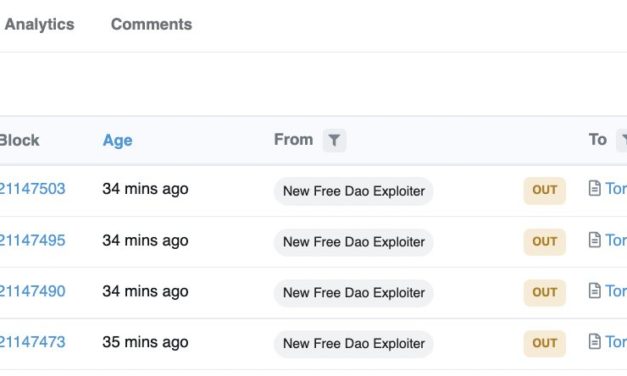
New Free DAO, a decentralized finance (DeFi) protocol, faced a series of flash loan attacks on Sept. 8, resulting in a reported loss of $1.25 million. The price of the native token has dropped by 99% in the wake of the attack.Unlike normal loans, several DeFi protocols offer flash loans that allow users to borrow large amounts of assets without upfront collateral deposits. The only condition is that the loan must be returned in a single transaction within a set time period. However, this feature is often exploited by malicious adversaries to gather large amounts of assets to launch costly exploitations targeting DeFi protocols.Blockchain security firm Certik alerted the crypto community on Thursday about the 99% price slippage of the NFD token due to a flash loan attack. The attacker reportedly deployed an unverified contract and called the function “addMember()” to add itself as a member. The attacker later executed three flash loan attacks with the assistance of the unverified contract.#CertiKSkynetAlert New Free Dao – $NFD was exploited via flash loan attack gaining the attacker 4481 WBNB (approx. ~$1.25M) causing the token to slip in price 99%.The attacker has connections to Neorder – $N3DR attack from 4 months ago where they took 930 BNB at the time. pic.twitter.com/5Rcht3YiIK— CertiK Alert (@CertiKAlert) September 8, 2022The attacker first borrowed 250 WBNB worth $69,825 via flash loan and swapped all of them for the native token NFD. The contract was then used to create multiple attack contracts to claim airdrop rewards repeatedly. The attacker then swapped all the airdrop rewards for WBNB benefiting 4481 BNB.Out of the 4481 BNB, the attacker returned the borrowed loan (250 BNB) and swapped 2,000 BNB for 550,000 BSC-USD. Later, the attacker moved 400 BNB to the popular coin mixer service Tornado Cash. Fund Movement From NFD Attacker Wallet to Tornado Cash Source: BSC ScanCertik also notified that the hacker behind the flash loan attack on NFD was related to those who exploited Neorder (N3DR) in May earlier this year. Later, another blockchain security firm Beosin told Cointelegraph that the attackers behind both the exploits could be the same.Related: Solana-based stablecoin NIRV drops 85% following $3.5M exploitBeosin also highlighted another vulnerability with the NFD protocol that could be further used for another type of flash loan attack. The security firm said that the price could be manipulated since they are calculated “using the balance of USDT in the pair, so it may lead to flash loan attack if exploited.”3/ Although unrelated to this attack, we also find another vulnerability in the $NFD contract that may lead to price manipulation. pic.twitter.com/kKvx4hRdE4— Beosin Alert (@BeosinAlert) September 8, 2022

Flash loan attacks have been increasingly popular among hackers due to the low risk, low cost and high reward factors. On Sept. 7, Avalanche-based lending protocol Nereus Finance became a victim of a crafty flash loan attack resulting in a loss of $371,000 in USDC. Earlier in June, Inverse Finance lost $1.2 million in another flash loan attack.

Čítaj viac

Bitcoin proponent Samson Mow highlights centralization aspect of the Merge

Samson Mow, a well-known Bitcoin proponent, recently took to social media to talk about the centralization aspects of the upcoming Merge, which he claimed isn’t widely known.Ethereum is in the countdown mode after the completion of the Bellatrix upgrade on Sept. 6 and is all set for the official transition between Sept.13-15, depending on the hashrate (computer power) input on the network. The Merge is slated to be triggered by a difficulty threshold called the Terminal Total Difficulty (TTD) at a value of 58750000000000000000000.Mow claimed that while everyone thinks that the Merge will be triggered by pre-set threshold difficulty, there is one aspect that not many people have paid attention to. He said node operators have the power to overwrite the TTD value by a single line of code. Mow cited a Galaxy blog post highlighting the key centralization issue with the Merge and claimed that Ethereum has knowingly suppressed this fact. So how does the MeRgE actually get triggered? I was curious so I did some digging. I thought it may be set with a fixed mechanism or readiness threshold, but no. Someone, probably Vitalik, will just say “go” and then it happens. The complex charade is to mask the centralization. pic.twitter.com/PmxcTMU8J5— Samson Mow (@Excellion) September 7, 2022He noted that with few nodes that matter, “so those in charge can simply “feed the actual value” for activation time whenever they feel like it. What’s hilarious is they then make tracker sites to “predict” when it will happen.”Cointelegraph reached out to Mow to get his perspective on the upcoming Merge and the centralization debate looming around Ethereum’s upcoming transition. Mow told Cointelegraph that with a move to proof-of-stake (PoS), the “centralization aspect of Ethereum would become permanent.” Related: Vitalik reminds node operators to update client before the Bellatrix upgradeHe added that in a PoS system, node operators are solely responsible for decision making which is clear from the TTD override example. He said:“If Ethereans really wanted to have something energy efficient, scalable, and cheaper, they would be doing R&D on Bitcoin second layer technologies like Lightning and Liquid.”Ethereum’s transition to a PoS network started out as a strategy to address its scalability woes but soon became a case for energy efficiency amid growing scrutiny around the Bitcoin network’s energy consumption. The Merge would mark the completion of the second phase of the three-phase transition process, and the majority of key benefits, including cheaper gas fees and faster transaction throughput, will arrive with the completion of the third phase.

Čítaj viac

DeFi Regulations: Where US regulators should draw the line

Decentralized finance (DeFi), one of the fastest growing ecosystems in the cryptocurrency market, has long been a dilemma for regulators, given the decentralized nature of the space. In 2022, United States regulators paid special focus to the nascent area with significant attention to ending the anonymous nature of the ecosystem.DeFi protocols allow users to trade, borrow and lend digital assets without having to go through an intermediary. DeFi ecosystems by nature are decentralized with the majority of projects being run by automated smart contracts and decentralized autonomous organizations (DAOs). Most DeFi protocols don’t require heavy Know Your Customer (KYC) requirements, making way for traders to trade anonymously.A leaked copy of a U.S. draft bill in June showed some of the key areas of concern for regulators including DeFi stablecoins, DAOs and crypto exchanges. The draft bill paid a special focus on user protection with the intention to eliminate any anonymous projects. The bill requires any crypto platform or service provider to legally register in the United States, be it a DAO or DeFi protocol.Sebastien Davies, principal at institutional infrastructure and liquidity provider Aquanow, blamed regulators’ lack of technological understanding as the reason behind the regressive approach. He told Cointelegraph that events like the sanctioning of Tornado Cash users after the application was added to the Specially Designated Nationals list produced by the Office of Foreign Assets Control demonstrate a lack of technological understanding. He explained:“I think the point that policymakers were trying to get across is that they’ll make it very difficult for developers/users of protocols that completely obfuscate transaction history and that they’re willing to act swiftly. Officials may eventually walk their stance back, but the precedent will be severe. Participants in the digital economy should continue to engage with regulators as often as possible to maintain a voice at the table to avoid these types of shocks and/or partake in the balancing dialogue after the fact.”Another discussion paper by the U.S. Federal Reserve Board released in August claimed that even though DeFi products represent a minimal share of the global financial system, they may still pose risks to financial stability. The report noted that DeFi’s resistance to censorship is overstated, and transparency could be a competitive disadvantage for institutional investors and an invitation for wrongdoing.Forced legislation will drive out budding projectsThe concerns of regulators around user protection are understandable, but experts believe that shouldn’t come at the cost of innovation and progress. If the focus is only on collecting data and putting barricades that hinder innovation, then the U.S. would be left behind in the innovation race.Hugo Volz Oliveira, secretary at the New Economy Institute — a nonprofit organization focused on developing digital economy policy recommendations — explained to Cointelegraph why regulators’ current approach and focus on eliminating anonymous projects won’t be fruitful. He said:“Take the fact that policymakers and regulators continue to insist on eliminating anonymous crypto projects and teams, de facto trying to choke this industry by targeting its builders. But this won’t be feasible in the more sophisticated projects that are being developed according to the ethos of the community.”He added further that there’s a real danger that the legislators will be successful in driving most of the crypto industry away from North America. He said, “This is also problematic as the rest of the world still needs large nation-states to stand up to the bullying from FATF and other undemocratic institutions that seem more keen on preserving their monopoly on power than on fostering a risk-based approach to innovation.”On Aug. 30, the U.S. Federal Bureau of Investigation released a fresh warning for investors in DeFi platforms, which have been targeted with $1.6 billion in exploits in 2022. The law enforcement agency warned that cybercriminals are taking advantage of “investors’ increased interest in cryptocurrencies,” and “the complexity of cross-chain functionality and open source nature of Defi platforms.”The #FBI warns that cyber criminals are increasingly exploiting vulnerabilities in decentralized finance (DeFi) platforms to steal investors cryptocurrency. If you think you are the victim of this, contact your local FBI field office or IC3. Learn more: https://t.co/fboL1N17JN pic.twitter.com/VKdbpbmEU1— FBI (@FBI) August 29, 2022While decentralization is a key aspect of the DeFi ecosystem, criminals can take advantage of it to process their illicit transactions. However, it is important to note that laundering via crypto has historically proven to be riskier as they can be traced and blocked. Criminals laundering their funds even after several years of the theft have been caught.DeFi regulation requires a mindset shiftCrypto regulations themselves are a significant discussion point in the mainstream industry, given that, apart from a few states with niche crypto-centered laws, there’s no universal rule book in the United States for crypto operators. Thus, in absence of fair clarity around the overall crypto market, regulating a niche ecosystem could be a complex task.Jackson Mueller, director of policy and government relations at blockchain-based financial and regulatory technology developer Securrency, told Cointelegraph that there’s a growing interest among policymakers regarding the DeFi space. However, they are currently caught up between whether to apply existing long-standing yet arguably unsuitable regulatory regimes or consider stepping outside the regulatory box to develop appropriate and responsible frameworks. He explained:“Policymakers are never going to be comfortable with a system based on complete anonymity, hence the push for the application of Anti-Money Laundering and KYC regulations. While this obviously triggers privacy and level-playing field concerns, advanced technologies capable of being deployed today can greatly preserve an individual’s right to privacy, without significantly restricting the potential of DeFi services or propelling opaque markets. Regulated DeFi is not an oxymoron. The two can, and must, coexist.”A new proposal released by the U.S. Securities and Exchange Commission (SEC) in February earlier this year highlighted the lack of understanding of the space by the SEC. The proposal aims to amend the definition of “exchange” by the Securities Exchange Act of 1934. The amendment would require all platforms with a certain threshold transaction volume to register as exchanges.The proposal threatens many DeFi projects as most of them are not operated centrally, and having to register as an exchange could very well spell doom for the industry. Hester Peirce, the SEC commissioner who is a well-known crypto advocate, was among the first to call out the flawed proposal and said it could reach more types of “trading mechanisms, including potentially DeFi protocols.”The multiple proposals and warnings by U.S. federal agencies suggest a hard-handed approach, which many experts believe wouldn’t necessarily work. Gabriella Kusz, CEO of a self-regulatory group called the Global Digital Asset and Cryptocurrency Association (Global DCA), told Cointelegraph:“DeFi regulation requires a mindset shift — away from the concept of a ‘cop on the beat’ and toward the concept of ‘community management.’ In a DeFi world where the nature of interactions and entities is decentralized, the entire nature of the relationship between the regulator and the regulated must change. As opposed to being reactionary, regulation must be reimagined to shift towards preventative measures, supporting the constructive development of the industry.”She added that Global DCA is working specifically on this subject to design and create a self-regulatory organization that forms a broad dialogue with a diverse group of stakeholders in the digital asset ecosystem. These insights and perspectives will be “reflected back in a framework for self-regulation which may help to advance market integrity and consumer protection.”Eric Chen, CEO and co-founder of DeFi research and development firm Injective Labs, told Cointelegraph that ecosystem stakeholders should have an input in regulatory discussions:“I personally believe that regulators should have more open conversations with Web3 companies and founders. I think this dialogue would help both sides of the spectrum to reach definitive regulatory clarity more rapidly. Many may not recall but the early Web2 space was also beholden to an opaque regulatory structure. This of course was rectified over time as regulators and founders began to work together to craft proper guidelines.”Any new technology that gains mass traction becomes a point of concern for regulators. However, their approach is key to determining if that technology can be utilized for good or simply prohibited because of a few bad actors. Industry experts believe that the current approach to regulating the DeFi market under existing financial laws could be devastating for the nascent industry and that dialogue is the right way to move forward at this point.

Čítaj viac

Vitalik reminds node operators to update client before the Bellatrix upgrade

Ethereum co-founder Vitalik Buterin is reminding node operators to upgrade their clients before the Bellatrix “hard fork,” slated for Sept. 6. Buterin said that the scheduled upgrade will be the final update that prepares the Beacon chain (proof-of-stake chain) for the Merge.The merge is still expected to happen around Sep 13-15. What’s happening today is the Bellatrix hard fork, which *prepares* the chain for the merge. Still important though – make sure to update your clients!— vitalik.eth (@VitalikButerin) September 6, 2022An Ethereum client is the software that allows Ethereum nodes to read blocks on the blockchain and smart contracts. A “node” is the running piece of the client software. In order to run a node, one has to first download an Ethereum client application. A node can be run by different Ethereum client software that varies in the programming language used and code base.Ethereum node operators must comply with the Bellatrix upgrade by updating its consensus layer clients prior to epoch 144896 on the Beacon Chain. The upgrade is scheduled to take place at 11:34:47 am UTC. This upgrade consolidates the PoS chain with the current execution layer and is the last key update before the Merge.Prior to the Bellatrix upgrade, 73.5% of all node operators were Merge ready, meaning 26.5% of node operators were yet to update their clients. Ethereum foundation warned that a non-updated client would sync to the pre-fork blockchain.Related: Ethereum Merge to ‘swamp’ other coins with miners — Mining CEOApart from Buterin, lead developer Tim Beiko also reminded node operators to update their clients before the key upgrade.Bellatrix is tomorrow Last chance to upgrade your node if you haven’t yet! We’re mergiiiing https://t.co/0VQ9zb6wjN— Tim Beiko | timbeiko.eth (@TimBeiko) September 5, 2022

The Bellatrix upgrade will be followed by the official Merge slated between Sept.13-15 in an official event called the “Paris Upgrade.” The Merge will be triggered when Terminal Total Difficulty (TTD) reaches 58750000000000000000000, after which the next block will be produced by a Beacon Chain validator marking the official beginning of Ethereum’s PoS era.The much-awaited transition would mark the completion of the second phase of the three-phase transition process for Ethereum. With the move to PoS, Ethereum is aiming to become more energy efficient and scalable. However, the Merge won’t have any impact on the gas fee or scalability, those features are expected to arrive with the completion of the final phase slated for late 2023.

Čítaj viac

US congressman and crypto skeptic explains why a crypto ban won't work

In a recent interview, United States congressman and a known crypto skeptic Brad Sherman claimed that banning cryptocurrencies is not an option at this point.In a statement to LA Times, the Northridge-area Democrat said that the crypto industry has become quite powerful over the years. He added that the high capital donations to the politicians and strong crypto lobbying make it impossible for them to impose a blanket ban. He explained:“We didn’t ban it at the beginning because we didn’t realize it was important, and we didn’t ban it now because there’s too much money and power behind it.The democratic representative is a well-known skeptic who has been demanding a crypto ban since 2019. Nearly three years later, Sherman has changed his tune about a ban and now advocates for regulating the crypto market.The U.S. congressman is especially worried about small and retail investors who often fall prey to gullible scams but admitted that any amount of effort by the judiciary to protect investors won’t work until they keep investing in cryptocurrencies such as meme coins. He said:“It is hard to be running the subcommittee dedicated to investor protection in a country in which people want to wager on [meme coins].”Sherman advocated for crypto being brought under the jurisdiction of the Securities and Exchange Commission (SEC). The same committee he criticized in July earlier this year for not going after the big fish crypto exchanges.U.S. lawmakers have been long demanding regulatory bodies in the U.S. to bring the nascent crypto market under the purview of the law. However, there has been a big difference in opinion on how the crypto market should be regulated. A significant majority of lawmakers, including Sherman, are in favor of strict regulatory policies that crypto proponents believe would infringe upon decentralization. The ban on Tornado Cash was one such example supported by the likes of Sherman. On the other hand, U.S. lawmakers such as Hester Peirce and Cynthia Lummis have been strongly fighting for pro-crypto regulations for a long time.

Čítaj viac

Získaj BONUS 8 € v Bitcoinoch

nakup bitcoin z karty

Registrácia Binance

Burza Binance

Aktuálne kurzy