Autor Cointelegraph By Prashant Jha

Crypto market bloodbath leads to $432M in liquidation

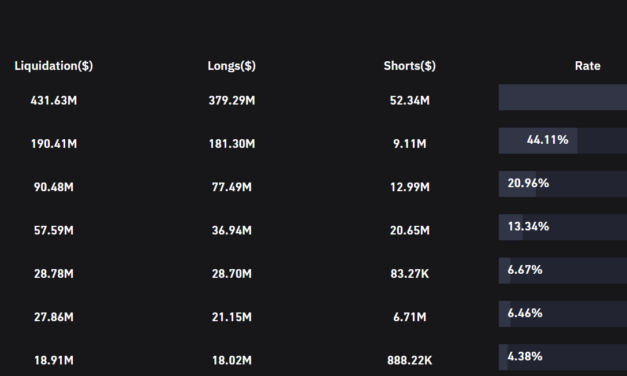
The crypto market turmoil entered the third week of September as most of the cryptocurrencies started the week on a bearish note. The total crypto market cap dipped below $1 trillion again, with several cryptocurrencies recording a double-digit downfall over the past 24 hours.The ongoing bearish turmoil has led to nearly half a billion in liquidations for the leverage crypto traders over the past 24 hours. Data from Coinglass highlight that 130,087 traders were liquidated with a total liquidations value of $431.51 million. Bitcoin (BTC) leverage traders lost $44.5 million, followed by Ether (ETH) traders with a total liquidation of $8.39 million.Long traders made a significant chunk of losses on majority of the exchanges with the average difference between the amount of long and short liquidations being 10X.Liquidations on Different Exchanges Source: CoinglassThe current market turmoil is being attributed to several macroeconomic factors, including the recently released consumer price index (CPI) data released on Sept. 13 that showed inflation is yet to cool off. BTC’s price fell nearly $1,000 within minutes of the CPI data release. Since then, the market showed some will to move up over the weekend but saw another bloodbath earlier on Monday.US inflation shows persistent US retail inflation w/acceleration at August core. Headline drops less than forecast to 8.3%, while Core CPI rose to 6.3%. pic.twitter.com/ZAhxPUlvjn— Holger Zschaepitz (@Schuldensuehner) September 13, 2022The higher CPI data is expected to be followed by a Fed rate hike in the upcoming meeting scheduled for Sept. 21. Market pundits have predicted that the rate hike could be the biggest in 40 years as a measure to control the soaring inflation.According to the CME FedWatch Tool, the market has now fully priced in a minimum 75-basis-point hike for the Fed funds rate and is not discounting the chances of 100 basis points. A 100-point increase would be the Fed’s first such action since the early 1980s.Related: Here is why a 0.75% Fed rate hike could be bullish for Bitcoin and altcoinsThe recently concluded Ethereum Merge was also blamed by many as a buy the rumor, sell the news” event, where the price of Ether (ETH) rose as high as $2,000 in the run-up to the Merge, but has now declined to $1,300 post Merge.The majority was right. The #Ethereum Merge was a sell the news event.— MMCrypto (@MMCrypto) September 15, 2022

With the stock and crypto markets seeing a similar bearish trend, popular trader Clark was quick to point toward the similarities of current market conditions to that of the 1970s. Also worth noting, leading into this, market behavior is on par with previous years in terms of realized vol. Nov-December should be good months. (Past returns not predictive of future results) pic.twitter.com/KKOKEIIvis— Clark (@CanteringClark) September 18, 2022

In his tweet, Clark noted that the market could turn bullish again towards the end of the year in the months of November and December. Thus, the crypto market could see another bullish rally in tandem with the stock market towards the end of 2022.

Čítaj viac

Bitcoin proponent claims PoS rewards aren't 'yields,' Vitalik snaps back

Independent developer and Bitcoin proponent Udi Wertheimer created quite a buzz on crypto Twitter earlier on Sept. 12, after he claimed that a proof-of-stake (PoS) based yield reward system for staking is more of a penalty for non-stakers.Wertheimer who is a well-known Ethereum critic believes that the PoS staking reward system isn’t exactly a yield reward. In PoS staking, a user cannot do anything with their staked ETH, while those who don’t stake their tokens and participate in other network activities aren’t rewarded.With Ethereum Merge just a couple of days away, the sly on the PoS system didn’t really go down well with the Ethereum community including co-founder Vitalik Buterin. Buterin responded to Wertheimer’s criticism by claiming that Bitcoin mining is not much different from PoS staking as proof-of-work (PoW) mining “penalizes anyone who has a smaller percentage of hashpower than their percentage of the coin supply.”And PoW penalizes anyone who has a smaller percentage of hashpower than their percentage of the coin supply ☺️(Actually, it penalizes much more than that because profit < revenue, but you get the point)— vitalik.eth (@VitalikButerin) September 12, 2022Wertheimer was quick to remind Buterin that miners and holders are two different sets that don't necessarily overlap in the PoW ecosystem, while the same can’t be said for the PoS system. He explained further that with liquid staking, one could expect holders and stakers to overlap due to the flaw in the rewarding system.  Related: Ethereum Merge: How will the PoS transition impact the ETH ecosystem?Another user claimed that the yield comes from the gas fee paid by the user for transaction processing, however, Wertheimer was quick to point out that on an average fee per block only makes 1% of the total yield rewards. people expect like 2-5% “yield”, if you count fees only they’d get 0.03% yield, so, umm, ask them if they think that’s cool i guess— Udi Wertheimer (@udiWertheimer) September 12, 2022Thus, the rest of the yield reward has to come from somewhere else, which many believe could come from printing more ETH, making the value of existing ETH lower and inflationary.If ETH devs decide to print more ETH and give it to people 'staking', that is not yield but just token inflation at expense of holders. 1st principles: if they up staking rewards to 50%, does it mean they created a 50% yield? Nope.ETH is great already, no need to make sh*t up https://t.co/SCaUbn9VTy— Jordi Alexander (@gametheorizing) July 26, 2022The Merge slated between Sept. 13-15 depending on the network hashpower, will see Ethereum move to a PoS mining consensus from its current PoW one. Ethereum developers and proponents claim that the move would make the network become more environment-friendly and scalable. However, critics have pointed out the centralization aspect of the Merge and how the move can make the Ethereum network more vulnerable to security risks.

Čítaj viac

DApp activity rises 3.7% in August for the first time since May: Finance Redefined

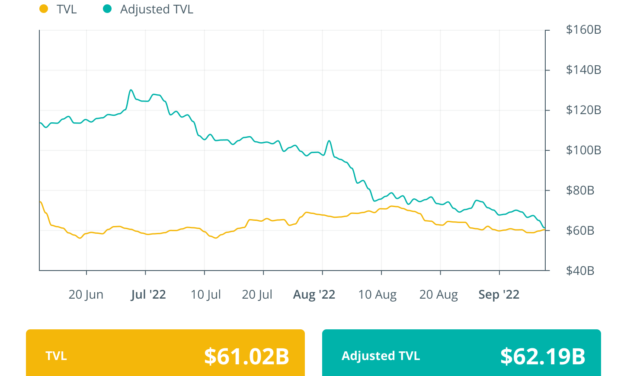
Welcome to Finance Redefined, your weekly dose of essential decentralized finance (DeFi) insights — a newsletter crafted to bring you significant developments over the last week.Decentralized applications, or DApps, finally showed a glimmer of recovery in August as the daily average of unique active wallets rose by 3.7% compared to May.With just under a week left for the Merge, SEBA Bank has opened Ethereum staking services for institutions. On the other side, layer-2 scalability solutions are hopeful of seeing a significant cut in their carbon emissions post Merge.This past week, two DeFi protocols became victims of coordinated flash loan attacks. On Wednesday, Avalanche-based lending protocol Nereus Finance became the victim of a crafty hack that saw a user net $371,000 worth of USD Coin (USDC) using a smart contract exploit. The very next day, on Thursday, New Free DAO, a nonfungible token- (NFT)-focused project, lost nearly $1.25 million in another similar flash loan attack.Top-100 DeFi tokens by market cap finally saw a week of green after nearly two weeks of dominant bearish price action. Most of the tokens recorded double-digit gains, with Luna Classic (LUNC) — formerly Terra (LUNA) — making an entry into the top 30 with over 100% gains in the past seven days.DApp activity rises 3.7% in August for the first time since May: ReportDApps showed a slight recovery for the first time since May, with the daily average of unique active wallets (UAWs) increasing 3.7% on a month-over-month basis, according to a report from DappRadar. The rise was partially driven by the Flow protocol, which rose 577% UAW due to Instagram’s support of its NFTs and the game Solitaire Blitz. On the other hand, Solana UAW shrank by 53% in August from the previous month, while transactions dropped by 68%, the findings showed.Continue readingSEBA Bank to provide Ethereum staking services to institutionsAs the Ethereum network moves from a proof-of-work (PoW) to a proof-of-stake (PoS) consensus, a digital asset platform initiated a service for institutions to dive into Ether (ETH) staking. In an announcement sent to Cointelegraph, Swiss digital asset banking platform SEBA Bank said that it has launched an Ethereum staking service for institutions that want to earn yields from staking on the Ethereum network. According to the firm, the move is a response to the growing institutional demand. for DeFi services.Continue readingDegens borrowing ETH to get fork tokens create headaches for DeFi platformsThe growing number of speculators taking out Ether loans to maximize their potential to earn forked Ether proof-of-work tokens (ETHPoW) has been causing headaches for DeFi protocols.The issue has been gaining traction over the past month or so as a significant number of Ether miners are expected to continue working on a forked PoW chain or possibly even multiple chains post the long-awaited Merge.Continue readingAvalanche flash loan exploit sees $371K in USDC stolenAvalanche-based lending protocol Nereus Finance has been the victim of a crafty hack that saw a user net $371,000 worth of USD Coin using a smart contract exploit.Blockchain cybersecurity firm CertiK was one of the first to detect the exploit on Tuesday, indicating that the attack impacted liquidity pools on Nereus relating to decentralized exchange (DEX) Trader Joe and automated market maker Curve Finance.Continue readingDeFi protocol token NFD crashes by 99% after a flash loan attackNew Free DAO, a DeFi protocol, faced a series of flash loan attacks on Thursday, resulting in a reported loss of $1.25 million. The price of the native token has dropped by 99% in the wake of the attack.Unlike normal loans, several DeFi protocols offer flash loans that allow users to borrow large amounts of assets without upfront collateral deposits. The only condition is that the loan must be returned in a single transaction within a set period. However, this feature is often exploited by malicious adversaries to gather large amounts of assets to launch costly exploits that target tarDeFi protocols.Continue readingDeFi market overviewAnalytical data reveals that DeFi’s total value locked registered a minor change from the past week. The TVL value was about $61.02 billion at the time of writing. Data from Cointelegraph Markets Pro and TradingView show that DeFi’s top 100 tokens by market capitalization had a bullish week with the majority of the tokens seeing double-digit gains, while a few others continue to trade in the red.LUNC was the biggest gainer on the weekly basis, registering a 101% gain over the past 7 days, followed by Chainlink (LINK) with 14.8% gains. Compound (COMP) rose by 7.71% and PancakeSwap (CAKE) registered a 6.24% gain on the weekly charts.Thanks for reading our summary of this week’s most impactful DeFi developments. Join us next Friday for more stories, insights and education in this dynamically advancing space.

Čítaj viac

Japanese gov't issues NFTs to reward local authorities' work

The Japanese government has become one of the first to issue nonfungible tokens (NFTs) as a form of supplementary rewards to recognize the work of local authorities who have excelled at using digital technology to solve local challenges.The awards were handed out by the cabinet secretariat, a government agency that is headed by the nation’s chief cabinet secretary Hirokazu Matsuno during the “Summer Digi Denkoshien 2022” ceremony. The event was also attended by the country’s prime minister Fumio Kishida, reported Coinpost.Seven mayors received recognition for their cities’ ideas centered on the digital economy. Among them was the mayor of Sakata, Yamagata Prefecture, whose administration suggested using electric vehicles for local deliveries. An NFT prize was also given to Maebashi in the Gunma Prefecture for their idea for a platform that uses cameras on mobile devices to track changes in traffic conditions in real time.The NFTs were issued on the Ethereum blockchain using the proof of attendance protocol (POAP). The issued NFTs are non-transferable and have been developed in a way to make them suitable for commemoration. Being non-transferable, these NFTs cannot be traded on the secondary market.The NFTs were issued using Indiesquare’s low-cost blockchain platform, the Hazama Base. The same platform was used earlier to issue and distribute NFTs at an event held by the Liberal Democratic Party Youth Bureau.Related: Japan considers implementing tax reforms to prevent capital flight of crypto startupsJapan is known as a pro-technology and innovation country, where crypto has been regulated by the government as a trading asset. The country’s prime minister has also shared interest in the use of NFTs on a number of occasions in the past. Thus, the recent initiative from the government could become a tradition to carry forward.NFTs gained a lot of traction during the peak of the bull run, however, with the downturn in the crypto market, the NFT market has seen a steep decline in interest as well. With many pundits quick to dismiss NFTs as a bull run fueled mania, initiatives taken by the Japanese government highlight the adoption of the nascent tech beyond market

Čítaj viac

What the Ethereum Merge means for the blockchain’s layer-2 solutions

Ethereum is just over a week away from officially moving to a proof-of-stake (PoS) blockchain with the Merge slated for completion around Sept. 13–15. With the transition, Ethereum would abandon its current proof-of-work (PoW) chain, eliminating miners from the ecosystem. Ethereum is a vast ecosystem with thousands of decentralized applications and decentralized finance protocols working on top of it. Additionally, there are several layer-2 solutions, i.e., solutions built on top of the blockchain itself, the layer 1, to facilitate faster transactions and make Ethereum more scalable. The Merge would mark the completion of the second phase of the three-phase transition process. The upcoming event will only see the official change of consensus, where the Ethereum blockchain would start processing transactions on the PoS chain. However, there won’t be much impact on scalability or gas fees. The scalability fixes are meant to arrive after the completion of the third phase, which would introduce sharding, a form of parallel processing that Ethereum founders and developers have claimed would increase Ethereum’s transaction throughput exponentially.Will layer-2 solutions like Polygon, Arbitrum One, Boba Network and Loopering be viable after the Merge? Cointelegraph got in touch with industry insiders for insight into how these L2 ecosystems will be impacted by the Merge.Bitfinex chief technology officer Paolo Ardoino believes the Merge won’t have any impact on L2s as the Merge won’t solve the scalability solutions immediately. He told Cointelegraph that even after the completion of the third phase of the Ethereum transition, when it becomes monumentally scalable, L2s will still find a place in the ecosystem. He explained:“It will be business as usual for L2s. These solutions still have key value for short, medium and long-term scalability. L2s will still be needed to fulfill the growing demand and usage of blockchains across the globe. Even 100,000 transactions per second would not be sufficient to meet true global demand and adoption.”Anton Gulin, global business director at AAX Exchange, told Cointelegraph that L2s wouldn’t face many issues or see a need for great technical changes as the translation is two years in the making, so L2 chains are already prepared. “The more significant point is how successful the Merge would be and whether it can meet the momentum. With the more significant investments flowing into space, we can expect even more performing solutions, regardless of what will happen after the Merge. The rest of the L2s would either adapt or seize to exist,” he explained.Recent: How high transaction fees are being tackled in the blockchain ecosystem It’s a general misconception that the Ethereum scaling solutions would eventually make L2 solutions redundant or of no use, but a majority of L2 solutions such as Polygon have said that the change of consensus for Ethereum won’t really cut down the need for such L2 scaling solutions. In an official blog post, the protocol said:“While the merge does pave the way for sharding, this future upgrade will not be enough to scale Ethereum. In fact, Polygon will benefit from it, and it will boost the performance of our scaling solution.”Looking at the short-term and long-term role of L2s post MergeMany people are wondering how L2 ecosystems fit into the picture, given that Ethereum is leveraging the Merge to build its infrastructure. L2 integrations have boosted Ethereum’s performance for a while now. But experts have claimed that the Merge will not just improve the Ethereum ecosystem, but that L2s are set to become more efficient as well. Vlad Totia, a research analyst at L1 blockchain platform Zilliqa, told Cointelegraph that L2 will improve in tandem with L1. He explained:“Every L2 that is built to help Ethereum scale moves together with Ethereum. Meaning that if, for example, we take that Arbitrum is faster than Ethereum before the Merge and the L1 itself becomes faster, then Arbitrum essentially scales in speed as well. User and developer experience with L2s will improve in tandem with how Ethereum improves over time.”The Merge is also expected to make L2s more environmentally friendly with the likes of Polygon claiming it would eventually cut their carbon emission by 60,000 metric tons, or 99.91% of their current value.The Merge will be erasing 60,000 Tonnes of #Polygon’s Carbon Footprint. Ethereum’s transition to the PoS consensus will reverberate throughout the broader ecosystem in many ways, but it will have a singular impact on the carbon emissions profile of Polygon’s network.[1/11] pic.twitter.com/RNkxvRQ1EL— Polygon – MATIC (@0xPolygon) September 7, 2022Experts believe the environmental aspect of the PoS transition could pave the way for better adoption via L2s. Pat White, CEO, and co-founder of enterprise digital asset platform Bitwave, told Cointelegraph that the shift to proof-of-stake would be key to legitimizing the Ethereum network and bringing more enterprises to the blockchain. He said that a “substantial number of businesses have been sitting on the sidelines of digital assets because of environmental concerns. The Merge might be the catalyst to bring enterprise into the fold.”Apart from efficiency and environmental benefits, the transition is expected to enhance the network’s security against coordinated attacks. White explained that PoW blockchains are vulnerable to reorg attacks, “while similar attacks are much more difficult to occur on a PoS blockchain since the attacker would have to burn two-thirds of the supply of ETH.”This de-risking of ETH will open floodgates of institutional capital as the network is more secure and friendly to corporate environmental, social and governance goals, White added.The Merge would mark the completion of the second phase of the three-phase process. A significant chunk of scalability features such as sharding and high transaction throughput will be achieved after the completion of the third and final phase, slated for the end of 2023.Daniel Nagy, chief scientist at decentralized storage and communication system provider Swarm Foundation, shed light on a different aspect of the Merge and its long-term impact on L2s. He told Cointelegraph that with the introduction of long-term scalability solutions, many projects, especially nonfungible token (NFT) projects, might opt for L1 rather than L2s. He said that in more advanced L2 transaction systems, the rollups will be significantly helped by the Merge and might also eat into the current market share of side-chains. Nagy added that rollups, both the optimistic and the zero-knowledge kind, will vastly benefit from sharding, even in its most primitive form, where it is only useful for storing guaranteed-availability data. Recent: Mt. Gox creditors fail to set repayment date, but markets to remain unaffectedThis will also not materialize immediately with the Merge but can be expected soon thereafter. He explained, “rollups will probably gain adoption, while side chains can be expected to lose popularity both to rollups and to the more scalable L1 enabled by the Merge.”Many industry insiders have indicated that L2s will continue to thrive and gain traction on the Ethereum blockchain irrespective of how scalable the network becomes, predicting that even though the Ethereum mainnet might see some traction after the completion of all phases, L2s will continue to be the execution layer.

Čítaj viac

Získaj BONUS 8 € v Bitcoinoch

nakup bitcoin z karty

Registrácia Binance

Burza Binance

Aktuálne kurzy