Autor Cointelegraph By Prashant Jha

Alameda Research FTT token transfer from September fuels wild speculations

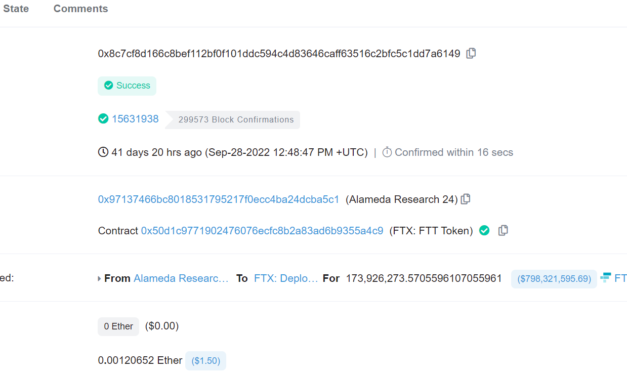
The rumors about the possible liquidity crisis for the world’s third-largest crypto exchange turned out to be true. Just a day after assuring funds are fine, and they have the assets to back customer’s funds, FTX CEO Sam Bankman-Fried (SBF) announced on Tuesday that Binance has shown intent to acquire the global crypto platform to help with the liquidity crisis.The liquidity crunch came as a surprise to many, given FTX bailed out numerous firms during the crypto contagion caused by the downfall of LUNA and the insolvency of 3AC.Even as the crypto community process the events of the past 24 hours, the focus has now shifted toward other SBF-owned entities, especially Alameda Research, a leading principal trading firm. Alameda and FTX merged their venture capital operations in August 2022. Speculation mills are rife that Alameda reportedly faced a crisis itself during the crypto contagion in the second quarter and FTX bailed it out, which eventually came to bite it back.[embedded content]Lucas Nuzzi, the head of the crypto analytic firm Coinmetric, took to Twitter to point out the FTT market cap increased 124.3% on September 28 when 173 million FTX Token (FTT) worth over $4 billion became active on-chain. Nuzzi pointed out that on the same day, a total of $8.6 billion worth of FTT tokens were moved on-chain.Related: SBF tumbles off Bloomberg’s billionaire index after trouble at FTXTracking the fund transfers of the day, Nuzzi found 173 million FTT tokens from a 2019 ICO-era contract and the recipient of the $4 billion mint was reportedly Alameda Research.4/ The recipient of the $4.19 B USD worth of FTT tokens was no one but Alameda Research!So what? Alameda and FTX were intrinsically connected from day 1 and Alameda obviously participated in the FTX ICO.But what happened next was interesting…— Lucas Nuzzi (@LucasNuzzi) November 8, 2022On-chain data confirms the same as the entire 173 million FTT tokens were then transferred from the Alameda Research address to an FTT ERC-20 deployer controlled by FTX.FTT token transfer on-chain data, Source: EtherscanAccording to Nuzz’s theory, Alameda blew up along with 3AC and other crypto lenders due to its overleveraged position but survived due to funding from FTX. The crypto exchange saved Alameda from imploding during the Q2 contagion using 173 million FTT as collateral vested for September. Nuzz believes that FTX not only helped Alameda from imploding but subsequently saved 173 million vested FTT from liquidation.6/ Remember, the FTT ICO contract vests automatically.Had FTX let Alameda implode in May, their collapse would have ensured the subsequent liquidation of all FTT tokens vested in September.It would have been terrible for FTX, so they had to find a way to avoid this scenario.— Lucas Nuzzi (@LucasNuzzi) November 8, 2022

The Alameda bailout eventually proved too costly for FTX to fill, especially in the wake of the Binance feud-led FTT selling spree. This eventually made FTX insolvent forcing it to go under. Cointelegraph reached out to FTX for clarity on the issue but didn’t get a response at press time.

Čítaj viac

Ethereum Shanghai upgrade: EIP-3651 to cut gas fees for key network participants

Ethereum’s Shanghai upgrade, the next major upgrade post Merge, is slated for the second half of 2023. The upgrade would be a key milestone as it would allow holders who have staked their Ether (ETH) for years to withdraw them systematically and make the network more scalable.Apart from some of the major scalability upgrades, the key event would also tuck in a few minor Ethereum improvement proposals (EIPs), including EIP-3651, EIP-3855 and EIP-3860. Among all the upcoming improvement proposals, EIP-3651, called WARM Coinbase, could be a game changer that could reduce network fees for some of the key network participants called builders.Coinbase here is the name of the software that builders use to receive new tokens on the network. Every new transaction on the platform needs to interact with the coinbase software multiple times, The first interaction costs more as the software needs to “warm” up, and then the fees decline as the interactions increase. However, with the introduction of EIP-3651, the coinbase software will remain warm to begin with, thus requiring a lower gas fee to access it.Doing so would reduce fees for calls that make transfers to the COINBASE address, which is frequently used in systems like Flashbots (do they not have a Twitter???)— timbeiko.eth (@TimBeiko) March 4, 2022As the name suggests, builders are responsible for packaging Ethereum transactions into blocks, thus called block builders. These transactions are then forwarded to validators, who put them in the proper order in the blockchain. Related: Vitalik reveals a new section in the Ethereum roadmap: The ScourgeThese builders are paid by traders to arrange transactions in a block in a certain order, meaning traders pay higher gas fees to get their transactions validated earlier. Currently, Flashbots is the biggest builder in the Ethereum ecosystem accounting for 80% of relayed blocks. While validators using builders will benefit the most from the upgrade, traders who use builders to execute their trades could also benefit, as they no longer have to pay transaction fees for failed trades. Traders are currently charged for failed transactions as well because miners need to confirm transactions to the chain whether they succeed or fail.The testnet version for the Shanghai upgrade dubbed Shandong went live on Oct. 18, and Ethereum developers will be working on various implementations until September 2023.

Čítaj viac

What Musk’s Twitter acquisition could mean for social media crypto adoption

The emergence of Web3 technologies has brought Web2-based companies to consider amendments to their current products and services. Many leading brands are using Web3 technologies such as nonfungible tokens (NFTs) to promote their brand as well as show their affiliation with emerging tech. Social media is another domain where Web3 seems to have the biggest impact. Facebook rebranded to Meta and has shifted its whole focus from being a social media platform to becoming the future gateway of the metaverse. Meta-owned Instagram announced it would add NFT minting and trading services within the app. Reddit, another prominent social media platform, became a hub for NFT trading with 3 million wallet holders on the platform.Apart from NFTs, social media giants like Twitter and Reddit have added support for users to tip content creators in cryptocurrency. However, the majority of social media platforms lack inherent crypto integration. Twitter was reportedly working on developing its own crypto wallet, and with Elon Musk’s recent $44-billion acquisition, many believed that the social media platform could very well integrate a crypto wallet soon. However, recent reports suggested that Musk has halted crypto wallet plans for the time being. Despite the current setback in the crypto wallet integration, market pundits are hopeful of seeing more Web3-focused services on the social media platform. Martin Hiesboeck, head of blockchain and crypto research at cryptocurrency trading platform Uphold, told Cointelegraph that Twitter already supports crypto tipping, thus adding crypto wallet support is the next logical step:“Many in the crypto space are bracing themselves for how Elon Musk will impact the industry, and the response has been surprisingly optimistic. It’s clear Musk will drive the digital asset integration with the platform along. For instance, many platforms will offer their own crypto wallets in order to keep transactions close to their ecosystem. Twitter doing this is a logical step for a social network that already enables users to send tips in crypto.”Musk’s acquisition of Twitter made headlines not just because of the controversies leading up to the finalization of the deal but also because he took the social media platform private nearly 13 years after it went public. With Twitter being a private company now, Musk has a bigger say in the decision-making process, and many believe this will help him push for more crypto and Web3-related services on the platform.Jack Jia, head of GateFi at fintech firm Unlimint, told Cointelegraph that over the course of the past 18 months, a significant chunk of Web2 platforms have integrated Web3 support, and he hopes Twitter will move in a similar direction with Musk at the helm:“You can connect noncustodial wallets like MetaMask to your Instagram or Twitter and display your NFT as a profile picture. Google launched a fully managed Ethereum node service much like Infura and Alchemy. Then Coinbase and Revolut look more similar today than different in terms of crypto features and functionality. So, Musk’s Twitter will have a great impact on crypto, probably by launching something similar to Aave’s Lens Protocol, decentralizing Twitter to make it more censorship-resistant.”Web3 onboarding is still lagging behind and needs to be made simpler and faster, and social media platforms can help to onboard billions of people to Web3, practically overnight. This was evident from the success of the Reddit NFTs. Max Kordek, CEO of blockchain infrastructure platform Lisk, told Cointelegraph that Web3 is not an independent internet ecosystem but rather a transition, and these platforms are best suited for onboarding.“I think what people often misunderstand is that Web3 is not an exclusive new internet. Inside Web3 we also find Web2, the same way we found the former World Wide Web within Web2. In the case of social media integrating crypto, we are talking about a merge of Web2 and Web3. At the end of the day, a social media platform is just a distribution channel; Web3 doesn’t make them irrelevant. They will be ever more important in a more connected future,” he said.Social media’s past hinders crypto and Web3 aspirationsSocial media platforms started out as a medium to connect with people across the world, and in the Web2 ecosystem, they became an integral part of the internet. However, with time, these social media platforms also became a centralized host of data for millions of users, which major brands and companies rely on to advertise their products.Social media platforms’ reliance on advertisers has led to malpractice at several social media platforms. These platforms were found to be selling users’ sensitive data to advertisers, and poor security measures have also led to data leaks and violations of privacy rights. This is the reason Kayla Kroot, co-founder and director of design at decentralized publishing protocol Koii Network, believes these social media companies’ crypto aspirations can damage the industry in the long term. Kroot cited the example of the recent controversy around Musk’s plans to introduce an $8-per-month fee for the infamous “blue tick,” telling Cointelegraph:“While any major mainstream technology platform’s integration of cryptocurrency may be seen as a positive step for adoption, the deep-rooted capitalistic tendencies of social media companies indicate that it would damage the industry in the long term. If mishandled, these integrations will push millions of potential users away. One recent example of this is Twitter’s controversial move towards requiring verified members to pay $8+ monthly for Twitter Blue.”She further noted growing awareness around data autonomy and user privacy — areas especially valued within the blockchain community — and said that a move to integrate cryptocurrency “into networks that actively violate the core beliefs of the community will be seen by crypto natives for what it is: a cash grab. The perception by the larger population could be much worse, damaging the perception of cryptocurrency altogether.”Meta is a prime example of this as the firm is struggling to transition from its Web2-based origins into a fully decentralized, Web3 ecosystem. Crypto integrations that are driven by profit and that don’t align with the ethos of the crypto community will not only alienate crypto-native users but could add fuel to the anti-crypto fire. At its core, blockchain technology promotes distributed governance and ownership for users, but the larger social media platforms are still very centralized, actively exploiting their users’ content for traffic and revenue.Currently, most popular creators on traditional social media platforms are driving platform traction, but the platforms themselves are benefiting from that traction with ad revenue, not the creators. Thus, a majority of these crypto integrations seem to bank on the trend rather than truly work within the ethos of the emerging technology.Tom McArdle, chief operating officer of decentralized messaging services Satellite.im, called Twitter’s Web3 aspirations a “classic wolf-in-sheep’s-clothing moment for Web3.” He told Cointelegraph, “It is likely that crypto will be integrated into the Twitter platform post-acquisition. Just adding the ability to pay in Bitcoin or Dogecoin on top of an existing Web2 technology stack is not a step forward for the Web3 movement. Twitter will continue to operate in a centralized nature and will more aggressively monetize platform participants since Musk has levered up the company to prosecute the acquisition and now needs $1 billion a year just to cover interest expenses.”“The integration of crypto payments is just another revenue stream and has nothing to do with the social and ethical priorities that come with the Web3 frontier — transparency, user privacy and data ownership.”On one hand, the growing interest in Web2 social media platforms in integrating Web3 technologies has been lauded as a step toward greater adoption. On the other hand, Web3 experts believe that social media platforms are only banking on the trend and not the ethos of Web3, which could eventually drive away true crypto adoption, citing the example of Meta and its recent failure to rebrand itself as a Web3 brand.

Čítaj viac

Wuhan omits NFTs from metaverse plan amid regulatory uncertainty in China

The Chinese city of Wuhan had reportedly shelved its aspirational nonfungible tokens (NFTs) plans amid growing regulatory uncertainty around the crypto and Web3 technologies in the country.Wuhan first announced its plans to support metaverse and NFTs in the aftermath of the coronavirus breakout as a measure to boost its economy ruined by the pandemic. The city was the epicenter of the COVID-19 breakout.The Wuhan government’s draft industrial plan for the city’s metaverse economy development included a line about NFTs. However, that part has now been omitted from the latest version, according to a report by South China Morning Post. The report noted that the revised version still encourages businesses to focus on decentralized tech and Web3 but makes no mention of NFTs.Under the newly revised plan, Wuhan aims to foster more than 200 metaverse companies and build at least two metaverse industrial estates by 2025. Looking at the revised version of the draft, the Chinese government seems to do away with anything that involves the exchange of tokens or digital properties. The stance has been clear over the years as the government development plans have included metaverse-related technologies. For example, several Chinese cities, including the capital city of Beijing and Shanghai, have announced metaverse innovation plans, but any private business or tech giants involved with NFTs have faced government hostility.Related: NFT platforms in China grow 5X in four months despite government warningsAt the start of the year, China was aiming to separate NFTs from cryptocurrencies in a bid to help the nascent industry grow despite a blanket ban on the latter. This resulted in a peak of interest among Chinese communities as NFT marketplace Opensea was flooded with listings from Shanghai during COVID lockdowns. However, with the rise in popularity, the number of fraudulent activities rose as well, leading to several government warnings to investors against NFT trade.China was very clear with its stance on crypto use in the country and eventually imposed a blanket ban in 2021 after several years of numerous restrictions. However, the government’s stance on emerging Web3 technologies, especially those that involve the exchange of tokens or digital collectibles (NFTs), seems far from clear at the moment.

Čítaj viac

JP Morgan executes first DeFi trade on a public blockchain: Finance Redefined

Welcome to Finance Redefined, your weekly dose of essential decentralized finance (DeFi) insights — a newsletter crafted to bring you significant developments over the last week.The first week of November proved to be the institutionalization of DeFi markets as major international banks and financial institutions executed and completed their first DeFi transaction.The global financial giant JP Morgan completed its first-ever cross-border transaction using DeFi on a public blockchain with the help of the Monetary Authority of Singapore’s (MAS) Project Guardian. DBS Bank started a trading test of foreign exchange (FX) and government securities using permissioned DeFi liquidity pools.Apart from JP Morgan and DBS Bank, the Bank of International Settlements also said that automated market-making technology in DeFi can serve as a “basis for a new generation of financial infrastructure.”In other news, the Team Finance hacker returned $7 million of the $14.5 million stolen and intends to keep 10% of the stolen amount as a bounty. MakerDAO co-founder Nikolai Mushegian was found dead at 29 in Puerto Rico, which started several conspiracy theories.Looking at the weekly DeFi market performance, the majority of the DeFi tokens in the top 100 started the first week of November on a bullish note. The Fed rate hike helped a majority of the tokens to post double-digit weekly gains.JP Morgan executes first DeFi trade on a public blockchainMultinational banking firm JP Morgan has successfully executed its first-ever cross-border transaction using DeFi on a public blockchain. The trade was facilitated by the MAS’ Project Guardian on Nov. 2.The pilot was another step into examining how traditional financial institutions can use tokenized assets and DeFi protocols to conduct financial transactions, among other use cases. Continue readingBank for International Settlements will test DeFi implementation in forex CBDC marketsAccording to a new announcement on Nov. 2, the Bank for International Settlements, or BIS — along with the central banks of France, Singapore and Switzerland — will embark on a new initiative dubbed “Project Mariana” in its exploration of blockchain technology. Project Mariana intends to use DeFi protocols to automate foreign exchange markets and settlements. This includes using DeFi protocols to stimulate the hypothetical exchange of cross-border transactions between the Swiss franc, euro and Singapore dollar wholesale central bank digital currencies, or CBDCs. Continue readingSingapore bank DBS uses DeFi to trade FX and state securitiesDBS Bank, a major financial services group in Asia, is applying DeFi to a project backed by Singapore’s central bank. DBS has started a trading test of FX and government securities using permissioned, or private, DeFi liquidity pools, the firm announced on Nov. 2.The development is part of Project Guardian, a collaborative cross-industry effort pioneered by the MAS. Conducted on a public blockchain, the trade included the purchase and sale of tokenized Singapore government securities, the Singapore dollar, Japanese government bonds and the Japanese yen.Continue readingMakerDAO co-founder Nikolai Mushegian dies at 29 in Puerto RicoNikolai Mushegian, the co-founder of the cryptocurrency lending platform MakerDAO and decentralized Dai (DAI) stablecoin, was found dead in Puerto Rico last week.Mushegian died due to drowning after being dragged by sea currents on the Condado beach in San Juan, the local newspaper El Nuevo Día reported. Mushegian had no vital signs by the time his body was rescued. The Condado beach is considered one of the world’s most dangerous places for swimmers, reportedly taking the lives of at least eight people in 2021.Continue readingTeam Finance hacker returns $7M to associated projects after exploitFour projects have received some $7 million worth of tokens from the hacker behind the $14.5 million Team Finance exploit on Oct. 27. Over the weekend, the attacker confirmed in a series of messages that they would keep 10% of the stolen fund as a bounty and return the other tokens to the affected projects.The exploiter — a self-described “whitehat” — drained assets from Team Finance through the Uniswap v2-to-v3 migrationContinue readingDeFi market overviewAnalytical data reveals that DeFi’s total value registered another weekly surge rising to $52 billion. Data from Cointelegraph Markets Pro and TradingView show that DeFi’s top 100 tokens by market capitalization had a bullish week, with the majority of the tokens trading in the green on the 7-day chart.Fantom (FTM) was the biggest gainer over the past week with 25..38% surge, followed by Chainlink (LINK) with a 19.05% surge. The Graph (GRT) surged over 17%, while Basic Attention Token (BAT) registered a 15.66% weekly surge.Thanks for reading our summary of this week’s most impactful DeFi developments. Join us next Friday for more stories, insights and education in this dynamically advancing space.

Čítaj viac

Získaj BONUS 8 € v Bitcoinoch

nakup bitcoin z karty

Registrácia Binance

Burza Binance

Aktuálne kurzy