Autor Cointelegraph By Prashant Jha

FTX crisis could extend crypto winter to the end of 2023: Report

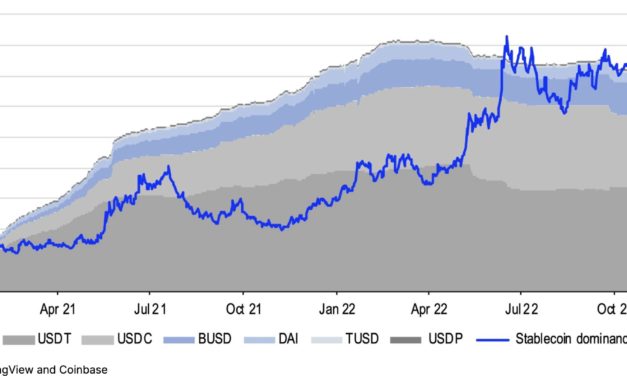
The FTX crisis has deterred investor confidence and created a liquidity crisis in the crypto market, which could very well extend the crypto winter until the end of 2023, according to a new report.A research report from Coinbase analyzing the fallout in the crypto ecosystem in the wake of the FTX collapse noted that the implosion of the world’s third-largest crypto exchange has created a liquidity crisis that may contribute to an extended crypto winter.Many institutional investors in FTX had their investments stuck on the platform after it filed for bankruptcy on Nov. 11. The FTX implosion has also deterred investors and large buyers away from the crypto ecosystem. Coinbase highlighted that the stablecoin dominance has reached a new high of 18%, indicating that the liquidity crisis might extend at least until the end of the year.Stablecoin dominance evaluates the relative dominance of stablecoins within the crypto ecosystem as compared to the total market cap. As stablecoin dominance rises, it suggests that market participants are exiting out of crypto assets and into dollar-pegged stablecoins.Related: FTX collapse: The crypto industry’s Lehman Brothers momentThe report predicted that even though the possibility of a crypto contagion is limited now, as the exchange has filed for bankruptcy, the crypto market might see “second-order effects” from counterparties that may have lent or interacted with either FTX or Alameda. An excerpt from the report reads:“The unfortunate events surrounding FTX have undoubtedly damaged investor confidence in the digital asset class. Remediation will take time, and very likely this could extend crypto winter by several more months, perhaps through the end of 2023 in our view.”The FTX collapse has come to bite the crypto market hard, especially at a time when traditional financial markets have registered a significant bounce back in the wake of lower-than-expected consumer inflation data. Many believed, if not for the self-inflected ongoing crisis, the crypto market would have seen a similar market uptick.

Čítaj viac
FTX hacker still draining exchange wallets? Analyst calls it on-chain spoofing

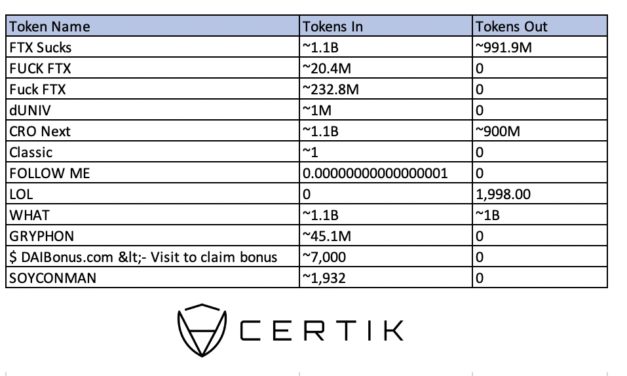
The FTX hacker that drained over $450 million worth of assets just moments after the doomed crypto exchange filed for bankruptcy on Nov. 11, continues to drain assets from the exchange, four days after the hack was first flagged.Crypto analytic firm Certik in a Tweet noted that the hacker wallet is still draining crypto assets from the wallets associated with the FTX and FTX.US. The FTX hacker wallet currently holds $62 million worth of assets.Since Nov. 12 the hacker wallet has received and swapped 3.2 billion meme tokens and sent 2.8 billion of these tokens to popular addresses. These meme tokens mostly comprised profanity tokens such as FTX Sucks, F*ck FTX, CRO Next and more.Meme tokens sent and received by FTX exploit address. Source: CertikA crypto analyst who goes by the Twitter name of ZachXBT claimed the recent movement of funds is just on-chain token spoofing. The analyst claimed that Etherscan transfer logs can be spoofed and the recent movement of funds in the FTX hack saga is one example of that.The ERC-20 standard transfer and transferFrom functions can be modified to allow any arbitrary address to be the sender of tokens, as long as this is specified within the smart contract, resulting in a token being transferred from a different address than the one that initiated the transaction.These tokens can be sent to any address and then sent out of that address (to any other address), without the address owner having any control of those tokens. If you open the transaction and see “sent from,” it will show a different address.As Cointelegraph reported on Nov, 12, the hack was flagged right after FTX announced bankruptcy. At the time, out of the $663 million drained, around $477 million were suspected to be stolen, while the remainder is believed to be moved into secure storage by FTX themselves. The wallet owner was found swapping $26 million Tether (USDT) to Dai (DAI) via 1inclh and approved Pax Dollar (USDP) — a Paxos-issued stablecoin — for trade on CoW Protocol. The wallet also approved transfers and sales of other cryptocurrencies, including Chainlink (LINK), Compound USDT (cUSDT) and Staked Ether (stETH).The fact that hackers managed to drain assets from FTX global and FTX.US at the same time, despite these two entities being completely independent, became a hot topic of discussion raising speculations about it being an insid job. Certik’s director of security operations Hugh Brooks told Cointelegraph that on-chain evidence points strongly toward that possibility:”Sticking to onchain evidence, unless there was a private key compromise (of which there is no evidence of at current) then we can’t rule out that someone with access to the FTX Exchange and FTX US wallets moved the funds into the black hat wallets”Kraken’s chief security officer Nick Percoco later Tweeted that they were aware of the user’s identity but did not share any more information publicly. Certik told Cointelegraph that Percoco might be referring to the white hack involved in moving the funds to cold wallets.

Čítaj viac

Solana TVL drops by almost one-third as FTX turmoil rocks ecosystem: Finance Redefined

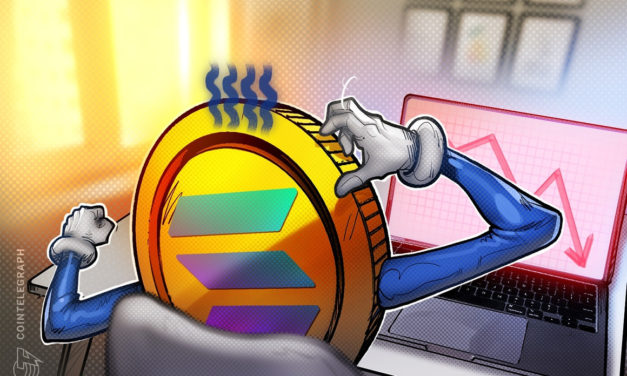
Welcome to Finance Redefined, your weekly dose of essential decentralized finance (DeFi) insights — a newsletter crafted to bring you significant developments over the last week.The second week of November could have been a bullish week, as consumer price index data released on Nov. 10 indicate lower-than-expected inflation. This resulted in a significant rally for traditional stocks, but the crypto ecosystem is currently fighting its own demon.The FTX turmoil has not just tanked the price of the native token FTX Token (FTT), but any token associated with Sam Bankman-Fried or his associate company. Solana, a top-10 cryptocurrency and one of Bankman-Fried’s biggest investments, lost 32% of its market cap over the past couple of days.Chainlink Lab said it would offer proof-of-reserve services for embattled exchanges. The new concept came to light after the collapse of the FTX exchange as a measure that can restore trust in crypto exchanges through greater transparency.The DeFi ecosystem also faced criticism for denying user access based on wallet content. Entrepreneur Brad Mills criticized the so-called decentralized ecosystem and said DeFi rebuilt everything wrong with Wall Street on a blockchain.It was a bloodbath on the crypto street this past week, with the majority of the top 100 DeFi tokens trading in red in the wake of FTX turmoil.Solana TVL drops 32.4% as FTX turmoil rocks ecosystemThe total value locked (TVL) on the Solana chain has plummeted 32.4% in the last 24 hours, as news stemming from the collapse of FTX has sent waves through the crypto ecosystem. According to DefiLlama, at the time of writing, Solana’s TVL has fallen to $423.68 million, down 32.4% in the last 24 hours, a far cry from its all-time-high (ATH) of $10.17 billion on Nov. 9, 2021.Continue readingChainlink Labs offers proof-of-reserve service for embattled exchangesChainlink Labs offered its proof-of-reserve product as a solution to future trust issues in the crypto exchange market on Nov. 10. In a tweet thread, Chainlink Labs asked, “Will crypto continue to repeat the mistakes of the traditional black-box financial industry? Or will a better system emerge?”In answer to this question, it offered its proof-of-reserve product, which it said is useful “for verifying centralized exchange asset reserves, off-chain bank account balances, cross-chain collateral, real-world asset reserves, and much more.”Continue readingDeFi faces criticism for denying user access based on wallet contentWhile DeFi is expected to be an upgrade to traditional finance mechanisms, some believe that denying users access to decentralized exchanges based on their wallets is a backward move. In a tweet, entrepreneur Brad Mills criticized DeFi for denying users access to decentralized exchanges (DEXs) due to various factors such as location and wallet content. Because of this, Mills described the future of Web3 as a “surveillance panopticon” and said that it has rebuilt everything wrong with Wall Street but on a blockchain. Within the tweet, Mills also shared an image of a pop-up message from 1inch Network’s decentralized application (DApp) restricting access because of the wallet address used.Continue readingReport: GALA token exploit resulted from public leak of private key on GitHubAccording to a new post by blockchain security firm SlowMist on Nov. 7, it appears that the last week’s token exploits affecting the GameFi project Gala Games resulted from a public leak of applicable security keys on GitHub. As told by SlowMist, pNetwork, the cross-chain interoperability bridge used by Gala Games on the BNB Smart Chain, had three privileged roles in its smart contract pGALA.SlowMist went on to explain that both the DEFAULT_ADMIN_ROLE and MINTER_ROLE roles were controlled by pNetwork during initialization. Meanwhile, the proxy admin contract was an externally owned address responsible for upgrading the pGALA contract. However, the firm posted a screenshot alleging that the plaintext private key for the proxy admin owner address was exposed and publicly viewable on GitHub.Continue readingDeFi market overviewAnalytical data reveals that DeFi’s total value locked plunged to $41 billion. Data from Cointelegraph Markets Pro and TradingView show that DeFi’s top 100 tokens by market capitalization had a bearish meltdown due to the FTX saga, with the majority of the tokens registering double-digit losses over the past week.Thanks for reading our summary of this week’s most impactful DeFi developments. Join us next Friday for more stories, insights and education in this dynamically advancing space.

Čítaj viac

FTX collapse: The crypto industry’s Lehman Brothers moment

The world’s third-largest cryptocurrency exchange, FTX, started the year with a $400 million Series C funding round, taking its valuation to over $32 billion. Ten months later, the crypto exchange is staring down the possibility of bankruptcy after its bid to be acquired by Binance failed.FTX was seen as one of the largest global crypto players as it established itself with multiple mainstream brand and sponsorship partnerships and billions in fundraising. The crypto exchange’s finances were never in question, given it bailed out multiple lending firms during the crypto contagion in the second quarter of 2022. However, things took a wild turn in the second week of November.It started with a report about Alameda Research’s illiquid FTX Token (FTT) holdings and the discrepancy in the market cap of FTT. The liquid market cap of FTT tokens was about $3.35 billion, while Alameda held about $5.5 billion worth of FTT in collateral and debt leverages.The report was followed by Binance CEO Changpeng Zhao taking to Twitter to announce that they are liquidating all their FTT holdings which the exchange received as part of its exit from FTX equity last year. Binance received roughly $2.1 billion cash equivalent in Binance USD (BUSD) and FTT. However, more than the liquidations, it was the wording of Zhao’s tweet that drew attention. He said that they don’t support people who “lobby against other industry players behind their backs.”Liquidating our FTT is just post-exit risk management, learning from LUNA. We gave support before, but we won’t pretend to make love after divorce. We are not against anyone. But we won’t support people who lobby against other industry players behind their backs. Onwards.— CZ Binance (@cz_binance) November 6, 2022Zhao’s sly against Sam Bankman-Fried and his lobbying efforts against the decentralized finance (DeFi) market created a panic in the market, leading to heavy selling of FTX’s native token, FTT. Bankman-Fried came out the next day to ensure that everything was fine with the exchange and that a competitor was creating FUD. However, that didn’t help Bankman-Fried’s case or the decline of FTT as the token continued to bleed and the price fell below $20, putting pressure on FTX.Just a day after assuring the crypto community that everything was fine and FTX had the funds to back customers’ assets, Bankman-Fried announced that FTX was in a deep liquidity crisis and that it was working on a plan to sell its global exchange to Binance. Some 48 hours later, Binance said that after looking at FTX’s internal books, it realized the situation was too advanced for it to help and backed out of the deal. As a result of corporate due diligence, as well as the latest news reports regarding mishandled customer funds and alleged US agency investigations, we have decided that we will not pursue the potential acquisition of https://t.co/FQ3MIG381f.— Binance (@binance) November 9, 2022

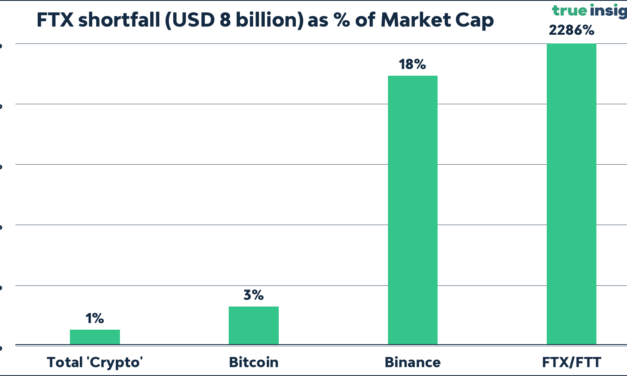
Another report stated that Bankman-Fried asked for $8 billion in emergency funding to make up for user’s withdrawals, indicating there was misappropriation of user funds as well. FTX’s $8 billion shortfall on the balance sheet against % market capitalization. Source: true insightsLooking at the numbers, it is clear why Binance decided to withdraw from the deal, as the $8 billion shortfall represents almost 20% of the Binance market cap after the recent slump.Recent: Maintaining decentralization: Are custody services a threat to DeFi protocols?Rob Viglione, CEO at Web3 infrastructure firm Horizen Labs, told Cointelegraph that the ongoing scenario could never happen in traditional finance as the United States Federal Deposit Insurance Corporation(FDIC) and Federal Reserve system provide regulatory oversight and act as a backstop. In the case of FTX he stated:“Here we had a web of financial obligations sitting on top of a volatile digital asset, FTT, that people seemed to forget can lose all liquidity in a crisis. The proximate reason, though, seems to be something akin to financial warfare in that a major holder, Binance, decided to suddenly dump all of their holdings on the spot market at once. This was done intentionally to crash the price and to collapse the web of financial obligations that ran across multiple organizations, probably in full recognition that many people would be hurt in the process.”When Bankman-Fried said the exchange was liquid, it may indeed have been the truth. The only problem being the exchange was heavily liquid in FTT, which it was also using extensively as collateral. Jonathan Zeppettini, strategy lead at Decred, called the FTX saga the crypto industry’s Lehman Brothers moment of this cycle, telling Cointelegraph:“It looks highly likely that a run on the exchange has revealed them to be operating on a fractional reserve basis after engaging in rehypothecation of customer assets to effectively bail out Alameda Research, the prop trading firm that was also founded by [Bankman-Fried], which became a zombie due to sustained losses. Simply put, they used a scheme involving overvalued junk collateral to raid the piggy bank and now the customers are left holding the bag.”Never use a token you print as collateralThe biggest culprit for FTX’s downfall turned out to be its associate firm, Alameda Research, and its own native token FTT. While crypto lenders like Three Arrows Capital and Celsius were struggling to cope with the Terra crash, Alameda managed to sail through the crisis. But, now it seems the trouble started brewing for the firm in the second quarter itself.As Cointelegraph previously reported, a Sept. 28 transaction of 173 million FTT, worth approximately $4 billion at that time, indicates FTX might have bailed out Alameda during the crypto contagion, knowing well that 173 million vested FTT will be released in September. According to on-chain data, FTT token supply increased by 124.3% on Sept. 28 when 173 million FTT tokens were created by a 2019 contract with Alameda as the recipient. Alameda then sent the entire newly minted FTT back to an FTX address, which led many to believe it was a return of debt. Rumors then abounded that FTX bailed out Alameda using unreleased FTT as collateral. Lucas Nuzzi, the head of the crypto analytic firm Coinmetric, believes FTX not only helped Alameda from imploding but subsequently saved 173 million vested FTT from liquidation. This theory was later confirmed in a Reuters report that suggested Bankman-Fried transferred at least $4 billion in FTX funds, secured by assets including FTT and shares in the trading platform Robinhood Markets Inc. A portion of these funds were customer deposits.1/ I found evidence that FTX might have provided a massive bailout for Alameda in Q2 which now came back to haunt them.40 days ago, 173 million FTT tokens worth over 4B USD became active on-chain. A rabbit hole appeared pic.twitter.com/DtCyPspME0— Lucas Nuzzi (@LucasNuzzi) November 8, 2022

Eric Chen, CEO and co-founder of DeFi research form Injective Labs, told Cointelegraph that FTX’s unchecked native token FTT-based liabilities increased to a point where it was impossible for the exchange to come back. He explained:“FTX was in a position in which their liabilities far exceeded their assets. Essentially, it was reported a few days ago that Alameda’s balance sheet was not very healthy. Alameda is closely tied to FTX and the firm also held a significant amount of their assets in the native FTX Token. As the value of FTT began to fall precipitously, Alameda likely could no longer cover their liabilities which led to a major whole across the FTX balance sheet.”Alameda had nearly $15 billion in assets by the end of June, with $3.66 billion of “unlocked FTT,” along with $2.16 billion in FTT collaterals. Joshua Peck, founder and chief investment officer at crypto hedge fund Truecode Capital, told Cointelegraph:“It appears that they have used this token to transfer customer funds from FTX to the Alameda hedge fund also owned by Bankman-Fried in exchange for collateral they could create out of thin air.”He added that if Alameda had been able to return the funds, clients would not have been at risk, but “it appears they made illiquid investments, so client funds would have required the sale of a number of interests ranging from tokens locked in smart contracts to venture investments, many of which are currently virtually valueless if sold at market value today.”Interests beyond cryptoSam Bankman-Fried was once seen as a prominent crypto personality with numerous successful fundraisers, mainstream sponsorship deals and a series of funding for other crypto startups. However, the public’s perception of Bankman-Fried took a wild turn after he was found lobbying for a bill that aims to curtail the budding DeFi market. The DCCPA draft bill was leaked online and proposed to eliminate anonymous crypto projects, with decentralized autonomous organizations and crypto exchanges required to legally register in the United States. Bankman-Fried’s heavy funding of the United States mid-term elections — rated at around $50 million — added to rumors of his lobbying efforts to get ahead of the competition caught up with him. Some in the crypto community have posited that his lobbying efforts in the United States, added to his notorious taunts against Zhao, were the key reasons that Zhao decided to publically liquidate FTT and call out Bankman-Fried, despite Zhao stating that it was a business decision.U.S. midterm election donations. Source: Unusual WhalesApart from his interest in politics and lobbying for the crypto industry, Bankman-Fried is a big gamer as well, a hobby that, according to some, cropped up during business hours. According to a blog post from Sequoia Capital, one of the biggest investors in FTX noted that Bankman-Fried was playing League of Legends, a popular multiplayer online game, during the fundraising rounds. An excerpt from the blog post read:“‘I sit ten feet from him, and I walked over, thinking, Oh, shit, that was really good,’ remembers [Ramnik Arora, FTX’s head of product].‘And it turns out that that fucker was playing League of Legends through the entire meeting.’”The downfall of FTX may go down as one of the biggest self-inflicted wounds for the crypto industry, a tragedy that could have been avoided if FTX was only as transparent as it’s CEO has previously claimed. The fall has also invited heavy scrutiny from the regulators with reports of a possible investigation into FTX’s sister company in the United States.The FTX crisis highlights the grave issue of centralization in the crypto ecosystem, which ironically is built on the ethos of decentralization. In the absence of clear regulatory guidelines, many more giants like FTX will self-implode due to opaqueness in the decision-making process. By the time these debacles come to light, it’s too late to save the firm from falling apart. This was evident during the crypto contagion as well when Terra imploded and brought down numerous crypto-lending firms along with it. Recent: Some central banks have dropped out of the digital currency raceThe exchange’s demise is certainly a massive event after the Terra crash earlier this year. Marius Ciubotariu, core contributor to Hubble Protocol and Kamino Finance on Solana, told Cointelegraph:“People have already been suffering for the past few months from the collapse of Terra and 3AC to the woes facing miners. Indeed, this is probably bigger than Terra as nobody was expecting it. It looks likely this could prompt the final leg down in the current crypto winter. The biggest question that currently remains unanswered is how lenders are faring right now. The fear is that this could cause loans to fall like dominoes across the cryptocurrency market. Many will be watching keenly to see what happens here.”

Čítaj viac

Unclear regulations drove 95% of trading activity offshore: Coinbase CEO

Coinbase CEO Brian Armstrong was not delighted with the news about the United States regulators looking into FTX.US along with Coinbase and Binance.US in the wake of the FTX crisis.Armstrong said that the enforcement action against U.S.-based companies for the irregularities committed by an offshore crypto exchange that fall out of the jurisdictions of U.S. regulators makes no sense.Armstrong’s comments came in response to Senator Elizabeth Warren’s call for “aggressive enforcement” in the wake of the FTX crisis. The Coinbase CEO blamed the Securities and Exchange Commission (SEC) for the lack of regulatory clarity in the U.S., which he believes drove out 95% of trading activity to offshore exchanges.https://t.co/0HxlRiI6Sy was an offshore exchange not regulated by the SEC.The problem is that the SEC failed to create regulatory clarity here in the US, so many American investors (and 95% of trading activity) went offshore.Punishing US companies for this makes no sense.— Brian Armstrong (@brian_armstrong) November 10, 2022Ripple CEO Brad Garlinghouse, who is currently involved in a securities lawsuit with the SEC, cited the example of Singapore. He said that companies have zero guidance on how to comply in the U.S., while in Singapore, there is a clear licensing framework and tax economy, which makes it much easier to comply.Compare that with Singapore which has a licensing framework, token taxonomy laid out, and much more. They can appropriately regulate crypto b/c they’ve done the work to define what “good” looks like, and know all tokens aren’t securities (despite what Chair Gensler insists) 2/2— Brad Garlinghouse (@bgarlinghouse) November 10, 2022

The collapse of the world’s third-largest crypto exchange finally attracted the attention of the U.S. regulatory bodies. According to a recent report, the U.S. Department of Justice (DoJ) and the Securities and Exchange Commission (SEC) are investigating the exchange’s U.S. subsidiary. As per the report, the regulators are investigating whether some of FTX’s crypto lending products qualify as securities. Along with that, regulators are also looking at its ties with the parent company headquartered in The Bahamas. Related: FTX and Binance’s ongoing saga: Everything that’s happened until nowFTX was one of the largest crypto exchanges with millions of customers across the globe. The exchange has raised billions in multiple funding rounds up until January 2022. Even at the peak of crypto contagion in the second quarter, FTX looked unscathed and even bailed out many lending firms. However, as of today, the Binance deal fell apart within 48 hours of the announcement. There are fresh accusations of mismanagement of users’ funds and using their own native token, FTX Token (FTT), for collateral. The liquidity crisis is so grave that SBF reportedly asked investors for $8 billion in emergency funding.

Čítaj viac

Získaj BONUS 8 € v Bitcoinoch

nakup bitcoin z karty

Registrácia Binance

Burza Binance

Aktuálne kurzy