
Autor Cointelegraph By Philip Wu

WEF 2022: SWIFT probably won't exist in 5 years, says Mastercard CEO

Mastercard CEO Michael Miebach said on Tuesday that he does not expect SWIFT, one of the most widely used platforms for cross-border fiat transactions, to exist in five years’ time. Miebach was speaking at a panel session on central bank digital currencies (CBDCs), as part of the Global Blockchain Business Council (GBBC)’s Blockchain Central Davos conference, which ran adjacent to the World Economic Forum 2022 in Davos, Switzerland.Kicking off GBBC’s #BlockchainCentral Davos session on CBDCs with @eva_szalay @FT @YuvalRooz @digitalassetcom @Jbrookslassiter @Digital_Dollar_ @MiebachMichael @Mastercard @BIS_org @DBTreat @Accenture pic.twitter.com/C2fvgy0Bij— Global Blockchain Business Council (GBBC) (@GBBCouncil) May 24, 2022Towards the end of the panel discussion, when the moderator asked each panelist whether they thought SWIFT would still exist in five years’ time, Miebach caused the audience to gasp in shock after answering “no”, according to a Cointelegraph reporter who attended the session. The response had not been expected given his position at Mastercard, and that the panelists before him, including Jon Frost, a senior economist at Bank of International Settlements and Jennifer Lassiter, executive director of the Digital Dollar project, an organization tasked with exploring a United States CBDC had answered in the affirmative. Other panelists following Miebach also took the affirmative viewpoint, including Yuval Rooz, CEO of Digital Asset, a data technology company and David Treat, director at Accenture and co-lead of the company’s blockchain business.Cointelegraph approached Miebach immediately following the panel discussion, but was denied any further comment on the subject. Later, a Mastercard spokesperson downplayed Miebach’s comments in an email statement:“Let us clarify the intent of the on-stage comment, as it’s not as simple as a yes or no answer. Michael was simply reinforcing what SWIFT has previously said – their operations continue to evolve. Its current form will not be the same in the future. They are adding more functionality and moving past just being a messaging system.”SWIFT processed 42 million messages a day last year, but transactions on the network can take several days to complete. The company has been striving to maintain its relevance in the international economic order, especially in regard to CBDCs.To this end, SWIFT has been exploring the use of CBDCs to facilitate seamless cross-border payments from as early as May 2021 when it released a joint paper with Accenture looking at how digital currencies can help cross-border payments. Related: WEF 2022: Blockchain community breaks stereotypes at DavosOn May 19, 2022, SWIFT announced its second round of experiments involving CBDCs, collaborating with French IT company Capgemini to explore the linking of domestic CBDCs to facilitate seamless cross-border payments.We’re collaborating with @Capgemini to explore how SWIFT can interlink the multiple domestic-based #CBDC networks emerging worldwide to make cross-border payments with #DigitalCurrencies more seamless & frictionless.Learn more: https://t.co/SgvjDf1dl4 pic.twitter.com/99g99A070H— SWIFT (@swiftcommunity) May 19, 2022

Cointelegraph reporters on the ground at Davos noted that in another panel session titled “Rules of the Road for Digital Economy,” Miebach talked about the role regulation can take in reducing the unnecessary noise around a nascent technology like crypto.“Not everyone is screaming for regulation but it does reduce the noise in the crypto world. Engaging actively with regulators and being principled, I am optimistic,” he said.

Čítaj viac

WeWork founder reinvents himself with $70M crypto carbon credit platform

Three years after being ousted as CEO of WeWork, Adam Neumann has jumped on the crypto bandwagon, raising $70 million in the first major funding round for his climate tech venture Flowcarbon.The project aims to make carbon trading more accessible by putting carbon credits on the blockchain. Neumann is an Israeli-American businessman and investor famous for his role in founding coworking space provider WeWork in 2010, a company once heralded as the future of work spaces. However, it all came crashing down in 2019 when the company attempted to go public, which instead lifted the lid on WeWork’s unprofitable business model and questionable leadership antics. The company went from being privately-valued at $47 billion in August 2019 to talk of filing for bankruptcy just six weeks after, with Neumann pressured to step down as CEO. Adam and his wife, Rebekah Neumann have been listed as co-founders of Flowcarbon, along with CEO Dana Gibber, and COO Caroline Klatt — both of whom are co-founders of Headliner Labs, a company building AI-powered chatbots for major media brands. Ilan Stern, another co-founder of Flowcarbon, heads up Neumann’s own family office. According to Flowcarbon, the recent funding round includes $32 million in funding from Silicon Valley investors Marc Andreessen and Ben Horowitz through their a16z crypto venture capital firm. Other investors include General Catalyst and Samsung Next.Another $38 million was raised in a token-sale of Flowcarbon’s first carbon-backed token, the Goddess Nature Token (GNT). The company describes itself as a pioneering climate technology company working to build market infrastructure in the voluntary carbon market (VCM). Through the tokenization of carbon credits on the Celo blockchain, Flowcarbon wants to make the purchase, selling and trading of carbon credits more accessible and efficient than the current carbon markets.We highlighted @weareflowcarbon in last week’s State of Crypto report as a prime example of web3 companies making a positive impact.Flowcarbon’s marketplace is funding projects that reduce or remove carbon from the atmosphere.https://t.co/yntqLkCUdp— cdixon.eth (@cdixon) May 24, 2022Carbon trading is a market-based system designed to reduce greenhouse gas emissions that contribute to global warming. Businesses that produce carbon-emissions can buy carbon credits to offset them from projects that remove or reduce greenhouse gases from the atmosphere, such as reforestation projects.Related: WEF 2022: Trust and clarity are missing in discussions of carbon emissions and cryptoHowever, Flowcarbon argues that the voluntary carbon market is currently “inefficient, opaque, and inaccessible,” with brokers and consultants charging up to 20 percent in fees, many deals done behind closed doors and inconsistent pricing for carbon credit depending on the buyer. Enter Flowcarbon, which will enable anyone to tokenize their certified off-chain carbon credits, unlocking a new economic flywheel for sustainability.— AriannaSimpson.eth (@AriannaSimpson) May 24, 2022

Flowcarbon’s solution to the voluntary carbon market is not unique. Other projects aimed at facilitating the buying and selling of tokenized carbon credits include Toucan Protocol, JustCarbon and Likvidi. Arianna Simpson, General Partner at a16z said it was an obvious area that could benefit from blockchain tech. “The carbon market is extremely opaque and we believe demand for offsets is rapidly outpacing the speed at which supply can be increased, especially for nature-based projects. Tokenization is an obvious solution.”

Čítaj viac

Crypto jobs market holding up despite tech industry cutbacks

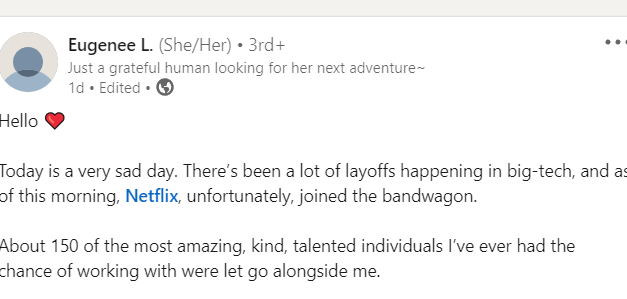
The crypto job market shows few signs of slowing down despite high profile cases of staff layoffs and hiring freezes across big tech companies. In recent weeks, several major tech companies have announced a paring back of staff, citing a downturn in the traditional market and narrowing demand for products that had boomed during the pandemic. Recently announced hiring cuts include Twitter, Uber, Amazon and Robinhood. On Tuesday, movie streaming service Netflix terminated the roles of 150 mostly U.S.-based employees, amidst a slowdown in revenue growth. Earlier this month, Facebook parent company Meta instituted a hiring freeze for most of its mid and senior level positions after failing to meet revenue targets.A Netflix employee post on LinkedInThe crypto industry has not been totally immune. On Tuesday Coinbase announced it was slowing down its hiring, after posting a $430 million loss in Q1. Coinbase chief operating officer Emelie Choi told employees in an internal memo that plans to triple the headcount in 2022 were on hold due to market conditions that require the company to “slow hiring and reassess our headcount needs against our highest-priority business goals.” So are we at the beginning of a major slow down in crypto industry hiring? Crypto recruiters Cointelegraph spoke to don’t think so.We’ve been hearing about a big slowdown in tech but we’ve hardly noticed it other than many more candidates looking to enter the crypto markets. We’ve been overwhelmed with requests for quality candidates and have positions across all sectors.— Cryptorecruit (@cryptorecruit) May 18, 2022“We have not seen a slowdown in crypto hiring. We are as busy as ever,” said Neil Dundon, founder of Crypto Recruit.. Dundon’s firm specializes in recruiting exclusively within the blockchain and cryptocurrency space. “We have a team based globally across the US, Asia/Pac and European regions and demand is equally as high across the region.”Kevin Gibson, founder of Proof of Search told Cointelegraph that lay-offs in the tech sector have had little to no impact on his crypto industry clients so far. “[I’ve] only heard of two companies letting people go,” said Gibson. “This may change in the next month but any slack will immediately be taken up by well funded quality projects. As such as a candidate you won’t notice any difference… if you do lose your job you will also have multiple offers pretty quickly.”VC funding runwaysGibson said that most crypto projects are still in the start-up and early stages of their life cycle, and are still operating off venture capital (VC) funding secured last year.“The vast majority of quality projects were funded last year so [they will] continue to build & hire. There was such an imbalance of talent to role that any pull back from pre-funded projects will not be noticed.”CB Insights’ State of Blockchain Q1 22 report stated that blockchain and crypto start-ups saw a record-breaking funding quarter, with venture funding reaching an all time high in the three-month period, raising $9.2 billion and beating the preceding quarter of $400 million in Q4 2021. It was the seventh consecutive quarter of record blockchain funding. Dundon said he has seen more traditional tech companies and employees venturing into the crypto space, further enriching the crypto job market. “At a minimum most forward thinking tech companies are allocating some budget to […] look at how they might incorporate blockchain into their existing models […] Not only are more companies venturing into this space but candidates are flocking over as traditional tech downsizes.”A study from Linkedin released in January this year found that crypto-related job postings surged 395 percent in the U.S. from 2020 to 2021, compared to only a 98 percent increase in the tech industry in the same period. The most common job titles demanded included blockchain developers and engineers. According to Glassdoor, the average annual blockchain developer salary is US$109,766. The average annual blockchain engineer salary sits slightly lower at US$105,180.Related: Analysts note parallels with March 2020: Will this time be different?Asked whether the current crypto bear market may translate to more crypto company lay-offs, Dundon said that he doesn’t expect a similar situation to play out as it did in 2018. “Crypto hiring in the past has tended to slow right down when the Bitcoin price tumbles. It was almost directly correlated to its price,” explained Dundon. “This time it’s different though as crypto companies now manage their treasuries in a much more responsible manner […] This all translates to a much more stable hiring market.”

Čítaj viac

TZ APAC’s Colin Miles: Blockchain will be taught in classrooms in 3-5 years

Colin Miles, the newly-appointed CEO of TZ APAC expects blockchain and web 3.0 curricula to start becoming an integral part of secondary and tertiary education within the next three to five years. “I would think it’s that classic medium-term, three-to-five timeline,” said Miles. Miles was speaking to Cointelegraph after the announcement of TZ APAC’s partnership deal with the National University of Singapore (NUS)’s School of Computing on May 10, which will see the Tezos agency supporting the development of the university’s new center for Nurturing Computing Excellence. Miles said:“If you have a dedicated center in NUS, which runs blockchain courses every day of every week for students… it will become part of the fabric of one of the best computing schools in the world. I would imagine that most other schools would look to that as an example to follow.”NUS currently offers an in-depth blockchain curriculum aimed at a range of levels from beginners to CEOs and mid-level managers. Other well-known universities offering courses in blockchain include Massachusetts Institute of Technology (MIT), Harvard University, Oxford University, Cornell University and University of California Berkeley. Related: Top universities have added crypto to the curriculum“Overall this trend will become a mainstay, because a large number of exciting new jobs will come from the Web3 environment. It is therefore incumbent on educational institutions to help gear their student cohorts up for this important shift,” he said.TZ APAC is the Asia-based blockchain adoption entity supporting the Tezos (XTZ) ecosystem. Tezos is an open-source proof-of-stake blockchain launched in 2018 as a platform for smart contracts. As part of the newly announced partnership, TZ APAC has been tasked with creating a blockchain developer curriculum where students will be able to take part in classes, workshops, developer hackathons and other practicals aimed at educating students about the Tezos blockchain.TZ APAC will also be supporting the university through the provision of a grant, which Miles said will go towards administrative support for running courses for undergraduates, as well as postgraduates and PhD students and their final year projects.TZ APAC ​​@NUSComputingWe’re delighted to partner with NUSComputing to set up the Centre for Nurturing Computing Excellence to build a strong #talent pipeline in fast-growing fields such as #blockchaintechnology and #cloudcomputing.Read more at: https://t.co/QX3mWU2QMS— TZ APAC (@TzApac) May 10, 2022Singapore has been leading the way in terms of institutionalizing crypto education, said Miles, particularly when compared against other APAC countries.“Singapore is starting to inculcate this education into the curriculum in a positive way.”“They’re starting to add these through smaller vocational courses… but you can imagine the next step is to literally burn it into their curriculum so that their undergrads can go through this process without having to do it voluntarily or otherwise.”Led by Associate Professor Tan Sun Teck from NUS Computing, the new Center will give students an avenue to learn directly from experts in the field of blockchain technology, cloud computing and data science. “By partnering with pioneering organizations such as TZ APAC, students will have the opportunity to benefit from real-world expertise at a critical juncture of their education,” said Professor Tan. Miles said that partnering with universities, academies and schools around the region are one of the key methods used by TZ APAC to drive adoption of the Tezos blockchain. “We now have a very strong proposition for educational institutions in the region. In partnership with [them], we can reach tens of thousands, if not hundreds of thousands of students, to not only help them understand the blockchain economy, but also Tezos blockchains’ role in that as well.”

Čítaj viac

Získaj BONUS 8 € v Bitcoinoch

nakup bitcoin z karty

Registrácia Binance

Burza Binance

Aktuálne kurzy