Autor Cointelegraph By Ornella Hernandez

Cryptopedia: What is the Metaverse and how will it alter the internet?

Cointelegraph’s Jackson DuMont, Director of video, tackles the topic of the “next big thing:” the Metaverse. He explains the who, what, why behind the Metaverse and deep dives into how its blockchain technology has the potential to alter the online lives of internet users. [embedded content]The term was originally coined by Neil Stephenson in his 1992 novel Snow Crash. Although not a new concept, recent increased activity and developments within the collaborative virtual spaces have turned it into a new economic virtual realm that rivals the current physical economy. “The metaverse is exactly like the current version of the internet,” but it’s on its way to becoming fully immersive, explained Dumont, especially thanks to tech and social media giants like Meta and Microsoft playing a big role in its evolution. In Meta’s case, it has invested billions of dollars and is positioning itself at the center of the “multi-billion dollar eden” while racking up the profits. Some of the features that the Metaverse looks to improve upon within cyberspace includes user privacy, data protection, trestles transactions and unchangeable record keeping. That’s where blockchain technology comes in. Metaverses operate on the same values that blockchain-based systems run on, such as permissionless access, censorship resistance, security and decentralization,”Blockchain and crypto assets are fundamental to creating a safe virtual reality. And NFT technology will also be the foundation for property ownership in the metaverse.”Decentraland and The Sandbox are examples of metaverses that have seen the most virtual real estate and NFT sales within the past year. Dumont points out, however, that in order for the general Metaverse to be more widely adopted, interoperability between individual virtual worlds is key. This means that users would be able to move from one virtual space to another using the same avatars and digital items while bridging a metaverse life from Ethereum to Solana for example.Related: Blockchain metaverse ecosystems gain traction as brands create digital experiencesWhat unites all of the metaverses, that for now are operating separately, is one larger community with a common shared vision: to build a new internet infrastructure that can support the Metaverse. Outstanding challenges include developing augmented and virtual reality devices with higher internet speeds and superprocessors that handle hyper-realistic graphics.The video ends with a lofty statement: “Humanity is in the midst of creating the most complete alternate reality to ever exist.” But how long will society have to wait to fully immerse itself into this fantasy?

Čítaj viac
Time Studios talks legacy media and the rise of NFTs

Cointelegraph spoke to Keith A. Grossman, President at TIME, about the legacy media company’s recent moves into the Web3 space. According to Grossman, TIME seeks to “modernize the relationship our brand can have with its community.” Some of these moves include creating 1:1 NFTs of their flagship magazine covers, the option for digital subscribers to pay in crypto, and the launch of their TIMEPieces NFT project collaborations.Grossman stated that an important result of all of these initiatives is the “opportunity to tap into the great creativity emerging within the NFT community and connect this with the larger distribution channels we have already established via TIME Studios.”One artist that has connected with TIME Studios, the TV and film production division of TIME, is Doug, the artist and founder behind the Toy Boogers NFT collection. TIME has agreed to produce and distribute an animated series based on the characters within the Toy Boogers collection.When Cointelegraph asked Doug why he partnered with TIME to expand the Toy Boogers universe, he said he was “honored” to do so.“Time is an iconic company and one that is also highly regarded in the NFT community for working with artists in a collaborative way. The creative direction for the Toy Boogers story and art will come from myself, and Time Studios will push forward its development and distribution.”Distribution and the ability to leverage multiple distribution channels and platforms is the key to growing an NFT community. Listings on multiple marketplaces like OpenSea and Rarible are standard practice but achieving true exposure is something digital artists are still exploring.Maria Perez-Brown, Head of Kids & Family at TIME Studios, also commented on the studios’ recent launch of the kids and family division that is developing programming based on NFT-native intellectual property.“We’re developing content that amplifies the vibrant world that kids live in, engages their curiosity, and encourages them to act. We want to meet young people where they are and help them understand and thrive in the world around them.”I am so excited and honored to announce that I’ve partnered with TIME Studios to develop a cartoon series bringing Toy Boogers from the blockchain to the big screen!!! ?????@timestudiosfilm @TIME @timepieces pic.twitter.com/08FgqZlpVo— Toy Boogers ??????? (@ToyBoogers) January 13, 2022Related: ‘The industry will need to have dynamic NFTs,’ says Vivid Labs CEO Halsey MinorAnd kids are already playing their own part within the blockchain community. Last year, a 12-year-old boy from London reportedly earned nearly $400,000 by creating and selling an NFT collection of whale emojis during the school holidays.In recent news, TIME released a weekly newsletter on the metaverse in a partnership with Galaxy Digital that was conducted using Ether (ETH).There has also been an increasing number of nonfungible token, or NFT, collections which have announced plans to create animated television series. From 1inch Network’s Take My Muffin and The Red Ape Family featuring Bored Apes to actress Mila Kunis’ Stoner Cats series and EXILE’s production of Lil’ Heroes.

Čítaj viac

StarkNet now open for DApp deployment on Ethereum mainnet

StarkNet, the Layer-2 scaling solution established by Ethereum protocol StarkWare, announced that the first few decentralized apps, or dApps, built on the platform have been deployed since it launched on the Ethereum Mainnet in November. Now that the Starkware team has developed all of the infrastructure needed for dApps to deploy, the company shared the nine projects listed by zkRollups, a digital directory for the zero-knowledge ecosystem, in a Twitter thread. The list ranges from decentralized finance (DeFi) to nonfungible tokens (NFTs) and gaming applications.Here are the latest projects we have listed – all building on StarkNet ✨ from @StarkWareLtd https://t.co/y55wb8p8nb ️1/— zkRollups.xyz (@zkRollupsXYZ) February 22, 2022StarkNet is a permissionless validity rollup, or zero-knowledge rollup, that uses basic compression technology to boost the production and security benefits of Ethereum Layer 1. The company prides itself in its products’ ability to provide “rock-bottom” gas fees, transactions costs and “limitless” scaling potential. Cointelegraph spoke to StarkWare co-founders Uri Kolodny and Eli Ben-Sasson. Ben-Sasson talks about the crucial missing step to taking crypto mainstream:”If you compare WeChat and WhatsApp and Facebook, they’re used by hundreds of millions of billions of people. There is nothing in crypto today that serves billions of people. And part of the reason is the limited scale.” Kolodny then drew a comparison between the skyscrapers in Manhattan that allowed for greater population growth to StarkNet’s potential to do the same for Ethereum’s user base. He added that Layer 2 technologies, like StarkNet, will be “crucial” in serving a “massive anticipated rise” in blockchain use. Ben-Sasson added that the StarkNet platform is like “the missing link in tech evolution which makes blockchain usable for everything” and will ultimately “propel us to a Web3 reality.” The founders noted that they expect StarkNet to be fully decentralized within the next year. Recently, StarkWare raised $50 million in a Series C funding round that brought the firm’s valuation to $2 billion.Related: ZK-Rollups step into the limelight after the quest to scale Ethereum evolvesOn Wednesday, Opera web browser announced its integration with Ethereum Layer-2 exchange DeversiFi, which is powered by Starkware and aims to provide cost and time-efficient transactions within the mobile browser wallet.

Čítaj viac

Puma rebrands to Puma.eth on Twitter

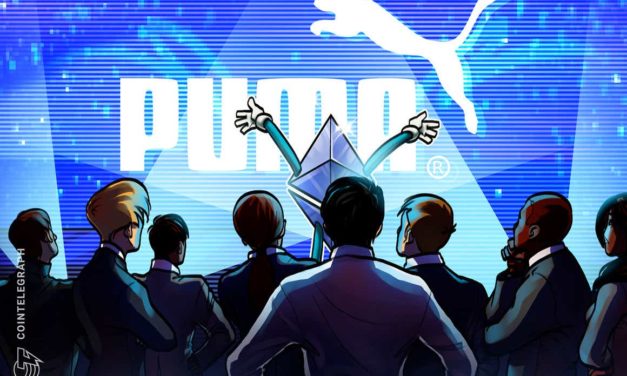
Puma is the latest in a growing list of major brands to purchase a decentralized URL and reveal their nonfungible token, or NFT, by changing their Twitter handle to Puma.eth. The German sportswear brand registered the domain name with the Ethereum Name Service, or ENS.welcome PUMA.eth (@PUMA) https://t.co/BuPplzfJgR— ens.eth (@ensdomains) February 21, 2022Other major companies with .ETH domains include Budweiser, the subsidiary of Anheuser-Busch InBev, which bought Beer.eth through ENS on OpenSea for 30 ETH last year. And when the fast-food chain White Castle registered whitecastleofficial.eth, ENS’ former director of operations even tweeted about his excitement.All .ETH names are NFTs that can be “easily plugged-in to the ever-expanding NFT ecosystem,” as an ENS Medium post reads. Some of the benefits of an ENS name include being able to receive any cryptocurrency, token or blockchain-based asset, in addition to being able to point to a decentralized website and to store profile information like an avatar, email address or Twitter handle.Puma’s ENS name is one of several NFT-related moves that the company has made recently. According to the Puma.eth OpenSea page, Puma has invested in various feline inspired NFT collections including Cool Cats NFT, Lazy Lions, Gutter Cat Gang and CatBlox.The cat’s out of the bag…@PUMA @ivandashkov #M3OW pic.twitter.com/lB8WU9EhJO— CatBlox (@CatBloxStudios) February 21, 2022

At the time of publication, Puma ranked in the 13th spot of the .eth Leaderboard, which lists the most followed Twitter accounts with .ETH names. In first place is parishilton.eth, secured by celebrity Paris Hilton and shaq.eth, owned by former NBA player Shaquille O’Neal, in second.Puma is one of the biggest global sportswear brands alongside Nike and Adidas, which have made their own entrances into the Web3 space with a big splash. Nike acquired the virtual sneakers and collectibles brand RTFKT, while Adidas Original’s launched an NFT collaboration with Bored Ape Yacht Club, PUNKS Comic and gmoney.Related: ENS DAO delegates offer perspective on DAO governance and decentralized identityThe Ethereum Name Service has a total of 724,096 ENS names created at the time of writing, according to Dune Analytics, with the highest number of monthly registrations occurring within the past few months. ENS’ competitor, Unstoppable Domains, has over 2 million domains registered, according to the company website, and it recently launched its own single-sign-on service for Ethereum and Polygon called Login. As more and more DApps, wallets, exchanges and marketplaces support NFT usernames, Web 3 users are increasingly adopting decentralized URLs for digital identities.  

Čítaj viac

FriesDAO scoops up fast food franchises as part of its crypto governance experiment

A new proof of concept decentralized autonomous organization, or DAO, called FriesDAO wants to democratize access to the fast food industry. Cointelegraph spoke to FriesDAO advisors Brett Beller and Bill Lee about their mission to be a “part of something that will connect crypto and virtual ownership to real-world assets.”FriesDAO aims to acquire and scale fast food restaurant franchises like Popeye’s, Burger King and Taco Bell by inviting FRIES token holders to run a decentralized network of Quick Service Restaurants, or QSR. Starting with Subway franchise owners, the FriesDAO team hopes to guide their partners about the blockchain space. What “started as a joke” turned into a serious proposition when they realized there “was a hole for people that were ready to run DAOs more like a business.”Lee clarified that FriesDAO does not directly own any of the stores due to legal reasons. Rather, the governance model allows members of the DAO to have a say in is how the treasury funds are spent, and which stores are going to be acquired. They also plan to provide nonfungible token (NFT) membership cards with perks, such as free food or discounts at FriesDAO network stores.At time of publication, the DAO has raised $5.4 million according to its website, exceeding their minimum $5 million goal. FriesDAO raise closes with $5.4M! $FRIES claiming is expected to be this Tue/Wed.As a Wyoming DAO LLC, a Notice of Intent to issue tokens is being filed this Monday.An Operating Agreement has also been released, which recognizes all $FRIES holders as co-owners of the DAO. pic.twitter.com/ehyF5sSRq7— friesDAO (,) (@friesdao) February 20, 2022Recently, FriesDAO added Kory Spiroff, former president of Domino’s, to its advisory board. Kory commented to Cointelegraph that he truly believes that blockchain technology can bring a new level of efficiency to the QSR industry. “The inherent transparency coupled with the immediacy of community-based insight may significantly reduce the time and effort required to understand consumer preferences. It’s like a permanently staffed, zero-cost built-in focus group, which can be called at a moment’s notice to provide critical feedback.”Related: Former Cisco employee launches DAO to buy Denver BroncosWhen asked about McDonald’s plans to create McMetaverse restaurants, Beller said it was “inevitable” for the chain to “take a Metaverse approach of a virtual store that will deliver food as if you are inside of a video game.”

Čítaj viac

Získaj BONUS 8 € v Bitcoinoch

nakup bitcoin z karty

Registrácia Binance

Burza Binance

Aktuálne kurzy